Donate Bitcoin

Donate Paypal


PeakOil is You

PeakOil is You

Trader's Corner 2007

Discussions about the economic and financial ramifications of PEAK OIL

Where will WTI crude be on DEC 31st 2007?

Poll ended at Thu 19 Apr 2007, 04:20:21

under $50 per barrel
5
No votes
around $55
0
0%
around $60
5
No votes
around $65
12
No votes
around $70
11
No votes
around $75
28
No votes
 
Total votes : 61

Re: Trader's Corner 2007

Unread postby rostov » Fri 30 Nov 2007, 01:13:21

MrBill,

Thank you. Didn't know you had a bloomberg terminal. I know the bandwidth is limited, but do you have the current charts of 1m + 3m LIBOR for the past 6mths or 1year?

Looking at the posts in this thread, it would seem to imply that since around the July/August period, the cost of money has increased due to lending (thus credit) being stopped, and banks attached a high cost (LIBOR rate ramps/spikes) as a result. To keep the banking system going, the Fed needed to pull this rate down back then, but because lending trust is still not restored, we today are still faced with distrust in the banks and therefore the banks still attach a high cost to each other, and thus the Fed's pre Dec-11 moves.

Looking forward (and seeking your historical experiences way back since 1945s till now), what then, when interest rates are forced DOWN due to lending dry-up?

BTW, thanks for your very own experience securing lending at terrible times. Why did you succeed when the rest didn't? Collateral quality differences?
regards,
Rostov
"Some {} are more equal than others"
User avatar
rostov
Lignite
Lignite
 
Posts: 346
Joined: Sat 29 Jan 2005, 04:00:00
Location: New Zealand

Re: Trader's Corner 2007

Unread postby MrBill » Fri 30 Nov 2007, 05:21:43

Daryl wrote:
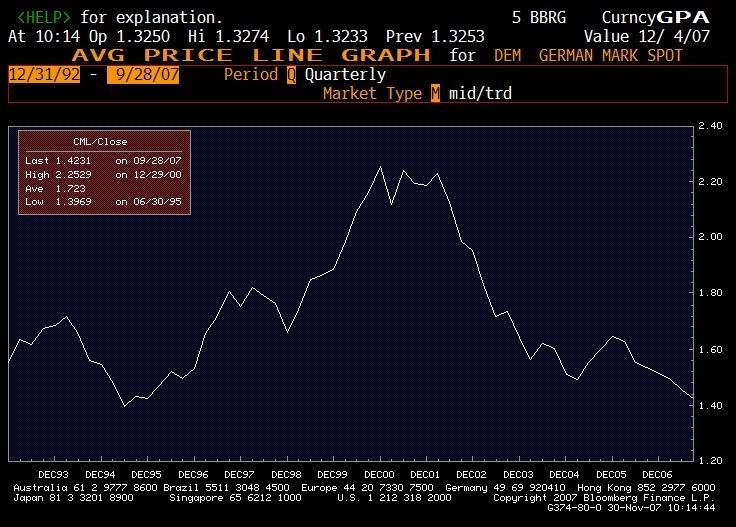
$this->bbcode_second_pass_quote('', 'B')y the way, nice looking charts, Mr. Bill. And a question. How does today's Euro rate translate back into the old $/DM rate? I can't remember how to do that. Are we past the old 1979 lows for the dollar yet? I believe that was around 1.76 DM or something.


MrBill writes:$this->bbcode_second_pass_quote('', '
')The fix of the DEM to EUR was at 1.95583

Bloomberg still does a continuous chart in DEM, so comparisons are quite straight forward. However, for historical charts that old I can only pull-up weekly, monthly and quarterly charts that hide the absolute highs and lows as they take the mid-point.

It seems to me that the low in USD/DEM was $1.3450 in 1995. Just after the ERM crisis. My American military friends in the National Ski Patrol could hardly afford to train in Switzerland that winter, but it was great to be paid in deutschmarks! ; - )

But according to weekly Bloomberg data the respective highs and lows were

Low $1.3679 04/21/95 - $1.4298/EUR @ 1.95583 DEM/EUR
High $2.3455 10/27/00 - $0.8339/EUR
Low $1.4377 12/31/04 - $1.3604/EUR
High $1.6709 11/18/05 - $1.1705/EUR
Low $1.3222 11/23/07 - $1.4792/EUR

Again that is using weekly averages that may hide the actual highs and lows. So for all the huff and puff we are $1.4725 today versus a US dollar low in 1995 of $1.4300 or about 3% weaker! Pretty darned stable compared to commodity or oil prices! ; - )


Here is the quarterly chart...


Image

$this->bbcode_second_pass_quote('', 'W')hich is once again going to mess up spacing on this page, so to compress the comments I will just make them look like quotes. Any JPG sizing tips most welcome. Thanks.
The organized state is a wonderful invention whereby everyone can live at someone else's expense.
User avatar
MrBill
Expert
Expert
 
Posts: 5630
Joined: Thu 15 Sep 2005, 03:00:00
Location: Eurasia

Re: Trader's Corner 2007

Unread postby MrBill » Fri 30 Nov 2007, 06:25:59

$this->bbcode_second_pass_quote('rostov', 'M')rBill,

Thank you. Didn't know you had a bloomberg terminal. I know the bandwidth is limited, but do you have the current charts of 1m + 3m LIBOR for the past 6mths or 1year?

Looking at the posts in this thread, it would seem to imply that since around the July/August period, the cost of money has increased due to lending (thus credit) being stopped, and banks attached a high cost (LIBOR rate ramps/spikes) as a result. To keep the banking system going, the Fed needed to pull this rate down back then, but because lending trust is still not restored, we today are still faced with distrust in the banks and therefore the banks still attach a high cost to each other, and thus the Fed's pre Dec-11 moves.

Looking forward (and seeking your historical experiences way back since 1945s till now), what then, when interest rates are forced DOWN due to lending dry-up?

BTW, thanks for your very own experience securing lending at terrible times. Why did you succeed when the rest didn't? Collateral quality differences?



MrBill writes:
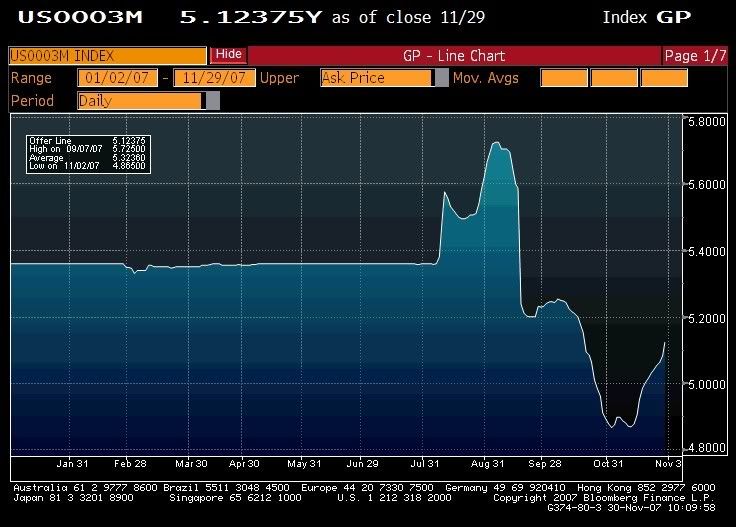
$this->bbcode_second_pass_quote('', 'C')areful, LIBOR rates have declined as the Fed has cut their Fed funds target rate from 5.25% to 4.50%, but 3-mos LIBOR is still above that target rate at 5.12% as banks are reluctant to lend to one another. Actually, one-month LIBOR that goes over year-end is as high as 5.22% according to Bloomberg.

Image

(continued)
$this->bbcode_second_pass_quote('', 'J')ust a caveat the screen prices may not be the Broker's price in money market. If you are lending Interbank and have a choice between IKB and KFZ , two German banks embroiled in the sub-prime mess, for example, you may not lend to IKB at all, while pumping-up the spread even for KFW who actually own IKB.

What has increased is not LIBOR rates (see chart), but the spread over LIBOR. Say L + 1.00% to L + 1.50% or L + 1.50% to L + 2.00%. So the Fed cuts by 0.75%, but in many cases the 'spread' has increased, so it has neutralized the easing. While if you are a single-A (or lower) rated bank you might find your access to capital either restricted or at least more expensive in terms of spreads. Ironically, if you are a highly rated bank, say AA+, then if there is excess liquidity in the money markets then you might benefit from a lower spread. Although this does not seem to be the case headed into year-end where liquidity is tight and banks are hoarding it for their own needs.

Overnight rates between December 28th and January 2nd might go up as high as 100% annualized if there is a severe short-squeeze. Therefore, banks are in emergency meetings between repos desks, money market traders and their Treasury department to make contingency plans for liquidity overnight. If they find themselves short, then they certainly are not going to lend to external hedge funds or other non-core customers.

Why have I survived? Pretty simple really. One, as you say, good collateral and a long-term track record. Secondly, as the sub-prime crisis has taken its toll on lending in these banks linked to mortgages and the US domestic market, for example, they have to be mindful of making 'some' of that money back elsewhere in the bank. Trading, and other areas like emerging markets, are picking-up the earning's slack.

What's worse than a $10-billion write-down? A $10-billion write-down AND no new business coming in the frontdoor. Banks are forced to earn their way out of this crisis and that is to be expected. Hopefully not by blowing-up another bubble somewhere else, but in improved credit and lending practices and by actively chasing opportunities elsewhere.

I am reminded of all the investment banks that left Moscow 'for good' in 1999 after the Russian debt crisis and vowed 'never to return'. Unfortunately for them, those that stayed took a beating, but earned those losses back and then some. Then those banks who left were forced to return to Russia, but only after the low-hanging fruit and wide spreads had disappeared. Plus they had no customer goodwill and had to pay more for experienced staff.

Which is an interesting thing about risk. Risk is risk. It is very hard to get rid of. So does it make sense to get in early when the fees are high to take those risks, and then scale back as spreads come down? Or does it make sense to wait until spreads have already come down, indicating less risk, and then increase your activities, or your risk, to make up for lower spreads? ; - )
The organized state is a wonderful invention whereby everyone can live at someone else's expense.
User avatar
MrBill
Expert
Expert
 
Posts: 5630
Joined: Thu 15 Sep 2005, 03:00:00
Location: Eurasia
Top

Re: Trader's Corner 2007

Unread postby Daryl » Fri 30 Nov 2007, 15:38:43

Thanks for info on DM. For some reason I don't recall the dlr being sold off that low in '95. I must have been entertaining too many clients at night and drinking too much. I must say, the ECB has performed way above my expectations when the politicians were negotiating the Bundesbank out of existence at Maastricht. Still I agree with you, they have benefitted from a relatively benign environment. We will see what happens to European monetary unity when a large convulsion occurs. Perhaps an overvalued Euro could be an upcoming problem of that nature.

BTW, if you ever need it, I chased down the dlr/dm historical rate data.

http://www.bundesbank.de/statistik/stat ... &year=1996
User avatar
Daryl
Tar Sands
Tar Sands
 
Posts: 927
Joined: Mon 10 Oct 2005, 03:00:00

Re: Trader's Corner 2007

Unread postby MrBill » Mon 03 Dec 2007, 05:38:55

[align=center]How the markets really work[/align]

don't miss the link! ; - )


$this->bbcode_second_pass_quote('', '
')Energy Weekly

Softening fundamentals gaining momentum

Shifts towards softer fundamentals are underway

The oil complex has declined sharply over the past week with WTI declining to below $90/bbl for the first time since mid-October owing to a substantial weakening in timespreads. This weakening has occurred as the shifts toward a cyclical softening in oil fundamentals that we have embedded in our forecasts are taking place, namely, increasing supply from the Arab Gulf, a potential
decline in crude oil demand as the strong heavy fuel oil market has finally cracked, and deterioration in the US and Chinese economic outlook with risks relative to this outlook increasingly skewed to the downside.

These shifts reinforce our view of near-term price weakness

These factors reinforce the near-term downside risk to oil prices that we have emphasized over the past month and that are embedded in our near-term price forecasts.

Long-dated oil price strength suggests a spike in near-dated prices much below the $80/bbl-$85/bbl range is much less likely

Much of the previous price rally in oil to record nominal highs resulted from a substantial rise in long-dated oil prices, which have remained exceptionally resilient despite the recent weakness on the front end. We maintain that the long-dated price strength has been grounded in fundamentals as increasing cost inflation and uncertainty have been priced in. As a result, we believe long-end prices are unlikely to decline meaningfully from current levels. This also suggests that a downside spike in near-dated prices much below the $80/bbl-$85/bbl range is much less likely despite the
anticipated fundamental weakness, as we do not believe this weakness will be severe enough to shift the long-dated timespread into contango.


Source: Goldman Sachs Commodities Research
November 30, 2007
The organized state is a wonderful invention whereby everyone can live at someone else's expense.
User avatar
MrBill
Expert
Expert
 
Posts: 5630
Joined: Thu 15 Sep 2005, 03:00:00
Location: Eurasia
Top

Re: Trader's Corner 2007

Unread postby drew » Mon 03 Dec 2007, 22:25:28

Thanks Bill, that was pretty funny! (and I'll bet quite true too)

Drew
User avatar
drew
Tar Sands
Tar Sands
 
Posts: 953
Joined: Thu 22 Jul 2004, 03:00:00
Location: canada

Re: Trader's Corner 2007

Unread postby MrBill » Tue 04 Dec 2007, 10:49:32

Nothing much to add here to be honest. I think last week's four day rally in the S&P 500 was for all the wrong reasons. Now it looks toppish again. Sort of like a cascading water fall. Not a precipitous drop, but a series of rapids on the way down.

The market has pretty much accepted the Fed will give them another 25 basis point cut. Helicopter Ben may try to get 'ahead of the curve' by dropping 50 bps again, but then what little inflation fighting credentials he might have had will be in tatters. December 11th can only disappoint.

Paulson's plan to arrange a 90-day moratorium on mortgage foreclosures, and to lock-in below market teaser rates on 2-28 loans for say 5 to 7 years for homeowners that keep up with their payments is really robbing Peter to pay Paul.

One this discriminates against those that locked in higher fixed rates or those that have already started paying higher ARMs. As well would be a nice little subsidy to those who could afford a higher reset, but may be spared this eventuality. Not to mention those would be homeowners that are renting and might also get their foot on the property ladder, as well as qualify for nice taxpayer benefits like an interest rate deduction, if home prices fell.

Thinking about capital ratios. Of course, all those low priced loans on those banks' books will curb the ability for new lending at higher rates, and so will be a drain on earnings for many years to come. They then drag the pain out so long as those borrowers keep making payments on their first mortgage. That is to say nothing about second mortgages or consumer loans made against home equity. Obviously this bunch of loans will not be paid in full or on time, so another hole in the banks' lending portfolio.

But I suppose like a drowning man at sea, the equity investor is grabbing at anything that looks like it floats at the moment even if it too will become water logged and submerge as well. Let them have their respite, the reality of their dire straits will sink in soon enough.

Crude got a little over-sold on the technicals, but looks like yesterday was a little bit of a correction as market players await more concrete news from OPEC. What is there left to say? OPEC does not want to add supply, and if, then only a token 500.000 bbls per day. We're not sure it is needed in any case. 321 crack margins are very narrow and the contango in the crude has unwound quite a bit. The need for prompt delivery seems to be moderating or is that just paper longs closing positions ahead of year-end? Flat price may depend more on the direction of the US dollar which seems to have found short-term support against the euro at $1.4620.

I am looking for new inputs for direction, but at the moment it seems to be re-occuring themes re-emerging rather than new events taking center stage.
The organized state is a wonderful invention whereby everyone can live at someone else's expense.

User avatar
MrBill
Expert
Expert
 
Posts: 5630
Joined: Thu 15 Sep 2005, 03:00:00
Location: Eurasia

Re: Trader's Corner 2007

Unread postby seahorse2 » Tue 04 Dec 2007, 13:34:13

I decided that if one wants to play the agri business, Monsanto and Syngenta are about the only ways to do it with publicly traded stocks.


Syngenta

Monsanto
User avatar
seahorse2
Expert
Expert
 
Posts: 2042
Joined: Mon 18 Oct 2004, 03:00:00

Re: Trader's Corner 2007

Unread postby Daryl » Tue 04 Dec 2007, 16:36:36

Looks like a break of a double top in the daily oil chart to me Mr. Bill Don't know what the regular charts looks like. I only have access to USO, the oil ETF. If that formation is confirmed and fills out, we could be falling another 10pct from here......
User avatar
Daryl
Tar Sands
Tar Sands
 
Posts: 927
Joined: Mon 10 Oct 2005, 03:00:00

Re: Trader's Corner 2007

Unread postby topcat » Wed 05 Dec 2007, 00:11:55

Other potential agri-bus plays:

Archer-Daniels

UAPH (chemicals - just received a buy-out offer)
AGU (offered to buy out UAPH)
DE (John Deere)
MOS (fertilizer)
LNN
POT (more fertilizer)
TRA

All of the above (expect AGU) are at yearly highs. Some have doubled/tripled this year. (per IBD 12/04/07)

The fertilizer market is streched thin, many are telling farmers to buy there products before year-end and stockpile it until use next year.
"No workey, no beef jerkey." TC

"Home is where the hot dogs are." TC
User avatar
topcat
Tar Sands
Tar Sands
 
Posts: 626
Joined: Wed 01 Feb 2006, 04:00:00
Location: Northern US

Re: Trader's Corner 2007

Unread postby MrBill » Wed 05 Dec 2007, 05:57:51

$this->bbcode_second_pass_quote('Daryl', 'L')ooks like a break of a double top in the daily oil chart to me Mr. Bill Don't know what the regular charts looks like. I only have access to USO, the oil ETF. If that formation is confirmed and fills out, we could be falling another 10pct from here......


We are flirting with the 0.236 retracement of this year's move from $49.90 to $99.29 at $87.63. That would be the minimum allowed retracement, but as we have already completed the 5th wave in this bull rally the retracement is likely to be deeper unless OPEC gives oil consuming nations the bird. That depends crucially on the value of the greenback.

The next likely retracement is the 0.382R which is $80.42. That is roughly in-line with GS' fundamental assessment. Below that we see $74.60 at the 0.50R and the 0.618R is $68.70.

But before we dip that low we have some other support levels. $78.40 was the previous top and therefore might add technical support. And the top of the 3rd wave was $78.77 which is another support. Therefore, between $80.42 and $78.40 we are likely to find the bottom ahead of year-end. However, the rout in 2006 erased 36% from the peaks, so a deeper correction is possible, just unlikely.

Looking at the Bollinger bands on the weekly chart we see resistance at $100.35 and support at $65.70. The mean is $83.00 that could act as another support point in the medium term. There appears to be plenty of downside based on the RSI signals. It reached a peak of 76.40 (over-bought) at $99.29 while the low was down at 36.95 at $49.90. Weekly RSI may be rounded-off relative to daily RSI measurements. Currently we are at 61, so a drop lower is not out of the question. An RSI of 30 is considered over-sold.

All in all the best guess is somewhere around $80.40? Whether that is $83 or $78.40 will depend on a) the US dollar, b) OPEC, c) wider market sentiment with regards to growth prospects, and d) remembering that WTI is often distorted by local factors.

For example, WTI ($88.70) is once again below Brent ($89.90), and that happens seldom, but unusually more often this year. A shift in benchmarks as Brent represents two-thirds of the global benchmark for pricing physical crude purchases, while WTI is heavily weighted in ETF baskets for paper longs. Whereas in futures trading volume the NYMEX WTI and ICE Brent contracts are roughly neck and neck.

I am not sure which is the better technical indicator as before I would have said where WTI goes, Brent follows. That may no longer be the case. So the current $1.20 difference between the two contracts may affect technical levels, say, anywhere from $0.60 to $2.40. Not insignificant if you are planning your entry and exit levels using technicals. Well within that $83 to $78.40 range in any case.

I am off tomorrow and Friday to Frankfurt to speak to banks. I will be back next week. Good luck and all the best. Cheers.

UPDATE: by the way, looking for some customer funding over year-end now. The best offers are around 70% higher than they would have been for comparable deals before the blow-out in August. That is not a 70% increase in funding costs, but the spread over Libor is approximately 70% higher. And that is for safe over-collateralized borrowing against a good security. The banks that have liquidity to lend will make out well in the run-up to the end of the year. The others?
The organized state is a wonderful invention whereby everyone can live at someone else's expense.

User avatar
MrBill
Expert
Expert
 
Posts: 5630
Joined: Thu 15 Sep 2005, 03:00:00
Location: Eurasia
Top

Re: Trader's Corner 2007

Unread postby MrBill » Tue 11 Dec 2007, 05:14:56

Flumuxed I am! The rally since the third week in November has me quite confused. Confused is the wrong word. I am having a hard time believing the stock market is rallying on the back of interest rate cut expectations because the US economy is heading into a recession? But apparently this is not only not unprecidented, but quite normal.

$this->bbcode_second_pass_quote('', 'J')ust because most economists on Wall Street predict the U.S. economy will slow next year, or sink into recession, doesn't mean their market strategist colleagues won't be right in their forecast of a record for the Standard & Poor's 500 Index.

The benchmark for American equities climbed in eight of the 10 years the economy grew less than 1 percent since Harry Truman was in the White House 60 years ago, data compiled by Bloomberg show. Six of those increases coincided with periods when the Federal Reserve was cutting interest rates.

The worst housing slump in 16 years will lead policy makers to reduce the target rate for overnight loans between banks this week for the third time since September, futures trading shows. Wells Capital Management, Morgan Keegan & Co. and Russell Investment Group, managers of more than $500 billion, say lower borrowing costs will spur growth by the end of next year and drive stocks to the longest rally in two decades.

(continued)

Cohen, whose firm is the biggest investment bank by market value, is pinning her forecast on a ``friendly'' Fed that will reduce borrowing costs enough to reignite economic and profit growth. Since the 1950s, the Fed has cut rates at least three times on 12 occasions, according to Bespoke Investment Group LLC. Higher stock prices followed in 11 of them, with the S&P 500 posting an average gain of 19.2 percent, according to Harrison, New York-based Bespoke.


Previous Cycles


In six years when the rate cuts coincided with annual economic growth of less than 1 percent, the index rose an average 23 percent, Bespoke's figures show.

(continued)

The gloomy outlook for the U.S. economy also is driving down stock valuations. The S&P 500 tumbled 10 percent last month, the first so-called correction in four years, as mortgage delinquencies grew and home prices dropped.

Source: Dec. 10 (Bloomberg)

But, of course, the 7% YTD gain for the S&P500 turns into a 4% loss when measured in euros, so the stock market gains are in reality just currency losses. That should help companies remain export competitive in foreign markets even as the US economy slows.

Image


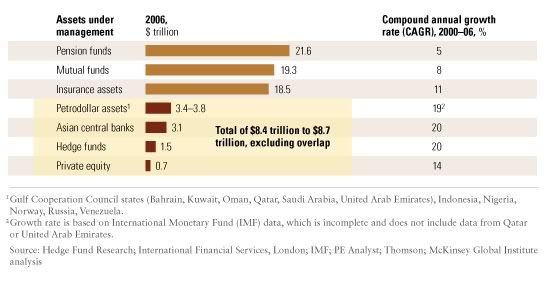
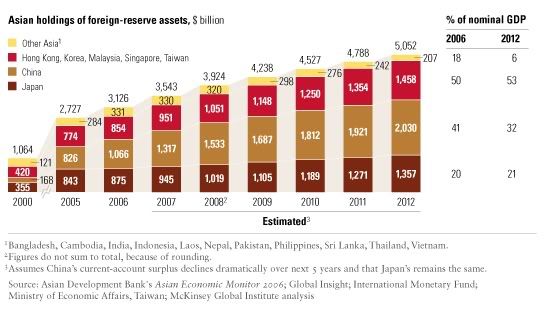
I really wanted to see a steeper correction going into year-end, but I may not get my wish here. To much BIG money betting that petrol-dollars and Asian sovereign wealth funds will find the combination of a weaker US dollar and cheaper stock valuations too tempting to resist. The size of assets under management are huge!

Image

$this->bbcode_second_pass_quote('', ' ')The asset management unit of Zurich-based UBS AG, which oversees $2.8 trillion for clients, purchased almost 2.5 million shares of Bear Stearns in the third quarter, when the shares of the fifth-largest securities firm fell 12 percent, filings with the U.S. Securities and Exchange Commission showed.

T. Rowe, which oversees almost $400 billion, purchased 4.5 million shares of New York-based Morgan Stanley, the world's second-largest brokerage by market value, while Legg Mason, which manages $1.01 trillion, bought 1.5 million shares of Goldman in the same period, SEC filings show. Both asset managers are located in Baltimore.


Image

Naturally, these many trillions in funds represent not only 5% annual growth compounded with parts of Asia growing 10% per year, and year on year trade gains around 9%, but also the effects of excess money supply creation when central banks attempt to sterilize their export receipts and keep their own currencies export competitive.

This is ultimately inflationary, but even as this is apparent central banks around the world have taken their collective foot off the monetary brake as they fear an economic slowdown more than that inflation. Under such a scenario it is wiser to keep buying equity on any dips rather than risk being under-invested and vulnerable to the effects of inflation.

That or do what this chap has done and that is invest into peak oil resource depletion.

$this->bbcode_second_pass_quote('', 'P')uru Saxena, chief executive officer at Puru Saxena Ltd., comments on the price of oil and gold. Saxena manages about $200 million. He spoke today in an interview.

On oil prices:

``Oil can go up to $120-$125 a barrel next year. Over a period of time it will go higher. I don't think we will see $35 ever again in our lifetime unless there is a recession. If there is a global recession or depression, oil will come down but it will come down the least and go back the quickest because the world needs oil.

``I'm not too sure what's going to happen in the short term but I do know that the supply of crude is falling worldwide. The supply of conventional crude oil peaked in the summer of 2005 and the supply has been declining ever since but the demand of oil is going up worldwide. There is now a 2 million barrel per day deficit.

On oil prices this week:

``It may go down a bit this week because we had a huge run-up in crude oil over the last couple of months so a retrenchment or a correction within an ongoing bull market is a normal event. It's not an extraordinary event. Oil may go down another $5 to $10 from here. Over the medium to long term, the price of crude is going to go significantly higher.

On oil supply:

``At the moment, supply globally is about 84 million barrels a day. Global demand is now 86 million barrels a day and rising. China and India together consume 10.3 million barrels of oil a day and demand is not going away anytime soon. I don't think the millions of Indians and Chinese will go back to their villages and stop using motorcycles and cars. Demand from the Middle East is increasing because the OPEC countries are booming.

On OPEC decision:

``The world is facing peak oil and I've maintained for a long time OPEC is not in a position to increase supply. It's not a question of whether they want to or not. Geology is forcing their hand. There's no excess in capacity. If you look at OPEC production over the last 2 to 3 years, it's in a decline and this is despite record prices. Saudi oil output has been declining in the last two and a half years. Saudi Arabia is producing less oil than it did in 1980. If the Saudis don't have incentive to produce oil at $100 you can guess why they're not producing. I don't think they can. I don't think there is any excess capacity.

On the impact of dollar, interest rates:

``The dollar will decline. I don't think the weak dollar is responsible for oil trading close to $100. This is supply and demand. The weak dollar is obviously contributing to the increase in nominal prices. If the Fed cuts rates, which I think is inevitable, then the weak dollar will get even weaker and commodity prices will go further north. We have invested the majority of our client's holdings or capital in commodities and resources energy, oil, natural gas, coal, uranium, agriculture, metal. That's where you will get most of the money in five to 10 years.

On gold prices:

``I believe gold is in the midst of consolidation. We had a big run-up in the last couple of months. I think the next rally will start sooner than later especially with the Fed cutting rates. I don't think $1,000 is too far fetched. Gold could even double from here in the next five years or so.''

Source: Dec. 10 (Bloomberg)

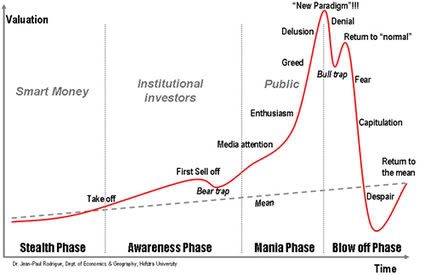
But if there is one thing I have learned it is that the fundamentals are always the clearest at the top and at the bottom. Therefore, I may just be getting bullish at the tail end of the Bull Trap? 17-days to go! ; - )

Image

UPDATE: timing is everything!

$this->bbcode_second_pass_quote('', 'I')t's fun being a contrarian but it's damn hard to make money at it.

Those who called the end of the credit and housing bubble while most were still applauding "good business" can pat themselves on the back -- but usually a pat is the most, or best, they can expect

(continued)

It can seem insane when masses of people buy Miami condos at impossibly high prices, or lend money to private equity shops at correspondingly low rates.

But the crowd has powerful things going for it. Firstly, the group has more information in aggregate than any individual. It's not always right, but it is telling you something important.

And secondly, and more powerfully, the crowd has a strong tendency to reinforce its own behavior. Prices going up bring more buyers, in investments if not in onions, which often forces prices higher still.

It is simply not enough to be right when most others are wrong: you need a catalyst to change enough other people's minds. This year it was a rash of defaults on U.S. mortgages.

Source: Contrarians have fun, but lose money
The organized state is a wonderful invention whereby everyone can live at someone else's expense.
User avatar
MrBill
Expert
Expert
 
Posts: 5630
Joined: Thu 15 Sep 2005, 03:00:00
Location: Eurasia
Top

Re: Trader's Corner 2007

Unread postby rostov » Tue 11 Dec 2007, 22:17:27

$this->bbcode_second_pass_quote('MrBill', 'F')lumuxed I am! The rally since the third week in November has me quite confused. Confused is the wrong word. I am having a hard time believing the stock market is rallying on the back of interest rate cut expectations because the US economy is heading into a recession? But apparently this is not only not unprecidented, but quite normal.


We gave back nearly 50% of what was rallied from the low of SPX1410 since that time, and that was like a knife through butter on the 3x(50,100,200)dma (dailies). I was not thoroughly convinced that the institutions were buying the 2nd leg, so it's going to be interesting to see what the next 2 weeks is going to be like on the holders of positions since the 1st week (that one had massive legs carrying it)

There is no lack of liquidity in the system right now (50b swimming around), so is it trust? Only one way to find out beyond January 2008?
regards,
Rostov
"Some {} are more equal than others"
User avatar
rostov
Lignite
Lignite
 
Posts: 346
Joined: Sat 29 Jan 2005, 04:00:00
Location: New Zealand
Top

Re: Trader's Corner 2007

Unread postby MrBill » Wed 12 Dec 2007, 04:36:14

$this->bbcode_second_pass_quote('rostov', '
')We gave back nearly 50% of what was rallied from the low of SPX1410 since that time, and that was like a knife through butter on the 3x(50,100,200)dma (dailies). I was not thoroughly convinced that the institutions were buying the 2nd leg, so it's going to be interesting to see what the next 2 weeks is going to be like on the holders of positions since the 1st week (that one had massive legs carrying it)

There is no lack of liquidity in the system right now (50b swimming around), so is it trust? Only one way to find out beyond January 2008?


Yesterday's reaction to the Fed's moderate rate cut reminds me of an old analogy of mine, 'walking-up the stairs only to fall down the elevator shaft!' I am not quite sure what the market was expecting, but they clearly were not amused with what they did get. I can only hope that this leads to another sustained move lower to clear the decks ahead of the New Year. This false rally since mid-August needs a real good colon cleansing!

$this->bbcode_second_pass_quote('', ' ')2008 Issues & Outlook: Bull in a bear's disguise

Recent sell-off provides buying opportunity

Demand concerns and rising supply in some cases had led us to expect a retrenchment in commodity prices from recent highs, which has already largely occurred. Despite recent downgrades of GS economic growth views, expectations of sustained strength in long-dated prices and other supply and demand drivers that provide offsets to the weaker economic backdrop are leading us to revise up our energy and agricultural price forecasts for 2008. As base metals are most closely tied to the industrial cycle, we are reducing our 2008 base metals forecasts, but still expect prices to reach historically high levels in some cases by year-end. Net, we generally view the recent sell-off as a buying opportunity across the commodity complex.

We maintain commodity overweight

We are raising our S&P GSCITM total returns forecast to 16.1%from 12.3%. We continue to recommend an overweight investment allocation to commodities within a portfolio context and an overweight towards energy relative to the rest of the complex.

Introducing top commodity trades for 2008

We are also introducing our top commodity trades for 2008 that more specifically leverage our expectations of fundamentals, term structure and volatility across the different commodities in the coming year.

Source: Goldman Sachs Commodities Research
December 11, 2007

There has been very little written about the 10th anniversary of the Asian Crisis. I suppose this is because on the whole the region has done so well since then, but given current global imbalances I think it would be a mistake to completely purge the lessons learned from our collective minds. This is a short summary written by McKinsey.

$this->bbcode_second_pass_quote('', 'T')his year marks the tenth anniversary of the beginning of the Asian financial crisis, a collapse brought on by macroeconomic imbalances that exposed fundamental weaknesses in Asia’s corporate and financial sectors. The sequence of events that began with the Thai baht’s collapse in July 1997 ultimately cost the region tens of billions of dollars and led many observers to speculate about an impending “lost decade” in Asia.

Today, after a remarkable ten years of transformation, Asia’s financial system is substantially deeper and more robust than it was in 1997. Sitting atop an enormous rising economic tide, it is poised to benefit from a host of factors, including the rise of China and India, the reemergence of Japan, robust intraregional trade, enormous infrastructure-financing needs, and the opportunities presented by increasingly powerful Asian sources of capital. Asia appears set to play an important role in the world’s financial system over the coming decade—a true third partner in the global triad, along with Europe and the United States.

But it would be foolhardy to believe that Asia has been immunized against imbalances, shocks, and dislocations. The sheer pace of growth and financial innovation across the region makes it inevitable that imbalances will build and shocks occur. Asian risk-management systems may have improved, but they have not become fully mature in just a decade. Asian regulators and CEOs of financial-services companies have concerns about the coordination of central banks, regulators, and government ministries—both within and among the region’s countries. Asian financial institutions face ever-stiffer competition for talent at a time when their activities are becoming increasingly complex. And worrying signs of asset bubbles are emerging in China, Hong Kong, Indonesia, Singapore, and Vietnam.

The Asian financial system will achieve truly global stature only if a number of critical improvements and initiatives, which should put the region on a stable path for the next decade, are implemented over the next two or three years. It has a very good chance of maintaining its momentum and emerging as a global leader, but it will take concerted effort to build on the progress of the recent past.

Summary

One particular warning: perhaps the most important challenge for Asia is to avoid the arrogance or overconfidence linked directly to extraordinary success. Overconfidence was certainly evident in Asia during the early part of 1997, as it was recently on Wall Street and in London—and in the run-up to all the financial crises of the past century.

Financial institutions and regulators across Asia have done a tremendous amount of good work since 1997. Massive opportunities lie ahead, but to seize them Asia must not only consolidate its gains but also build for the future—informed by a keen sense of recent history and its own fallibility.


Source: editorial@e.mckinseyquarterly.com

Ten years goes by quickly! ; - )

UPDATE: this is too good not to share and it mirrors a conversation I have been having with myself all year!
$this->bbcode_second_pass_quote('', 'A')s a result of my values and life experiences, I chose conservative personal finances. Due to my preference for security and prudence, I forego the opportunity for larger gains and windfalls in exchange for the lower risk and security.

It used to be that I could live with this trade-off. However, the last decade (and last few years in particular) made this choice increasingly difficult. Not only have risky investments been deliberately supported by government policy, less-risky paths have been infected by overspill from the risk-taking activities; worse yet, my very own government is treating me as a sucker. I mean openly, which is kind of new.

The increasing role of federal intervention in stimulating certain segments of the economy and bailing out risk-takers has made it increasingly clear that the choice to be a conservative investor was not only foolish, but is being deliberately singled out for punishment by our own government. The flogging of the prudent investor has moved from sublime to ridiculous, as government officials blatantly enter a mode of panicked bailout of preferred gamblers and spreading misinformation about the situation.

Not to be too dramatic, but I am left wondering how to explain this to my children. I was ready to explain risky versus conservative financial preferences. As some of my friends and neighbors seemed to prosper without end in reward for their doubling-down of high personal leverage and asset concentration, I began to wonder how to explain to my children why their dad was such a, well, loser. I kept telling myself that the once-a-generation correction (the same one that stung my grandparents in the 1930s, and my parents in the 1970s) would eventually validate my own choices as a reasonable personal strategy. Now I wonder.

The net effect of these bailout activities is to reward the people who took wild risk and ignored generations of wisdom about debt and gambling. It leaves me trying to explain why I chose a higher-rate fixed mortgage and a modest house and modest consumer debt, with a higher proportion of my investment in low yield supposedly "safe" mutual funds. I am left now, perhaps always on the sidelines, too late to enjoy those low-rate ARMs and to jump on the leveraged house purchase bandwagon, watching as my government actively turns the knife in my back.

Dramatic? Perhaps. But I would argue that we are witnessing a very dramatic episode in U.S. economic history. The "end of consequences" and the era of overt elite market socialism? I don't know yet what I will tell my kids. Something along the lines of: Go ahead and be reckless; someone will save your butt - so long as that butt is aligned with the chosen elite butts.
"Never bet against the house." I get that now.

Thanks, Minyan Malcolm

source: Slipping into the swamp of moral hazard
The organized state is a wonderful invention whereby everyone can live at someone else's expense.
User avatar
MrBill
Expert
Expert
 
Posts: 5630
Joined: Thu 15 Sep 2005, 03:00:00
Location: Eurasia
Top

Re: Trader's Corner 2007

Unread postby MrBill » Wed 12 Dec 2007, 11:24:36

[align=center]Central Banks Ride to the Rescue of Capital Markets[/align]

$this->bbcode_second_pass_quote('', 'S')everal top central banks including the Federal Reserve and the European Central Bank on Wednesday announced the launch of a new temporary term auction facility designed to address elevated pressures in short-term funding markets.

Under the program, the Federal Reserve will auction short-term funds to depository institutions against a wide variety of collateral that can be used to secure discount window loans. The program also includes establishment of foreign exchange swap lines with the European Central Bank and the Swiss National Bank.

The Bank of England also joined in the announcement issued by the Federal Reserve in Washington.

The first auction under the program will be $20 billion in 28-day term funds on Monday, settling December 20, with a second auction of $20 billion in 35-day funds scheduled for December 20, settling on December 27. Subsequent auctions are scheduled on January 14 and 28.

"Experience gained under the temporary program will be helpful in assessing the potential usefulness of augmenting the Federal Reserve's current monetary policy tools -- open market operations and the primary credit facility -- with a permanent facility for auctioning term discount window credit," the Fed said.

Fed, central banks coordinate to ease market stress

buy, Buy, BUY!
The organized state is a wonderful invention whereby everyone can live at someone else's expense.
User avatar
MrBill
Expert
Expert
 
Posts: 5630
Joined: Thu 15 Sep 2005, 03:00:00
Location: Eurasia
Top

Re: Trader's Corner 2007

Unread postby rostov » Wed 12 Dec 2007, 15:55:25

My good mother of <fairy>, MrBill, the pump UP since the Asian morning (ASX 1st, with RBA trying to relax the banking sector markets) for the SPX and finally leading up to the FTSE/DAX cycle was awesome, which led a gap up on the even before the 9am announcement. Dailies show a gap UP from yesterday's close, slicing the 50/100/200dmas with a huge pin.

I don't get it. Unlike 1999 (where they had much more liquidity to add), this year they only have like 50b or so swimming in the system. They now want a global approach to hide their debts from outside their own circle by increasing their circle to 3 CBs (Canada, EU, USA), but here's the thing that worries me : isn't this just recycling it among the existing systems that are effectively having the same credit TRUST problems?

Where are the sovereign funds outside the system in this scenario? China? SA? Singapore?

Anyway, it was a nice 2nd chance morning to lunch time BANK sell (BIX, BKX showed that the retailers were handed over), so let's see where this closes after the lunch pump. The 1483 seems heavily contended for as a support and target, and the currencies went ape as well. Very exciting times for a bear market to the New Year.

Editted to add:
1) MrBill, what was the US LIBOR action like on the Fed's announcement, and how does that affect your current lending?
Last edited by rostov on Wed 12 Dec 2007, 22:41:09, edited 1 time in total.
regards,
Rostov
"Some {} are more equal than others"
User avatar
rostov
Lignite
Lignite
 
Posts: 346
Joined: Sat 29 Jan 2005, 04:00:00
Location: New Zealand

Re: Trader's Corner 2007

Unread postby seahorse » Wed 12 Dec 2007, 17:26:26

Mr. Bill,

I know you've argued long, hard, and convincingly, about the benefits of free market capitalism, the problem I see is this, no matter where I look, I don't see it. Whether we are talking about the combined, concerted action of our central banks, national oil companies, pegging currencies, etc., there's little about the big picture that has anything to do with true free market capitalism.
User avatar
seahorse
Expert
Expert
 
Posts: 2275
Joined: Fri 15 Oct 2004, 03:00:00
Location: Arkansas

Re: Trader's Corner 2007

Unread postby MrBill » Thu 13 Dec 2007, 04:58:01

RE: Libor rates versus Fed funds

3 mos. Libor is 5.0575% vs. the Fed funds target rate of 4.25% which is approximately +81 bps spread. That compares with the discount rate of 4.75% where banks can borrow directly from the Fed's Open Window. That 31 bps spread shows that banks would sooner forego going to the Fed for reputational reasons, prefering instead to borrow from one another at Libor instead.

Plus not all banks have access to the Fed, and not all Interbank lending takes place at Libor, but usually a spread over Libor. That spread over Libor has increased between 35-70% in the run-up to a year-end liquidity squeeze (based on my own observations and talking to other banks). Hence why the Fed is launching a special auction on December 20th (my birthday) to tide the Interbank market over year-end with another $40 billion in fresh funds.

Will it be enough? I don't know? Although rallying immediately after the announcement stock markets ended lower, and Asia is opening this morning deep in the red.

Despite a 25 bps rate cut to the Fed funds target rate, 3 mos. Libor has only gone down from 5.15% to 5.0575% (or 10 bps) versus lows of 4.87% earlier in November. The Fed's rush to 3.50% (thrown about as a likely target by next summer) is not being matched by a willingness on behalf of banks to lend to one another, much less to tapped out consumers.

Of course, a lower Fed funds target rate offers immediate financial assistance to borrowers with debt tied to that benchmark, so it does have an impact outside the banking system. But for the money multiplier effect to work properly banks have to be willing to lend new money. That is not showing up, yet.

$this->bbcode_second_pass_quote('seahorse', 'M')r. Bill,
I know you've argued long, hard, and convincingly, about the benefits of free market capitalism, the problem I see is this, no matter where I look, I don't see it. Whether we are talking about the combined, concerted action of our central banks, national oil companies, pegging currencies, etc., there's little about the big picture that has anything to do with true free market capitalism.


Wow, I am not sure I want that free market mantle much less having to defend the excesses of capitalism?

I think there is a huge disconnect between how markets and economies SHOULD work and how they work in practice due to political interference that is carried out through the government's agents such as the central bank and treasury as well as by discretionary tax and spending priorities by the government itself.

That may be due to lobbying on behalf of market participants or in order to pander to voters, but it is a layer of interference in the real economy that usually distorts market signals, and more often than not favors one group of investors at the expense of another. Is that right? No. Does it happen anyway? Yes.

The rationale behind market intervention be it in the currency markets or by adjusting interest rates is usually defended as ensuring market stability and guarding against systemic risks that can undermine confidence in the efficiency of the market.

But let's be serious the events of the past four months by the Fed, the Treasury, the White House and Congress to do everything possible to support markets and protect both banks and their customers from poor lending and investment decisions smacks of corporate welfare and socialism undermining the principles of a free market.

If there is always a buyer and a seller to every transaction then obviously these actions are overtly favoring one group of investors (the risk takers) over another set of investors (the savers). That isn't right! To describe it as free market capitalism is also not right because the moral hazard is that some investors are being protected from their actions by governments at the expense of other investors and ulimtately the taxpayer.

How can I defend that? Why would I defend that? It is populism and favoritism run amok. And it is not even loosely based on the principles of fiscal conservatism, prudent economics or sound financial practices. It is better described as Chavez-Lite!

Unfortunately, there are always economic consequences for these irresponsible actions, and these are not usually borne by those that benefit initially from them. You can rationalize it and say that all countries, of all political stripes, play these games, but, really, does that make it right?

The underlying problem being that your average voter does not understand, nor is particularly interested in learning about, sound economics and finance. Whereas many economists, politicians and even bankers that SHOULD have a basic understanding have conflicts of interest and even conflicts in their ideology. There are plenty of policy makers from the left-side of the political spectrum that believe economics do not matter, while on the far right they pick and choose their economic arguments based on expediency with little regard for their long-term impact. Whereas the bankers just arbitrage between public policy and the real economy.

Again why would I want to defend that or hold it up as an example of how markets and economies should work? It is neither efficient nor fair, and it is not even particularly democratic. It is a SNAFU!
The organized state is a wonderful invention whereby everyone can live at someone else's expense.
User avatar
MrBill
Expert
Expert
 
Posts: 5630
Joined: Thu 15 Sep 2005, 03:00:00
Location: Eurasia
Top

Re: Trader's Corner 2007

Unread postby mkwin » Thu 13 Dec 2007, 07:41:29

Whats your take on Gold and Oil in the short-term MrBill? I am suprised this cash injection and interest rate cuts in the US and Uk didn't send gold higher, any thoughts?

It also looks like the UK is following the US into a housing lead recession, what index would you advise to short to get the best exposure to this?

Cheers.
User avatar
mkwin
Tar Sands
Tar Sands
 
Posts: 625
Joined: Fri 01 Jun 2007, 03:00:00

Re: Trader's Corner 2007

Unread postby MrBill » Thu 13 Dec 2007, 07:58:29

$this->bbcode_second_pass_quote('mkwin', 'W')hats your take on Gold and Oil in the short-term MrBill? I am suprised this cash injection and interest rate cuts in the US and Uk didn't send gold higher, any thoughts?

It also looks like the UK is following the US into a housing lead recession, what index would you advise to short to get the best exposure to this?

Cheers.


I wrote this yesterday before the central banks announced they would coordinate their intervention in credit markets.

$this->bbcode_second_pass_quote('', 'M')y forecast is for a 'near' US recession in 2008 (low, slow, no growth) that eventually spreads to Asia and other emerging markets, but not likely until after the Beijing Olympics next summer. The UK and EU may slowdown sooner. No decoupling. In the meantime emerging markets, commodities, energy and metals should benefit from Asian growth and US dollar weakness. However, I would expect some sort of a US dollar recovery later in the year as other central banks continue to ease and OPEC and non-OPEC oil producers as well as Asian manufacturers try desperately to keep their own currencies export competitive due to the slowdown in the USA. A continuation of the informal Bretton Woods II agreement of exporting goods 'and' capital to developed markets to finance consumption.

The 4% YTD gain in the S&P 500 turns into a 6-7% YTD loss as measured in euros, so it is the flipside of US currency weakness. Therefore, with ongoing credit tightening I expect the real economy to decelerate quickly despite lower interest rates and a weak US dollar. I believe the banks have been the first to take write-downs only because they have been earning strong profits and had the reserves to take these losses. However, other non-bank financial institutions, hedge funds and private investors have not yet disclosed all their losses on credit derivatives, and they were the primary buyers of the risks that banks did not want on their own balance sheets. Where are those securities now?

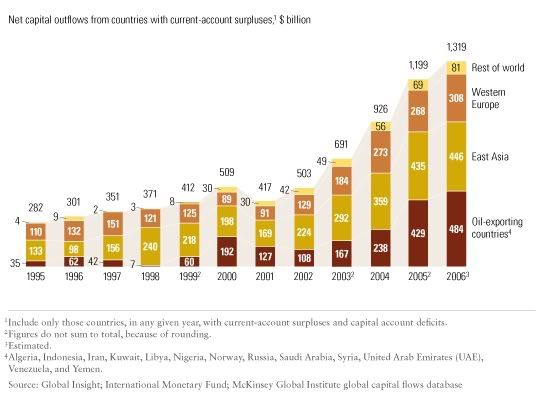
That is going to drag this whole credit issue into 2008 even as real-estate and home prices in the USA, and elsewhere, continue to correct lower. So any stock market rally on the back of lower interest rate expectations is bound to disappoint equity investors if they do not arrive in time to avoid that slowdown in the real economy. The market is still buying minus 10% corrections. Probably on the expectation that sovereign wealth funds and petrodollars coming from the ME and Asia will be attracted to a low US dollar and cheaper stock valuations. I suppose that buy on dips strategy will work until it doesn't? Those sovereign wealth funds are a lot smaller in size compared to total assets than many commentators realize (see graph Global Capital).

Anyway that is my take on the current situation. I was hoping for the S&P500 at 1250 for year-end. And I believe we would have been there or even lower had the Fed, Treasury and White House not started capitulatinig to capital markets so soon. That would have set us up for a nice rally in Q1'08 had we dipped say 20-25% as opposed to 10-11%. So in the absense of such a market dive I think it makes Q1'08 a whole lot less attractive other than to stay invested in what has been profitable in 2007. Namely emerging markets, energy, commodities, metals and any non-US denominated assets. But by mid-year those rallies might have also run their course. Especially if growth in Asia starts to falter in H2'08 after the Olympic games.


As for gold and oil specifically, I think it will depend crucially on the value of the US dollar. In the short-term I would expect crude to retrace to the $80.40 area (per my technical comments last week) and gold back to the $770/767 area (again technically driven) before perhaps attempting an assault on higher levels should the US dollar break $1.5000 against the euro.

Mutual funds that survive end of the year redemptions will likely benefit from fresh funds allocated to those sectors that outperformed in 2007. The looking back investment model. It is a lousy predictor of what will happen in 2008, but perhaps it sheds clues as to what will happen to investment patterns in Q1'08?

I do not have a UK specific investment strategy, but the BOE cutting rates as the economy slows will undermine Sterling's strength. Therefore, export oriented UK companies (are there any left?) and those UK companies that earn a significant portion of their revenues outside the UK (but not in the USA I would assume) might do better than domestic ones or those in the financial arena that may be still exposed to real-estate sector losses.

It seems to be assumed wisdom that the emerging markets are a good place to be at the moment. I am not sure longer term, say H2'08, but likely in the short to medium term momentum is on their side with few attractive alternatives in the major markets.

I like Germany and Switzerland's exposure to Asian growth as well as some high yielders in CEE where local companies have a cost advantage of still being outside the eurozone compared to France, Italy and Spain, for example, who will get killed from lower labor productivity (relative to Germany) and a stronger euro (relative to the PLN, CZK, SKK or HUF) for example. Although I would expect some CEE currencies like the PLN to appreciate due to higher interest rate differentials now that a change in government there seems to be opening the door for economic reform. However, that is more a fixed income investment versus equity.
The organized state is a wonderful invention whereby everyone can live at someone else's expense.

User avatar
MrBill
Expert
Expert
 
Posts: 5630
Joined: Thu 15 Sep 2005, 03:00:00
Location: Eurasia
Top

PreviousNext

Return to Economics & Finance

Who is online

Users browsing this forum: No registered users and 0 guests

cron