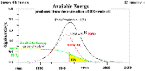
According to My West Texas
$this->bbcode_second_pass_quote('', 'T')he International Energy Agency released its monthly Oil Market Report last week. According to the report, the agency expects global demand to increase by +1.8 percent in 2007.
The adviser group did make some weather related demand changes in Europe and the Pacific, but those downward revisions were offset by strong demand in United States as well as upward revisions for the Former Soviet Union, India, and China.
On the supply side, world output decreased in February. OPEC supplied 125,000 barrels per day less than in January. However, the OPEC-10's production cuts were partially offset by increased production coming from Angola and Iraq. The IEA estimates suggest the OPEC-10 are about 73 percent compliant with their Abuja cut.
The IEA report says the Organization for Economic Cooperation and Development inventories decreased 8.6 million barrels in January. The data for February suggests stock piles may have fallen 65.7 million barrels in the OECD nations. This suggests industrialized countries are heading towards their largest decline in reserves (for the first quarter) in 10 years. The data is bullish on numerous fronts.
In short, demand is up and supply is down.



PeakOil is You
THE International Energy Agency (IEA) Thread pt 1 (merged) A
IEA report shows oil demand is up, supplies are down
 by simontay78 » Sun 25 Mar 2007, 16:15:58
Is this latest report by IEA an indication to the coming peak oil?
- simontay78
- Peat

- Posts: 191
- Joined: Mon 01 May 2006, 03:00:00
- Location: SG
Re: IEA report shows oil demand is up, supplies are down
by steam_cannon » Mon 26 Mar 2007, 08:02:55
That's sounds like the IEA's way of saying Peak Oil with out using such dirty words... 
-

steam_cannon - Expert

- Posts: 2859
- Joined: Thu 28 Dec 2006, 04:00:00
- Location: MA
Re: IEA report shows oil demand is up, supplies are down
by Newsseeker » Mon 26 Mar 2007, 09:44:07
This will definitely be an interesting summer but I wonder what the summer of 2010 will be like. I do that and cringe. When I start thinking about my life when I am 42 (2020) I cry myself to sleep at night. This definitely does look like a red flag and if I am not mistaken they have already warned OPEC but OPEC could have cared less and left the cuts in place.
- Newsseeker
- Heavy Crude

- Posts: 1126
- Joined: Thu 12 May 2005, 03:00:00
Re: IEA report shows oil demand is up, supplies are down
by simontay78 » Mon 26 Mar 2007, 10:58:29
Do you think OPEC can boost supply even if they want to? It's easier to say they cut the oil production "on purpose" rather then the depletion of oil production is part of the reason why they HAD TO cut the production....
The final verdict ....suspicious...let's see if they can ramp up the production when the demands shoots above the supply figures!
The final verdict ....suspicious...let's see if they can ramp up the production when the demands shoots above the supply figures!
- simontay78
- Peat
- Posts: 191
- Joined: Mon 01 May 2006, 03:00:00
- Location: SG
Re: IEA report shows oil demand is up, supplies are down
by DantesPeak » Mon 26 Mar 2007, 12:07:47
I find it most interesting that they say worldwide February production was down. Up until a few weeks ago, it was widely assumed that production was going up, and that total production increases in 2007 would be about 1.5 mbpd.
So we are not off to a very good start here in 2007, being that it has been verified that worldwide demand has been increasing about 2 mpbd so far this year (850,000 bod just from the US). Granted a recession or some other calamity could not demand down, but right now it appears that demand is exceeding supply. This excess demand is so far being met by inventory rundowns, which can not continue for very much longer.
Accelerating demand is soon to collide with the brick wall of stagnant supply.
So we are not off to a very good start here in 2007, being that it has been verified that worldwide demand has been increasing about 2 mpbd so far this year (850,000 bod just from the US). Granted a recession or some other calamity could not demand down, but right now it appears that demand is exceeding supply. This excess demand is so far being met by inventory rundowns, which can not continue for very much longer.
Accelerating demand is soon to collide with the brick wall of stagnant supply.
It's already over, now it's just a matter of adjusting.
-

DantesPeak - Expert
- Posts: 6277
- Joined: Sat 23 Oct 2004, 03:00:00
- Location: New Jersey
International Energy Agency: World Energy Outlook
by MonteQuest » Fri 13 Apr 2007, 00:53:38
The annual World Energy Outlook is the leading source for medium to long-term energy market projections and analysis and has achieved widespread international recognition. It is the flagship publication of the International Energy Agency.
http://www.worldenergyoutlook.org/
http://www.worldenergyoutlook.org/
A Saudi saying, "My father rode a camel. I drive a car. My son flies a jet-plane. His son will ride a camel."
-

MonteQuest - Expert
- Posts: 16593
- Joined: Mon 06 Sep 2004, 03:00:00
- Location: Westboro, MO
Re: Plateau, or no? IEA supply chart says "absolutely&
by Zardoz » Thu 26 Apr 2007, 14:51:12
The IEA just posted the figure for world oil production in the first quarter of this year:

World Oil Supply
Okay, that's it. We're there. Time to cut the crap and call peak.
If that isn't the dreaded undulating plateau of the peak of global oil production, then what in the name of all that's holy is it?
God, I would love to be able to walk into Daniel Yergins' office with an 11 x 17 copy of that graphic, wave it in his face, and see how he'd try to explain it away.
World Oil Supply
Okay, that's it. We're there. Time to cut the crap and call peak.
If that isn't the dreaded undulating plateau of the peak of global oil production, then what in the name of all that's holy is it?
God, I would love to be able to walk into Daniel Yergins' office with an 11 x 17 copy of that graphic, wave it in his face, and see how he'd try to explain it away.
"Thank you for attending the oil age. We're going to scrape what we can out of these tar pits in Alberta and then shut down the machines and turn out the lights. Goodnight." - seldom_seen
-

Zardoz - Expert
- Posts: 6323
- Joined: Fri 02 Dec 2005, 04:00:00
- Location: Oil-addicted Southern Californucopia
Re: Plateau, or no? IEA Supply Chart says "maybe"
by emersonbiggins » Thu 26 Apr 2007, 14:55:39
$this->bbcode_second_pass_quote('dukey', 'l')et me get this straight
even though non opec oil has peaked
and opec oil seems to have peaked .. if i read all the latest reports correctly. Saudi arabia down half a million barrels per day etc
we somehow magically made it to 85.1 million barrels per day ?
Where is the extra oil coming from. The moon ?
even though non opec oil has peaked
and opec oil seems to have peaked .. if i read all the latest reports correctly. Saudi arabia down half a million barrels per day etc
we somehow magically made it to 85.1 million barrels per day ?
Where is the extra oil coming from. The moon ?
Maybe they're measuring in 1980 barrels, rather than 2007.
You know, adjusting for inflation and all...
(j/k)

"It's called the American Dream because you'd have to be asleep to believe it."
George Carlin
George Carlin
-

emersonbiggins - Expert
- Posts: 5150
- Joined: Sun 10 Jul 2005, 03:00:00
- Location: Dallas
Re: Plateau, or no? IEA supply chart says "absolutely&
by grink1tt3n » Thu 26 Apr 2007, 15:49:46
$this->bbcode_second_pass_quote('Zardoz', '
')If that isn't the dreaded undulating plateau of the peak of global oil production, then what in the name of all that's holy is it?
')If that isn't the dreaded undulating plateau of the peak of global oil production, then what in the name of all that's holy is it?
To play the Devil's Advocate, I would say that the run-up in production of 2003 to 2006/2007 was so great that there is no real great need to increase production further at this point.
Furthermore, the problems USA seems to be experiencing this point is a refining problem and not a crude-supply problem.
-

grink1tt3n - Peat
- Posts: 134
- Joined: Sat 28 Oct 2006, 03:00:00
- Location: Southern California
Re: Plateau, or no? IEA supply chart says "absolutely&
by Twilight » Thu 26 Apr 2007, 16:15:56
$this->bbcode_second_pass_quote('grink1tt3n', '')$this->bbcode_second_pass_quote('Zardoz', '
')If that isn't the dreaded undulating plateau of the peak of global oil production, then what in the name of all that's holy is it?
')If that isn't the dreaded undulating plateau of the peak of global oil production, then what in the name of all that's holy is it?
To play the Devil's Advocate, I would say that the run-up in production of 2003 to 2006/2007 was so great that there is no real great need to increase production further at this point.
Well, try telling that to the Nigerians who can't buy fuel. They've been having internal market shortages for a year judging by the various BBC reports I've seen since the start of unrest. The West is not feeling the squeeze yet, because the domestic supply of servile exporting countries can be squeezed first, and you can bet they're not going to be given airtime on Bloomberg. That provides only temporary respite, it will reach us in a few years. I can imagine European refinery news now, "WTF is happening with our deliveries?!", while American refined product importers go "Aaaargh!"
Comical, but you just know the wave is only a handful of years away.
- Twilight
- Expert
- Posts: 3027
- Joined: Fri 02 Mar 2007, 04:00:00