Well, I'm a cornicopian by this site's standards but I still think everything's going to go to hell sooner or later. Not that it has to go down that way but it probably will because most people are so Expletive deleted. complacent.
Those ping-pong guys were very impressive. If I manage to ever acquire a doomstead I will definitely have a ping-pong table on it.


PeakOil is You
THE Chess Thread (merged)
Re: chess
 by Narz » Tue 25 Aug 2009, 19:59:36
Last edited by Ferretlover on Wed 26 Aug 2009, 08:33:40, edited 1 time in total.
Reason: *We* are not complacent about the swearing.
Reason: *We* are not complacent about the swearing.
“Seek simplicity but distrust it”
-

Narz - Intermediate Crude

- Posts: 2360
- Joined: Sat 25 Nov 2006, 04:00:00
- Location: the belly of the beast (New Jersey)
Re: chess
by Narz » Sat 09 Jan 2010, 20:59:56
I drew a Master for the first time today. I should have won against him actually but missed my chance & the game drifted into a draw. The guy showed up for the Cherry Hill Quads with an average 400 point advantage over everyone ele in the quad & seemed pretty certain he'd be walking home with the $50 pot. But I'm not one to give up without a hard fight, especially with money on the line. Another tourney tomorrow, going for the Best-Under-1900 prize.
I made a new YouTube channel showcasing some of my more recent games (haven't fully analyzed my Master draw yet but probably will make a vid on it).
http://www.youtube.com/user/InfinityCurve
Also, I set up a simil for my local chess club with the cutest lil' chess player you will ever see.
http://main.uschess.org/content/view/10018/319/
I made a new YouTube channel showcasing some of my more recent games (haven't fully analyzed my Master draw yet but probably will make a vid on it).
http://www.youtube.com/user/InfinityCurve
Also, I set up a simil for my local chess club with the cutest lil' chess player you will ever see.
http://main.uschess.org/content/view/10018/319/
“Seek simplicity but distrust it”
-
Narz - Intermediate Crude
- Posts: 2360
- Joined: Sat 25 Nov 2006, 04:00:00
- Location: the belly of the beast (New Jersey)
Re: chess
by Consensi » Sun 10 Jan 2010, 00:30:52
$this->bbcode_second_pass_quote('Narz', '')$this->bbcode_second_pass_quote('Carlhole', '[')img]http://i182.photobucket.com/albums/x276/Carlhole/WhiteForces.png[/img]
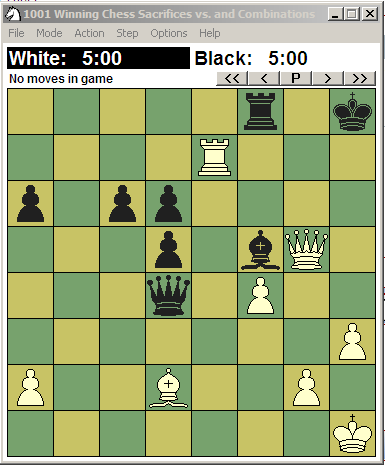
I think this is the position. White's got a superior position here but there's a way to make Black resign pretty much immediately.
I think this is the position. White's got a superior position here but there's a way to make Black resign pretty much immediately.
Rc8+ RxR
Qa7+ KxQ
pxR promote to Knight (royal fork)
Stalemate ?
- Consensi
- Peat

- Posts: 112
- Joined: Wed 28 May 2008, 03:00:00


Re: chess
by Carlhole » Sun 10 Jan 2010, 18:21:28
$this->bbcode_second_pass_quote('Consensi', '')$this->bbcode_second_pass_quote('Narz', '')$this->bbcode_second_pass_quote('Carlhole', '[')img]http://i182.photobucket.com/albums/x276/Carlhole/WhiteForces.png[/img]
I think this is the position. White's got a superior position here but there's a way to make Black resign pretty much immediately.
I think this is the position. White's got a superior position here but there's a way to make Black resign pretty much immediately.
Rc8+ RxR
Qa7+ KxQ
pxR promote to Knight (royal fork)
Stalemate ?
If KxP, then RC8xRH8
White wins a rook, which in this situation is an inevitable win barring any major blunders.