


PeakOil is You
THE Deflation Thread (merged)
Re: Deflation!
 by KingM » Wed 10 Sep 2008, 20:39:00
$this->bbcode_second_pass_quote('scienceteacher', 'A')nd what about silver. Anybody here think it will return to $20+ -and if so when? I've lost a fortune.
Take this as a valuable lesson. Never buy precious metals as an investment. They're insurance against a collapse, is all. You need to keep saving as if the world will continue on as it always has--because it probably will--while doing some things on the side for just in case.
Anything else and you're likely to find yourself seventy and working at Wal-Mart, while your friends retire to a beach house somewhere because they didn't act as if the world was going to end.
-

KingM - Tar Sands

- Posts: 732
- Joined: Tue 30 Aug 2005, 03:00:00
- Location: Second Vermont Republic
Re: Deflation!
by DantesPeak » Wed 10 Sep 2008, 20:49:00
WHy is the dollar index a deflation index? The US dollar, which is actually issued only by the Federal Reserve, is mostly backed by loans to banks and brokers, plus various mortgage backed securities and derivatives.
Previously the dollar was almost entirely backed by US government debt.
How can a huge drop in the dollar's intrinsic value be deflationary?
The dollar index only measures a perceived value change vs. other currencies. A deflation index should be similar to a cost of living index.
The cost of living here in the US is rising faster than last year, mortgage rates and real estate taxes are moving up. While the value of existing homes is falling, it's not clear if the cost of buying a new home is falling. The cost of most everything else is going up.
Previously the dollar was almost entirely backed by US government debt.
How can a huge drop in the dollar's intrinsic value be deflationary?
The dollar index only measures a perceived value change vs. other currencies. A deflation index should be similar to a cost of living index.
The cost of living here in the US is rising faster than last year, mortgage rates and real estate taxes are moving up. While the value of existing homes is falling, it's not clear if the cost of buying a new home is falling. The cost of most everything else is going up.
It's already over, now it's just a matter of adjusting.
-

DantesPeak - Expert

- Posts: 6277
- Joined: Sat 23 Oct 2004, 03:00:00
- Location: New Jersey
Re: Deflation!
by threadbear » Wed 10 Sep 2008, 20:56:27
$this->bbcode_second_pass_quote('scienceteacher', 'A')nd what about silver. Anybody here think it will return to $20+ -and if so when? I've lost a fortune
I really wouldn't worry too terribly much. Generally speaking though, it's a good when times are confusing to be equally weighted in cash and pm's.
-

threadbear - Expert
- Posts: 7577
- Joined: Sat 22 Jan 2005, 04:00:00
Re: Deflation!
by mattduke » Wed 10 Sep 2008, 21:00:32
It's difficult to perceive timescales greater than a couple months, isn't it?
-

mattduke - Intermediate Crude

- Posts: 3591
- Joined: Fri 28 Oct 2005, 03:00:00
Re: Deflation!
by kjmclark » Wed 10 Sep 2008, 21:13:03
$this->bbcode_second_pass_quote('scienceteacher', 'A')nd what about silver. Anybody here think it will return to $20+ -and if so when?I've lost a fortune
Oh, yeah! Of course it will. This is just round one of the Long Emergency. Heck, the real declines in oil production haven't really started yet. Silver will head higher than $20 an ounce, but it may take a few years until the rest of the world has chosen a new reserve currency.
The only lesson to learn from PMs dropping is that there are no sure bets, so you should always stay diversified enough to never lose a fortune. If PMs shouldn't be used as an investment, nothing else should be either. What a load of pucky!
The other way to look at it - if we are headed for deflation, science teachers have a pretty decent chance of staying employed. A stable job is one of the best hedges against deflation. Look at the bright side -you may have lost a bunch on silver, but you aren't a real estate agent, mortgage broker, construction worker, auto worker, etc.
-
kjmclark - Coal

- Posts: 428
- Joined: Fri 09 Dec 2005, 04:00:00
Re: Deflation!
by LoneSnark » Wed 10 Sep 2008, 22:45:16
Sorry scienceteacher, not anytime soon. Remember the old axiom: buy low, sell high. Holding precious metals is always a good idea to hedge against societal collapse. But you should have bought it years ago when silver was cheap, not recently when silver was expensive.
Afterall, anyone can tell that society is healthy enough right now (there should be several years of street riots and total warfare before collapse, I suspect). As such, I went ahead and sold all my gold for $940 an ounce (paid $360 an ounce for it back in 2001). That makes me goldless, but I feel confident I can buy it all back in a few years, well before anything serious will have a chance to go down.
Afterall, anyone can tell that society is healthy enough right now (there should be several years of street riots and total warfare before collapse, I suspect). As such, I went ahead and sold all my gold for $940 an ounce (paid $360 an ounce for it back in 2001). That makes me goldless, but I feel confident I can buy it all back in a few years, well before anything serious will have a chance to go down.
-

LoneSnark - Tar Sands
- Posts: 514
- Joined: Thu 15 Nov 2007, 04:00:00
Re: Deflation!
by shady28 » Wed 10 Sep 2008, 22:53:36
$this->bbcode_second_pass_quote('DantesPeak', 'W')Hy is the dollar index a deflation index? The US dollar, which is actually issued only by the Federal Reserve, is mostly backed by loans to banks and brokers, plus various mortgage backed securities and derivatives.
Previously the dollar was almost entirely backed by US government debt. How can a huge drop in the dollar's intrinsic value be deflationary? The dollar index only measures a perceived value change vs. other currencies. A deflation index should be similar to a cost of living index.
The cost of living here in the US is rising faster than last year, mortgage rates and real estate taxes are moving up. While the value of existing homes is falling, it's not clear if the cost of buying a new home is falling. The cost of most everything else is going up
Previously the dollar was almost entirely backed by US government debt. How can a huge drop in the dollar's intrinsic value be deflationary? The dollar index only measures a perceived value change vs. other currencies. A deflation index should be similar to a cost of living index.
The cost of living here in the US is rising faster than last year, mortgage rates and real estate taxes are moving up. While the value of existing homes is falling, it's not clear if the cost of buying a new home is falling. The cost of most everything else is going up
I'm not sure where to begin with this - most everything you said here is either false or seriously distorted.
First, no one said the dollar index was a deflation index. I posted the link simply to inform. Clearly, some don't like people being informed. Movement in the dollar index, in and of itself, doesn't signify inflation or deflation. ALTHOUGH - I would point out that it has been used MANY times by gold and oil bugs on this board as some kind of proof of inflation when it was going DOWN. Now that it's going UP, it's not too popular eh?
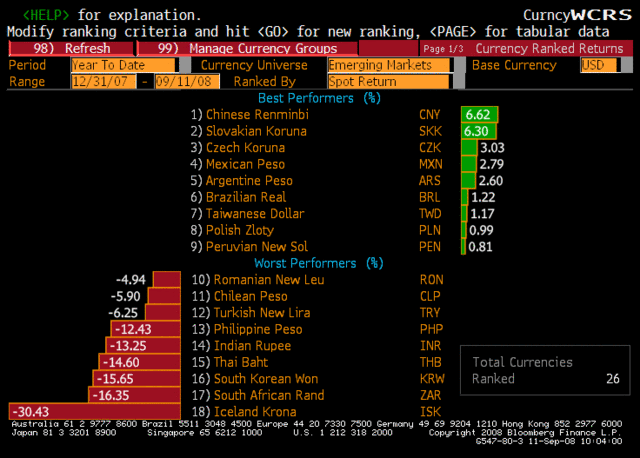
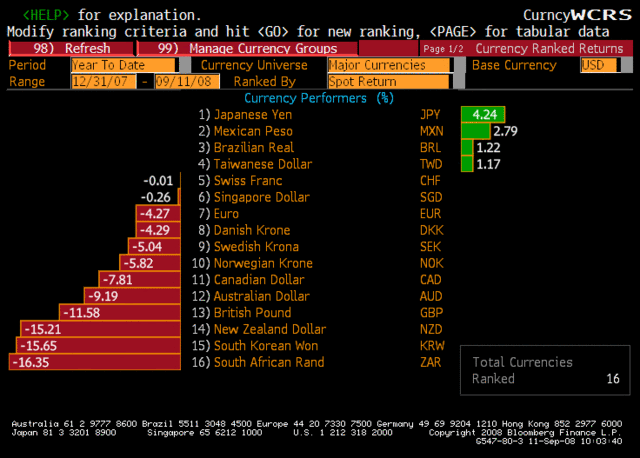
It means what it means - which is that the dollar is appreciating in value RELATIVE TO OTHER CURRENCIES.
Obviously if those other currencies are going up or down relative to hard assets then it may or may not mean deflation or inflation. In fact, the dollar could go way down on this index and you could still have deflation (or, vice versa).
As far as what backs the currency - that's highly debatable and actually quite irrelevant. The dollar is the only legal currency for buying and selling in the USA. Wal-mart and Kroger won't take your gold for food, sorry. You must find another gold or silver bug to give you dollars for your PM. That is what PM is - a commodities market. Nothing more, nothing less.
Your last statement about homes is absolutely false. The average cost of a new home is going down. You can see the Case-Shiller indexes here (Excel format): link
What has changed is that you need more CASH to purchase a home because the lending standards are tightening (down payments are a more normal 10-20% now for most people). Again, that is more demand for cash. That is less willingness to lend (and hence, less willingness to inject new money into the economy). These are deflationary forces.
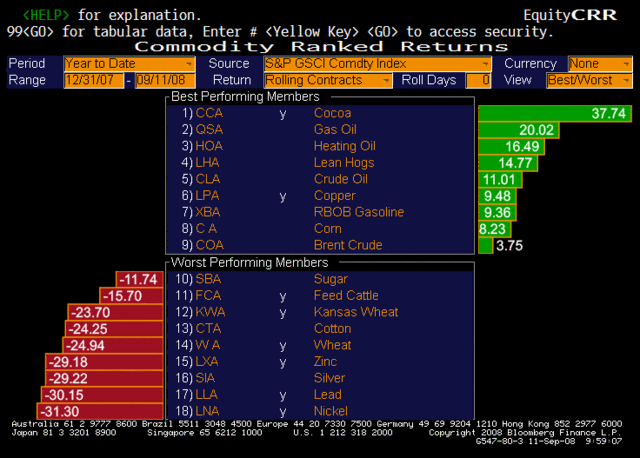
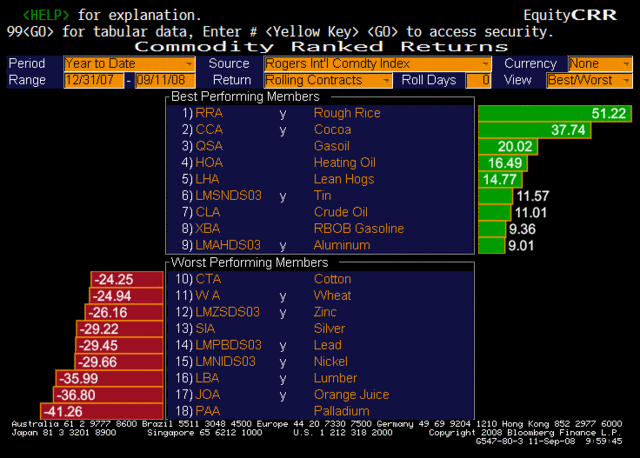
As far as everything else going up - true for the year to date. However, what you completely fail to mention is that the commodities - which is what has been powering the spurt of inflation in the first half - are deflating rapidly. In fact, as stunning as the final run up (ie, the blow off top) in commodities was, the fall is much more staggering.
Look here, CRB commodities index chart. Commodities have in less than 2 months completely retraced nearly a year of increases: link
This is a classic inflationary boom driven by debt, followed by a deflationary bust as the debt bubble implodes. The commodities market was simply the last of the big bubbles - bubbles are the places investors look to put their money (hoping that they will get out before the next guy). Now that there are no bubbles left, there are only two good bets: cash and treasuries.
Welcome to the Kondratieff Winter
-
shady28 - Coal
- Posts: 412
- Joined: Wed 06 Jul 2005, 03:00:00




 [/align]
 [/align]
 [/align]
 [/align]


