PeakOil is You
Peak oil: Do you want it to occur?
Re: Peak oil: Do you want it to occur?
 by Dry » Sat 29 Dec 2007, 05:06:51
no.......It isn't going to be pretty and I have small children. enjoy today and prepare for the future.
-

Dry - Wood

- Posts: 23
- Joined: Mon 10 Dec 2007, 04:00:00
Re: Peak oil: Do you want it to occur?
by Concerned » Sat 29 Dec 2007, 05:29:19
$this->bbcode_second_pass_quote('JohnDenver', '')$this->bbcode_second_pass_quote('Oil-Finder', 'T')he only thing they really care about is that we stop producing and consuming so much oil.
That's not really true either. Sure the folks here talk a lot about how we need to do something about peak oil and carbon emissions. But mostly that's just their lips flapping. Basically, they're all a bunch of hypocrits living energy guzzling lifestyles, like Al Gore. They attack Bush&Cheney for waging a "War for Oil", and then fire up the SUV to go to a Peak Oil meeting.
Amen brother we're going over a cliff. I'm in the SUV up front and you're on my tailcoat riding your bike.

It's a wonderful world.
"Once the game is over, the king and the pawn go back in the same box."
-Italian Proverb
-Italian Proverb
-

Concerned - Heavy Crude

- Posts: 1571
- Joined: Thu 23 Sep 2004, 03:00:00
Re: Peak oil: Do you want it to occur?
by JohnDenver » Sat 29 Dec 2007, 06:11:16
$this->bbcode_second_pass_quote('thuja', 'T')hose new projects are wonderful, because they offset the rapid declines happening in the major fields. But as you can see by the flattening of worldwide production, its getting harder and harder for those new projects to keep up with the rapid decline.
That last sentence is unsupported opinion. It's not clear that it's getting harder and harder to keep up with decline. It's very common for large multi-country blocks to plateau for decades. North America, for example, has been on an undulating plateau of about 14-15mbd for almost 30 years.
1979 13578kbd
1980 14063
1981 14344
1982 14790
1983 14838
1984 15226
1985 15304
1986 14792
1987 14730
1988 14642
1989 14014
1990 13856
1991 14182
1992 14050
1993 13899
1994 13807
1995 13789
1996 14052
1997 14267
1998 14182
1999 13678
2000 13904
2001 13906
2002 14069
2003 14193
2004 14137
2005 13695
2006 13700
Canada and Mexico kept up just fine with the decline of the U.S. for almost 30 years. So if it was getting "harder and harder", it was clearly doing so very very SLOWLY.
The FSU managed a plateau of about 12 years from 1978-1990 at roughly 12mbd:
1978: 11531
1979: 11805
1980: 12116
1981: 12260
1982: 12330
1983: 12403
1984: 12297
1985: 12040
1986: 12442
1987: 12655
1988: 12601
1989: 12298
1990: 11566
Asia-Pacific has been on a plateau of 6-7mbd for almost 20 years. South/Central America has logged a couple of long plateaus, most recently a plateau of about 6.5mbd for 10 years. Non-Opec has been on a plateau of roughly 35mbd since 1997:
1997 34925
1998 35028
1999 34887
2000 35507
2001 35415
2002 35933
2003 35673
2004 35661
2005 35343
2006 35162
Clearly, it's not so hard to "hold a plateau", so to speak.
$this->bbcode_second_pass_quote('', 'I')f it weren't for these new projects, we would experience a dramatic worldwide decline rate. That was the point of the article I suggested reading.
The case where we don't bring on new projects is irrelevant to the real world, for obvious reasons. The only thing that matters is the net decline rate after new projects are added. And the latest word from the really smart people
 is that the world will decline at a rate of less than 1% for 10 years after peak, and less than 2% for 20 years:
 Hubbert Theory says Peak is Slow Squeeze
Technical reading, but well worth the effort thuja, if you really want to bring yourself up to speed on peak oil.
$this->bbcode_second_pass_quote('', 'F')or example, Cantarell- one of the largest fields in the world, is declining at a 13% rate per year.
EIA C&C stats for Mexico after its peak in 2004 look like this:
2004: 3383kbd
2005: 3334
2006: 3256
2007: 3126 (9-month average)
That's an annual decline rate of 2.8%, not 13%. Even Mexico (during the collapse of Cantarell!) doesn't collapse like Cantarell. So why do you think that the decline rate of Cantarell has anything to say about the net decline rate of the world? It barely affects Mexico, let alone the world.
$this->bbcode_second_pass_quote('', 'T')here are only a few of these big boys in the world. Another is Burgan in Kuwait (declining) and Ghawar in Saudi Arabia (most likely declining).
If Ghawar is declining, it's clearly nothing to worry about because Saudi Arabia has been on a level plateau for most of the last year. I also don't believe that you know whether Ghawar is declining, and thus (again) you are trying to pass off unsupported opinion as evidence.
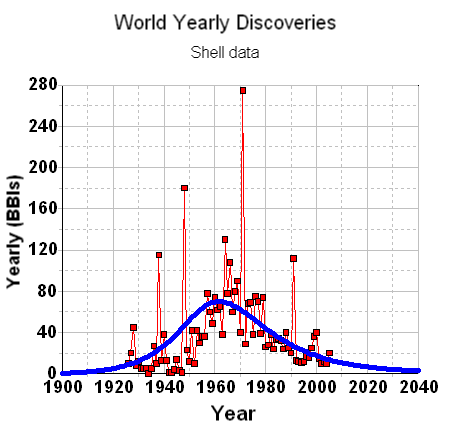
$this->bbcode_second_pass_quote('', 'W')e have not made a discovery of a massive field like these for decades. We are now exploting a lot of smaller fields and working on the harder to access and more difficult to refine fields.
All of this leads to some very scary prospects.
You haven't made any argument, or produced any data, to show that a scary outcome is PROBABLE. The U.S., Canada and Mexico have been operating on 90% small fields for decades, and they're still on the same plateau. All you have is a couple of really tired examples like Cantarell, and a big "What if?" That's it.
$this->bbcode_second_pass_quote('', 'L')ike I said, if it weren''t for those new fields you are talking about we may be looking at decline rates in the double digits.