$this->bbcode_second_pass_quote('Graeme', 'Y')ou can't have business without cooperation. In fact, the nature of business is changing:
Mapping the Connections Between Cities, Inequality, and Creative Economies
$this->bbcode_second_pass_quote('', 'C')apitalism is in transition. It’s pulling away from its previous industrial model to a new one based on creativity and knowledge. In place of the natural resources and large-scale industries that powered the economies of previous centuries, economic growth today turns on knowledge, innovation, and talent.
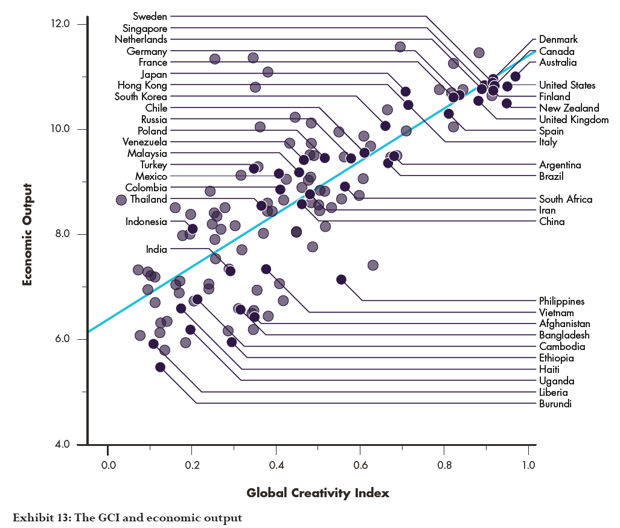
In a new report released Wednesday, my Martin Prosperity Institute colleagues Charlotta Mellander and Karen King and I evaluate 139 nations worldwide on their ability to compete and prosper in this new, creativity-powered knowledge economy.
The map below shows how the nations of the world stack up on our Global Creativity Index—a comprehensive measure of creative competitiveness based on six indicators organized across the three key factors (“the three Ts”) driving today’s economic development: technology, talent, and tolerance. On the map, the nations that perform the best are in purple; the nations that do most poorly by our ranking are in light blue.
Australia takes the top spot on the GCI, followed by the United States. New Zealand comes in third, Canada fourth, and Denmark and Finland are tied for fifth. The rest of the top 10 includes Sweden in seventh place, Iceland in eighth, Singapore in ninth, and the Netherlands in tenth. While much has been made of the recent economic performance of the so-called BRIC nations—Brazil, Russia, India, and especially China—these rank much lower on our index: Brazil is in 29th place, Russia 38th, China 62nd, and India 99th.


PeakOil is You
Renewable Energy and Economic Growth Pt. 2
You're confusing cooperation as profitable agreements made between entities in business enterprises with global, non-profitable agreements made to deal with global warming and other crises.
-

ralfy - Light Sweet Crude

- Posts: 5651
- Joined: Sat 28 Mar 2009, 11:36:38
- Location: The Wasteland
Re: Renewable Energy and Economic Growth Pt. 2
 by Graeme » Fri 10 Jul 2015, 22:25:32
No that is false. RE growth and climate mitigation has just recently been proven. Look back and you will see that growth has decoupled from emissions (see page eight).
$this->bbcode_second_pass_quote('', 'T')he global economy grew strongly last year without increasing greenhouse gas emissions, suggesting that government regulations, carbon markets and existing technologies are starting to bite in the battle against climate change.
The IEA outlook that’s being presented Monday shows what would happen under the national pledges already set out for Paris, which at the time the report was written in May accounted for a third of global emissions. Under that outlook, the IEA sees the world economy growing 88 percent by 2030 with carbon emissions gaining just 8 percent.
$this->bbcode_second_pass_quote('', 'T')he global economy grew strongly last year without increasing greenhouse gas emissions, suggesting that government regulations, carbon markets and existing technologies are starting to bite in the battle against climate change.
The IEA outlook that’s being presented Monday shows what would happen under the national pledges already set out for Paris, which at the time the report was written in May accounted for a third of global emissions. Under that outlook, the IEA sees the world economy growing 88 percent by 2030 with carbon emissions gaining just 8 percent.
Human history becomes more and more a race between education and catastrophe. H. G. Wells.
Fatih Birol's motto: leave oil before it leaves us.
Fatih Birol's motto: leave oil before it leaves us.
-

Graeme - Fusion

- Posts: 13258
- Joined: Fri 04 Mar 2005, 04:00:00
- Location: New Zealand
Re: Renewable Energy and Economic Growth Pt. 2
by Graeme » Sat 11 Jul 2015, 18:25:10
A Low-Carbon Revolution Can Mean Good Economic Growth
$this->bbcode_second_pass_quote('', 'L')ast month, two democrats, Sens. Sheldon Whitehouse (D-RI) and Brian Schatz (D-HI), unveiled new legislation to address climate change at an event hosted by the American Enterprise Institute. If it becomes a law, the proposed bill will tax fossil fuels, starting at $45 per ton of carbon dioxide and steadily rising each year.
Policymakers are often addressing conflicting goals when tackling climate change. While they see an urgent need for action, they also fear slow economic growth. But, as British Columbia has shown us, climate change action can be synonymous with economic prosperity.
When British Columbia implemented the carbon tax in 2008, it was a risky proposition. Critics said the tax would devastate BC's economy. Seven years later, it is an economic and environmental success. For countries that grapple with the economic realities that come with switching from fossil fuels to renewable resources, this is one option that deserves serious consideration.
Since 2008, BC's fuel consumption has declined 17.4 percent across all fuel types covered by the tax, according to Sustainable Prosperity. During that time, BC's GDP stayed in line with the rest of Canada. The tax levies a fee on carbon-based fuels, and all revenues from the carbon tax fund tax rebates in other areas. In 2012, this tax program gave BC the lowest tax rate in Canada.
World leaders may want to take the clue. According to Time, this year, G-7 world leaders laid out an "ambitious" plan to eliminate the use of fossil fuels worldwide by 2100, but didn't provide specifics on scaling back fuel consumption in their respective countries. In other words, the plan is a whole lot of nothing, wrapped in the pretty ribbon of good intentions.
It's a complex issue, which requires leaders to balance the fate of the planet against economic realities, powerful lobbying groups, and some legislators' skepticism about global warming. Even Germany, who many see as an environmental pioneer, has had to evaluate their ambitious climate change agenda when faced with the prospect of losing 100,000 jobs after the country approved a levy on high-polluting coal plants.
On the flip side of the coin, the carbon-climate crisis is also devastating. In 2010, economic problems caused by climate change were severe, causing $700 billion in losses or one percent of the global GDP, according to DARA International. Combined climate change and carbon economy losses in 2010 totaled $1.2 trillion.
DARA projects severe economic losses in the United States, China and India. In 2030, these three countries will have $2.5 trillion in combined economic costs linked to climate change and the carbon economy.
According to Time, 59 percent of global carbon emissions are created by G-7 countries. More than 10 times the carbon emissions produced by 48 developing countries. But, DARA reports that developing countries will feel the brunt of the economic loss from the carbon-climate crisis, totaling $4 trillion in 2030.
In the meantime, BC's economic performance is slightly outperforming the rest of Canada. In fact, the political debate focuses more on where to spend the tax revenue than whether or not to keep the tax. The carbon tax represents the out-the-box thinking and decisive action required to enact change.
$this->bbcode_second_pass_quote('', 'L')ast month, two democrats, Sens. Sheldon Whitehouse (D-RI) and Brian Schatz (D-HI), unveiled new legislation to address climate change at an event hosted by the American Enterprise Institute. If it becomes a law, the proposed bill will tax fossil fuels, starting at $45 per ton of carbon dioxide and steadily rising each year.
Policymakers are often addressing conflicting goals when tackling climate change. While they see an urgent need for action, they also fear slow economic growth. But, as British Columbia has shown us, climate change action can be synonymous with economic prosperity.
When British Columbia implemented the carbon tax in 2008, it was a risky proposition. Critics said the tax would devastate BC's economy. Seven years later, it is an economic and environmental success. For countries that grapple with the economic realities that come with switching from fossil fuels to renewable resources, this is one option that deserves serious consideration.
Since 2008, BC's fuel consumption has declined 17.4 percent across all fuel types covered by the tax, according to Sustainable Prosperity. During that time, BC's GDP stayed in line with the rest of Canada. The tax levies a fee on carbon-based fuels, and all revenues from the carbon tax fund tax rebates in other areas. In 2012, this tax program gave BC the lowest tax rate in Canada.
World leaders may want to take the clue. According to Time, this year, G-7 world leaders laid out an "ambitious" plan to eliminate the use of fossil fuels worldwide by 2100, but didn't provide specifics on scaling back fuel consumption in their respective countries. In other words, the plan is a whole lot of nothing, wrapped in the pretty ribbon of good intentions.
It's a complex issue, which requires leaders to balance the fate of the planet against economic realities, powerful lobbying groups, and some legislators' skepticism about global warming. Even Germany, who many see as an environmental pioneer, has had to evaluate their ambitious climate change agenda when faced with the prospect of losing 100,000 jobs after the country approved a levy on high-polluting coal plants.
On the flip side of the coin, the carbon-climate crisis is also devastating. In 2010, economic problems caused by climate change were severe, causing $700 billion in losses or one percent of the global GDP, according to DARA International. Combined climate change and carbon economy losses in 2010 totaled $1.2 trillion.
DARA projects severe economic losses in the United States, China and India. In 2030, these three countries will have $2.5 trillion in combined economic costs linked to climate change and the carbon economy.
According to Time, 59 percent of global carbon emissions are created by G-7 countries. More than 10 times the carbon emissions produced by 48 developing countries. But, DARA reports that developing countries will feel the brunt of the economic loss from the carbon-climate crisis, totaling $4 trillion in 2030.
In the meantime, BC's economic performance is slightly outperforming the rest of Canada. In fact, the political debate focuses more on where to spend the tax revenue than whether or not to keep the tax. The carbon tax represents the out-the-box thinking and decisive action required to enact change.
huffingtonpost
Human history becomes more and more a race between education and catastrophe. H. G. Wells.
Fatih Birol's motto: leave oil before it leaves us.
Fatih Birol's motto: leave oil before it leaves us.
-
Graeme - Fusion
- Posts: 13258
- Joined: Fri 04 Mar 2005, 04:00:00
- Location: New Zealand


