PeakOil is You
Renewable Energy and Economic Growth Pt. 2
Re: Renewable energy and economic growth
 by MonteQuest » Sun 07 Dec 2014, 12:02:37
$this->bbcode_second_pass_quote('copious.abundance', '')$this->bbcode_second_pass_quote('MonteQuest', 'D')idn't say it did. I mentioned that, in the US, inflating assets via $4 trillion of QE has contributed to a rising GDP without needing a corresponding increase in energy use.
1. Since money just sitting in an account does not count towards GDP, any "asset inflation" cannot contribute towards GDP unless it is spent on goods or services, or on capital investments (the latter of which always involves spending on goods and services anyway). So ...
So, who says it sat there? I sure didn't. You assert I don't know what QE is or what it did. I am quite well read on the subject, so here goes.
In 2007, the Fed followed an expansionary monetary policy in an effort to stimulate economic growth. One key part of this effort was to buy short-term Treasury securities through its open-market operations. Through these asset purchases, the Fed adds reserves to the commercial banking system, thus allowing banks to lend more money.
These open-market operations failed to provide the stimulus needed due to unusually slow economic growth.
Quantitative easing then became an extension of TARP. (Troubled Asset Relief Program). I guess the theory was that by removing toxic assets from the bank's books they would have more liquidity to offer more credit, or to purchase more government debt. The Fed purchased troubled assets in exchange for base money rather than have the banks borrow money from the FED through the discount window.
Somehow this was supposed to trickle down and help improve unemployment; it did not.
Since the banking system was not prepared to immediately loan this new base money, the system's reserves increased dramatically. The Fed then started paying interest on these excess reserves to remove the incentive for them to be fully used and cause inflation (too much money in circulation). I still fail to see the sense that makes unless it was a ploy to make the FED look like inflation fighters while they bailed out the banks and investors, again.
These banks held a lot of mortgage-backed securities that, if sold, would make many banks insolvent. Why?
Take California subprime housing where loans were made on inflated prices. A house with, say a $500,000 mortgage, became worth only $175,000. The loan became upside down with the owner owing more than the house was worth if marked to market. Those types of loans were bundled together and bought by banks (mortgage-backed securities). The banks maintained the loan value on their books as an asset, even though it was no longer really worth that much.
So, QE effectively took these toxic assets off the books of the banks in exchange for cash. A liquidity swap. The unmarketable toxic assets became liquid; easily bought and sold. The FED’s purchase, in effect, inflated their value bailing out the banks and investors and pumping up the stock market.
Inflated assets have nothing to do with GDP? Why did this headline just pop up?
BOJ keeps QE intact in wake of shocking GDP

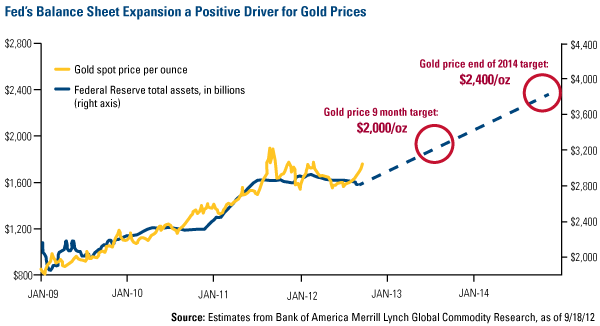
Or this chart? These numbers show the Fed's QE programs inflated GDP.

One thing all of this tells me is that economic growth like we have known it is over. After injecting all this stimulus economies are still going into recession and depression? Even the IMF has cut its global growth forecasts for 2014 and 2015 and warned that the world economy may never return to the pace of expansion seen before the financial crisis.
A Saudi saying, "My father rode a camel. I drive a car. My son flies a jet-plane. His son will ride a camel."
-

MonteQuest - Expert

- Posts: 16593
- Joined: Mon 06 Sep 2004, 03:00:00
- Location: Westboro, MO
Re: Renewable energy and economic growth
by MonteQuest » Sun 07 Dec 2014, 12:55:35
Getting back to this threads main point. Many have pinned their hopes on the assumption that somewhere, somehow a technological solution will come along that will allow us to continue our ways. The optimists have concentrated their efforts on finding new ways to exploit renewable resources or come up with a new infinite source of energy. While we all agree that there must, and will be a shift from non-renewable back to renewable, what remains to be determined is the type of energy transformers we shall embrace and at what scale. They reject the notion to returning to a low-entropy flow and a greater accord with natural systems. While the solar flow is virtually unlimited, the matter-energy that makes up the Earth is not. Thus, the faster we speed up the flow of matter-energy through the system, the faster we will run out of renewable resources, regardless of how long the sun shines. Continuing to try to meet demand with renewables is a fool’s errand. And trying to continue economic growth in a finite world is just pure folly.
A Saudi saying, "My father rode a camel. I drive a car. My son flies a jet-plane. His son will ride a camel."
-
MonteQuest - Expert
- Posts: 16593
- Joined: Mon 06 Sep 2004, 03:00:00
- Location: Westboro, MO
Re: Renewable energy and economic growth
by Graeme » Sun 07 Dec 2014, 16:10:23
I have to say that I am gratified to see you say this:
$this->bbcode_second_pass_quote('', 'W')hile we all agree that there must, and will be a shift from non-renewable back to renewable
$this->bbcode_second_pass_quote('', 'W')hile we all agree that there must, and will be a shift from non-renewable back to renewable
However, the rest of your argument is flawed for basically two main reasons; firstly, you do not acknowledge that raw materials to make RE systems can be recycled, nor do you realize that the new systems developed after serving their lifetime will be the product of new innovations and increased efficiencies. We are not going to run out of renewable resources! We will be returning to natural renewable energy sources like the sun and wind, which is in accord with exploiting sustainable natural systems. We discussed earlier that GDP growth has decoupled from energy consumption. As noted on page three (see part 1 old thread), in the US, this decoupling occurred within the last few years by a combination of a switch from coal to natural gas, greater energy efficiency, and a rise in renewable power (in order of importance). So your conclusions are false. As noted in the following article, this trend toward using RE is global - that is the scale of the RE development which is occurring now.
Locally-Controlled, Renewable Energy Championed as Key to Climate Justice
$this->bbcode_second_pass_quote('', 'A')s progress at the UN climate summit in Lima, Peru has been reported as "slow" by many observers so far, green campaigners on Friday called on world governments participating in the talks to end their continued dependence on outdated fossil fuel- and nuclear-powered energy systems and urged investment and policies geared toward building clean, sustainable, community-based energy solutions.
"We urgently need to decrease our energy consumption and push for a just transition to community-controlled renewable energy if we are to avoid devastating climate change," said Susann Scherbarth, climate justice and energy campaigner at Friends of the Earth Europe. "We must stop subsidizing fossil fuels and put this money towards community-based energy solutions."
Backed by a new white paper by researchers at the What's Next Forum, Scherbarth and her colleagues at FOEI say that locally implemented and decentralized energy systems—including small-scale wind farms and distributive solar arrays that can feed-in to local power grids—are the key to pulling people out of poverty while also addressing the glaring crisis of runaway greenhouse gas emissions that are ruining the planet and the climate.
"We urgently need a transition to clean energy in developing countries and one of the best incentives is globally funded feed-in tariffs for renewable energy," said Godwin Ojo, executive director of Friends of the Earth Nigeria.
With rights activists across the world putting an emphasis on the idea of climate justice, Ojo put forth that Africans are not interesting in the fossil fuel industry's promises that more oil, coal and natural gas projects are the answer to the continent's energy needs or economic woes. Instead, he said, "Africans are pointing to real solutions to stop global warming and for environmental justice."
Among other policies, Ojo and his colleagues at Friends of the Earth have endorsed a proposal presented by African nations (pdf) earlier this year which called for an energy transformation focused on renewable sources, local control, and sustainable financing.
According to Sven Teske, a senior energy expert with Greenpeace, the debate that any nation must choose between economic prosperity and cleaner forms of energy should now be over.
"What’s giving this conference and the energy transition an added boost is that the costs of wind and solar energy have fallen considerably over the past few years," Teske wrote in a blog post as the talks began earlier this week. "In many countries renewable power plants are now cheaper and produce energy at a lower cost that fossil power plants. Nuclear energy is losing its allure as it proves to be expensive, dangerous and unsustainable."
Reporting last month from the New York Times showed that the overall costs of "providing electricity from wind and solar power plants has plummeted over the last five years, so much so that in some markets renewable generation is now cheaper than coal or natural gas."
And according to the Renewables 2014 Global Status Report (pdf), published in November, "Global installed capacity and production from all renewable technologies have increased substantially; costs for most technologies have decreased significantly; and supporting policies have continued to spread throughout the world."
commondreams
Human history becomes more and more a race between education and catastrophe. H. G. Wells.
Fatih Birol's motto: leave oil before it leaves us.
Fatih Birol's motto: leave oil before it leaves us.
-

Graeme - Fusion

- Posts: 13258
- Joined: Fri 04 Mar 2005, 04:00:00
- Location: New Zealand




 BTW, as proof of the humor of that statement, your explanation of QE was WAY off, but I digress.