by threadbear » Mon 11 Feb 2008, 01:59:26
$this->bbcode_second_pass_quote('cube', '')$this->bbcode_second_pass_quote('threadbear', 'e')dited due to extreme rudeness....but it sure felt good!
Threadbear don't get upset. Anybody who can't see the writing on the wall is free to lose their own money that's my take on life. I think the stock market toady is where the real estate market was 2 years ago. Back in early 2006 there were already OBVIOUS signs of a housing slow down. I remember vividly driving down one street and almost literally seeing a "For Sale/Open House" sign on every other street intersection.......and that was 2 years ago! The only people who couldn't see it were those who believe in:
"The school of perpetual economic growth to infinity and beyond!"Anybody who does not pull out of the stock market
TODAY will have deep regrets by the end of this year. Nope I'm not making a prediction, I'm just simply reading the writing that's on the wall.

We have the difficult task of "predicting" the present!
by threadbear » Mon 11 Feb 2008, 02:03:56
$this->bbcode_second_pass_quote('LoneSnark', '')$this->bbcode_second_pass_quote('', 'Y')eah. They were profitable for the full year, but the trend is down. In 2004 they had over $17 billion in net income. Lots more pain to come.
Why do you think so? After all the shit they have been through, they were still profitable for the year. There are only so many sub-prime mortgages in existance, so how much pain can there be?
Regardless, even if you are right and Citigroup actually begins losing money, perish the thought, it still does not bring it much closer to collapse: lots of corporations lose vast sums of money every year and stick around (think about the auto industry), so even if their future is as grim as you imagine, I still doubt the company would be liquidated.
In answer to your question:
Now, Bush, our Debt Junkie-in-Chief, needs another fix. The US Treasury, Citibank, Merrill-Lynch and other financial desperados need another hand-out from Abdullah’s stash. Abdullah, in turn, gets this financial juice by pumping it out of our pockets at nearly $100 a barrel for his crude.
http://www.gregpalast.com/george-of-ara ... e-goodbye/
by MrBill » Mon 11 Feb 2008, 04:37:09
$this->bbcode_second_pass_quote('Fiddlerdave', 'I')ndeed. Elegant clarity in a concise summary. I often wish I had MrBill's work in a PDF to send to the clueless. God knows they'll never sign on to PO.com.
And thanks, Mattduke, for pointing out how the Bush's chronic excuse for hitting brick walls of "No one could have foreseen it coming" (as if it were moving instead of us madly speeding into it) by no means originated with his administration. The voices of weathermen and non-sycophant military advisers alike are ignored with regularity to keep the good times rolling against all hope.
Thanks efarmer & fiddlerdave. My pleasure. MrBill

; - )
Patience wrote:
$this->bbcode_second_pass_quote('', '
')I expect to set off a storm here, but I only want to get at the truth. Nor am I any kind of expert in this area, just trying to offer a digest of what I have read and believe to be the truth.
The best I have been able to learn, the FED does NOT set interest rates, it sets TARGETS, which it must "defend" with either increasing short term loans to banks, or less of them. That being the case, they end up following the interest rates that are actually set by supply and demand in the credit markets. The tail does not wag the dog. The FED is a bank, with a finite ability to supply money, which may be reaching its' limit, according to the recent news.
Patience, your summary is very good. I did not reprint it here in full, but good work! ; - )
FoxV wrote:
$this->bbcode_second_pass_quote('', '
')I think the deflation side of the things will hit hard and fast and the stagflation will only be for a short time while the global liquidity pool evaporates. At the end of the day all that will be left is Inflation Inflation Inflation.
Stagflation will be killed under a mountain of stimulus checks falling from helicopters all over the world
anyways, not trying to be argumentative. What I'm really wondering is what is your take on the above?
For anyone that wants to get a good feel for ‘where we are likely headed’ there is a book called
The Volatility Machine: Emerging Economics and the Threat of Financial Collapse by Michael Pettis.
The Volatility Machine: Emerging Economics and the Threat of Financial Collapse
Although it is very well written it has two main weaknesses as far as I am concerned. For one it was written in 2000 after the Tequila & Asian crises and Russia’s and Argentina’s debt default. So it has good insights ‘why those crises were bound to happen’, but unfortunately it misses on the global imbalances that have ballooned since 2001/02. And secondly most of his research focuses on the flow of capital from developed countries to lesser-developed countries (LDCs) whereas during this latest boom of the past decade that flow has been reversed. In the case of bailouts of Wall Street Banks and LDC takeovers in the mining and energy sector, for example, quite dramatically. So as interesting as it is – there is a passage on Rome’s first real estate credit crunch in 33 A.D. – it needs to be updated to reflect the events of the past decade as well.
In any case it is his premise, and I agree, that ‘almost’ all financial crises are inherently caused by structural problems in the financial architecture – like global imbalances – and are not necessarily caused by mismanagement of the economy, but mismanagement certainly does not help.
In other words, markets by their nature adjust to ‘external normalities’ whether that is low, stable or high and unstable inflation, for example, and the crisis occurs as those underlying assumptions about growth and investment strategy are unexpectedly or quickly reversed.
So if the market is expecting low, stable inflation going forward, and this in turn leads to low volatility, then they will misprice risk expecting those benign conditions to continue. They (collectively) will overpay for assets – in real inflation-adjusted terms as well as a function of projected revenue or income – and take on too much debt to pay for those assets. Then almost inevitably when there is a nasty surprise when those assets prove to be too expensive - as income or revenue cannot cover those debts - then there are either are defaults, forced sales or both.
But it can work the other way as well. If a country is experiencing prolonged high inflation then the market – and its citizens – will make saving and investment decisions based on that high inflation and the subsequent erosion of purchasing power, and then if that inflation is quickly brought under control by draconian fiscal and monetary policy measures then that too can cause financial hardship as those who bet on high inflation and invested accordingly will be caught out by a sudden shift in those underlying conditions.
Doing 'a Paul Volcker' actually increases the burden of inflation in the short-term as those higher real interest rates drive up the cost of borrowing and servicing existing debt due to the time lags with which monetary works in bringing down long-term inflation expectations.
So in terms of whether to expect inflation, deflation or stagflation we would have to know what the public policy response is going to be. And on a worldwide scale as capital markets are interconnected and heavily correlated with one another because they draw on the same pool of global liquidity. There are not just asset bubbles in America, or other Anglo-Saxon countries, that need to be unwound, but globally asset bubbles ‘almost’ everywhere.
The public policy response may well be inflation, inflation, inflation via fiscal stimuli and monetary easing - the world can collectively run a ZIRP - but you can only pump asset prices so high based on future revenues or real incomes that are adjusted for that inflation. Then too expensive is just too expensive and those assets need to fall in real terms back to their long-run averages. At that point in time the world will be experiencing a Japan Moment [sup]TM[/sup] where only many years of low, slow, no growth and intermittent recessions can unwind those global imbalances, work-off excessive capacity and bring asset prices back down to fair value!
No more quick fixes, no more passing the buck! ; - )
The organized state is a wonderful invention whereby everyone can live at someone else's expense.
by roccman » Mon 11 Feb 2008, 11:55:11
This is for the painter of the group...planetagent...from a blog...so you probably should not give it much credence...
$this->bbcode_second_pass_quote('', 'T')he tension building between deflation and inflation is almost tangible. I'm expecting massive deflation over the next 6 months then the government exercising eminent domain over money, bonds, stocks and all investments and enforcing an inflationary scenario. Either that or complete incompetence and chaos.
Hopefully there will be sufficient warning to change strategies. No use arguing about something that won't happen for awhile anyway.
"There must be a bogeyman; there always is, and it cannot be something as esoteric as "resource depletion." You can't go to war with that." Emersonbiggins
-

roccman
- Light Sweet Crude

-
- Posts: 4065
- Joined: Fri 27 Apr 2007, 03:00:00
- Location: The Great Sonoran Desert
-
by roccman » Mon 11 Feb 2008, 13:03:24
DOW games
Well - looks like our wizards are at it again.
$this->bbcode_second_pass_quote('', 'H')oneywell is being dropped because it is the smallest company on the index by revenue and profit, Dow Jones said.
Plus, industrial companies have become less important to the stock market, Dow Jones said.The changes are effective Feb. 19. Dow Jones said this is the first change in the makeup of the index in almost four years.
Chevron shares rose 31 cents to $79.57 in morning trading, while BofA shares fell 74 cents to $41.85. Honeywell fell 49 cents to $57.34 and Altria fell 45 cents to $72.64.
Dow Jones said it will make mathematical changes to the way it computes the value of the index before Feb. 19 so that the change in components will not affect the index's level.
For those thinking a declining dollar is good for amerika's exports...think again...apparently now "industrial companies have become less important"...
"There must be a bogeyman; there always is, and it cannot be something as esoteric as "resource depletion." You can't go to war with that." Emersonbiggins
-
roccman
- Light Sweet Crude
-
- Posts: 4065
- Joined: Fri 27 Apr 2007, 03:00:00
- Location: The Great Sonoran Desert
-
by MOCKBA » Mon 11 Feb 2008, 22:44:21
$this->bbcode_second_pass_quote('MrBill', '')$this->bbcode_second_pass_quote('eXpat', 'I')nteresting article in the Asian Times that predicts that in 2008 most Asian countries will abandon their pegs to the Us dollar,
link$this->bbcode_second_pass_quote('', '
')Thirdly, it is now inevitable that Asian countries will loosen or abandon their pegs to the US dollar over the course of 2008. Their battle with inflation lost comprehensively, (Inflation - China's lost battle Asia Times Online, December 15, 2007) governments around the region have no choice but to get more aggressive on their monetary conditions, which cannot be accomplished when their currencies remain pegged to the US dollar.
The interesting part about the informal Bretton Woods II agreement between the US (and increasingly EU) and its creditors is that it is mutually re-inforcing.
That is not to say that it cannot end. But, of course, ending it in 2008 would logically cause the value of the US dollar to plummet just as the real US economy is headed into a housing and credit lead recession in any case. That means Asian manufacturers would suffer a triple whammy. Whammy is a technical term, but bear with me.
First their US dollar holdings would plummet in value. As they have offsetting liabilities against those dollar assets they suffer a whole in their collective balance sheets.
Second, with a weaker dollar and weak US economy the States would be forced to import less. That means less exports from Asia.
Then thirdly, a loss in value against the US dollar means these Asian currencies must rise in real terms. That weakens their external competitiveness. Lower exports mean less growth, and in the case of China with new workers coming into the employment market every month, higher unemployment.
Feeling any better about 'no global contagion' spreading from a US lead slowdown, yet? ; - )
I think keeping the peg or otherwise keeping the currency tied to USD is more likely scenario since it is the path of the least resistense and generally would create better perception of false prosperity. Moreover since world economy didn't come even close to decoupling from US (despite all the talking) it is close to imposible for Asian countries unless they would want to risk civil unrest and other upleasant things which at the end would negate all effects.
Let's look at energy rich industrial Asian country - Russia... 6 years ago Putin promised Russian people to double GDP... last week he kinda answered about the promises made and despite that Russian bean counters cannot give him "double GDP" number using any voodoo available, he called it "mission accomplished" citing that incomes did rise 2.5 times... and it wasn't outright lie - they did! Inflation was roughly 10% every year which in about 6 years amounts to double the prices so overall all those energy exports didn't yield any miracle, but considering that exchange rate was more or less flat (give or take USD weakness) Russians love Putin for that now they earn $400/month vs. $200/mo 6 years ago which buy about as much alas imported goods in better packaging overall creating perception of better life. The scheme worked for the last 6 years in Russia and I believe this is what we will see in Asia going forward.
Europe and Americas are totally different story... They cannot compete on labor cost as the engine for the growth so they have to make up on productivity which they maxed out in 2007... so unless Asia explode right after Olympics I think 2008 would be "hardest" for Europe. Would be quite a "test with the first recession" that is unless Asia explode first.
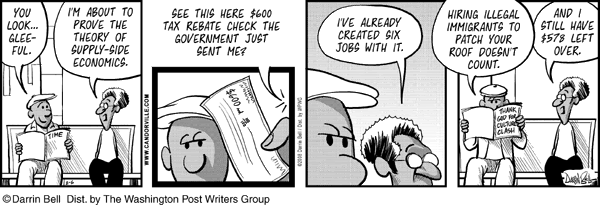
In US expectations are so low already that anything but outright collapse would be perceived as very positive thing and I wonder how many points those tax checks alone would add to GDP.
by MrBill » Tue 12 Feb 2008, 04:38:01
MOCKBA wrote:
$this->bbcode_second_pass_quote('', 'I') think keeping the peg or otherwise keeping the currency tied to USD is more likely scenario since it is the path of the least resistense and generally would create better perception of false prosperity. Moreover since world economy didn't come even close to decoupling from US (despite all the talking) it is close to imposible for Asian countries unless they would want to risk civil unrest and other upleasant things which at the end would negate all effects.
I think the informal Bretton Woods II agreement between America and her creditors is a defacto peg to the US dollar as the exports of goods and capital have to keep intervening to keep the value of their currencies export competitive with the US dollar.
If the US dollar is already weak then this just means the US dollar is weak against a basket of weak currencies instead of being weaker against a basket of currencies that are appreciating on a trade-weighted or PPP basis. This just exacerbates underlying inflationary pressures from excess money supply creation in those oil producing and Asian manufacturing countries.
Ironically, those exporters are therefore not even reaping the full benefits of their comparative advantage from trade. They have high domestic inflation - especially in asset prices - and they pay more for their own imports. And as they are exporting capital to the dollar zone (and eurozone) it means their own living standards are rising much slower due to a lack of domestic inward investment in infrastructure and development.
Of course, the time to address these global imbalances was when the world economy was strongly expanding. Now that a US lead slowdown and credit/banking crisis is hitting the US, UK, EU and sooner or later those Asian countries there will be even more reluctance to change the financial architecture already in place. This is the mechanism by which America can export contagion from its own housing implosion, banking crisis and impending recession.
Are there any winners out there? Perhaps only those developing countries that are producing the ag commodities and metals that are benefiting at the moment from US dollar inflation. However, looking at the weakness of the ZAR, for example, you would not guess it because those meager gains are offset by bureaucracy, incompetence and corruption - BIC Syndrome[sup]TM[/sup]. Not unlike in Russia itself! ; - )
The organized state is a wonderful invention whereby everyone can live at someone else's expense.
-

MrBill
- Expert

-
- Posts: 5630
- Joined: Thu 15 Sep 2005, 03:00:00
- Location: Eurasia
-