Donate Bitcoin

Donate Paypal


PeakOil is You

PeakOil is You

The Last Days of the Dollar?

Discussions about the economic and financial ramifications of PEAK OIL

Re: The Last Days of the Dollar?

Unread postby FoxV » Thu 07 Feb 2008, 17:23:42

10yr is spiking on this. Thought housing was going down. Wait till this starts hitting the sheeple's consciousness.

[web]http://ichart.finance.yahoo.com/w?s=%5ETNX[/web]


And the yield curve is still inverted so more rate cuts to come. I wonder if Ben is building any muscles from all the strings he's pushing on.

This by the way is extremely bad for gold and now is a good time to think about shorting (the current sucker's rally is making some good opportunities.

That was of course until the rally ended

[web]http://ichart.finance.yahoo.com/z?s=%5EDJI&t=1d&q=l&l=on&z=m&c=%5EGSPC,%5EIXIC&a=v&p=s[/web]

p.s.: hmm, a spike. Guess the market hasn't run out of suckers yet
Angry yet?
FoxV
Heavy Crude
Heavy Crude
 
Posts: 1321
Joined: Wed 02 Mar 2005, 04:00:00
Location: Canada

Re: The Last Days of the Dollar?

Unread postby seahorse2 » Thu 07 Feb 2008, 17:38:11

Can someone explain all of this. I understand the 30 yr bond auction didn't go well today, but what does that mean? Did the bonds not sell? Sell for less than expected? How does this affect yields of bonds?
User avatar
seahorse2
Expert
Expert
 
Posts: 2042
Joined: Mon 18 Oct 2004, 03:00:00

Re: The Last Days of the Dollar?

Unread postby roccman » Thu 07 Feb 2008, 17:48:02

$this->bbcode_second_pass_quote('seahorse2', 'C')an someone explain all of this. I understand the 30 yr bond auction didn't go well today, but what does that mean? Did the bonds not sell? Sell for less than expected? How does this affect yields of bonds?


$this->bbcode_second_pass_quote('', ' ')It means that the 30-year auction today was a bust and a near failure. Bid to cover ratio was 1.82 and the yield was 4.449, a big drop.

It means that few are buying 30-year treasuries.

This could mean many things:

-They think the rates will spike higher in the short term and are waiting to rotate.
-They think the .gov is going to bailout someone and that this will devalue .gov debt.
-They think the 30-yr is too risky and are putting it into the IRX or their mattress.


http://www.tickerforum.org/cgi-ticker/a ... 033&page=1
"There must be a bogeyman; there always is, and it cannot be something as esoteric as "resource depletion." You can't go to war with that." Emersonbiggins
User avatar
roccman
Light Sweet Crude
Light Sweet Crude
 
Posts: 4065
Joined: Fri 27 Apr 2007, 03:00:00
Location: The Great Sonoran Desert

Re: The Last Days of the Dollar?

Unread postby FoxV » Thu 07 Feb 2008, 18:54:08

Just to add to that, a quick Bond refresher...

Bonds are basically a loan you give to a company for a certain number of years. For the service of doing this, the company says they will pay you interest until the loan is due. No Problems there.

The tricky part comes in when you start talking about the chances of the company defaulting, or the effects of inflation, or both. This is where pricing comes and yields come in.

Lets say you lend a company $1000 for 5 years and there's a 5% chance of that company going bankrupt in that time. Then value of the bond is $950 (as an example). So you're obviously going to want something to compensate you for this possible loss. And that is where interest comes in.

If you're bond is going to be worth 5% less at the end of the 5 years then you're going to want an additional 1% in interest to make up for it.

That's the theory behind it. How it actually works in real life is they offer up a bond auction and say "Any Takers". If there are no takers then they reduce the price, but you still pay the full bond face value, so you ask for more interest to make up for it.

This is also where the "Bond Market Vigilantes" step in. If the bond market does not like the inflation/Risk that banks/fed/government are putting into the economy, then interest rates go up. This reduces inflation and risk because it makes borrowing money too expensive to buy things or take on new "adventures"

One of the reasons we have gotten into this mess is Greenspan's "Conundrum" where the bond market did not respond properly to the risks of the tech bubble (and subsequent housing bubble) and everyone got greedy and out of hand.

This "Conundrum" is a direct effect of derivatives (and why the Bond Market Vigilantes did not step in after the Tech collapse and stop the Fed rate from going below inflation). Under the guise of "shared risk" through derivatives, the bond market felt there was no risk in the economy so they didn't demand higher interest rates.

Now that the entire economy is flying apart at the seems, the Bond Market is noticing.

If the Treasury/Mortgage/Car loans/Credit card interest rates go up significantly this spells big time
D-E-F-L-A-T-I-O-N
And much more than in the 1930s because in the 1930s people still had savings to be able to spend. If interest rates go up now, North America is basically screwed because of the negative savings rate and no cushion till times get better.

btw, Long term I'm a big time Inflationist. However in the short term I believe we'll have a huge deflationary crash. But it will only last as long as it takes Ben to get the helicopters warmed up.

Anyways, sorry for the long post, but this is a HUGE development in the current collapse

P.S.: please correct me where I am wrong about how bonds work. I'm stretching my knowledge a bit
Angry yet?
FoxV
Heavy Crude
Heavy Crude
 
Posts: 1321
Joined: Wed 02 Mar 2005, 04:00:00
Location: Canada

Re: The Last Days of the Dollar?

Unread postby mattduke » Thu 07 Feb 2008, 22:28:05

$this->bbcode_second_pass_quote('BIS', '"')Virtually nobody foresaw the Great Depression of the 1930s, or the crises which affected Japan and Southeast Asia in the early and late 1990s. In fact, each downturn was preceded by a period of non-inflationary growth exuberant enough to lead many commentators to suggest that a 'new era' had arrived", said the bank.


$this->bbcode_second_pass_quote('', 'H')ayek, writing for the Austrian Institute of Economic Research Report in February 1929 predicted the economic downturn, stating that "the boom will collapse within the next few months."


$this->bbcode_second_pass_quote('', 'L')udwig von Mises also expected this financial catastrophe, and is quoted as stating "A great crash is coming, and I don't want my name in any way connected with it." [12] when he turned down an important job at the Kreditanstalt Bank in early 1929.
User avatar
mattduke
Intermediate Crude
Intermediate Crude
 
Posts: 3591
Joined: Fri 28 Oct 2005, 03:00:00
Top

Re: The Last Days of the Dollar?

Unread postby LoneSnark » Fri 08 Feb 2008, 02:12:28

FoxV, you completely forgot the time value of money. $1000 today is worth more than $1000 a year from now. So, even if the chance of default is zero you are still not going to be willing to pay face value for a bond.
User avatar
LoneSnark
Tar Sands
Tar Sands
 
Posts: 514
Joined: Thu 15 Nov 2007, 04:00:00

Re: The Last Days of the Dollar?

Unread postby MrBill » Fri 08 Feb 2008, 06:44:42

FoxV wrote:
$this->bbcode_second_pass_quote('', 'A')nd much more than in the 1930s because in the 1930s people still had savings to be able to spend. If interest rates go up now, North America is basically screwed because of the negative savings rate and no cushion till times get better.


I also see deflation, but not for the same reasons as you. I think there is more than enough global capital swirling around as evidenced by asset price bubbles around the world.

The problem as you correctly point out is that it is not controlled by those who need it the most to repay the debt on those over-priced assets.

Potential buyers of those distressed assets are going to want a big discount to existing prices before they agree to take the risk of ownership and/or the currency risk of holding US dollar assets.

Image

Lennar sold their property portfolio at a discount of 60% of its book value. Citgroup sold prefered shares at about 11% versus Libor at 5% or about 700 bps over interbank lending rates. MBIA got its cash infusion from selling shares at a 14% discount to its existing share price. So buyers are going to be demanding large incentives to compensate them for the risks.


Image

Also, there may be political problems as cash strapped companies turn to sovereign wealth funds (SWFs). But beggars cannot be choosers.

Image


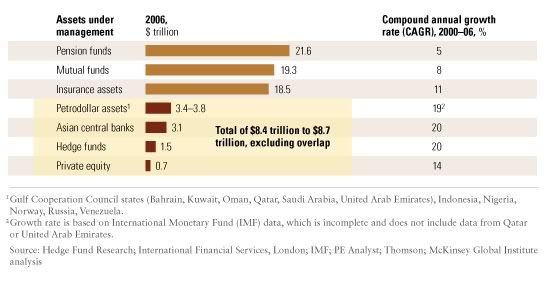
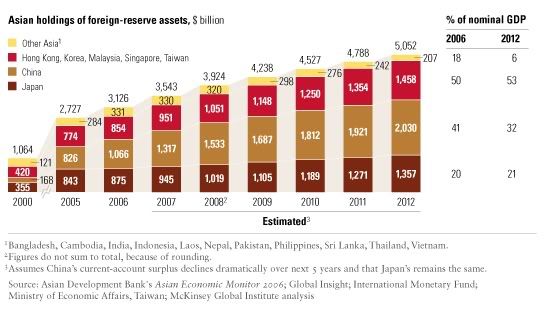
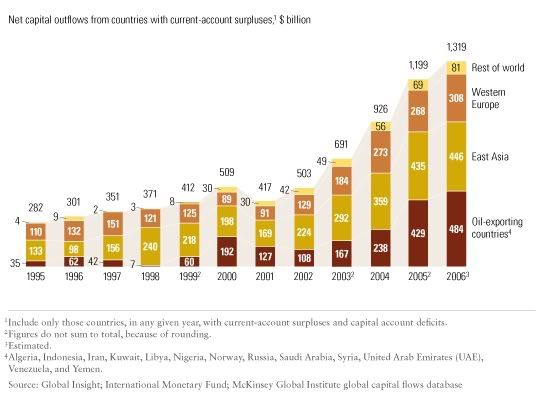
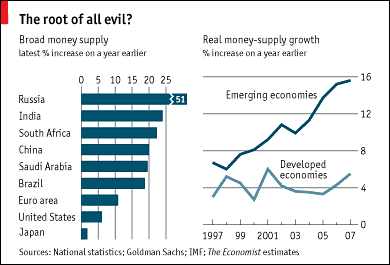
The net effect of running large budget and trade deficits has been a net wealth transfer from the USA as Consumer of Last Resort to oil producers and Asian manufacturers. That wealth was perversely been re-invested back into US dollar denominated assets that kept interest rates low including long bond yields.

However, due to currency weakness those oil producers and Asian manufacturers are less likely to accept more US dollar risk without proper compensation. Read higher real interest rates and a weaker US dollar.

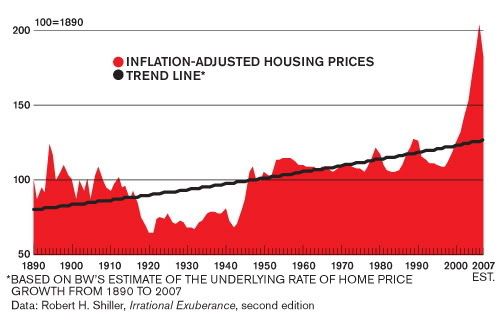
Therefore, the liquidity has not disappeared, so much as the underpricing of risk. The higher cost of capital will therefore spur deflation as those debts are serviced at higher real interest rates and/or asset prices fall as debtors walk away from their overpriced homes that have risen 70% in real inflation adjusted terms over the past two decades.


Image

The public policy response will be too cut interest rates and inject fiscal stimuli. That will only result in higher inflation for physical assets such as commodities, metals and energy. This will consume core incomes leaving less room for discretionary spending. Causing more asset price deflation as wages cannot keep up with rises in prices. The result between the two competing forces will be stagflation.

Image

The origin of global imbalances.
The organized state is a wonderful invention whereby everyone can live at someone else's expense.
User avatar
MrBill
Expert
Expert
 
Posts: 5630
Joined: Thu 15 Sep 2005, 03:00:00
Location: Eurasia
Top

Re: The Last Days of the Dollar?

Unread postby efarmer » Fri 08 Feb 2008, 16:18:05

Mr. Bill you have once again delivered a masterpiece. Aaron has set up
quite a forum, and it is great to be able to come out here and participate. And then there are these nuggets like your last post,
that are content that you might glean in esoteric and verbose form
in some place or another, but they are here in plain language and
beautiful terse format. Mr. Bill, Montequest, Pup55, and so many
more are laying down these fine works and they are mixed in with
the banter and other traffic and often missed I am sure. I sure wish there was a finest of PO blog, much like JD's debunker format, where you can send someone to sample the finest examples of the inventory
at peakoil.com There is some beautiful music coming out of all of
these jam sessions and it is world class. Kudos Mr. Bill.
User avatar
efarmer
Intermediate Crude
Intermediate Crude
 
Posts: 2003
Joined: Fri 17 Mar 2006, 04:00:00

Re: The Last Days of the Dollar?

Unread postby Fiddlerdave » Fri 08 Feb 2008, 17:22:10

Indeed. Elegant clarity in a concise summary. I often wish I had MrBill's work in a PDF to send to the clueless. God knows they'll never sign on to PO.com.


And thanks, Mattduke, for pointing out how the Bush's chronic excuse for hitting brick walls of "No one could have foreseen it coming" (as if it were moving instead of us madly speeding into it) by no means originated with his administration. The voices of weathermen and non-sycophant military advisers alike are ignored with regularity to keep the good times rolling against all hope.
User avatar
Fiddlerdave
Tar Sands
Tar Sands
 
Posts: 582
Joined: Sun 18 Mar 2007, 03:00:00

Re: The Last Days of the Dollar?

Unread postby mattduke » Fri 08 Feb 2008, 17:28:28

Peter Schiff's latest essay addresses what he calls "the mother of all bubbles", that is, US treasuries.

europac
User avatar
mattduke
Intermediate Crude
Intermediate Crude
 
Posts: 3591
Joined: Fri 28 Oct 2005, 03:00:00
Re: The Last Days of the Dollar?

Unread postby FoxV » Fri 08 Feb 2008, 18:41:19

$this->bbcode_second_pass_quote('MrBill', 'I') also see deflation, but not for the same reasons as you. I think there is more than enough global capital swirling around as evidenced by asset price bubbles around the world.

I think we are more in agreement than not. The lack of NA savings are only part of the reasons why the coming deflation will be worse.

but there is caveat in your statement about the swirling global capital. The big problem is that capital is both coming from and going to USD denominated assets.

From the examples you have given.

Lennar: property portfolio 60% of book value
Real Estate downturn is only beginning. Final price of portfolio 10% or less

Citgroup: Rescue by Dubai with 11% loan.
Chalked full of SIVs, derivatives, and subprime crap, Bankruptcy imminent. Chance Dubai gets its loan back 0%. Final price of assets 10% or less.

MBIA: selling shares at a 14% discount
Backs $600B of bonds including Municipalities with shrinking Tax bases and lots of CDO/MBS derivative crap. Loan Lost Reserves 1%? 2%?. Final price of assets ???

So as the Soverign funds step in with their huge bank roll of treasuries, they are A) using a toxic collateral to B) invest in toxic assets. The end results is that both will be worth 0 at the end of the day.

And as for the European banks. Well US banks have buried themselves in 25% of the $700Trillion pile of the derivatives crap. where doest that put the remaining 75%.

I think the deflation side of the things will hit hard and fast and the stagflation will only be for a short time while the global liquidity pool evaporates. At the end of the day all that will be left is Inflation Inflation Inflation.

Stagflation will be killed under a mountain of stimulus checks falling from helicopters all over the world

anyways, not trying to be argumentative. What I'm really wondering is what is your take on the above?
Angry yet?
FoxV
Heavy Crude
Heavy Crude
 
Posts: 1321
Joined: Wed 02 Mar 2005, 04:00:00
Location: Canada
Top

Re: The Last Days of the Dollar?

Unread postby LoneSnark » Fri 08 Feb 2008, 22:53:35

FoxV, all of your predictions appear to be unsound. Citigroup reported $3.62 billion dollars in post-write off profits in 2007; to suggest bankruptcy is imminent is rediculous. The financial fiasco has done nothing but reduce otherwise rediculous profit margins.

Similarly, while foreigners have a long track record of losing money in America, to suggest they are stupid enough to get none of their money back is similarly rediculous.

Similarly, we know how to fight inflation; we learned in the 1980s. To suggest policy makers have suddenly become incompetent lacks credibility.

We have evidence from Japan that the tools available may be insufficient to fight persistent deflation. But inflation is easily solved with the policy tools we have, the only question is whether we use them or not. And as the 70s and 80s demonstrate, both parties are willing to sacrifice their political careers to fight the inflation dragon (Carter and Reagan). That Reagan got credit and popularity was sheer luck; had the Fed. induced recession drug on into the election year he would not have kept office. And as he said, he was happy to do it.
User avatar
LoneSnark
Tar Sands
Tar Sands
 
Posts: 514
Joined: Thu 15 Nov 2007, 04:00:00

Re: The Last Days of the Dollar?

Unread postby cube » Sat 09 Feb 2008, 06:06:27

$this->bbcode_second_pass_quote('LoneSnark', '.')..
Similarly, we know how to fight inflation; we learned in the 1980s. To suggest policy makers have suddenly become incompetent lacks credibility.
....
Yes the central bank knows how to fight inflation. However knowing and doing are 2 completely different things. Ben Bernanke is NOT Paul Volcker!
Paul Volcker raised the fed funds rate to over 18% to reduce inflation
Ben Bernanke is doing the exact opposite...lowering interest rates
Image
cube
Intermediate Crude
Intermediate Crude
 
Posts: 3909
Joined: Sat 12 Mar 2005, 04:00:00
Top

Re: The Last Days of the Dollar?

Unread postby Ferretlover » Sat 09 Feb 2008, 11:06:23

It still looks like a bunch of people allowed their greed factor to overrule every hint of logic and responsibility, while telling the public one thing and doing another in the backroom.
Goodbye democracy, dollar and America.
Hello, New World Order/North American Union.

Of course, still struggling to understand Economics 101, I could be wrong...
"Open the gates of hell!" ~Morgan Freeman's character in the movie, Olympus Has Fallen.
Ferretlover
Elite
Elite
 
Posts: 5852
Joined: Wed 13 Jun 2007, 03:00:00
Location: Hundreds of miles further inland

Re: The Last Days of the Dollar?

Unread postby LoneSnark » Sat 09 Feb 2008, 12:06:45

But Ben Bernanke has read Paul Volcker's book. What more do you need?

And lowering interest rates when inflation is 3% is completely different from lowering interest rates when inflation is 12%.

Looking at your graph Paul Volker himself cut interest rates from time to time. Which is only logical: sometimes inflation is a serious risk, other times it is not.
User avatar
LoneSnark
Tar Sands
Tar Sands
 
Posts: 514
Joined: Thu 15 Nov 2007, 04:00:00

Re: The Last Days of the Dollar?

Unread postby CrudeAwakening » Sat 09 Feb 2008, 18:19:40

The Fed is not concerned with price inflation per se... it is only concerned with "bad" inflation, while it is more than happy to see "good" inflation (i.e. rising asset values) roar away unmolested.

The housing bubble was an example of simple price inflation, which Greenspan massaged by dropping interest rates like a stone.

The Fed is an inflation creating machine, being the ultimate source of money creation. They are more concerned about "inflation expectations" than inflation itself; after all, they are in the inflation business, that is what they do.
"Who knows what the Second Law of Thermodynamics will be like in a hundred years?" - Economist speaking during planning for World Population Conference in early 1970s
User avatar
CrudeAwakening
Tar Sands
Tar Sands
 
Posts: 834
Joined: Tue 28 Jun 2005, 03:00:00

Re: The Last Days of the Dollar?

Unread postby patience » Sun 10 Feb 2008, 10:54:44

I expect to set off a storm here, but I only want to get at the truth. Nor am I any kind of expert in this area, just trying to offer a digest of what I have read and believe to be the truth.

The best I have been able to learn, the FED does NOT set interest rates, it sets TARGETS, which it must "defend" with either increasing short term loans to banks, or less of them. That being the case, they end up following the interest rates that are actually set by supply and demand in the credit markets. The tail does not wag the dog. The FED is a bank, with a finite ability to supply money, which may be reaching its' limit, according to the recent news.

Definitions must be given here-deflation is a contraction of the money supply, and inflation is an increase in the money supply. Neither inflation, nor deflation, are caused by price changes, but rather, price changes are often the EFFECTS of them. The tail does not wag the dog here, either. Prices are the result of supply and demand of money supply vs goods supply. Money supply is the total of circulating cash and CREDIT. The amount of credit in the worldwide system dwarfs the amount of cash, by oreders of magnitude.

The supply of credit is contracting at an unprecedented rate, as the toxic investments brewed lately are failing and causing real losses of money to banks/investors. Because fractional reserve banking creates money, by originating credit (loaning money into existence), the reverse is also true, so money is destroyed when credit implodes as it is doing. Less money/credit=deflation. What happens to prices is an effect of less money, and tempered, or offset by, the supply of goods.

The scale of the current credit contraction is unprecedented, from which follows, a deflation of unprecedented scale. Governments and banks will obviously attempt everything in their powers to fight this, and delay,delay, delay it. I've seen credit-loss numbers quoted of many times the GDP of various countries, dwarfing their abilities to inject money to fight the contraction. That being the case, it is not a question of if, but when, and HOW we reach the bottom of this credit cycle. The actions of governments and central banks will define our course to the bottom.

That said, I presently believe that food and energy will remain costly relative to income, whatever the prices become, and am invested accordingly.

Please do not kill the messenger. I'm just quoting what I've read, primarily at Tickerforum.org, search posts by NOTHING, and GENESIS. I am not qualified to answer questions on this, but barely able to re-state their position. I hope I got it right, and I hope this adds something of value to the discussions here.
User avatar
patience
Resting in Peace
 
Posts: 3180
Joined: Fri 04 Jan 2008, 04:00:00

Re: The Last Days of the Dollar?

Unread postby patience » Sun 10 Feb 2008, 11:03:04

FWIW, I am 61, and the amount I've paid into SS notwithstanding, I don't expect to see much of that again. I expect to work until I die.

Will we see hyperinflation? I have no idea. I don't have enough to hedge against it anyway. I'll be fortunate to subsist on what little we have, using every trick learned from ancestors who survived the Great Depression. It is not a happy prospect for me, and even less so for the younger generations.
User avatar
patience
Resting in Peace
 
Posts: 3180
Joined: Fri 04 Jan 2008, 04:00:00

Re: The Last Days of the Dollar?

Unread postby sjn » Sun 10 Feb 2008, 11:58:52

$this->bbcode_second_pass_quote('patience', '
') The best I have been able to learn, the FED does NOT set interest rates, it sets TARGETS, which it must "defend" with either increasing short term loans to banks, or less of them. That being the case, they end up following the interest rates that are actually set by supply and demand in the credit markets. The tail does not wag the dog. The FED is a bank, with a finite ability to supply money, which may be reaching its' limit, according to the recent news.

Definitions must be given here-deflation is a contraction of the money supply, and inflation is an increase in the money supply. Neither inflation, nor deflation, are caused by price changes, but rather, price changes are often the EFFECTS of them. The tail does not wag the dog here, either. Prices are the result of supply and demand of money supply vs goods supply. Money supply is the total of circulating cash and CREDIT. The amount of credit in the worldwide system dwarfs the amount of cash, by oreders of magnitude.

The supply of credit is contracting at an unprecedented rate, as the toxic investments brewed lately are failing and causing real losses of money to banks/investors. Because fractional reserve banking creates money, by originating credit (loaning money into existence), the reverse is also true, so money is destroyed when credit implodes as it is doing. Less money/credit=deflation. What happens to prices is an effect of less money, and tempered, or offset by, the supply of goods. .

I think the critical point here is the differentiation of money/cash and credit. The fed deals in both. Credit is debt based, while money is either fiat (faith backed) or backed by some (scarce) commodity. The deflation we are observing is purely credit/debt based, the ability of the fed to create more credit is constrained by the willingness of market participants to take on further debt. This leaves monetization the only recourse if net deflation is to be avoided i.e printing more dollars.
User avatar
sjn
Elite
Elite
 
Posts: 1332
Joined: Wed 09 Mar 2005, 04:00:00
Location: UK
Top

Re: The Last Days of the Dollar?

Unread postby patience » Sun 10 Feb 2008, 13:11:48

sjn,
Yes indeed, that's what it looks like to me. The fly in the ointment then, is one of scale, that is, what the ratio of cash to credit means to this attempt.

The US economy is about 70% consumer spending, of an approximate $14 tril GDP, or $9.8 tril/yr.. The US consumer is said to be "tapped out", so burdened with debt that they can assume no more of it. The housing ATM is dead, etc. The underlying assets to consumer credit are devaluing. Thus, to stimulate the US economy alone, would require some major amount of money, compared to the US national debt of about $9 tril. Such a degree of spending would destroy the currency, right? Numbers I have seen regarding potential bank losses are many times these amounts, indicating that the finance system cannot be saved. Futile, or not, I'm sure the attempt will be made, only delaying the crash and adding to its' violence, per Mises.

Banks in the UK, Germany, and France are in the news this week, along with US bond insurers. The falling of dominoes, worldwide, cannot be far off.

If we assume TPTB are smart enough to see that this way lies collapse, then what do they choose? Granny's pension fund and Social Security get trashed, along with most of the Federal budget, or, let the banks swirl down the drains? If the answer turns out to be printing un-backed paper, (govt checks, or whatever) then inflation is a given, to the degree that it is done. Meanwhile, credit would be almost impossible to get for the poor. (In the 1930's, my uncle needed a co-signer to borrow 10% of the price of a farm, which he lost when a cannery went bankrupt, to whom he'd contracted a crop.)

So, is this what we are going to see, along with outrageous prices?

It looks to me like the banks are toast, no matter what, and we little folk will first give the banks all we have, through the govt, then starve along with the bankers.
User avatar
patience
Resting in Peace
 
Posts: 3180
Joined: Fri 04 Jan 2008, 04:00:00

PreviousNext

Return to Economics & Finance

Who is online

Users browsing this forum: No registered users and 0 guests

cron