Donate Bitcoin

Donate Paypal


PeakOil is You

PeakOil is You

The Last Days of the Dollar?

Discussions about the economic and financial ramifications of PEAK OIL

Re: The Last Days of the Dollar?

Unread postby FoxV » Fri 18 May 2007, 13:48:44

$this->bbcode_second_pass_quote('eXpat', 'I') think that the signs of a big economic crisis are clear for everyone to see,


I beg to differ on that. What I'm seeing these days is a "polarization" of reports where half the people are screeming "Duck and Cover" and the other half are screeming "Back up the Truck". (Primary source is financialsense.com, and Yahoo financial links).

and just to re-enforce that there's a report about of GLD is dumping its physical gold (causing the recent unexpected drops).

$this->bbcode_second_pass_quote('', 'B')ullion held by StreetTRACKS fell 16.6 tonnes, or more than 3 percent, to Thursday's 469.15 tonnes, which marked the level last seen in mid-February, compared with 485.8 tonnes on Tuesday.

(sorry no link, url button is not working for me)

February's sell of was margin covering in the wake of the Asian crash. However in light of all the recent LBO media, I'm suspecting this sell off is for cashing back into stocks.

As for companies making money in foreign countries, well, cheap labour and easy capital does not a good business make. I think the world is in for a pretty rude awakening when it realizes its just dumped trillions of dollars into Communist countries and Banana Repulics

(Received a company jacket recently and it had a Mynnamar label on it. I actually lost my breath for a moment. And don't get me started on the horror stories of calling "Customer Service" )
Angry yet?
FoxV
Heavy Crude
Heavy Crude
 
Posts: 1321
Joined: Wed 02 Mar 2005, 04:00:00
Location: Canada

Re: The Last Days of the Dollar?

Unread postby dr_doom » Sun 03 Jun 2007, 21:29:30

$this->bbcode_second_pass_quote('halcyon', '
')I'm afraid I lost you.

Both Marc Faber and Jeremy Grantham have said that even gold has been driven up by investors having an access to more money (markets awash with liquidity).

http://biz.yahoo.com/ts/070427/10353243.html
http://www.ameinfo.com/116367.html

Both anticipate corrections across ALL ASSET CLASSES (if you believe what they say), including gold and silver.


The liquidity point you bring up is also why the rig will not be able to continue long-term. At some point it will probably fail and the market will prevail to bring the price of gold to its true market value vs the dollar & other fiat currencies. Too much money chasing too little gold. Supply and demand.

I don't think gold can be usefully compared to other asset classes, like stocks and real-estate. While I believe there is probably also manipulation going on in these markets too I don't think it is as clear cut as with gold. The manipulators in the market & the media in recent years have IMO been trying to create the appearance of a link between the stock-market & gold. To be honest I think this is to reassure people they shouldn't be moving their wealth into gold, i.e. keep demand down.


$this->bbcode_second_pass_quote('', '
')Can you explain to us, why it didn't become detached from gold?

Central banks have been offloading gold by large numbers with the most recent long gold upward run.

Don't you think they would have hold on to them, in a situation of high monetary inflation and high gold prices, IF gold had such an important position?

Can you explain why they would sell if the currencies were attached to gold (which none of the currencies are NOT, of course)?

Can you explain BY WHICH MECHANISM is dollar (or any other currencies) attached to gold (through the central banking system)?


The gist of what you're asking here seems to be, why the hell would they want to sell something they have a lot of, when its price is going up, and should continue going up.

It's a bit of a mindbender, but the best quote I have heard which explains it is this, straight from a GATA speaker:

"the power to issue what is used as money is infinitely more important than the price of a portfolio asset".

Basically no national currency is linked to gold anymore. The USD after WW2 was a gold standard, hence central banks around the world would no longer have to keep gold on reserve, they could keep dollars. Until 1973 that is. And then the dollar became the oil-standard at roughly the same time, but the gold price was giving the game away, so they got onto bringing it down around 1980.

If a country did have a gold-standard, i see no reason why it would need to sell gold to keep the price down.


$this->bbcode_second_pass_quote('', '
')Can you explain:

- Why would they want to keep the price down?
- Why is not the gold selling move just another profit move (great bull run, let's sell gold and find stability levers through other means)?

This is how it has been historically, afaik. Oil price and gold price have been fairly tightly linked, because high oil price has been an inflation trigger and gold has been seen as an inflation hedge. Historical market psychology, esp. during the 70s.

But why would central banks want to bring the price of gold down? Gold price run is not monetary/CPI inflation. They want to adjust inflation/liquidity, not gold price. Can you explain how gold affects either of these?


The reason why gold is a good store of wealth is that it is scarce, and the rate of supply increase is fairly stable. The same cannot be said for paper currencies which are constantly being inflated by CBs, causing inflation.

The gold price needs to be kept down because it exposes what the CBs have done to the value of our paper money. You will notice in schools there is scarce mention of what the basis of money is, the history of money, etc. The great depression is often taught as being caused by too little money, because of a gold-standard. This is a lie.
User avatar
dr_doom
Wood
Wood
 
Posts: 34
Joined: Sun 26 Mar 2006, 04:00:00
Top

Re: The Last Days of the Dollar?

Unread postby evilgenius » Mon 04 Jun 2007, 06:11:06

I think the biggest reason to be into gold is the faith the people place in gold. Because of the people's faith central banks are not going to want to be seen selling in down crises. They are, however, always able to sell at other times. Gold might go up in the long term given inflation but most people aren't into the long term. Keynes said, "In the long term I'll be dead". That about sums up the long term when you are referring to gold. It makes a good familial investment, not a good personal one. That is unless there is a crisis.

Many on this thread are expecting a crisis. If it does come you might not want to be into physical gold. Silver is better for buying and selling. Where you might want to be regarding gold is in the miners. They will see a real upswing, those able to respond, precisely because if the crisis is bad enough all that they have in reserve gets reevaluated along with the current income stream. Mind you the capricious nature of this kind of speculation makes it hard to make very much money if you don't get out in time. Basically if you get stuck oil is a better place to be because it tends to come back around and put you back into the money before your children grow up.
When it comes down to it, the people will always shout, "Free Barabbas." They love Barabbas. He's one of them. He has the same dreams. He does what they wish they could do. That other guy is more removed, more inscrutable. He makes them think. "Crucify him."
User avatar
evilgenius
Intermediate Crude
Intermediate Crude
 
Posts: 3730
Joined: Tue 06 Dec 2005, 04:00:00
Location: Stopped at the Border.

Re: The Last Days of the Dollar?

Unread postby MrBill » Mon 04 Jun 2007, 08:43:18

Keeping in mind this snapshot of the US economy comes from a S. African bank, and they know a little something about currency devaluation and volatility from experience. But take it for what its worth. Cheers.

$this->bbcode_second_pass_quote('', ' ') Consumption and job growth holding up, but inflation pressures remain subdued

The bond market has overreacted to this morning’s data. The most important information to be gleaned from today’s many reports is the following: the suggestion, based on March data, that US consumption might finally be succumbing to pressures from the housing market has not been reinforced in the April report on personal income and outlays. There is to date, therefore, no evidence of a ‘wealth effect’ from home prices to households’ propensity to spend. This can be readily explained by the offsetting impact of appreciating equities, which benefit most Americans, if only through their 401k plans.

At the same time, there is no evidence of rising inflationary pressure, despite the stability at a very low level (4.5%) of the unemployment rate and the ongoing gasoline price surge. Except for construction employment (for which there was no change in April), none of today’s indicators bore directly on the housing slump, leaving intact our expectation that new residential construction will remain depressed, leaving US economic growth positive, but at a subpar rate.

Because consumers have ignored the housing slump, Standard has been too optimistic in its UST yield projections for mid-year; these will be adjusted upward. However, longer term yields at current levels make sense only in the context of either 1) a fairly substantial upward revision in longer term inflation expectations, 2) an enhanced inclination on the part of non-US central banks (and perhaps other investors) to shed longer-term US dollar debt in favour of debt denominated in currencies now appreciating against the dollar.

We see no basis for the former and little evidence so far of the latter (admittedly, this can readily change).
Accordingly we are inclined to leave unchanged our year-end UST projections, which imply UST price appreciation between now and year-end. For the bond market reassessment we expect, we cite as precedent the sell-off of late 2006/early 2007, which looked unstoppable at the time, but was quickly unwound in February.

Consumption spending is holding up. In our view, national accounts data for Q2:07 (not available until late July) will almost certainly show a deceleration from the 4.4% real consumption growth of Q1:07; that will be due to the erosion of real incomes by higher gasoline prices and should not be seen as a change of trend. Monthly real consumption had been unchanged from February to March, leading to speculation (ours included) that the wealth effect might finally be operative, but has rebounded with a 0.2% increase in April. This is not much, but enough to banish the housing contagion story --- at least for the moment.

Even more revealing is the fact that nominal consumption expenditures rose a monthly 0.5% in April, not sensational, but again strong enough, annualising to 6.7%. Consumers appear to be bearing the gasoline price increases without cutting back too much on other items.

Personal and disposable incomes and labour compensation for the first four months of the year have been distorted by a technical factor, precluding month-by-month comparison, even though the data are seasonally adjusted. To abstract from that, we looked at year-over-year growth of these measures for the first four months of the year as a whole. They posted nominal growth rates of 5.9%, 5.5% and 5.3%, respectively, all faster than nominal GDP growth of about 4.6%. It does not appear that incomes are being squeezed.
And household saving (or rather the lack thereof) from those incomes appears unfazed by the home price slump.
In the first four months of 2007, households dissaved 1.0% of their disposable income (ie, consumption exceeded such income), the same rate that was seen in the last four months of 2006.

The two most important inflation indicators appearing today were the April changes in hourly earnings and in core (ie, ex-food and energy) PCE prices, the latter a measure of consumer inflation preferred by the Fed to the CPI (which is always released earlier). The former rose an unexceptional 0.3% and the latter a very gratifying 0.1%. (Due to gasoline price increases, of course, headline inflation was higher at 0.3%.) Given the stability of the labour market and the apparent recovery of non-residential investment from the Q4:06 correction (easing any potential strain on productive capacity), inflationary pressures do not appear to be building. The score of 71 for prices in the ISM manufacturing survey is much higher than early in the year, but lower than in April. The report bears only on the factory sector. Moreover, the series is not seasonally adjusted and so provides little additional information about price trends in the month just past.

Today’s bond market sell-off has been affected disproportionately by the day’s most prominent headline, the 157K monthly job increase when only 132K was expected. To put this in perspective, we remind the reader that this amounts to a mere 0.1% monthly increase in employment, 1.4% if annualised. Joined to the stability of the unemployment rate, we cannot say that the labour market is tauter than in March, only that it has not slackened.

The ISM manufacturing survey overall score of 55 was higher than the market expectation of 54, but not high enough to warrant a reassessment of the factory sector. Our view remains that manufacturing has averted an outright recession, is recovering and will continue to do so, but at a modest pace, ie, one not conducive to higher overall inflation. The final University of Michigan survey of consumer confidence for May was slightly below the preliminary reading, slightly above expectations and generally in line with the consumer behaviour described above. It was not a market mover. Today’s data have not affected Standard’s forecast for annual US GDP growth in 2007, which remains at 2.2%.


Source: ResearchStrategy@Standardbank.com

$this->bbcode_second_pass_quote('', 'l')onger term yields at current levels make sense only in the context of either 1) a fairly substantial upward revision in longer term inflation expectations, 2) an enhanced inclination on the part of non-US central banks (and perhaps other investors) to shed longer-term US dollar debt in favour of debt denominated in currencies now appreciating against the dollar.

We see no basis for the former and little evidence so far of the latter (admittedly, this can readily change).


So there may be a tipping point for the US dollar, but they just do not see it now in the context of a housing lead slow down or a mass exodus out of the US dollars based on narrowing interest rate differentials between the USD and the EUR for example.

Anecdotally, EURJPY seems to be taking the lion's share of revaluation at the moment hitting another high of 164.06 on the back of a weaker yen and stronger euro. That despite another drop in Chinese equities today that seems to be having a diminishing impact on other markets, unlike in February where they caused an across the board sell-off and some unwinding of the yen carry trade at the time.
The organized state is a wonderful invention whereby everyone can live at someone else's expense.
User avatar
MrBill
Expert
Expert
 
Posts: 5630
Joined: Thu 15 Sep 2005, 03:00:00
Location: Eurasia
Top

Re: The Last Days of the Dollar?

Unread postby eXpat » Mon 25 Jun 2007, 17:31:29

The Bank for International Settlements joins the chorus warning for an economic crash link

$this->bbcode_second_pass_quote('', 'T')he Bank for International Settlements, the world's most prestigious financial body, has warned that years of loose monetary policy has fuelled a dangerous credit bubble, leaving the global economy more vulnerable to another 1930s-style slump than generally understood.
"I learned long ago, never to wrestle with a pig. You get dirty, and besides, the pig likes it."
George Bernard Shaw

You can ignore reality, but you can't ignore the consequences of ignoring reality.” Ayn Rand
User avatar
eXpat
Intermediate Crude
Intermediate Crude
 
Posts: 3801
Joined: Thu 08 Jun 2006, 03:00:00
Top

Re: The Last Days of the Dollar?

Unread postby MrBill » Fri 29 Jun 2007, 04:40:46

$this->bbcode_second_pass_quote('eXpat', 'T')he Bank for International Settlements joins the chorus warning for an economic crash link

$this->bbcode_second_pass_quote('', 'T')he Bank for International Settlements, the world's most prestigious financial body, has warned that years of loose monetary policy has fuelled a dangerous credit bubble, leaving the global economy more vulnerable to another 1930s-style slump than generally understood.


Thanks for that excellent link eXpat. There is so much important information contained in that short article that I am going to post it here in full just in case the link disappears as often happens. (And in case some were too lazy to click on it) ; - ) I think it is a concise discription of where we find ourselves at the present. It neatly changes the argument 'that America has a problem' to 'the world has a problem' that it cannot easily solve. Thanks again.

$this->bbcode_second_pass_quote('', 'B')IS warns of Great Depression dangers from credit spree


The Bank for International Settlements, the world's most prestigious financial body, has warned that years of loose monetary policy has fuelled a dangerous credit bubble, leaving the global economy more vulnerable to another 1930s-style slump than generally understood.

"Virtually nobody foresaw the Great Depression of the 1930s, or the crises which affected Japan and Southeast Asia in the early and late 1990s. In fact, each downturn was preceded by a period of non-inflationary growth exuberant enough to lead many commentators to suggest that a 'new era' had arrived", said the bank.

The BIS, the ultimate bank of central bankers, pointed to a confluence a worrying signs, citing mass issuance of new-fangled credit instruments, soaring levels of household debt, extreme appetite for risk shown by investors, and entrenched imbalances in the world currency system.

advertisement"Behind each set of concerns lurks the common factor of highly accommodating financial conditions. Tail events affecting the global economy might at some point have much higher costs than is commonly supposed," it said.

The BIS said China may have repeated the disastrous errors made by Japan in the 1980s when Tokyo let rip with excess liquidity.

"The Chinese economy seems to be demonstrating very similar, disquieting symptoms," it said, citing ballooning credit, an asset boom, and "massive investments" in heavy industry.

Some 40pc of China's state-owned enterprises are loss-making, exposing the banking system to likely stress in a downturn.

It said China's growth was "unstable, unbalance, uncoordinated and unsustainable", borrowing a line from Chinese premier Wen Jiabao

In a thinly-veiled rebuke to the US Federal Reserve, the BIS said central banks were starting to doubt the wisdom of letting asset bubbles build up on the assumption that they could safely be "cleaned up" afterwards - which was more or less the strategy pursued by former Fed chief Alan Greenspan after the dotcom bust.

It said this approach had failed in the US in 1930 and in Japan in 1991 because excess debt and investment build up in the boom years had suffocating effects.

While cutting interest rates in such a crisis may help, it has the effect of transferring wealth from creditors to debtors and "sowing the seeds for more serious problems further ahead."

The bank said it was far from clear whether the US would be able to shrug off the consequences of its latest imbalances, citing a current account deficit running at 6.5pc of GDP, a rise in US external liabilities by over $4 trillion from 2001 to 2005, and an unprecedented drop in the savings rate. "The dollar clearly remains vulnerable to a sudden loss of private sector confidence," it said.

The BIS said last year's record issuance of $470bn in collateralized debt obligations (CDO), and a further $524bn in "synthetic" CDOs had effectively opened the lending taps even further. "Mortgage credit has become more available and on easier terms to borrowers almost everywhere. Only in recent months has the downside become more apparent," it said.

CDO's are bond-like packages of mortgages and other forms of debt. The BIS said banks transfer the exposure to buyers of the securities, giving them little incentive to assess risk or carry out due diligence.

Mergers and takeovers reached $4.1 trillion worldwide last year.

Leveraged buy-outs touched $753bn, with an average debt/cash flow ratio hitting a record 5.4.

"Sooner or later the credit cycle will turn and default rates will begin to rise," said the bank.

"The levels of leverage employed in private equity transactions have raised questions about their longer-term sustainability. The strategy depends on the availability of cheap funding," it said.

That may not last much longer.

Source: http://www.telegraph.co.uk
25/06/2007
The organized state is a wonderful invention whereby everyone can live at someone else's expense.
User avatar
MrBill
Expert
Expert
 
Posts: 5630
Joined: Thu 15 Sep 2005, 03:00:00
Location: Eurasia
Top

Re: The Last Days of the Dollar?

Unread postby seahorse » Fri 29 Jun 2007, 09:18:43

Yesterday, the CEO of Goldman Sachs said "the world is less risky today" but then added, jokingly, "nervous is my resting position."
Just remember, many serious things are said in jest.

Yahoo News
User avatar
seahorse
Expert
Expert
 
Posts: 2275
Joined: Fri 15 Oct 2004, 03:00:00
Location: Arkansas

Re: The Last Days of the Dollar?

Unread postby eXpat » Fri 29 Jun 2007, 19:22:24

Thank you MrBill, to be honest I find the news to be more ominous every day, I have the feeling that big s**it is coming to us, and I don't like it a little bit :(
"I learned long ago, never to wrestle with a pig. You get dirty, and besides, the pig likes it."
George Bernard Shaw

You can ignore reality, but you can't ignore the consequences of ignoring reality.” Ayn Rand
User avatar
eXpat
Intermediate Crude
Intermediate Crude
 
Posts: 3801
Joined: Thu 08 Jun 2006, 03:00:00

Re: The Last Days of the Dollar?

Unread postby eXpat » Tue 25 Dec 2007, 08:52:20

Interesting article in the Asian Times that predicts that in 2008 most Asian countries will abandon their pegs to the Us dollar, link

$this->bbcode_second_pass_quote('', 'T')he second path of impact for Asian borrowers is that as their local banks lose billions on the US financial system, their natural tendency to tighten up standards would likely cause hardships to the average borrower, either through lower credit limits or higher cost of borrowings. Asian banks, unlike their US and European counterparts, tend not to distribute their risk, which means the impact of localized losses can be quite high, in turn triggering a tightening in credit conditions.

Thirdly, it is now inevitable that Asian countries will loosen or abandon their pegs to the US dollar over the course of 2008. Their battle with inflation lost comprehensively, (Inflation - China's lost battle Asia Times Online, December 15, 2007) governments around the region have no choice but to get more aggressive on their monetary conditions, which cannot be accomplished when their currencies remain pegged to the US dollar.
User avatar
eXpat
Intermediate Crude
Intermediate Crude
 
Posts: 3801
Joined: Thu 08 Jun 2006, 03:00:00
Top

Re: The Last Days of the Dollar?

Unread postby MrBill » Tue 25 Dec 2007, 10:02:01

$this->bbcode_second_pass_quote('eXpat', 'I')nteresting article in the Asian Times that predicts that in 2008 most Asian countries will abandon their pegs to the Us dollar, link

$this->bbcode_second_pass_quote('', '
')Thirdly, it is now inevitable that Asian countries will loosen or abandon their pegs to the US dollar over the course of 2008. Their battle with inflation lost comprehensively, (Inflation - China's lost battle Asia Times Online, December 15, 2007) governments around the region have no choice but to get more aggressive on their monetary conditions, which cannot be accomplished when their currencies remain pegged to the US dollar.


The interesting part about the informal Bretton Woods II agreement between the US (and increasingly EU) and its creditors is that it is mutually re-inforcing.

That is not to say that it cannot end. But, of course, ending it in 2008 would logically cause the value of the US dollar to plummet just as the real US economy is headed into a housing and credit lead recession in any case. That means Asian manufacturers would suffer a triple whammy. Whammy is a technical term, but bear with me.

First their US dollar holdings would plummet in value. As they have offsetting liabilities against those dollar assets they suffer a whole in their collective balance sheets.

Second, with a weaker dollar and weak US economy the States would be forced to import less. That means less exports from Asia.

Then thirdly, a loss in value against the US dollar means these Asian currencies must rise in real terms. That weakens their external competitiveness. Lower exports mean less growth, and in the case of China with new workers coming into the employment market every month, higher unemployment.

Feeling any better about 'no global contagion' spreading from a US lead slowdown, yet? ; - )
The organized state is a wonderful invention whereby everyone can live at someone else's expense.
User avatar
MrBill
Expert
Expert
 
Posts: 5630
Joined: Thu 15 Sep 2005, 03:00:00
Location: Eurasia
Top

Re: The Last Days of the Dollar?

Unread postby eXpat » Tue 25 Dec 2007, 12:24:18

I have a question MrBill, do you consider that is likely that 2008 will be the year that most countries will start ditching the dollar in favour of a basket of currencies or maybe the Euro? it seems to be that enough momentum is gathering already...
User avatar
eXpat
Intermediate Crude
Intermediate Crude
 
Posts: 3801
Joined: Thu 08 Jun 2006, 03:00:00

Re: The Last Days of the Dollar?

Unread postby Euric » Tue 25 Dec 2007, 13:10:09

$this->bbcode_second_pass_quote('MrBill', '')$this->bbcode_second_pass_quote('eXpat', 'I')nteresting article in the Asian Times that predicts that in 2008 most Asian countries will abandon their pegs to the Us dollar, link

$this->bbcode_second_pass_quote('', '
')Thirdly, it is now inevitable that Asian countries will loosen or abandon their pegs to the US dollar over the course of 2008. Their battle with inflation lost comprehensively, (Inflation - China's lost battle Asia Times Online, December 15, 2007) governments around the region have no choice but to get more aggressive on their monetary conditions, which cannot be accomplished when their currencies remain pegged to the US dollar.


The interesting part about the informal Bretton Woods II agreement between the US (and increasingly EU) and its creditors is that it is mutually re-inforcing.

That is not to say that it cannot end. But, of course, ending it in 2008 would logically cause the value of the US dollar to plummet just as the real US economy is headed into a housing and credit lead recession in any case. That means Asian manufacturers would suffer a triple whammy. Whammy is a technical term, but bear with me.

First their US dollar holdings would plummet in value. As they have offsetting liabilities against those dollar assets they suffer a whole in their collective balance sheets.

Second, with a weaker dollar and weak US economy the States would be forced to import less. That means less exports from Asia.

Then thirdly, a loss in value against the US dollar means these Asian currencies must rise in real terms. That weakens their external competitiveness. Lower exports mean less growth, and in the case of China with new workers coming into the employment market every month, higher unemployment.

Feeling any better about 'no global contagion' spreading from a US lead slowdown, yet? ; - )


Any way you look at it, they are damned if they do and damned if they don't. If the present situation brings on high inflation, then the Asians will have to charge more for their products they sell to the US. Their inflation will be passed on to the US consumer, which will make a present economic mess in the US even worse.

One way or another something will give. Hopefully they will be able to find other markets for their products to make up for a loss from the US. There are over 6.5 milliard people (consumers) worldwide with only 300 million in the US. The US represents less then 5 % of the world's population.

It would be in the best interest of the other 95 % of the world's consumers and producers to buy each other's goods so they don't have to worry about a loss of business when the US tanks.
User avatar
Euric
Tar Sands
Tar Sands
 
Posts: 622
Joined: Sat 04 Dec 2004, 04:00:00
Top

Re: The Last Days of the Dollar?

Unread postby MrBill » Wed 26 Dec 2007, 05:46:11

$this->bbcode_second_pass_quote('eXpat', 'I') have a question MrBill, do you consider that is likely that 2008 will be the year that most countries will start ditching the dollar in favour of a basket of currencies or maybe the Euro? it seems to be that enough momentum is gathering already...


If the US goes into a recession than the rationale for holding US dollar assets is diminished except for perhaps the stocks of American companies that earn a significant portion of their overall revenues outside of the USA or are major exporters. Especially those that are selling into the faster growing Asian market and/or the ME oil producing nations.

Image


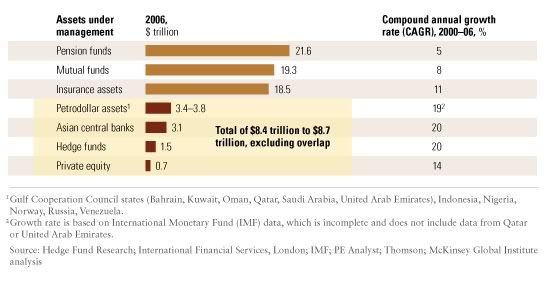
Some GCC oil producers are investing their not so insignificant export revenues in non-financial assets, so they are devilish hard to track except through anecdotal evidence. I plan a trip to Dubai and Abu Dhabi in 2008 to find out exactly where these investors favor. I do know that hundreds of millions of US dollars have been invested into real-estate in places like Montenegro as well as here in Cyprus, but even those large block investments are just a drop in the proverbial bucket versus to the wall of money that needs to be invested somewhere outside the Gulf.

Euric wrote:
$this->bbcode_second_pass_quote('', ' ')Any way you look at it, they are damned if they do and damned if they don't. If the present situation brings on high inflation, then the Asians will have to charge more for their products they sell to the US. Their inflation will be passed on to the US consumer, which will make a present economic mess in the US even worse.

One way or another something will give. Hopefully they will be able to find other markets for their products to make up for a loss from the US. There are over 6.5 milliard people (consumers) worldwide with only 300 million in the US. The US represents less then 5 % of the world's population.

It would be in the best interest of the other 95 % of the world's consumers and producers to buy each other's goods so they don't have to worry about a loss of business when the US tanks.


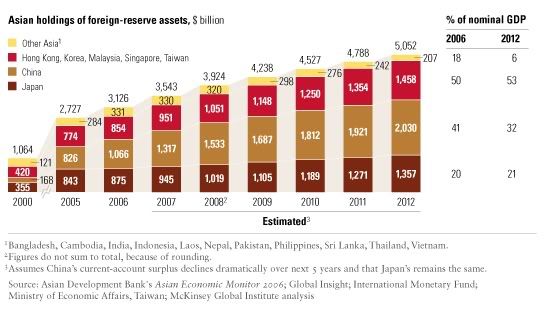
I tend to agree, but outside of western Europe and N. America the absolute size of purchasing power declines drastically. Throw in a few countries like Australia and a few rich Gulf states that have compartively small populations and this total market segment is about one billion consumers give or take. The other five and a half billion are not insignificant, but they cannot make up for a drop in rich world consumption.

Image


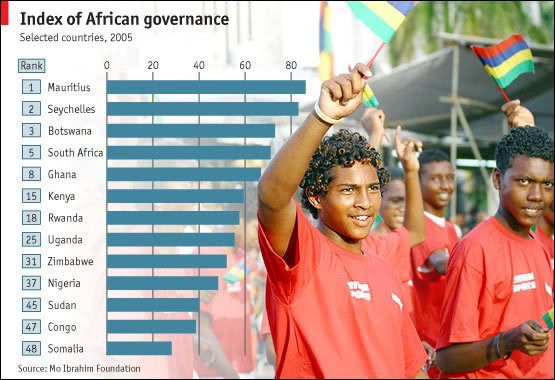
And, ironically, these under-developed nations like those in Africa that should be benefiting from higher commodity prices will run smack into China as the world's low cost producer. That means it is very hard for them to diversify from being hewers of wood and drawers of water.

If the US slips into a recession and UK and EU growth slows then I would expect China to drop prices and try to make up for a loss of margins with volume. China Inc. runs a jobs only economic policy. Short-term profitability is not an issue. Especially not ahead of the Beijing Olympics next summer. Therefore, in a worldwide slowdown I would expect China to be exporting deflation that would exacerbate manufacturing woes abroad.

China has implemented some hefty export taxes on steel and other semi-finished goods. I think that is to cut their import bill, slow inflationary growth and cool speculation, but also they may realize that all that excess capacity would be a real drain should the rest of the world slowdown. Deflationary as I said above.

In such a situation with a slowdown in the USA, a weaker US dollar curbing non-energy imports and excess capacity in China it would be extremely difficult for them to pass along higher input prices to the final consumer. Especially if any real appreciation in the renminbi would make other Asian manufacturers more competitive at the same time.

Image


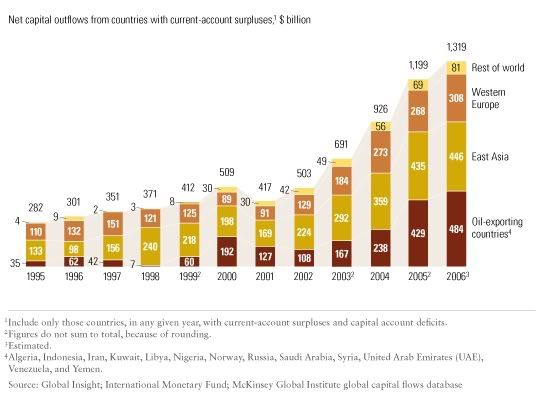
When I add the two sides together it points to stagflation where there is low, slow or no growth in the US economy, while due to a weaker US dollar and growth elsewhere that we see higher nominal prices for energy, metals and commodities. That inflation could be made worse if the US were to adopt looser monetary and fiscal policies in response to the domestic housing lead slowdown. We might even see a return to the US dollar carry trade. Borrowing in US dollars to invest them elsewhere. That would put even more downward pressure on the US dollar. While a strong euro would hurt European manufacturing even more.


Image

So yes, I think there is a desire to diversify away from the US dollar, and out of concerns for inflation to drop US dollar currency pegs, but exporters still have to find a home for their export receipts. Enter the emerging markets that could benefit handsomely from such a switch in capital flows, but only if they prove they can absorb those flows productively.

Image

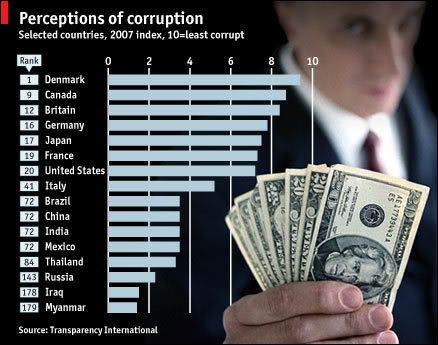
There is a good growth story in emerging markets that benefit from higher energy, metals and commodity prices, but it is partially offset by concerns of bureacracy, incompetence and corruption - BIC Syndrome [sup]TM[/sup]. ME and Asian investors may have a stronger stomach for doing deals in these countries, but they still want to protect their capital. While a weak US dollar may make US stocks all the more attractive. So expect more take-overs to be announced in 2008 as well.

BIC Syndrome:
$this->bbcode_second_pass_quote('', 'M')alaysia's drive to woo investment is losing traction, as efforts to get rid of red tape and inept bureaucrats falter, threatening to put it further behind neighboring Singapore.

A year after the authorities vowed to speed up the business approval process, businessmen are still battling unwieldy procedures and inert government staff.


source: Malaysia's stalling reform threatens investment


UPDATE:
$this->bbcode_second_pass_quote('', 'A')n expanding foreign appetite for capital goods such as tractors, medical equipment and electrical machinery is driving much of the boom. Much of that growth is in China, the fourth-largest export market for U.S. goods, where U.S. sales are growing 17 percent this year, according to federal officials. In the first nine months of this year, sales of U.S. aircraft to China are up 30 percent and plastics are up 37 percent.

Source: Companies Finding Markets Overseas For Niche Items
The organized state is a wonderful invention whereby everyone can live at someone else's expense.
User avatar
MrBill
Expert
Expert
 
Posts: 5630
Joined: Thu 15 Sep 2005, 03:00:00
Location: Eurasia
Top

Re: The Last Days of the Dollar?

Unread postby eXpat » Thu 27 Dec 2007, 07:47:15

Thank you for the answer MrBill you gave me a lot to think about...
User avatar
eXpat
Intermediate Crude
Intermediate Crude
 
Posts: 3801
Joined: Thu 08 Jun 2006, 03:00:00

Re: The Last Days of the Dollar?

Unread postby MrBill » Thu 27 Dec 2007, 09:38:06

$this->bbcode_second_pass_quote('eXpat', 'T')hank you for the answer MrBill you gave me a lot to think about...


Thanks its my job. I am being paid by the CIA and FSB as well as others like the TPPT, so don't worry! ; - )
The organized state is a wonderful invention whereby everyone can live at someone else's expense.
User avatar
MrBill
Expert
Expert
 
Posts: 5630
Joined: Thu 15 Sep 2005, 03:00:00
Location: Eurasia
Top

Re: The Last Days of the Dollar?

Unread postby eXpat » Thu 27 Dec 2007, 18:49:59

$this->bbcode_second_pass_quote('MrBill', '')$this->bbcode_second_pass_quote('eXpat', 'T')hank you for the answer MrBill you gave me a lot to think about...


Thanks its my job. I am being paid by the CIA and FSB as well as others like the TPPT, so don't worry! ; - )


Ahh, in that case i want the precise date of the stock crash in 2008 if you don't mind.. :)
Happy New Year by the way! and to everybody in the forum!
User avatar
eXpat
Intermediate Crude
Intermediate Crude
 
Posts: 3801
Joined: Thu 08 Jun 2006, 03:00:00
Top

Re: The Last Days of the Dollar?

Unread postby MrBill » Fri 28 Dec 2007, 04:38:08

$this->bbcode_second_pass_quote('eXpat', '')$this->bbcode_second_pass_quote('MrBill', '')$this->bbcode_second_pass_quote('eXpat', 'T')hank you for the answer MrBill you gave me a lot to think about...


Thanks its my job. I am being paid by the CIA and FSB as well as others like the TPPT, so don't worry! ; - )


Ahh, in that case i want the precise date of the stock crash in 2008 if you don't mind.. :)
Happy New Year by the way! and to everybody in the forum!


Sell in May, go away! Happy Holidays to everyone as well. I am gone until mid-January, so try to behave yourselves! ; - )
The organized state is a wonderful invention whereby everyone can live at someone else's expense.
User avatar
MrBill
Expert
Expert
 
Posts: 5630
Joined: Thu 15 Sep 2005, 03:00:00
Location: Eurasia
Top

Re: The Last Days of the Dollar?

Unread postby emersonbiggins » Thu 07 Feb 2008, 16:19:18

USD index on a tear right now, up to about 77, off lows of 74~ish.

INO USD index
"It's called the American Dream because you'd have to be asleep to believe it."

George Carlin
User avatar
emersonbiggins
Expert
Expert
 
Posts: 5150
Joined: Sun 10 Jul 2005, 03:00:00
Location: Dallas

Re: The Last Days of the Dollar?

Unread postby roccman » Thu 07 Feb 2008, 16:42:50

$this->bbcode_second_pass_quote('emersonbiggins', 'U')SD index on a tear right now, up to about 77, off lows of 74~ish.

INO USD index


Ahhhhhhhhhhhhhhhh...

But the bodies in the basement are beginning to rot and that smell is creaping into the Treasury market...

Won't be long now...got bunker?

Time to short the gov?

$this->bbcode_second_pass_quote('', 'F')eb. 7 (Bloomberg) -- U.S. 30-year Treasuries fell the most since June as demand was weaker than expected at the government's $9 billion auction of the securities.


Link
"There must be a bogeyman; there always is, and it cannot be something as esoteric as "resource depletion." You can't go to war with that." Emersonbiggins
User avatar
roccman
Light Sweet Crude
Light Sweet Crude
 
Posts: 4065
Joined: Fri 27 Apr 2007, 03:00:00
Location: The Great Sonoran Desert
Top

Re: The Last Days of the Dollar?

Unread postby emersonbiggins » Thu 07 Feb 2008, 16:49:58

$this->bbcode_second_pass_quote('roccman', '
')Time to short the gov?

$this->bbcode_second_pass_quote('', 'F')eb. 7 (Bloomberg) -- U.S. 30-year Treasuries fell the most since June as demand was weaker than expected at the government's $9 billion auction of the securities.


Looks that way; don't know if this is a sucker's rally or not, though.
"It's called the American Dream because you'd have to be asleep to believe it."

George Carlin
User avatar
emersonbiggins
Expert
Expert
 
Posts: 5150
Joined: Sun 10 Jul 2005, 03:00:00
Location: Dallas
Top

PreviousNext

Return to Economics & Finance

Who is online

Users browsing this forum: No registered users and 1 guest

cron