 by MarkJ » Mon 28 Dec 2009, 09:43:11
$this->bbcode_second_pass_quote('', 'I') think that there are a lot of places where the poor are invisible. Here in Maine that's not the case. The rich live right next door to the poor.
Locally, most of the poor are concentrated in blighted sections of older urban areas. In some of these areas, only a few hundred yards separate upper middle class and wealthy neighborhoods from neighborhoods of slumlord properties and run-down, foreclosed, vacant abandoned, condemned and tax seizure properties.
The poor are actually more visible, since many of them don't own vehicles and don't work. Because of this, they're often more visible since they walk, hang out on streets and hang out on porches.
$this->bbcode_second_pass_quote('', '[')b]A Rising Tide Of Poverty: Tech Valley's Economic Gains Bypassing Inner Cities
The census numbers are clear. The contrast is stark. Increasingly, the Capital Region is developing into a place populated by haves and have-nots.
While suburbs and many city neighborhoods have mostly prospered, some inner-city sections of Albany, Schenectady and Troy are like doughnut holes -- up to 10 times poorer than areas surrounding them, according to U.S. census data.
And experts say there has been no trickle-down effect for poorer households here. Urban poverty is rising while upstate growth centered on Tech Valley continues.
Economic integration is so lacking that roughly a third of Albany, Schenectady and Troy residents currently survive on less than $20,650 a year, the federal poverty level for a family of four, according to recent census estimates.
"The numbers keep climbing," said Harris Oberlander, CEO of Trinity Institution, a social service agency in Albany. Oberlander saw Trinity's food pantries in Arbor Hill and the South End serve 4,700 people last year -- a mind- number, he said.
In Albany's West Hill, impoverishment rose from 21 percent 31 percent from 1980 to 2000, census data show. One South End tract jumped to 45 percent poverty during that time.
That compares to less than 10 percent poor in adjacent Bethlehem. Bethlehem's median household income was $63,168 in 2000, compared to $16,158 in the South End neighborhood between Madison and Fourth avenues.
Exacerbating the problem locally, experts say, is a severe housing shortage.
"There's a real big disparity between what people make and what the rents are," said Maria Markovics of United Tenants of Albany. "A lot of people just aren't making it."
Investors who might make a difference aren't coming into areas like Schenectady's impoverished Hamilton Hill, observers say.
Instead, scores of two-family homes have been chopped up into smaller apartments to make quick profits for nonresidents, Schenectady Mayor Brian U. Stratton said. "Absentee landlords are our worst nightmare."
But if, as some economists argue, a "rising tide lifts all boats," why haven't the Capital Region's inner cities benefited from wealth that surrounds them?
Exchanges are rare, experts say, and often restricted to suburban commuters driving through poor neighborhoods on their way to work.
"There's really no connection between the suburbanite and inner city," said Robert Jones, associate professor of economics and chair of the Economics Department at Skidmore College.
Suburbanites "don't shop, except for lunches. In the older days, the big department stores were downtown."
Economic opportunity has bypassed many poor residents since they're unemployable by today's much tougher employee qualification and pre-employment screening process. Many lack a high school diploma and can't pass a background check drug test, aptitude test, physical assessment and performance reviews, plus many lack reliable vehicles, off-street parking, clean driving records etc.
Many jobs we're adding to the local economy require a technical education, college education, certifications, professional licenses, knowledge, experience, skills, multiple skills, reliable transportation, trucks, tools, equipment, commercial licenses etc.


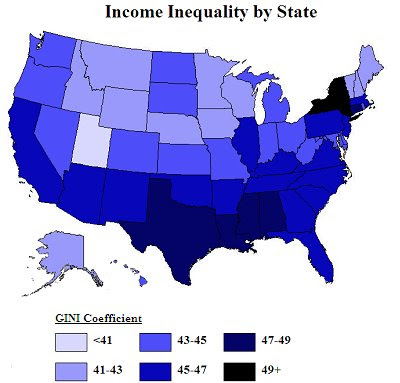




 That chart will only get worse...


