$this->bbcode_second_pass_quote('bencole', '
')I think he is putting the money out there to see if industry and the public will bite, I honestly don't think he is trying to deliberately delay high speed rail, he realizes that the only way to get it started is to stir up considerable interest. This will have to be a massive effort across the board with cooperation on all levels, I don't think the Federal Gov. can simply mandate it into existance.



PeakOil is You
THE High Speed Rail [US] Thread (merged)
Re: Billions to High Speed Rail
 by Plantagenet » Fri 17 Apr 2009, 15:29:49
Obama pays lip service to many different priorities. The reality is that high speed rail is not at the top of his list. Follow the money-----Obama put 28 billion into the stimulus for highway maintainance......and over 25 billion so far on bailing out the failed auto industry......and only 8 billion for high speed rail.
Somebody needs to tell Obama the world is running out of oil....on his watch, and he isn't doing anything to get the US ready.
Rather then wasting hundreds of billions of dollars in the porkulus bill, if Obama wanted high speed rail he would have put hundreds of billions of dollars into building a rail network. Spending money on high speed rail would create high-paying cutting edge tech jobs, manufacturing jobs, and make the US a world leader in this important high tech industry.
Obama didn't do it, and he isn't going to do it. He says he'll put another whole billion a year into high speed rail for the next five years......whoopee.
Meanwhile, the Japanese are ACTUALLY BUILDING the world's most modern mag-lev rail system that will operate at speeds over 300 mph. Obama's failure to lead on the high speed rail issue means the Japanese will get the high paying jobs and the Japanese will lead the world in this industry, and the Chinese and the EU will be right behind them, and the US will be building and developing nothing comparable, thanks to Obama's misplaced priorities.

Japanese maglev train
-

Plantagenet - Expert

- Posts: 26765
- Joined: Mon 09 Apr 2007, 03:00:00
- Location: Alaska (its much bigger than Texas).
Re: Billions to High Speed Rail
by TheDude » Fri 17 Apr 2009, 17:43:04
I see that the Acela was cobbled out of shorter Amtrak lines, including their very first which opened in 1971. Not exactly cutting edge.
Providence to Boston is 51 miles. Cheapest air fare is $341...
Paris to Lille is 140 miles. TGV fare is £33.50/$50 USD. Rail Europe for more info.
Even on long distances this obsession with speed is a bit overblown, and just heaps on the additional costs. I'm curious what Alan Drake is saying about all this over at TOD, as he's a big rail booster in the PO crowd, who takes a dim view of HSR, at least in the initial stages - much more sensible to double track and electrify freight for a start.
Interurbans worked! We led the way in Oregon:
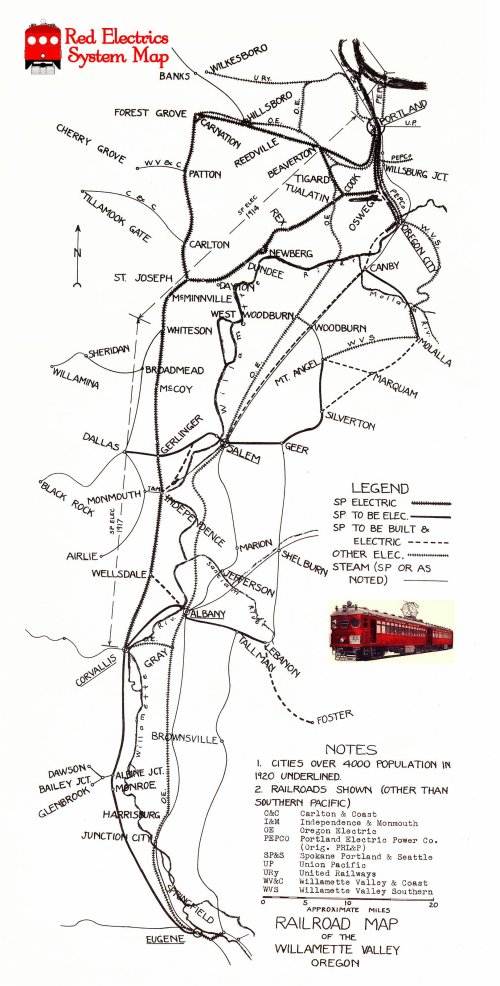
Portland to Corvallis is 81 miles, in 1917 that was 3 1/2 hours by train, compared with 1 1/2 hours driving. What's the hurry? Red Electrics
Providence to Boston is 51 miles. Cheapest air fare is $341...
Paris to Lille is 140 miles. TGV fare is £33.50/$50 USD. Rail Europe for more info.
Even on long distances this obsession with speed is a bit overblown, and just heaps on the additional costs. I'm curious what Alan Drake is saying about all this over at TOD, as he's a big rail booster in the PO crowd, who takes a dim view of HSR, at least in the initial stages - much more sensible to double track and electrify freight for a start.
Interurbans worked! We led the way in Oregon:
Portland to Corvallis is 81 miles, in 1917 that was 3 1/2 hours by train, compared with 1 1/2 hours driving. What's the hurry? Red Electrics
Cogito, ergo non satis bibivi
And let me tell you something: I dig your work.
And let me tell you something: I dig your work.
-

TheDude - Expert
- Posts: 4896
- Joined: Thu 06 Apr 2006, 03:00:00
- Location: 3 miles NW of Champoeg, Republic of Cascadia
Re: Billions to High Speed Rail
by ReverseEngineer » Fri 17 Apr 2009, 18:26:50
$this->bbcode_second_pass_quote('Plantagenet', '
')
Meanwhile, the Japanese are ACTUALLY BUILDING the world's most modern mag-lev rail system that will operate at speeds over 300 mph. Obama's failure to lead on the high speed rail issue means the Japanese will get the high paying jobs and the Japanese will lead the world in this industry, and the Chinese and the EU will be right behind them, and the US will be building and developing nothing comparable, thanks to Obama's misplaced priorities.
Japanese maglev train
')
Meanwhile, the Japanese are ACTUALLY BUILDING the world's most modern mag-lev rail system that will operate at speeds over 300 mph. Obama's failure to lead on the high speed rail issue means the Japanese will get the high paying jobs and the Japanese will lead the world in this industry, and the Chinese and the EU will be right behind them, and the US will be building and developing nothing comparable, thanks to Obama's misplaced priorities.
Japanese maglev train
This train should provide a fabulous new form of Seppuku by Unemployed Nipponese throwing themselves in front of 300MPH Bullet Trains.
Reverse Engineer
-

ReverseEngineer - Intermediate Crude

- Posts: 3352
- Joined: Wed 16 Jul 2008, 03:00:00
Re: Billions to High Speed Rail
by nobodypanic » Fri 17 Apr 2009, 20:19:41
it seems to me that high-speed rail is just a waste. rather, we need more work-horse rail, the kind that moves a ton of bulk freight 400+ miles on a single gallon of fuel.
-

nobodypanic - Heavy Crude

- Posts: 1103
- Joined: Mon 02 Jun 2008, 03:00:00
Re: Billions to High Speed Rail
by emersonbiggins » Mon 20 Apr 2009, 10:39:04
A good primer for why high-speed rail is a non-starter, at least under the current regulatory environment in the US:
How the FRA is Regulating Passenger Rail Out of Existence
$this->bbcode_second_pass_quote('', '
')What if the FAA required that jet aircraft be able to survive crashes into the ground?
Or if the FHA said automobiles had to survive any head-on crash at 60 mph into a tractor trailer without deformation?
Even if such vehicles could be engineered, they would be far too costly to operate. But for passenger trains, that is precisely what the FRA has been doing.
It is an arcane government agency few ever heard of. The Federal Railroad Administration was created in 1966 to set and enforce railway safety standards. And certainly in terms of safety, the FRA has been wildly successful passenger rail is perhaps the safest mode of transport in the US. But many rail advocates argue that the FRA regulations have not only come at too high a price (by making rail prohibitively expensive) but in many cases are completely nonsensical.
...
Then, in 1999 with Acela planning fully underway,
the FRA pulled the rug out by issuing regulations for high-speed rail service requiring trains to withstand 800,000 pounds force without deformation. The 800,000 figure is an arbitrary number dating back to the 1920s; this mandate has since been increased to 1 million pounds.
The buffering requirement confounded Bombadier. Train weight is of crucial importance as it affects the amount of track wear, noise, and energy costs. To meet the buffering regulation, the train would have to be significantly bulked-up. The result was a highspeed train nearly twice as heavy as its European counterparts. As such, the Acela has been described variously as a tank-on-wheels and a bank-vault-on-wheels. Indeed, an overweight train like Acela would be banned from the European high speed rail network.
How the FRA is Regulating Passenger Rail Out of Existence
$this->bbcode_second_pass_quote('', '
')What if the FAA required that jet aircraft be able to survive crashes into the ground?
Or if the FHA said automobiles had to survive any head-on crash at 60 mph into a tractor trailer without deformation?
Even if such vehicles could be engineered, they would be far too costly to operate. But for passenger trains, that is precisely what the FRA has been doing.
It is an arcane government agency few ever heard of. The Federal Railroad Administration was created in 1966 to set and enforce railway safety standards. And certainly in terms of safety, the FRA has been wildly successful passenger rail is perhaps the safest mode of transport in the US. But many rail advocates argue that the FRA regulations have not only come at too high a price (by making rail prohibitively expensive) but in many cases are completely nonsensical.
...
Then, in 1999 with Acela planning fully underway,
the FRA pulled the rug out by issuing regulations for high-speed rail service requiring trains to withstand 800,000 pounds force without deformation. The 800,000 figure is an arbitrary number dating back to the 1920s; this mandate has since been increased to 1 million pounds.
The buffering requirement confounded Bombadier. Train weight is of crucial importance as it affects the amount of track wear, noise, and energy costs. To meet the buffering regulation, the train would have to be significantly bulked-up. The result was a highspeed train nearly twice as heavy as its European counterparts. As such, the Acela has been described variously as a tank-on-wheels and a bank-vault-on-wheels. Indeed, an overweight train like Acela would be banned from the European high speed rail network.
"It's called the American Dream because you'd have to be asleep to believe it."
George Carlin
George Carlin
-

emersonbiggins - Expert
- Posts: 5150
- Joined: Sun 10 Jul 2005, 03:00:00
- Location: Dallas
Re: Billions to High Speed Rail
by Newfie » Mon 20 Apr 2009, 11:49:24
Emmerson,
While much of what you say is true the FRA still serves an important role in enforcing safety inspections.
Generally, if it ain't a fine it ain't attended to. There are non-FRA properties that demonstrate the point.
While much of what you say is true the FRA still serves an important role in enforcing safety inspections.
Generally, if it ain't a fine it ain't attended to. There are non-FRA properties that demonstrate the point.
When going through hell, keep going! Churchill
Nothing is ever lost by courtesy. It is the the cheapest of pleasures, costs nothing, and conveys much. E Wiman
I know there’s no solution, so I just enjoy what’s here and I enjoy the journey G Carlin
Nothing is ever lost by courtesy. It is the the cheapest of pleasures, costs nothing, and conveys much. E Wiman
I know there’s no solution, so I just enjoy what’s here and I enjoy the journey G Carlin
-

Newfie - Forum Moderator

- Posts: 18651
- Joined: Thu 15 Nov 2007, 04:00:00
- Location: Between Canada and Carribean
Re: Billions to High Speed Rail
by emersonbiggins » Mon 20 Apr 2009, 14:19:39
$this->bbcode_second_pass_quote('Newfie', 'E')mmerson,
While much of what you say is true the FRA still serves an important role in enforcing safety inspections.
Generally, if it ain't a fine it ain't attended to. There are non-FRA properties that demonstrate the point.
While much of what you say is true the FRA still serves an important role in enforcing safety inspections.
Generally, if it ain't a fine it ain't attended to. There are non-FRA properties that demonstrate the point.
I'm sure the FRA serves an important role in determining overall rail safety; however, it is onerous to the development of passenger rail on par with Europe & Asia (safest in the world) within the US. Two choices are clear:
1) Rewrite FRA regs to require sensible lower limits for train weight & structural stability.
2) Build entirely new dedicated high-speed passenger rail lines that would not be bound to FRA regs concerning mixed-mode (pax+freight) traffic.
While #2 is much more costly, it would allow high-speed rail in the US to perform more closely to its theoretical maximum speed and capability.
"It's called the American Dream because you'd have to be asleep to believe it."
George Carlin
George Carlin
-
emersonbiggins - Expert
- Posts: 5150
- Joined: Sun 10 Jul 2005, 03:00:00
- Location: Dallas


