Donate Bitcoin

Donate Paypal


PeakOil is You

PeakOil is You

Drastic Reduction In Global Shipping

Discussions about the economic and financial ramifications of PEAK OIL

Re: Drastic Reduction In Global Shipping

Unread postby cube » Fri 01 Aug 2008, 06:19:58

$this->bbcode_second_pass_quote('MrBill', '.')..
Another type of risk that is considerably higher is when you attempt to build a factory or a mine in one of these countries. Then you deal with corruption on a whole other level. And once you have sunk costs in your project it is not so easy to walk away. Therefore you're more vulnerable to corruption on an ongoing basis and officials have leverage over you because they know you cannot leave.
...
I've always wondered why most of the world's oil refineries were built in oil importing nations and not exporting nations. Is there some engineering rule that says an oil refinery can't be built at the point of production and an oil rich nation can get into the business of exporting gasoline and diesel fuel instead of raw crude oil? I know that gasoline is much more susceptible to evaporation which can be a serious fire hazard if stored in very large containers. This is one of the reasons why large ships are powered by bunker fuel instead of gasoline or diesel.
However if humanity has figured out a way to launch rocket ships into space I'm quite sure the technical challenges involved in figuring out how to store gasoline in very large containers can be solved. :roll:

That leads to only 1 conclusion. --> a failed government.
I guess if an investor is going to sink $10 billion into building an oil refinery, property rights would definitely trump cheap labor!
cube
Intermediate Crude
Intermediate Crude
 
Posts: 3909
Joined: Sat 12 Mar 2005, 04:00:00

Re: Drastic Reduction In Global Shipping

Unread postby ReverseEngineer » Fri 01 Aug 2008, 09:31:38

I think you have two opposing forces at work here, one is the economies of scale Mr Bill talks about which make larger ships which can use a variety of fuels for propulsion as being economic, the other one is smaller ships which run primarily on wind power and human labor as being economic.

He is right in the sense that during a transition period, scaling up works, but you also have to take into account the fact that overall the trade will decrease as the products themselves become too expensive to buy. So what happens faster here, demand destruction or shipping capability?

I think relative to what we see right now, demand destruction is the leader. Beyond the necessities of life of shelter, food and water, very little is going to be sought after in the downward spiral. All those commodities have to be available locally for any given community to survive. Mass shipments of grain will decrease as the grain needs to be distributed locally. Mass shipments of oil decrease as the price of the oil is out of reach of the consumers at the end of the shipping line. Clearly it takes some time for this to happen, but eventually it makes the big ships not economic to run. Not to mention, those big ports with the huge cranes lifting the containers on and off the ships take a lot of oil powered energy to work effectively.

Mr Bill's economic analysis is one which looks at the traditional aspects of supply and demand, its essentially correct but it does not take into account catastrophic failure of the system as a whole. In other words, at some point the big boats just won't be able to refuel at the point of destination in order to return back to the point of origin. Sailboats ALWAYS can do this.

The amount of international trade of all goods shrinks as the currency gets debased in all the countries. This is happening in China just as it is here, just in a somewhat different fashion, and its slightly lagging, but it fails as the economy here fails. At what point does the international trade fall off to such a point that the big boats are no longer economic to run, because it just costs too much in fuel to push them across the ocean at any speed? when is the actual volume too small to justify such big boats?

Well, I could project out here that it takes no more than 20 years for it to devolve to this level, and for really BIG boats, your lead time in building them and getting them fit out is gonna take a couple of years to begin with, and if you are to recoup the investment, they better keep operating for at least 20 years. Very risky proposition there.

Smaller boats take a much lower investment, and shorter lead time to get operating. The human labor needed to operate them is clearly out there desperate for work. Instant boats, instant labor, lower risk.

On the question of sailing into the wind using any technology, its clearly possible, its called TACKING. Makes the trip longer, but long as you can sail even just 20 degrees into the wind, its always possible to make decent progress. Obviously well designed sailing vessels can do better than that anyhow.

Reverse Engineer
User avatar
ReverseEngineer
Intermediate Crude
Intermediate Crude
 
Posts: 3352
Joined: Wed 16 Jul 2008, 03:00:00

Re: Drastic Reduction In Global Shipping

Unread postby MrBill » Fri 01 Aug 2008, 09:59:09

cube wrote:

$this->bbcode_second_pass_quote('', 'I')'ve always wondered why most of the world's oil refineries were built in oil importing nations and not exporting nations. Is there some engineering rule that says an oil refinery can't be built at the point of production and an oil rich nation can get into the business of exporting gasoline and diesel fuel instead of raw crude oil? I know that gasoline is much more susceptible to evaporation which can be a serious fire hazard if stored in very large containers. This is one of the reasons why large ships are powered by bunker fuel instead of gasoline or diesel.
However if humanity has figured out a way to launch rocket ships into space I'm quite sure the technical challenges involved in figuring out how to store gasoline in very large containers can be solved.

That leads to only 1 conclusion. --> a failed government.
I guess if an investor is going to sink $10 billion into building an oil refinery, property rights would definitely trump cheap labor!


[align=center]World's biggest refinery to test oil bulls[/align]
$this->bbcode_second_pass_quote('', ' ') On India's West coast, the world's biggest refining complex is nearly ready to begin pumping a wave of diesel fuel into the world oil market, removing one of the last near-term fundamentals supporting $100-plus crude.

But unfortunately for oil consumers and for a fragile world economy, Reliance Industries Ltd's <RELI.BO> new plant is likely to have a much greater impact on global refinery profits and price spreads than it will on New York Mercantile Exchange (NYMEX) crude futures or prices at the petrol pump.

Although a severe refining bottleneck was one of the initial catalysts for oil's six-year rally, it has been eclipsed by the growing importance of financial investors, attacks by Nigerian militants and lacklustre upstream oil output growth.

"The notion that new refineries will bring significantly lower crude prices doesn't look likely," says Kevin Norrish of Barclays Capital, which has been a consistent bull on prices.

"We may see some narrowing in spreads between heavy and
lighter grades...but we don't see any major changes in crude
price dynamics, since there are other more important factors at
work."

Reliance is expected within weeks to begin test running a new
580,000 barrel per day (bpd) refinery in Jamnagar, with full-fledged operation likely by early next year, industry sources say. Together with its existing 660,000 bpd, built less than a decade ago, the site will be world's biggest.

More remarkable is the fact that the new plant -- the most
sophisticated in the world for its size -- will produce an estimated 40 percent diesel, helping meet demand that has surged due to power shortages and growing use in passenger cars.

At the same time, demand for most other fuels -- from jet to gasoline to fuel oil -- is clearly in decline, one of the factors that has sliced 16 percent off oil prices since they hit a high of nearly $150 a barrel on July 11.

Whether easing the remaining strain on distillate markets with new supplies will deepen crude oil's losses remains an open question. Many analysts have reason to doubt it.

"The market does appear less concerned about downstream capacity constraints than previously," says Mike Wittner, global head of oil research at Societe Generale.

"I believe that the impact will be more on easing the gasoil cracks than on easing the crude flat price."


Source: SINGAPORE, Aug 1 (Reuters)
The organized state is a wonderful invention whereby everyone can live at someone else's expense.
User avatar
MrBill
Expert
Expert
 
Posts: 5630
Joined: Thu 15 Sep 2005, 03:00:00
Location: Eurasia

Re: Drastic Reduction In Global Shipping

Unread postby ReverseEngineer » Fri 01 Aug 2008, 10:13:12

$this->bbcode_second_pass_quote('cube', 'I')'ve always wondered why most of the world's oil refineries were built in oil importing nations and not exporting nations. Is there some engineering rule that says an oil refinery can't be built at the point of production and an oil rich nation can get into the business of exporting gasoline and diesel fuel instead of raw crude oil? I know that gasoline is much more susceptible to evaporation which can be a serious fire hazard if stored in very large containers. This is one of the reasons why large ships are powered by bunker fuel instead of gasoline or diesel.

However if humanity has figured out a way to launch rocket ships into space I'm quite sure the technical challenges involved in figuring out how to store gasoline in very large containers can be solved.


This goes to a favorite concept here, EROEI. While technologically its certainly possible to transport gasoline, or compressed or cooled Propane or Natural Gas, the kind of ships you would have to build to do it would be very energy intensive. this would only make the end product more expensive than it already is for the consumer of the product.

Same reason you can't REALLY build communities on Mars or do anything more than fly to the Moon and back. It simply takes too much energy to do these things, and have enough left ober to actually start BUILDING something. If Mars had Oxygen and plenty of combustible materials and fertile soil, long as we could get there we could build there. It has none of those things in sufficient measure to make life viable, heck it would be easier to make life viable on Antartica, and even just keeping a Military Base there is a waste of money.

Sure its technoligically possible to build a ship that carries gasoline, but it would be expensive and chances are quite a few of those expensive ships would BLOW UP, like the Challenger did. You pull the oil in unrefined form to the place that uses it, then you refine it and send it out in smaller doses. The system developed this way for a REASON.

Reverse Engineer
User avatar
ReverseEngineer
Intermediate Crude
Intermediate Crude
 
Posts: 3352
Joined: Wed 16 Jul 2008, 03:00:00

Re: Drastic Reduction In Global Shipping

Unread postby MrBill » Fri 01 Aug 2008, 10:59:49

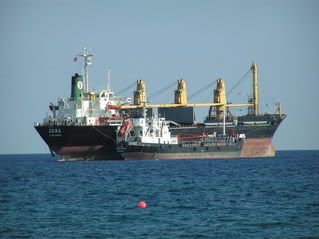
The bunkering of large ships is done by smaller fuel supply ships in any case. In the hub and spoke trans-shipment of intermodal containers there will be bunker fuel at those larger hubs where the greatest demand is. There may not be bunker fuel available at those smaller places down the line that cannot afford to buy imported goods in any case. No ability to pay, no demand, no supply.

[align=center]Bunker ship in Limassol[/align]
Image

As these large container ships can accomodate a wide range of fossil fuels using basically anything that can burn then they outlast what many of us see as a liquid fuel crisis. Grades of heavy oil that cannot be easily turned into gasoline and diesel can still be used as bunker fuel. But also coal to liquids and bio-fuels.

[align=center]Dhows used to transport bulk goods between Dubai to India[/align]
Image

As bulk loads are less-efficient, and cost more to transport in smaller boats than by container, then those goods become even more expensive when delivered. So if there is no ability to pay via delivery by large ship then there is no demand for delivery by sail either. Then the only solution is local production close to the consuming market or doing without.

Of course, sailing ships need to be built-out of natural resources using energy as well. Basically anything you can build a sailing ship out of like wood you can burn - wood pellets or cellulosic ethanol made from wood chips - to power a container ship. If it is steel then that steel is using energy that can power a ship as well. LPG ships run on their own cargo.

I have to disagree about the endless supply of cheap labor though. Even in days of old not everyone was cut out to be a seaman. It is very tough physical work and quite dangerous. There are very many poor people in the world today. Not all of them are flocking to the sea in search of work.

Technically if they could they would be logging trees locally, building boats by themselves and taking to the sea as either fishermen or involved in transport. There must be a reason why that is not taking place today on a wider scale? The answer is that despite having trees and surplus labor they still could not compete against modern ships. I am not of the opinion that this will change in the next twenty years. Perhaps less container traffic due to reduced world trade. But not sail replacing container ships for transport.

Plus seamen still need to be fed. Long journies mean more men to feed for longer periods of time. That reduces the economics of the voyage or adds to the cost of the goods delivered. In the past that meant only low volume, high value goods were transported by sailing ships. Again the option is locally or regionally produced or going without. If the world runs out of oil and does not have an alternative then I cannot see the demand for sailing ships either? What would be their economic purpose?
The organized state is a wonderful invention whereby everyone can live at someone else's expense.
User avatar
MrBill
Expert
Expert
 
Posts: 5630
Joined: Thu 15 Sep 2005, 03:00:00
Location: Eurasia

Re: Drastic Reduction In Global Shipping

Unread postby MrBill » Fri 01 Aug 2008, 11:09:11

RE wrote:
$this->bbcode_second_pass_quote('', 'T')his goes to a favorite concept here, EROEI. While technologically its certainly possible to transport gasoline, or compressed or cooled Propane or Natural Gas, the kind of ships you would have to build to do it would be very energy intensive. this would only make the end product more expensive than it already is for the consumer of the product.


This is not true. Europe exports gasoline to the USA market as they consume more diesel than gasoline. India refines and then exports to Iran. S. Korea and China both export petroleum products regionally in Asia. Etc.


Total Imports of Petroleum (Top 15 Countries)
The organized state is a wonderful invention whereby everyone can live at someone else's expense.
User avatar
MrBill
Expert
Expert
 
Posts: 5630
Joined: Thu 15 Sep 2005, 03:00:00
Location: Eurasia
Top

Re: Drastic Reduction In Global Shipping

Unread postby the48thronin » Fri 01 Aug 2008, 22:12:17

My thinking was not that a wind only vessel could be made from existing hulls, but that a wind assisted hybrid could...

rather than direct driven, electric generated to the existing electric drive props.. the generator being one of the vertical windmills such as you can see when crossing tehachapi on rt 58.

Several years ago I saw such a design but at that time wind assist was not worth the investment.. I only brought this idea up into a conversation of using existing hulls..


PS Mr Bill... I lived and worked in central america for several years and find you statements and facts about Africa similar to what I saw there...
Last edited by the48thronin on Fri 01 Aug 2008, 22:13:18, edited 1 time in total.
Malthusian Riders Member!

Courtesy and Courage Sincerity and Self-control Honor and Loyalty a Code to Live By!
What do the miners do when the canary dies? EVACUATE THE MINE not argue about the color of it's feathers or buy a parrot instead.

Where is my pitchfork and torch? I need them for a visit to the castle!
User avatar
the48thronin
Tar Sands
Tar Sands
 
Posts: 871
Joined: Fri 30 May 2008, 03:00:00
Location: On the highway, or the water somewhere!

Re: Drastic Reduction In Global Shipping

Unread postby Tanada » Fri 01 Aug 2008, 22:13:07

Shipping Gasoline slightly pressureized and Propane a bit more so is not difficult, but transporting Natural Gas cryogenically is a whole different ballgame in energy intensity.
$this->bbcode_second_pass_quote('Alfred Tennyson', 'W')e are not now that strength which in old days
Moved earth and heaven, that which we are, we are;
One equal temper of heroic hearts,
Made weak by time and fate, but strong in will
To strive, to seek, to find, and not to yield.
Tanada
Site Admin
Site Admin
 
Posts: 17094
Joined: Thu 28 Apr 2005, 03:00:00
Location: South West shore Lake Erie, OH, USA
Top

Re: Drastic Reduction In Global Shipping

Unread postby Canuk » Sat 02 Aug 2008, 00:41:31

$this->bbcode_second_pass_quote('cube', 'I')'ve always wondered why most of the world's oil refineries were built in oil importing nations and not exporting nations. Is there some engineering rule that says an oil refinery can't be built at the point of production and an oil rich nation can get into the business of exporting gasoline and diesel fuel instead of raw crude oil?

That leads to only 1 conclusion. --> a failed government.
I guess if an investor is going to sink $10 billion into building an oil refinery, property rights would definitely trump cheap labor!


This applies to many products shipping and labour are not the only reasons. England did not grow cotton but in the 1800's had many spinning mills and textile plants. The USA does not grow coffee but has many coffee roasters/canners. Malaysia and Brazil grow rubber trees yet most of the processing does not happen there.

The infrastructure and support systems are not always available in the originating countries or the product may better suit processing near the end use. In many cases I suspect that the refineries are in the original industrialized nations due to earlier needs to suit the domestic market but have remained after the domestic supplies were reduced. I think the property rights may be a factor but it is not the only factor.
User avatar
Canuk
Peat
Peat
 
Posts: 109
Joined: Fri 04 Jul 2008, 03:00:00
Location: Hamilton, Ontario, Canada
Top

Re: Drastic Reduction In Global Shipping

Unread postby the48thronin » Sat 02 Aug 2008, 00:53:04

$this->bbcode_second_pass_quote('Canuk', '')$this->bbcode_second_pass_quote('cube', 'I')'ve always wondered why most of the world's oil refineries were built in oil importing nations and not exporting nations. Is there some engineering rule that says an oil refinery can't be built at the point of production and an oil rich nation can get into the business of exporting gasoline and diesel fuel instead of raw crude oil?

That leads to only 1 conclusion. --> a failed government.
I guess if an investor is going to sink $10 billion into building an oil refinery, property rights would definitely trump cheap labor!


This applies to many products shipping and labour are not the only reasons. England did not grow cotton but in the 1800's had many spinning mills and textile plants. The USA does not grow coffee but has many coffee roasters/canners. Malaysia and Brazil grow rubber trees yet most of the processing does not happen there.

The infrastructure and support systems are not always available in the originating countries or the product may better suit processing near the end use. In many cases I suspect that the refineries are in the original industrialized nations due to earlier needs to suit the domestic market but have remained after the domestic supplies were reduced. I think the property rights may be a factor but it is not the only factor.


Another factor...


shrinkage.

The more valuable the item the more shrinkage from any handling.... And the closer to the end user the tighter the security usually.
Malthusian Riders Member!

Courtesy and Courage Sincerity and Self-control Honor and Loyalty a Code to Live By!
What do the miners do when the canary dies? EVACUATE THE MINE not argue about the color of it's feathers or buy a parrot instead.

Where is my pitchfork and torch? I need them for a visit to the castle!
User avatar
the48thronin
Tar Sands
Tar Sands
 
Posts: 871
Joined: Fri 30 May 2008, 03:00:00
Location: On the highway, or the water somewhere!
Top

Re: Drastic Reduction In Global Shipping

Unread postby ReverseEngineer » Sat 02 Aug 2008, 02:30:45

$this->bbcode_second_pass_quote('MrBill', 'I')f the world runs out of oil and does not have an alternative then I cannot see the demand for sailing ships either? What would be their economic purpose?


By this logic, why were sailing ships EVER economic? Back in the years from around 1500 to 1750, the world had not run out of oil, but neither was anybody using it. Somehow in the absence of oil they managed to build the ships, and then once built they gave years of service transporting goods across the oceans, enough gold certainly got transported from Central and South America to do wonders for the Spanish economy. Enough Slaves got transported from Africa to do wonders for the American economy, and enough Rum got transported back to keep the ship full in both directions, a nicer backhaul payload than empty Containers.

Your postulate I gather is that as long as there is ANYTHING to burn, that the engine powered ship is going to be more economic than the sail rigged ship, It might be, but I think only marginally so and it would demand having big enough markets to make such large ships economic to run. Aren't we in agreement that the size of the markets is going to shrink tremendously due to die off? So will there really be enough people around to warrant such large vessels plying the oceans of the world?

Sailboats operate more autonomously, they don't NEED smaller vessels to refuel them at sea, they don't NEED large ports to offload their goods. They can make many stops at smaller ports to trade, wherever there might be a local economy running that has some goods another place needs, that needs goods another place produces. A sailing vessel in the time of Magellan or Cook could be 4 or more years before returning to its home port, not even needing any real port at all to drop anchor and send the crew out foraging for food. Dangerous business, no doubt, and many did not return from those voyages, but those who did return were made quite wealthy by them, the Captain and Owner of the vessel much more so than the crew, but even the crew did well on a successful voyage.

Large boats are limited to only being economic in a large economy. As the economy shrinks, the size of the vessels has to shrink with it. Again I ask you, do you wish to be ahead of the curve here, or behind it? Spend a ton of money on large boats that will burn your Bunker fuel, but in 10 years before the boat is half paid off there aren't enough goods to ship about to make it worthwhile, what have you got? A very large hunk of floating metal not worth a whole lot more than a GM Plant that used to produce cars. You have invested a huge amount of money in a machine that no longer is applicable in a smaller economy in the absence of cheap energy. However, will the population necessarily dwindle down below what it was in 1750? Unlikely except in the event of Thermonuclear War. About a 5/6ths reduction, around 83% not a whole lot different a percentage than what Merrill Lynch just sold off $8B worth of collateralized debt for, about 22 cents on the dollar. 78% reduction, 83% reduction, lets not quibble about 5% here, its only 300 million people or so out of the 4 or 5 billion drop off. LOL.

Anyhow, if sailboats were economic in 1750, why would they not work again in a world population roughly the same size with roughly the same kind of productivity? One could postulate we will do somewhat better on the productivity end, since at least some of the technology developed since can survive, so you probably have a slightly larger carrying capacity, but you also could build slightly larger sailboats by reworking the steel of old hulls into configurations more suited to sail, and certainly the Hull of one supertanker of today would provide raw material for a LOT of smaller sailing vessels that STILL could carry 10 or 20 Containers.

It appears to me here you are arguing both sides of this issue. In a prior post you argue that canals will become a more prevalent form of transportation for bulk goods as the railroads become uneconomic to run. What put the canals out of business? The railroads of course, just as the fossil fuel powered ocean vessel put out of business the sailing ship. However, as you work your way back down the ladder here, just as the canals once again become economic, so also do the sailboats. Now, if you had money to invest, which would you invest in for Canals, a few HUGE barges that require engine power to run, or many smaller barges that could be pulled along the canal by teams of horses? The latter model is more flexible, does not take so much initial investment, and can be grown as the economy grows. There is no difference on the ocean end of the transport, the smaller ships are more flexible and can still operate in a vastly smaller economy.

Again the main questions here revolve not around the endgame, but the timeline to the end game. If the lead time here to complete devolution of the economy is 20 years or more, then it might make sense to invest in larger ships that burn Bunker fuel, they might pay themselves off and you might eventually realize some profit from it. However, if in 5 years nobody is producing enough goods for you transport in such a large ship, your business will go Belly Up. There might very well be a Sailboat Captain in the slip next door to yours that can take a small load across the ocean and realize a hefty profit from it. A more human intensive labor business with more food costs for the transport no doubt, but it still is operating on the small scale a large ship cannot operate on. When the economy and population size shrink enough, this is the form of transportation that WORKS. It worked in 1750, it will work again.

Reverse Engineer
User avatar
ReverseEngineer
Intermediate Crude
Intermediate Crude
 
Posts: 3352
Joined: Wed 16 Jul 2008, 03:00:00
Top

Re: Drastic Reduction In Global Shipping

Unread postby cube » Sat 02 Aug 2008, 05:45:29

*warning may be controversial*
It's my observation that many people on this website like to think of themselves as "open minded" and definitely more "informed" than the majority "ignorant" unwashed masses.
A VERY common belief on this website is that in a PO world, humanity will stop transporting almost all goods beyond 1,000 miles. The argument is simple, expensive energy will make long distance transport economically unprofitable.
People who hold this position should go back and re-read their history books.
If we look at historical fact, even before the advent of steam engine ships, Europeans were drinking tea from India, smoking tobacco from Virginia, and drinking coffee from Africa. However this is not limited to "super premium" goods. Back in the old days the items listed above were luxury goods!
By very late Victorian times, steel hull sailing ships (Wind-Jammers), became efficient enough that even everyday mundane items like wool and grains could be transported from Australia to England economically.
Don't get me wrong I'm not saying we're going to be transporting cheap Chinese plastic toys 10,000 miles on sailing ships post PO, obviously there will be major changes to the world.
I'm just saying this ridiculous "Locavore-theory" that many people on this website subscribes too falls apart very quickly when compared to historical fact.

I lost count how many people on this website have this silly idea they have discovered some great knowledge that puts them above the unwashed masses.
People who fall into this category usually have a very firm belief what post PO will look like.
Unfortunately once you contradict their "theories" they tend to lash out violently.
People who fall into this category often get put on my ignore list.
I'm just rambling about what happened in another thread, everything is going fine in this post.
continue on.... :-D
cube
Intermediate Crude
Intermediate Crude
 
Posts: 3909
Joined: Sat 12 Mar 2005, 04:00:00

Re: Drastic Reduction In Global Shipping

Unread postby cube » Sat 02 Aug 2008, 06:02:43

To: ReverseEngineer
I believe you are misinterpreting MrBill's post.

I don't know where in the world you got all that "analysis" from but that certainly was NOT the impression I got from reading MrBill's posts.
cube
Intermediate Crude
Intermediate Crude
 
Posts: 3909
Joined: Sat 12 Mar 2005, 04:00:00

Re: Drastic Reduction In Global Shipping

Unread postby ReverseEngineer » Sat 02 Aug 2008, 06:49:24

$this->bbcode_second_pass_quote('cube', '*')warning may be controversial*
It's my observation that many people on this website like to think of themselves as "open minded" and definitely more "informed" than the majority "ignorant" unwashed masses.


I guess I am one of the "Ignorant Unwashed Masses". LOL.

Seriously, Cube's observation is correct at least so far as I have experienced life on the Peak Oil board to date. There are some long term members with "Expert" designations who have staked out their territories, and if you contradict them, you get belittled for it. Doesn't bother me much, I can hold my own in an argument, but as I read through the archives I see it all over the place.

Its always a mistake to think you "know it all" or that others might not have an insight you did not consider. Its easy once you have staked out a territory to belittle newbies, to tell them they are naive or they need to read the vast archives of the group or 10 books you read this year. I never accept such arguments myself, I argue from my own first principles. I do NOT know it all, I just know what I know, and I can defend it.

I am enjoying the discussion with Mr Bill. I hope he is as well, and to date it has not devolved to the point of endless flame. I been there, done that many times. It goes nowhere. Each of us has our own spin, and you can attack an IDEA, but attacking the PERSON who speaks the idea is counter productive always. I try not to do that, but when I get pushed, I can spit out fire like you would not believe. LOL. In any event, this discussion does not seem to be going that way, so far its just an exploration of ideas. That is good.

Reverse Engineer
User avatar
ReverseEngineer
Intermediate Crude
Intermediate Crude
 
Posts: 3352
Joined: Wed 16 Jul 2008, 03:00:00
Top

Re: Drastic Reduction In Global Shipping

Unread postby cube » Sat 02 Aug 2008, 07:54:53

$this->bbcode_second_pass_quote('ReverseEngineer', '.')..
I guess I am one of the "Ignorant Unwashed Masses". LOL.
...
There's a lot of people here who think just because they are PO aware they must have the amazing ability to predict the future. There's a lot of stupid ideas and theories that have been proposed on this website. That's what debate is for.
To weed out bad ideas from the good.
Hopefully I have not proposed too many bad ideas myself. :wink:

BTW here's a post I made awhile back.
It's "only" 1/3 rd of a page long and it is related to shipping.
The last mile and PO
cube
Intermediate Crude
Intermediate Crude
 
Posts: 3909
Joined: Sat 12 Mar 2005, 04:00:00
Top

Re: Drastic Reduction In Global Shipping

Unread postby ReverseEngineer » Sat 02 Aug 2008, 22:18:30

$this->bbcode_second_pass_quote('cube', 'T')o: ReverseEngineer
I believe you are misinterpreting MrBill's post.

I don't know where in the world you got all that "analysis" from but that certainly was NOT the impression I got from reading MrBill's posts.


So what was the impression you got from Mr. Bill's post, and how does it differ from the impression I got? Far as where I got all the analysis, I just responded to what he wrote. He appears to me to make the case that large ships which use Bunker Fuel are a better alternative and more economic than moving toward smaller sail powered vessels. Am I misinterpreting that? I am making the opposite case, that smaller sailing vessels represent the better strategy as the economy shrinks downward.

Please clarify the nature of what you think my misinterpretation is, and why you think this is a misinterpretation.

Reverse Engineer
User avatar
ReverseEngineer
Intermediate Crude
Intermediate Crude
 
Posts: 3352
Joined: Wed 16 Jul 2008, 03:00:00
Top

Re: Drastic Reduction In Global Shipping

Unread postby nobodypanic » Sat 02 Aug 2008, 23:26:40

Image

$this->bbcode_second_pass_quote('', 'D')esigned for a future with declining supplies of fossil fuels and increasing environmental responsibility, the concept vessel would have a capacity of 10,000 standard cars and would use only renewable energy sources and naturally-charged fuel cells for power.


$this->bbcode_second_pass_quote('', 'T')he ship's design incorporates a cargo deck area equivalent to 14 football fields. Three giant rigid sails manufactured of special lightweight composite materials are covered in solar panels to help drive the ship at its cruising speed of 15 knots.

Wave power is utilized through a series of 12 fins, which will be able to transform wave energy into hydrogen, electricity or mechanical energy. The fins double as propulsion units, driven either by wave energy or other renewable energy sources onboard.


link

maybe you'll have the best of both worlds: a 'return' to the age of sail while retaining modern size and cargo capacity.
User avatar
nobodypanic
Heavy Crude
Heavy Crude
 
Posts: 1103
Joined: Mon 02 Jun 2008, 03:00:00
Top

Re: Drastic Reduction In Global Shipping

Unread postby BlueGhostNo2 » Sun 03 Aug 2008, 00:59:49

Reversed, the argument seems essentially to be: you state small old-tech sailing boats will replace current container oil driven shipping. To start with you said this could happen now but you've now switched to saying it will happen sometime. This is vs Bill saying container based shipping will continue more or less as it is for a long time to come although they might switch to burning other fuels, no problem as they can burn pretty much anything.

To argue as to why I think you're wrong on this I am not going to argue 'properly' a couple of other posters have already done this and it doesn't seem to be going anywhere, instead I'm going to raise points as to why, looking from the outside and knowing nothing much about shipping I think they're right and you're wrong.

* The burden of proof is on YOU on making this claim, the market shows that it is currently economic to run oil driven container ships. To challenge that you need to prove something else is better.

* You make this claim, with no figures to back you up! So you're going on a hunch not a rigorous analysis of the costs. (These two points basically make me feel your and Bills argument is a waste of time)

* You write long waffly posts and have no 'killer fact', if for example you turned up and said 'Container based shipping needs large quantities of helium to function, helium is in short supply, therefore soon we will have to stop using container based shipping' you'd seem more factual and less waffly, you'd also waste less time writing your posts.

* You are emotionally attached to your argument. To start with you argued that small sailing boats are a better economic alternative right now. You then came to agree that this was not the case but then switched your argument to say they'd be a better alternative soon. This suggests you have come to believe a particular 'vision' and are now trying to defend it.

* You are arguing for two changes which are not connected at the same time. First that shipping will switch energy source to wind power, second that shipping will switch scale from large to small. This again suggests you are emotionally attached to this 'future vision' if you tried to argue either point singularly with facts and figures to back you up, I would think you less of a crack pot.

Anyway despite my slightly ranty and overly long post I do think you've got a valuable contribution to make on the board. If only you'd be more flexible in changing your ideas and less waffly in communicating them!
User avatar
BlueGhostNo2
Peat
Peat
 
Posts: 124
Joined: Tue 24 Jun 2008, 03:00:00

Re: Drastic Reduction In Global Shipping

Unread postby ReverseEngineer » Sun 03 Aug 2008, 01:36:41

If my text made it appear I think small sailing vessels could succeed economically right NOW, then I was not clear. I don't think that at all, its a projection out into the future. Right NOW, Bunker Fuel style ships of the type Mr. Bill describes ARE the more economic form of transport. But they do depend on a large volume of goods to REMAIN viable into the future. How far away is the future of reduced intercontinental transport, and by how much does it need to be reduced before the economics of this mode fail? Nobody here really has demonstrated they can accurately project that one out, so aain it is a question of time frame to amortize out the cost of any type of ship you plan for and build today. My GUESS would be its a decade or so at best before global shipping shrinks to a trickle, so what is the point in spending a lot of money on building big new ships that run on bunker fuel and big new ports that require big cranes that need oil when there just won't be that much stuff to ship?

Insofar as my emotional attachment to such concepts goes, again if it appears emotional, this is my style of writing, I'm not REALLY all that attached to it. Where some folks like to use numbers to justify their concepts, I tend to appeal to the emotions with my writing. Having been trained as a numbers guy, I am fully aware that the numbers thorwn out and the way in which they are derived are in themselves subjective quantities, but by using them you can take what is really opinion and make it seem more factual. I don't play that game, you won't find me ever quoting "hard" numbers in my posts. If this bothers you and makes you feel my posts are without merit, so be it.

What I do is look at the big picture and look for motivations and social dynamics and historical precedents, and then I work up theories based on those things. They are just theories, they are not absolute predictions of the future. I have MANY theories, and I am not all that emotionally attached to ANY of them. LOL. However, when I write about any given theory, I'll use metaphor and emotional arguments to drive home the point I am trying to make, just as others will pound you to death with numbers.

If this does not suit your taste and does not hold enough weight with you to consider the arguments for their validity, that is fine. However, I still will write in this way because its how I THINK about the topics. I'm right as often as anybody else is who does it by the numbers, about 50% of the time. LOL.

Reverse Engineer
User avatar
ReverseEngineer
Intermediate Crude
Intermediate Crude
 
Posts: 3352
Joined: Wed 16 Jul 2008, 03:00:00

Re: Drastic Reduction In Global Shipping

Unread postby cube » Sun 03 Aug 2008, 02:51:30

$this->bbcode_second_pass_quote('ReverseEngineer', 'I')f my text made it appear I think small sailing vessels could succeed economically right NOW, then I was not clear. I don't think that at all, its a projection out into the future. .....
Okay that clarifies a lot.
For a while I mistakenly thought you were trying to debate with MrBill sailing ships vs. bunker fueled ships right now or the very near future. When MrBill said sailing ships can't "cut the mustard" he meant right NOW and not some distant past or future.
never mind....continue on....
//
There's a lot of talk of building BIGGER ships.
Imagine a Malacca-max container ship: 1/4 mile long, 18000 TEU capacity or 9000 standard 40ft long containers.
Will such a ship ever get built or have ships gotten as big as they will ever get?
If this Malacca-max container ship does get built will it become a white elephant?
interesting questions...
I think it's too early to tell if we have definitely reached "peak shipping". Maybe 10 years from now the anwser will be obvious but not now.

BTW we've reached "peak-Starbucks" that's for sure. :wink:
cube
Intermediate Crude
Intermediate Crude
 
Posts: 3909
Joined: Sat 12 Mar 2005, 04:00:00
Top

PreviousNext

Return to Economics & Finance

Who is online

Users browsing this forum: No registered users and 1 guest

cron