Donate Bitcoin

Donate Paypal


PeakOil is You

PeakOil is You

Drastic Reduction In Global Shipping

Discussions about the economic and financial ramifications of PEAK OIL

Re: Drastic Reduction In Global Shipping

Postby CarlosFerreira » Wed 06 Aug 2008, 05:14:45

$this->bbcode_second_pass_quote('MrBill', '
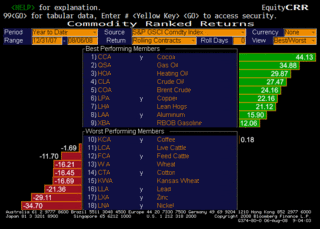
')Image

This graph just shows that wheat prices have sunk 16% year to date so far. Despite higher fuel and fertilizer prices, and the increased use of corn for bio-fuel. Wheat generally trades at a premium to corn as corn is primarily an animal feed whereas wheat is mostly used to make bread or pasta for human consumption. That relationship does not always hold, but overtime it has shown to be quite stable.


Can the usage of corn for bio-fuel raise the price of wheat? Is wheat being used as a substitute for corn as animal feed?
Environmental News and Clippings:
http://www.google.co.uk/reader/shared/1 ... 4898696533
Environmental Economics and Systems
http://enviroecon.wordpress.com/
CarlosFerreira
Tar Sands
Tar Sands
 
Posts: 734
Joined: Wed 02 Jul 2008, 03:00:00
Location: Canterbury, UK

Re: Drastic Reduction In Global Shipping

Postby MrBill » Wed 06 Aug 2008, 05:39:05

The least-cost formulation of animal feed can substitute almost any grain for any other grain as well as add protein supplements like soybean, canola and fishmeal. However, they are imperfect substitutes for one another. Wheat has a different protein content than either corn or soybean/canola meal. Changes in formulation have to be done over time to avoid digestion problems. There is a limit to how much wheat you can feed poultry due to the amount of wheat gluten. You can feed beef cattle on alfalfa, but if you turn a cow out in a lush alfalfa field they will eat too much, become bloated and suddenly die. Etc. Also they are often grown on the same land, so land dedicated to corn can affect the price of wheat through supply. So corn and wheat are substitutes, but only within limits.
[align=center]Image[/align][align=center]A tractor farm.[/align]
[align=center]Growing GM tractors that can run on bio-diesel
[/align]
The organized state is a wonderful invention whereby everyone can live at someone else's expense.
User avatar
MrBill
Expert
Expert
 
Posts: 5630
Joined: Thu 15 Sep 2005, 03:00:00
Location: Eurasia

Re: Drastic Reduction In Global Shipping

Postby ReverseEngineer » Wed 06 Aug 2008, 06:45:49

$this->bbcode_second_pass_quote('MrBill', 'T')hanks for those links, Canuk. I remember reading about how the container revolutionised shipping, but it is nice to find a source for the information again.


I think in any scenario, containerized shipping remains the best model. I'm going to paint a picture of how containerized shipping works in a world completely devoid of Oil, and to keep Mr Bill happy, I'm going to use both Bunker Fueled ships for intercontinental transport as well as the hub-spoke system for those Ports :-) I could make it work with Sail, but its not essential.

First off, I am going to hypothesize a 50% global die off so we are less stressed on the population level. 50% die off, 50% reduction in the total volume of goods, ships 1/2 the size necessary for the same relative transport of goods.

On the Intercontinental level, these ships are about half the size of current container ships, for a while can burn what heavy crude is available, eventually they just burn switchgrass or whatever. The containers they carry though are not the size of current containers, they are maybe 1/4 the size. Small enough that they can be on and offloaded utilizing human and animal powered winching systems if necessary, but around the Hub ports there is electricity generated by Windmills, Tidal Generators and Solar Collection.

At said Hub Ports, these smaller containers are put on still smaller SAIL vessels and barges which ply the coasts and inland waterways. Don't need as many Longshoremen as in the old days of bulk transport in the hold of a ship, but more than in the days when you could depend on oil to power huge cranes and so forth to haul up the containers.

To this point in the equation of downsizing, you haven't lost most of the technology from the old days, its just all scaled down to represent the population at large scaling down. Very little oil needed in this if any, and of course those Bunker Fuel ships could at least be assisted by a Parachute Sail when heading downwind, which they will for sure in at least one direction. Make them nice and long and skinny and optimize the drag coefficient as well.

These smaller sailboats and barges hit the more local hubs, where there aren't the Windmills and the Hydropower to drive the small cranes needed to offload the small containers, but long as there are enough guys working the shore, they can winch them up and winch them down with their own muscle and some mechanical advantage. Employ a few horses to do some of the major pulling also, I would bet if you were real efficient about it you could do the same job of offloading a container as is done now utilizing oil. The SLOW part of this step has nothing to do with the power involved, its the ACCURACY. I drove a Big Rig for 6 years, I hit the railyards MANY times to pick up containers, and droping these things on the trailer frame takes accuracy mainly. The speed has nothing to do with the power of the engines driving it, its all about not running the engines too fast or trying to swing into position too fast. Then you go outta control, which I saw happen on a couple of occassions also. In any event, you work with smaller containers, you actually can work a bit faster because you don't have so many problems with the inertia. Yes you will need more people here involved, but this is good from the employment perspective.

So anyhow, once dropped onshore at the Local Ports, how do these smaller containers make their way the Last Mile to the Consumer?

Well, first off you still have the Railroads, which like the ships can be Bunker Fuel powered. Or the rail lines might be electrified with Wind/Hydro Power, or a combination of both. Or you simply could have teams of Horses pulling the rail cars along the tracks. Slower than a modern railroad? Somewhat yes, but really have you ever sat at a crossing and watched how slow a freight train generally moves? Not more than about 15 mph most of the time except on long stretches of flat ground uninterupted by crossings. You simply cannot speed such things up and slow them down all that fast. Inertia. So again, while this slows down the whole process some, it does not slow it down SOOOO much it doesn't work. Know that because that is how it was DONE in the past, as long as the goods you are moving don't go bad, it does not matter if it takes a week or 3 months to move it around. Will you be able to get Maine Lobster in San Diego and eat it? No way. However, you certainly can get grain from the Midwest to New York this way and it still still be in fine shape.

Once you get the stuff to a central destination point, the individual consumer can go pick up the stuff himself with his horse and wagon, like we go to Walmart or the Big Box stores today in our Auomobiles. Do you go as often or buy the same Chinese CRAP? NO of course not, you mainly take a trip once a week or once a month to buy grain at the distribution center, to buy it you trade the nice Knives you make in your Forge at home since you are a Blacksmith, and the nice Sweaters your wife Knits at home from the Yarn you picked up on your last trip to the market. She ADDED VALUE to the yarn making a sweater, as you ADDED VALUE to the metal you got from the JUNKED CARS in your neighborhood by turning them into USEFUL KNIVES.

Where in ANY of this was OIL necessary? It was not necessary ANYWHERE, and commerce continues on the international level, albeit somewhat slower and somewhat reduced in the speed of transport and production. To say that Oil is necessary to retain international commerce long term is a CANARD. Reduced in volume for sure, but gone entirely? Not necessarily.

The problem here is in the transition downward, the dislocation, the Divide by Zero point in the current economy. The collapse of the current economic system means that for a period of time, we are in the Darkness of the Tunnel, but it does not have to mean that forever and all time society is DOOMED. We can emerge from the other side of this, smaller and in many senses BETTER, because we will be in better balance with what the Planet Earth can provide us in a sustainable fashion. We don't NEED Oil, we don't even need High Tech solutions like Solar Cells derived from Oil or Nuclear Power we can't run without oil to mine for the Uranium and refine it. All we REALLY need is what the Earth gives us, the Wind, the Animals for labor, a little basic engine technology and our own intelligence to properly organize the SYSTEM. Its all about systems, not energy really. Work it efficiently, my bet is you could achieve a carrying capacity of 2 Billion or perhaps even 3 Billion this way.

Reverse Engineer
User avatar
ReverseEngineer
Intermediate Crude
Intermediate Crude
 
Posts: 3352
Joined: Wed 16 Jul 2008, 03:00:00

Re: Drastic Reduction In Global Shipping

Postby CarlosFerreira » Wed 06 Aug 2008, 07:11:00

I still think a large container ship would be more efficient, whatever the size of the population (number of clients). The efficiency of the vessel itself, measured in the energy used per kilogram of cargo carried, increases with the size of the vessel. A larger, heavier, more capacious ship will give a better ROI, whatever the size of the population it's serving. I suppose the ships used to haul cargo into Portugal are the same size as the ships used to haul cargo into the US.
Environmental News and Clippings:
http://www.google.co.uk/reader/shared/1 ... 4898696533
Environmental Economics and Systems
http://enviroecon.wordpress.com/
CarlosFerreira
Tar Sands
Tar Sands
 
Posts: 734
Joined: Wed 02 Jul 2008, 03:00:00
Location: Canterbury, UK

Re: Drastic Reduction In Global Shipping

Postby skeptik » Wed 06 Aug 2008, 07:16:56

$this->bbcode_second_pass_quote('MrBill', 'I')t either needs to be melted down or abandoned depending on the cost of new steel versus the cost of recycling. If left to rot then rust will make the steel all but unusable.
What generally happens with larger vessels is that they are run up a beach in Bangladesh and then dismantled /cut up by hand. A swarm of guys using nothing much more than cutting torches and muscle power. About as lo-tech as it gets. The scrap steel is very much worth recycling at current prices. Bronze, brass and copper fittings, especially the propellers, are the cream on the cake.

http://news.bbc.co.uk/1/hi/world/south_asia/2561965.stm
User avatar
skeptik
Coal
Coal
 
Posts: 418
Joined: Wed 24 Aug 2005, 03:00:00
Location: Costa Geriatrica, Spain

Re: Drastic Reduction In Global Shipping

Postby ReverseEngineer » Wed 06 Aug 2008, 07:36:09

$this->bbcode_second_pass_quote('CarlosFerreira', 'I') still think a large container ship would be more efficient, whatever the size of the population (number of clients). The efficiency of the vessel itself, measured in the energy used per kilogram of cargo carried, increases with the size of the vessel. A larger, heavier, more capacious ship will give a better ROI, whatever the size of the population it's serving. I suppose the ships used to haul cargo into Portugal are the same size as the ships used to haul cargo into the US.


This only works if the volume of goods is actually sufficient to fill the ship for each of its journeys. Sure its more efficient if it is FULL, but if its only half full it has a whole lot of drag that is totally unnecessary. If you do not need to move so many gods, you just don't need to use such big ships to do it with.

If you could WAIT unitl they are filled up to the brim, they are more efficient. But once the economy slows enough, to fill such a large ship you need to wait too long. Could get to the point even long lasting grains will spoil on you.

You have to match the size of the vessel to the frequency at which you ship out. The frequency must remain at least the same in a smaller population, but given that the hyptohesis is here that because everything moves slower you must ship more frequently, it demands a smaller vessel.

Reverse Engineer
User avatar
ReverseEngineer
Intermediate Crude
Intermediate Crude
 
Posts: 3352
Joined: Wed 16 Jul 2008, 03:00:00

Re: Drastic Reduction In Global Shipping

Postby MrBill » Wed 06 Aug 2008, 07:40:54

$this->bbcode_second_pass_quote('skeptik', '')$this->bbcode_second_pass_quote('MrBill', 'I')t either needs to be melted down or abandoned depending on the cost of new steel versus the cost of recycling. If left to rot then rust will make the steel all but unusable.
What generally happens with larger vessels is that they are run up a beach in Bangladesh and then dismantled /cut up by hand. A swarm of guys using nothing much more than cutting torches and muscle power. About as lo-tech as it gets. The scrap steel is very much worth recycling at current prices. Bronze, brass and copper fittings, especially the propellers, are the cream on the cake.

http://news.bbc.co.uk/1/hi/world/south_asia/2561965.stm


The Chinese trawlers off the coast of Guinea
Return of the Zombie ships


I am looking at picture no. 3 in this slideshow (not possible to copy). The hole in the side of the vessel next to the guy is what I refer to as Peak Rust commonly known as air. Once it rusts to this point there is not much metal to salvage! ; - )
The organized state is a wonderful invention whereby everyone can live at someone else's expense.
User avatar
MrBill
Expert
Expert
 
Posts: 5630
Joined: Thu 15 Sep 2005, 03:00:00
Location: Eurasia
Top

Re: Drastic Reduction In Global Shipping

Postby CarlosFerreira » Wed 06 Aug 2008, 07:57:27

$this->bbcode_second_pass_quote('ReverseEngineer', 'T')his only works if the volume of goods is actually sufficient to fill the ship for each of its journeys. Sure its more efficient if it is FULL, but if its only half full it has a whole lot of drag that is totally unnecessary. If you do not need to move so many gods, you just don't need to use such big ships to do it with.

If you could WAIT unitl they are filled up to the brim, they are more efficient. But once the economy slows enough, to fill such a large ship you need to wait too long. Could get to the point even long lasting grains will spoil on you.

You have to match the size of the vessel to the frequency at which you ship out. The frequency must remain at least the same in a smaller population, but given that the hyptohesis is here that because everything moves slower you must ship more frequently, it demands a smaller vessel


Wait longer. Increase lead times. Carry more than one product in ships - that's what containers are good for. Plan cargo hauls according to the faster-deteriorating product.

This "just-in-time" philosophy of retailers and whole sellers will be put in strain. What's heavier on your value-chain? Shipping or storing locally? Right now, stocking is more expensive. Maybe in some years, with rising costs, stocking will be cheaper that transportation. That, I assume, happened in the past - that's why either people made do without some goods on a permanent base, or there was stocking of really necessary goods.
Environmental News and Clippings:
http://www.google.co.uk/reader/shared/1 ... 4898696533
Environmental Economics and Systems
http://enviroecon.wordpress.com/
CarlosFerreira
Tar Sands
Tar Sands
 
Posts: 734
Joined: Wed 02 Jul 2008, 03:00:00
Location: Canterbury, UK
Top

Re: Drastic Reduction In Global Shipping

Postby skeptik » Wed 06 Aug 2008, 08:07:55

$this->bbcode_second_pass_quote('MrBill', '
')

I am looking at picture no. 3 in this slideshow (not possible to copy). The hole in the side of the vessel next to the guy is what I refer to as Peak Rust commonly known as air. Once it rusts to this point there is not much metal to salvage! ; - )

Ha! anything that's still afloat is a meal to the guys in Bangladesh.

Must look worse than it is. Peak rust is usually accompanied by totally depleted buoyancy....
;-)

...great story... run it till it sinks, and sod the crew. Unregulated capitalism at its finest.
Last edited by skeptik on Wed 06 Aug 2008, 08:19:21, edited 1 time in total.
User avatar
skeptik
Coal
Coal
 
Posts: 418
Joined: Wed 24 Aug 2005, 03:00:00
Location: Costa Geriatrica, Spain
Top

Re: Drastic Reduction In Global Shipping

Postby MrBill » Wed 06 Aug 2008, 08:12:08

Totally Depleted Buoyancy = Peak Sinkage

If you agree to sail on one of these vessels they don't give you a signing bonus, they give you a life jacket and a pale for bailing! : - ))
The organized state is a wonderful invention whereby everyone can live at someone else's expense.
User avatar
MrBill
Expert
Expert
 
Posts: 5630
Joined: Thu 15 Sep 2005, 03:00:00
Location: Eurasia

Re: Drastic Reduction In Global Shipping

Postby ReverseEngineer » Wed 06 Aug 2008, 23:36:33

$this->bbcode_second_pass_quote('CarlosFerreira', '
')Wait longer. Increase lead times. Carry more than one product in ships - that's what containers are good for. Plan cargo hauls according to the faster-deteriorating product.


The economies of scale start to fall apart after a while, and no you can't just keep on WAITING until the ship fills before you sail. If for instance the capacity of the ship is greater than the total available goods for trade available in a given year from a given location including grain, you can't wait longer than a year between voyages for the simple reason the rats will get to the food before the people at the other end of the line do. LOL.

You also take on a higher risk this way, if the one ship that sailed that year is lost in a storm, kiss off an entire year's worth of production for trade. If however you sailed 12 smaller vessels one each month and lost 2 of them in storms, you have only lost 1/6th of your trade goods for the year.

You also ignore the change in the dynamics of the loading cycles at both ends. To load the big ships with the big containers, you need a lot of heavy equipment all run on oil, not bunker fuel. Such a ship makes port, with fewer people available to do the transit between modes and less oil available to run the machinery, you are going to have a terrific problem unloading said ship. It hits the port all at once, and overwhelms the labor force available to do the transhipment.

On the other hand, you spread the deliveries out over the course of the year with 12 smaller ships with smaller containers, the same labor force can work steadily year-round with hand winches and oxen driven cranes to move the smaller containers onto the smaller rail cars and keep the goods flowing in a steady fashion.

The shrinkage here hits all sectors, from the number of people consuming the goods to the number of people moving them about, and it just makes no sense to build such large ships in this environment. You only build so big as the resultant economy needs to efficiently move the goods with what technology there is available through the system. Behemoth Cargo Vessels, while they themselves might be powered by Bunker Fuel, depend on a support system at both ends that is heavily dependent on oil. Scaling down your model, you enable a similar movement of goods in the absence of any oil at all. More labor intensive than the current model dependent on cheap oil yes; but less labor intensive than the old model of legions of Longshoremen unloading the holds of an old style Windjammer. Since the old model actually did work and so much value was not consumed in the transport process as to make it uneconomic, one can only conclude this hybridized model would work better.

In any event, what this demonstrates fairly conclusively is that the concept that Peak Oil ends shipping and trade on a Global Scale PERMANENTLY and for All Time is a CANARD. There is little doubt we are headed into a period of extreme dislocation where about all forms of trade come to a grinding halt. However, once enough people are dead so that there is surplus value in the world, trade in some form reboots. I made the 50% argument to demonstrate how in discrete mathematical terms, once half are dead consumption is halved, demand destruction retains the fixed commodities a while longer, and actual worth per capita is doubled, long as the remaining people are productive beyond the Zero point. However, for a while here, we are Dividing by Zero, we CANNOT be productive enough to service the debt we created in the paper economy. So this economy HAS to fail. Something else will eventually spring up in its place, first a barter economy but gradually some form of monetary economy follows it. As happenned in 7 Days in May of 1917, all the Wealth the Monarchy had in Russia was dissolved and taken over by another form of Government with another Economic System. It did not work all THAT much better than the old Monarchy did long term, but at least for a while it was better than it was when the wealth of Russia was all consolidated into the hands of the Aristocracy. Same principle applies here, while certainly going into the abyss is no picnic, the EXTREME inequity in the distribution of wealth we have now is not supportable in the society of man. As always, Greed brings it Crashing Down in the end.

Soemthing else will take its place when we see the Light at the End of the Tunnel. Its probably the Light of an Oncoming Train, but hopefully its a ways down the track before we run into that one. LOL.

Reverse Engineer
User avatar
ReverseEngineer
Intermediate Crude
Intermediate Crude
 
Posts: 3352
Joined: Wed 16 Jul 2008, 03:00:00
Top

Re: Drastic Reduction In Global Shipping

Postby Snowrunner » Thu 07 Aug 2008, 00:38:57

$this->bbcode_second_pass_quote('CarlosFerreira', 'T')his "just-in-time" philosophy of retailers and whole sellers will be put in strain. What's heavier on your value-chain? Shipping or storing locally? Right now, stocking is more expensive. Maybe in some years, with rising costs, stocking will be cheaper that transportation. That, I assume, happened in the past - that's why either people made do without some goods on a permanent base, or there was stocking of really necessary goods.


There's one problem in this: It requires a lot more capital. Considering the strain of the captial markets I somehow don't think it will be possible for a retailer like Wal-Mart to get the funding to actually carry that much stock.

Wal-Marts claim to fame really IS a tight supply chain managment, down to the minute they expect the truck to make it's delivery, if they miss their (rather small) window they won't be able to unload.

Now imagine suddenly that Wal-Mart has to have longer lead times and larger inventory, not only would this mean they have to expand or build new distribution centers but they also have to keep more money tied up in inventory, and Wal-Mart is probably the one with the deepest pockets right now who could do this. Other retailers (regardless of size) will not have the option.

So the end result will be a lower number of items carried at a higher cost, and that may end up being a rather severe drop if the financial markets cannot or won't provide the capital needed to make these inventory investments.
User avatar
Snowrunner
Tar Sands
Tar Sands
 
Posts: 795
Joined: Wed 24 Aug 2005, 03:00:00
Location: Screwed
Top

Re: Drastic Reduction In Global Shipping

Postby Canuk » Thu 07 Aug 2008, 01:54:55

$this->bbcode_second_pass_quote('Snowrunner', 'W')al-Marts claim to fame really IS a tight supply chain managment, down to the minute they expect the truck to make it's delivery, if they miss their (rather small) window they won't be able to unload.


I agree it is Wal-Marts advantage - it is not the ambiance. Currently other retailers have a cost disadvantage due to the fact many do carry inventory and have far less efficient supply chains. Inventory build ups will likely occur in different regions at different times so the capital requirements and costs will not hit all at once - also, product variety will likely be reduced and I anticipate that life cycles (style and or minor feature changes) will likely slow as well.
User avatar
Canuk
Peat
Peat
 
Posts: 109
Joined: Fri 04 Jul 2008, 03:00:00
Location: Hamilton, Ontario, Canada
Top

Re: Drastic Reduction In Global Shipping

Postby Snowrunner » Thu 07 Aug 2008, 02:47:15

$this->bbcode_second_pass_quote('Canuk', '')$this->bbcode_second_pass_quote('Snowrunner', 'W')al-Marts claim to fame really IS a tight supply chain managment, down to the minute they expect the truck to make it's delivery, if they miss their (rather small) window they won't be able to unload.


I agree it is Wal-Marts advantage - it is not the ambiance. Currently other retailers have a cost disadvantage due to the fact many do carry inventory and have far less efficient supply chains. Inventory build ups will likely occur in different regions at different times so the capital requirements and costs will not hit all at once - also, product variety will likely be reduced and I anticipate that life cycles (style and or minor feature changes) will likely slow as well.


They have to, but the problem is that other retailers (national ones anyway) do have similar supply chains going now, maybe not yet as efficent as Wal-Marts but they are going down the same road.

The biggest problem I see is that they may not have the capital to build up an inventory in distribution centres etc. With the capital markets tight for a few years this will get worse.

The end result will be a reduction in products carried and a lot LESS invenetory, the immediate effect will be a shortage and partially empty shelves. This should be interesting to watch.
User avatar
Snowrunner
Tar Sands
Tar Sands
 
Posts: 795
Joined: Wed 24 Aug 2005, 03:00:00
Location: Screwed
Top

Re: Drastic Reduction In Global Shipping

Postby MrBill » Thu 07 Aug 2008, 03:26:23

$this->bbcode_second_pass_quote('Canuk', '')$this->bbcode_second_pass_quote('Snowrunner', 'W')al-Marts claim to fame really IS a tight supply chain managment, down to the minute they expect the truck to make it's delivery, if they miss their (rather small) window they won't be able to unload.


I agree it is Wal-Marts advantage - it is not the ambiance. Currently other retailers have a cost disadvantage due to the fact many do carry inventory and have far less efficient supply chains. Inventory build ups will likely occur in different regions at different times so the capital requirements and costs will not hit all at once - also, product variety will likely be reduced and I anticipate that life cycles (style and or minor feature changes) will likely slow as well.


I suppose it is inevitable in such a discussion to switch back and forth between the present and the future as well as draw parallels with the past, but I think it is wrong to compare Wal-Mart's warehouse on wheels JIT logistics system today with a post peak oil future that will have completely different dynamics.

If you agree that high energy prices, lack of discretionary income and disruption of supply will end JIT delivery then Wal-Mart's current business plan is by definition obsolete. They or their competitors at some point in the future will have to abandon their warehouse on wheels JIT system, build more warehousing capacity and carry a larger inventory. Or they will go out of business and someone else will replace them.

As for the cost of capital. Capital will flee an outdated business model and crowd into a different investment space based on a new perception of reality. Therefore, if Wal-Mart clung to its outmoded business model in the face of a changing reality of higher fuel price and fuel shortages then their shareprice would fall and they would find it difficult to attract capital. They would not be seen as the business model to copy, but as an outdated has been.

Going back to the past once again we saw that in merchantile capitalism where benefactors front-ended risky voyages they demanded a large share of the profits in return. Either in gold, cash or goods in kind. So as the cost of transportation rises in real terms and/or transport times become longer then the risk increases. That means goods will cost more at their final destination. Therefore, buyers will consume less. And the cost of capital will be higher due to the increased risk. That will skew more profits to the holders of capital away from the intermediaries that merely let goods pass through their hands.

Times change. Business models change. But the pursuit of profit does not.
The organized state is a wonderful invention whereby everyone can live at someone else's expense.
User avatar
MrBill
Expert
Expert
 
Posts: 5630
Joined: Thu 15 Sep 2005, 03:00:00
Location: Eurasia
Top

Re: Drastic Reduction In Global Shipping

Postby CarlosFerreira » Sun 10 Aug 2008, 07:36:48

An interesting news posted elsewhere in the forum, concerning the comeback of waterways for local shipping.

$this->bbcode_second_pass_quote('', 'B')ritain's waterways are on the brink of an astonishing revival – and some of the UK's biggest trucking firms are leading the way. The UK's long-neglected latticework of canals and rivers, which once helped to jump-start the industrial revolution, are poised for a renaissance.

Growing traffic jams, rising fuel prices and environmental pressures are driving the boom, according to industry experts, to such an extent that many shipping and barge companies say they have received more inquiries about transporting goods by water in the past 18 months than they have had in 20 years. Some companies that have traditionally used roads are now appointing managers to mastermind their expansion on to water.
(...)
"It seems ironic that we are now looking to revive more traditional modes of transport, but new pressures such as congestion, rising fuel prices and the environment mean the old methods are becoming viable again," she added.


Indeed, Stobbart and other big transportation companies swiftly realized their business is hauling, not trucking. Also, Tesco and Sainsbury's are quoted as being on the frontline: these people have realized what's are the most cost-efficient ways of transporting things.

Note this is not a decrease of shipping of goods - the experiments involve transporting goods value from the New World, for instance, and bottling it locally. This is possibly a case of reduction of costs and impact by packaging locally. I would expect this becomes an important trend in wine market - The Economist brought a piece about packaging in the wine industry, and the players involved agreed transporting glass bottles was both expensive and polluting, since glass is quite heavy.

Funny thing about the text for everyone (like me) who expects governments and local authorities to take the front line in promoting these alternatives: companies are complaining their efforts are being delayed by the public management of waterways. Perhaps public management really can't act until there's demand?

News
Environmental News and Clippings:
http://www.google.co.uk/reader/shared/1 ... 4898696533
Environmental Economics and Systems
http://enviroecon.wordpress.com/
CarlosFerreira
Tar Sands
Tar Sands
 
Posts: 734
Joined: Wed 02 Jul 2008, 03:00:00
Location: Canterbury, UK
Top

Re: Drastic Reduction In Global Shipping

Postby the48thronin » Sun 10 Aug 2008, 16:35:22

I have posted about the emerging collapse of the Walmart distribution system before on several threads here.

I myself delivered to a SAM'S CLUB and Walmart DC last week (something I seldom do) and the rules have not changedmuch... they still expect their contract carriers to provide drop trailers and containers to allow them to use for storage due to the severe shortage of sq ft of floor in the DC.

The slowing of their DC to store is still about the same ( about 1/2 of normal miles for the contract drivers doing the dedicated dc to store deliveries.) This cutting of income to the contractors doing the deliveries will pay out in the next few months as the contractors lose their trucks due to inability to make payments on and maintenance on them.

The rules about late delivery are the same, you miss your appointment by 1 hour you have to reschedule usually meaning you sit on the load for 24 or 48 hours awaiting a new appointment.

One thing that has changed is they now allow you to come onto the DC property as much as 12 hours before your appointment so that you can abide by federal rest standards imposed on truckers at the last Hours of Service rules change..

More and more manufacturer to DC loads are showing up on load boards at higher and higher rates as need to ship now to make appointment or even partial loads.

The same results I predicted before either Walmart will eliminate slow selling items, or shelves at local stores will begin to have missing products as fast sellers sell out between the later and later deliveries from D Cs.

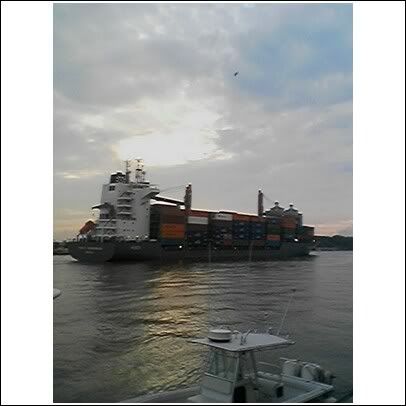
Now on to containers... here is a picture I took Friday of an outbound container ship at Savannah, Ga..


It struck me as I watched 3 similar ships sail up the river to the port that a reduction in container volume isn't visible there... and I was pleasantly surprised to see the outbound container ship also looked fully loaded...Image
Malthusian Riders Member!

Courtesy and Courage Sincerity and Self-control Honor and Loyalty a Code to Live By!
What do the miners do when the canary dies? EVACUATE THE MINE not argue about the color of it's feathers or buy a parrot instead.

Where is my pitchfork and torch? I need them for a visit to the castle!
User avatar
the48thronin
Tar Sands
Tar Sands
 
Posts: 871
Joined: Fri 30 May 2008, 03:00:00
Location: On the highway, or the water somewhere!

Re: Drastic Reduction In Global Shipping

Postby Snowrunner » Sun 10 Aug 2008, 17:16:11

$this->bbcode_second_pass_quote('the48thronin', '
')It struck me as I watched 3 similar ships sail up the river to the port that a reduction in container volume isn't visible there... and I was pleasantly surprised to see the outbound container ship also looked fully loaded...


I think shipping is going to be the last one were you will realize that the economy has tanked. They will first "combine" shipments and drop frequency before you will see half empty ships going in and out of port.

Do you know if the amount of traffic has changed?
User avatar
Snowrunner
Tar Sands
Tar Sands
 
Posts: 795
Joined: Wed 24 Aug 2005, 03:00:00
Location: Screwed
Top

Re: Drastic Reduction In Global Shipping

Postby the48thronin » Sun 10 Aug 2008, 22:23:59

$this->bbcode_second_pass_quote('Snowrunner', '')$this->bbcode_second_pass_quote('the48thronin', '
')It struck me as I watched 3 similar ships sail up the river to the port that a reduction in container volume isn't visible there... and I was pleasantly surprised to see the outbound container ship also looked fully loaded...


I think shipping is going to be the last one were you will realize that the economy has tanked. They will first "combine" shipments and drop frequency before you will see half empty ships going in and out of port.

Do you know if the amount of traffic has changed?


While I have seen reports that containers from Asia are down, I will try to spend some time in the next day or so contacting people who actually haul containers to see if the 28 day or so lag between shipment from asia and arrival here has resulted in lower volume in containers yet ( lower numbers of loads for trucks).

Mr Bill might be able to tell us more and quicker than I.

The NUMBERS are so skewed here in press releases.. I tend to believe contacts I know.

Several people I know are contract delivery types.. some with Walmart some with other store chains dc to store dedicated. THEY all are running less and desperately talking about looking for a different place to put their trucks.

My end of the business is actually booming.. I am doing a lot of relocation of financial institution records and servers and offices. ( duh, they have to send them somewhere when they close regional offices)

I am also still doing reasonably well with new store and restaurant fixtures, but the lag between planning and opening is about a year so this winter would be the time I expect this to slow a lot. Some projects have been canceled and delayed, but with larger stores this is not really possible as the building project ( mall etc) takes a year or more.

As to ship board loads from Asia, I can get some on the spot reports in the next day or two I think from container haulers.

Generally truck freight is down around the entire country here.
Malthusian Riders Member!

Courtesy and Courage Sincerity and Self-control Honor and Loyalty a Code to Live By!
What do the miners do when the canary dies? EVACUATE THE MINE not argue about the color of it's feathers or buy a parrot instead.

Where is my pitchfork and torch? I need them for a visit to the castle!
User avatar
the48thronin
Tar Sands
Tar Sands
 
Posts: 871
Joined: Fri 30 May 2008, 03:00:00
Location: On the highway, or the water somewhere!
Top

Re: Drastic Reduction In Global Shipping

Postby MrBill » Mon 11 Aug 2008, 03:21:46

I counted 16 ships at anchor off the coast this weekend waiting to get into port. That nominally seems like more than usual, but I have no idea, so it is hard to draw any conclusions. I do know that I can buy imported Spanish table wine here for 1.95 euros. A liter of water costs one euro. So how the Spanish can make wine, ship it to Cyprus in bottles and sell it at a nominal profit is beyond me? They cannot even reuse those bottles. The cost of shipping must still be ridiculously cheap. Or the Spaniards are selling surplus wine at their variable cost of production?

The water off-loading is going well now. About 10 ships in the past week. Six ships will deliver 160 loads of water this summer to Limassol from Greece. An expensive solution to our water problems here. However, there is still no consensus to build the water desalination plants they need. NIMBY and environmental concerns. So the Orthodoz Church is going to pray for rain instead. I am not kidding. I couldn't make this stuff up! ; - ))

They have cancelled 14-golf courses that were planned, which is too bad because the only decent golf courses are 50-60 km away near Pafos, so at least one closer would have been really nice. I would have thought that if properly designed they would have been able to use gray water for irrigation? But the Cypriots themselves have no idea when it comes to water. They still water their driveways despite water shortages.

You would think that living on a semi-arid island in a hot climate they might, but you would be wrong. They have zero idea. They end up burning all the grass because one they cut it too short, and second they water during the day, so the water acts like a magnifying glass and burns the grass. So they waste water and they still end up with brown grass. My friend just got back from the golf course near Pafos and confirmed the same thing.

It just goes to prove that although necessity may be the mother of invention that not all cultures are up to the task. I think that importing water is ten times as expensive as desalination and that somehow it is corruption that is holding it up. There is no transparency or honesty here in politics. So as 25-percent of the island's GDP depends on tourism and they have no water to support development like golf courses, for example, I guess this island will slowly turn into Africa.

Limassol lives off shipping and financial firms like mine. Both are here for tax and legal reasons. If the government needs to raise taxes to pay for such things as importing water then you can guess that shipping companies will go to Malta or UAE, and financial firms like mine can operate from anywhere. The island has been storing up some economic and environmental problems for quite some time. All that is coming back to haunt them now.
The organized state is a wonderful invention whereby everyone can live at someone else's expense.
User avatar
MrBill
Expert
Expert
 
Posts: 5630
Joined: Thu 15 Sep 2005, 03:00:00
Location: Eurasia

PreviousNext

Return to Economics & Finance

Who is online

Users browsing this forum: No registered users and 1 guest

cron