by ReverseEngineer » Wed 06 Aug 2008, 06:45:49
$this->bbcode_second_pass_quote('MrBill', 'T')hanks for those links, Canuk. I remember reading about how the container revolutionised shipping, but it is nice to find a source for the information again.
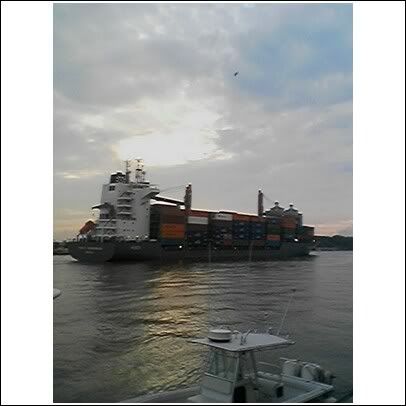
I think in any scenario, containerized shipping remains the best model. I'm going to paint a picture of how containerized shipping works in a world completely devoid of Oil, and to keep Mr Bill happy, I'm going to use both Bunker Fueled ships for intercontinental transport as well as the hub-spoke system for those Ports

I could make it work with Sail, but its not essential.
First off, I am going to hypothesize a 50% global die off so we are less stressed on the population level. 50% die off, 50% reduction in the total volume of goods, ships 1/2 the size necessary for the same relative transport of goods.
On the Intercontinental level, these ships are about half the size of current container ships, for a while can burn what heavy crude is available, eventually they just burn switchgrass or whatever. The containers they carry though are not the size of current containers, they are maybe 1/4 the size. Small enough that they can be on and offloaded utilizing human and animal powered winching systems if necessary, but around the Hub ports there is electricity generated by Windmills, Tidal Generators and Solar Collection.
At said Hub Ports, these smaller containers are put on still smaller SAIL vessels and barges which ply the coasts and inland waterways. Don't need as many Longshoremen as in the old days of bulk transport in the hold of a ship, but more than in the days when you could depend on oil to power huge cranes and so forth to haul up the containers.
To this point in the equation of downsizing, you haven't lost most of the technology from the old days, its just all scaled down to represent the population at large scaling down. Very little oil needed in this if any, and of course those Bunker Fuel ships could at least be assisted by a Parachute Sail when heading downwind, which they will for sure in at least one direction. Make them nice and long and skinny and optimize the drag coefficient as well.
These smaller sailboats and barges hit the more local hubs, where there aren't the Windmills and the Hydropower to drive the small cranes needed to offload the small containers, but long as there are enough guys working the shore, they can winch them up and winch them down with their own muscle and some mechanical advantage. Employ a few horses to do some of the major pulling also, I would bet if you were real efficient about it you could do the same job of offloading a container as is done now utilizing oil. The SLOW part of this step has nothing to do with the power involved, its the ACCURACY. I drove a Big Rig for 6 years, I hit the railyards MANY times to pick up containers, and droping these things on the trailer frame takes accuracy mainly. The speed has nothing to do with the power of the engines driving it, its all about not running the engines too fast or trying to swing into position too fast. Then you go outta control, which I saw happen on a couple of occassions also. In any event, you work with smaller containers, you actually can work a bit faster because you don't have so many problems with the inertia. Yes you will need more people here involved, but this is good from the employment perspective.
So anyhow, once dropped onshore at the Local Ports, how do these smaller containers make their way the Last Mile to the Consumer?
Well, first off you still have the Railroads, which like the ships can be Bunker Fuel powered. Or the rail lines might be electrified with Wind/Hydro Power, or a combination of both. Or you simply could have teams of Horses pulling the rail cars along the tracks. Slower than a modern railroad? Somewhat yes, but really have you ever sat at a crossing and watched how slow a freight train generally moves? Not more than about 15 mph most of the time except on long stretches of flat ground uninterupted by crossings. You simply cannot speed such things up and slow them down all that fast. Inertia. So again, while this slows down the whole process some, it does not slow it down SOOOO much it doesn't work. Know that because that is how it was DONE in the past, as long as the goods you are moving don't go bad, it does not matter if it takes a week or 3 months to move it around. Will you be able to get Maine Lobster in San Diego and eat it? No way. However, you certainly can get grain from the Midwest to New York this way and it still still be in fine shape.
Once you get the stuff to a central destination point, the individual consumer can go pick up the stuff himself with his horse and wagon, like we go to Walmart or the Big Box stores today in our Auomobiles. Do you go as often or buy the same Chinese CRAP? NO of course not, you mainly take a trip once a week or once a month to buy grain at the distribution center, to buy it you trade the nice Knives you make in your Forge at home since you are a Blacksmith, and the nice Sweaters your wife Knits at home from the Yarn you picked up on your last trip to the market. She ADDED VALUE to the yarn making a sweater, as you ADDED VALUE to the metal you got from the JUNKED CARS in your neighborhood by turning them into USEFUL KNIVES.
Where in ANY of this was OIL necessary? It was not necessary ANYWHERE, and commerce continues on the international level, albeit somewhat slower and somewhat reduced in the speed of transport and production. To say that Oil is necessary to retain international commerce long term is a CANARD. Reduced in volume for sure, but gone entirely? Not necessarily.
The problem here is in the transition downward, the dislocation, the Divide by Zero point in the current economy. The collapse of the current economic system means that for a period of time, we are in the Darkness of the Tunnel, but it does not have to mean that forever and all time society is DOOMED. We can emerge from the other side of this, smaller and in many senses BETTER, because we will be in better balance with what the Planet Earth can provide us in a sustainable fashion. We don't NEED Oil, we don't even need High Tech solutions like Solar Cells derived from Oil or Nuclear Power we can't run without oil to mine for the Uranium and refine it. All we REALLY need is what the Earth gives us, the Wind, the Animals for labor, a little basic engine technology and our own intelligence to properly organize the SYSTEM. Its all about systems, not energy really. Work it efficiently, my bet is you could achieve a carrying capacity of 2 Billion or perhaps even 3 Billion this way.
Reverse Engineer



 [/align][align=center]