$this->bbcode_second_pass_quote('MrBill', '.')..
Another type of risk that is considerably higher is when you attempt to build a factory or a mine in one of these countries. Then you deal with corruption on a whole other level. And once you have sunk costs in your project it is not so easy to walk away. Therefore you're more vulnerable to corruption on an ongoing basis and officials have leverage over you because they know you cannot leave.
...
I've always wondered why most of the world's oil refineries were built in oil importing nations and not exporting nations. Is there some engineering rule that says an oil refinery can't be built at the point of production and an oil rich nation can get into the business of exporting gasoline and diesel fuel instead of raw crude oil? I know that gasoline is much more susceptible to evaporation which can be a serious fire hazard if stored in very large containers. This is one of the reasons why large ships are powered by bunker fuel instead of gasoline or diesel.



PeakOil is You
Drastic Reduction In Global Shipping
Re: Drastic Reduction In Global Shipping
 by cube » Fri 01 Aug 2008, 06:19:58
However if humanity has figured out a way to launch rocket ships into space I'm quite sure the technical challenges involved in figuring out how to store gasoline in very large containers can be solved.

That leads to only 1 conclusion. --> a failed government.
I guess if an investor is going to sink $10 billion into building an oil refinery, property rights would definitely trump cheap labor!
- cube
- Intermediate Crude

- Posts: 3909
- Joined: Sat 12 Mar 2005, 04:00:00
Re: Drastic Reduction In Global Shipping
by ReverseEngineer » Fri 01 Aug 2008, 09:31:38
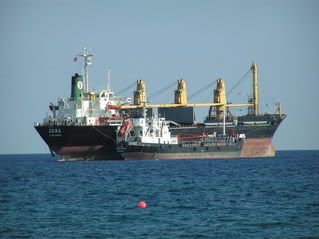
I think you have two opposing forces at work here, one is the economies of scale Mr Bill talks about which make larger ships which can use a variety of fuels for propulsion as being economic, the other one is smaller ships which run primarily on wind power and human labor as being economic.
He is right in the sense that during a transition period, scaling up works, but you also have to take into account the fact that overall the trade will decrease as the products themselves become too expensive to buy. So what happens faster here, demand destruction or shipping capability?
I think relative to what we see right now, demand destruction is the leader. Beyond the necessities of life of shelter, food and water, very little is going to be sought after in the downward spiral. All those commodities have to be available locally for any given community to survive. Mass shipments of grain will decrease as the grain needs to be distributed locally. Mass shipments of oil decrease as the price of the oil is out of reach of the consumers at the end of the shipping line. Clearly it takes some time for this to happen, but eventually it makes the big ships not economic to run. Not to mention, those big ports with the huge cranes lifting the containers on and off the ships take a lot of oil powered energy to work effectively.
Mr Bill's economic analysis is one which looks at the traditional aspects of supply and demand, its essentially correct but it does not take into account catastrophic failure of the system as a whole. In other words, at some point the big boats just won't be able to refuel at the point of destination in order to return back to the point of origin. Sailboats ALWAYS can do this.
The amount of international trade of all goods shrinks as the currency gets debased in all the countries. This is happening in China just as it is here, just in a somewhat different fashion, and its slightly lagging, but it fails as the economy here fails. At what point does the international trade fall off to such a point that the big boats are no longer economic to run, because it just costs too much in fuel to push them across the ocean at any speed? when is the actual volume too small to justify such big boats?
Well, I could project out here that it takes no more than 20 years for it to devolve to this level, and for really BIG boats, your lead time in building them and getting them fit out is gonna take a couple of years to begin with, and if you are to recoup the investment, they better keep operating for at least 20 years. Very risky proposition there.
Smaller boats take a much lower investment, and shorter lead time to get operating. The human labor needed to operate them is clearly out there desperate for work. Instant boats, instant labor, lower risk.
On the question of sailing into the wind using any technology, its clearly possible, its called TACKING. Makes the trip longer, but long as you can sail even just 20 degrees into the wind, its always possible to make decent progress. Obviously well designed sailing vessels can do better than that anyhow.
Reverse Engineer
He is right in the sense that during a transition period, scaling up works, but you also have to take into account the fact that overall the trade will decrease as the products themselves become too expensive to buy. So what happens faster here, demand destruction or shipping capability?
I think relative to what we see right now, demand destruction is the leader. Beyond the necessities of life of shelter, food and water, very little is going to be sought after in the downward spiral. All those commodities have to be available locally for any given community to survive. Mass shipments of grain will decrease as the grain needs to be distributed locally. Mass shipments of oil decrease as the price of the oil is out of reach of the consumers at the end of the shipping line. Clearly it takes some time for this to happen, but eventually it makes the big ships not economic to run. Not to mention, those big ports with the huge cranes lifting the containers on and off the ships take a lot of oil powered energy to work effectively.
Mr Bill's economic analysis is one which looks at the traditional aspects of supply and demand, its essentially correct but it does not take into account catastrophic failure of the system as a whole. In other words, at some point the big boats just won't be able to refuel at the point of destination in order to return back to the point of origin. Sailboats ALWAYS can do this.
The amount of international trade of all goods shrinks as the currency gets debased in all the countries. This is happening in China just as it is here, just in a somewhat different fashion, and its slightly lagging, but it fails as the economy here fails. At what point does the international trade fall off to such a point that the big boats are no longer economic to run, because it just costs too much in fuel to push them across the ocean at any speed? when is the actual volume too small to justify such big boats?
Well, I could project out here that it takes no more than 20 years for it to devolve to this level, and for really BIG boats, your lead time in building them and getting them fit out is gonna take a couple of years to begin with, and if you are to recoup the investment, they better keep operating for at least 20 years. Very risky proposition there.
Smaller boats take a much lower investment, and shorter lead time to get operating. The human labor needed to operate them is clearly out there desperate for work. Instant boats, instant labor, lower risk.
On the question of sailing into the wind using any technology, its clearly possible, its called TACKING. Makes the trip longer, but long as you can sail even just 20 degrees into the wind, its always possible to make decent progress. Obviously well designed sailing vessels can do better than that anyhow.
Reverse Engineer
-

ReverseEngineer - Intermediate Crude
- Posts: 3352
- Joined: Wed 16 Jul 2008, 03:00:00
Re: Drastic Reduction In Global Shipping
by MrBill » Fri 01 Aug 2008, 09:59:09
cube wrote:
$this->bbcode_second_pass_quote('', 'I')'ve always wondered why most of the world's oil refineries were built in oil importing nations and not exporting nations. Is there some engineering rule that says an oil refinery can't be built at the point of production and an oil rich nation can get into the business of exporting gasoline and diesel fuel instead of raw crude oil? I know that gasoline is much more susceptible to evaporation which can be a serious fire hazard if stored in very large containers. This is one of the reasons why large ships are powered by bunker fuel instead of gasoline or diesel.
However if humanity has figured out a way to launch rocket ships into space I'm quite sure the technical challenges involved in figuring out how to store gasoline in very large containers can be solved.
That leads to only 1 conclusion. --> a failed government.
I guess if an investor is going to sink $10 billion into building an oil refinery, property rights would definitely trump cheap labor!
$this->bbcode_second_pass_quote('', 'I')'ve always wondered why most of the world's oil refineries were built in oil importing nations and not exporting nations. Is there some engineering rule that says an oil refinery can't be built at the point of production and an oil rich nation can get into the business of exporting gasoline and diesel fuel instead of raw crude oil? I know that gasoline is much more susceptible to evaporation which can be a serious fire hazard if stored in very large containers. This is one of the reasons why large ships are powered by bunker fuel instead of gasoline or diesel.
However if humanity has figured out a way to launch rocket ships into space I'm quite sure the technical challenges involved in figuring out how to store gasoline in very large containers can be solved.
That leads to only 1 conclusion. --> a failed government.
I guess if an investor is going to sink $10 billion into building an oil refinery, property rights would definitely trump cheap labor!
[align=center]World's biggest refinery to test oil bulls[/align]
$this->bbcode_second_pass_quote('', ' ') On India's West coast, the world's biggest refining complex is nearly ready to begin pumping a wave of diesel fuel into the world oil market, removing one of the last near-term fundamentals supporting $100-plus crude.
But unfortunately for oil consumers and for a fragile world economy, Reliance Industries Ltd's <RELI.BO> new plant is likely to have a much greater impact on global refinery profits and price spreads than it will on New York Mercantile Exchange (NYMEX) crude futures or prices at the petrol pump.
Although a severe refining bottleneck was one of the initial catalysts for oil's six-year rally, it has been eclipsed by the growing importance of financial investors, attacks by Nigerian militants and lacklustre upstream oil output growth.
"The notion that new refineries will bring significantly lower crude prices doesn't look likely," says Kevin Norrish of Barclays Capital, which has been a consistent bull on prices.
"We may see some narrowing in spreads between heavy and
lighter grades...but we don't see any major changes in crude
price dynamics, since there are other more important factors at
work."
Reliance is expected within weeks to begin test running a new
580,000 barrel per day (bpd) refinery in Jamnagar, with full-fledged operation likely by early next year, industry sources say. Together with its existing 660,000 bpd, built less than a decade ago, the site will be world's biggest.
More remarkable is the fact that the new plant -- the most
sophisticated in the world for its size -- will produce an estimated 40 percent diesel, helping meet demand that has surged due to power shortages and growing use in passenger cars.
At the same time, demand for most other fuels -- from jet to gasoline to fuel oil -- is clearly in decline, one of the factors that has sliced 16 percent off oil prices since they hit a high of nearly $150 a barrel on July 11.
Whether easing the remaining strain on distillate markets with new supplies will deepen crude oil's losses remains an open question. Many analysts have reason to doubt it.
"The market does appear less concerned about downstream capacity constraints than previously," says Mike Wittner, global head of oil research at Societe Generale.
"I believe that the impact will be more on easing the gasoil cracks than on easing the crude flat price."
Source: SINGAPORE, Aug 1 (Reuters)
The organized state is a wonderful invention whereby everyone can live at someone else's expense.
-

MrBill - Expert

- Posts: 5630
- Joined: Thu 15 Sep 2005, 03:00:00
- Location: Eurasia
Re: Drastic Reduction In Global Shipping
by ReverseEngineer » Fri 01 Aug 2008, 10:13:12
$this->bbcode_second_pass_quote('cube', 'I')'ve always wondered why most of the world's oil refineries were built in oil importing nations and not exporting nations. Is there some engineering rule that says an oil refinery can't be built at the point of production and an oil rich nation can get into the business of exporting gasoline and diesel fuel instead of raw crude oil? I know that gasoline is much more susceptible to evaporation which can be a serious fire hazard if stored in very large containers. This is one of the reasons why large ships are powered by bunker fuel instead of gasoline or diesel.
However if humanity has figured out a way to launch rocket ships into space I'm quite sure the technical challenges involved in figuring out how to store gasoline in very large containers can be solved.
However if humanity has figured out a way to launch rocket ships into space I'm quite sure the technical challenges involved in figuring out how to store gasoline in very large containers can be solved.
This goes to a favorite concept here, EROEI. While technologically its certainly possible to transport gasoline, or compressed or cooled Propane or Natural Gas, the kind of ships you would have to build to do it would be very energy intensive. this would only make the end product more expensive than it already is for the consumer of the product.
Same reason you can't REALLY build communities on Mars or do anything more than fly to the Moon and back. It simply takes too much energy to do these things, and have enough left ober to actually start BUILDING something. If Mars had Oxygen and plenty of combustible materials and fertile soil, long as we could get there we could build there. It has none of those things in sufficient measure to make life viable, heck it would be easier to make life viable on Antartica, and even just keeping a Military Base there is a waste of money.
Sure its technoligically possible to build a ship that carries gasoline, but it would be expensive and chances are quite a few of those expensive ships would BLOW UP, like the Challenger did. You pull the oil in unrefined form to the place that uses it, then you refine it and send it out in smaller doses. The system developed this way for a REASON.
Reverse Engineer
-
ReverseEngineer - Intermediate Crude
- Posts: 3352
- Joined: Wed 16 Jul 2008, 03:00:00