

PeakOil is You
How my own observations mirrored Peak Oil...
Re: How my own observations mirrored Peak Oil...
 by btu2012 » Thu 05 Jun 2008, 21:35:53
$this->bbcode_second_pass_quote('BO', 'W')hat I find to be really funny though is the trotting out of the old dead horse, Papau New Guinea. I can't tell you how many arguments I have had with academics, etc. who always bring that up. Somehow, because tribes on Papau New Guinea practiced cannibalism, the other millions of tribes did too, how absolutely naive and simplistic.
Yeah man, P-NG is only the best collection of examples of isolated tribal cultures which we have. The basis for most comparative studies of tribal culture, given that anthropology is supposed to be an empirical science.
 Not for
 ![[smilie=adora.gif]](https://udev.peakoil.com/forums/images/smilies/adora.gif "adora") Quinn and his followers, apparently. What do those pesky academics know, the Guru has spoken.
Quinn and his followers, apparently. What do those pesky academics know, the Guru has spoken.
Given that most of the other millions of tribes have been extinct for millenia, it would make sense to draw conclusions
by studying the tribes which still exist. It is called the method of scientific induction. Admittedly itself a product of civilization, so perhaps we should drop it and return to magical thinking:
-tribal=good
-civilized=bad
-logic=evil
-reason=taboo
But I can see how the evidence presented by anthropologists who spent decades in the field could be so inconvenient for armchair speculators like
Quinn .
Papuans have inhabited the Australasian continental island of Papua for over 40,000 years while Austronesians have been there for several thousand years. These groups have developed diverse cultures and languages in situ; there are over 300 languages and two hundred additional dialects in West New Guinea alone
Western New Guinea is home to around 312 different tribes, including some uncontacted peoples.
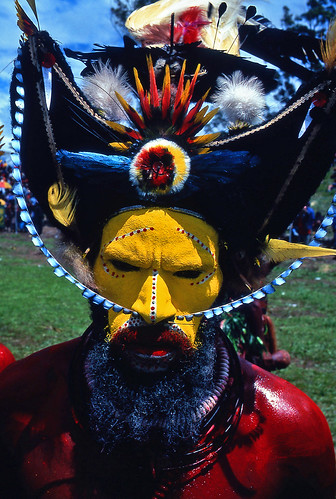
Kind hearted tribal warrior.

Last edited by btu2012 on Thu 05 Jun 2008, 23:27:49, edited 3 times in total.
only the paranoid survive
-

btu2012 - Heavy Crude

- Posts: 1802
- Joined: Mon 24 Sep 2007, 03:00:00
- Location: third from the sun
Re: How my own observations mirrored Peak Oil...
by threadbear » Thu 05 Jun 2008, 21:48:07
From Jane's original post. This is the attitude I've been responding to, that I've been asked to reference. Tribal life, as BTU and Yesplease and others describe, isn't all Care Bears and rainbows. There is a world of difference between simple living and primitive tribal life where people bash each others heads in for sport. Why put them on pedestals. They're people. Nuts, just like us.
"I am spiritual, however, and do respect others religious views.
My view of a natural lifestyle also coincided with my love for all tribal cultures and their respect for nature and understanding of the world around them, how they live in harmony on earth and with themselves. When I first thought about it I thought to myself, “that is the real way we should be living in life, like the tribal cultures.” Every aspect of their cultures describe a harmony with nature and because we are from nature I saw this as the best way to live."
"I am spiritual, however, and do respect others religious views.
My view of a natural lifestyle also coincided with my love for all tribal cultures and their respect for nature and understanding of the world around them, how they live in harmony on earth and with themselves. When I first thought about it I thought to myself, “that is the real way we should be living in life, like the tribal cultures.” Every aspect of their cultures describe a harmony with nature and because we are from nature I saw this as the best way to live."
-

threadbear - Expert

- Posts: 7577
- Joined: Sat 22 Jan 2005, 04:00:00
Re: How my own observations mirrored Peak Oil...
by btu2012 » Thu 05 Jun 2008, 22:06:28
Yup.
Regarding mass extinction, many scientists agree that the great mammals (a long series including the mammoth and many other) met their ends as species at the hand of tribal human hunters.
Fifty thousand years ago, continents were populated with more than 150 genera of megafauna (animals weighing more than 44 kg) [1-4]. By 10,000 years ago, at least 97 of those genera were gone . Prevailing explanations include human impacts, environmental changes, and a combination of both. If humans caused the extinctions, it will profoundly influence our thinking about what is "natural", how ecosystems respond to different scales and kinds of environmental change, how long extinctions take, and conservation of species and ecosystems.
Anthropogenic extinction models, including overkill, blitzkrieg (rapid overkill), and sitzkrieg (fire, habitat fragmentation, and the introduction of exotic species and diseases), have been considered plausible because large animals were preferentially affected. Species with low reproductive rates, with which large body size correlates, were hit hardest. Almost all of the slow-breeding survivors in Australia, Eurasia, the Americas, and Madagascar are nocturnal, arboreal, alpine, and/or deep-forest dwellers, which is consistent with overkill models of extinction but hard to explain by environmental change alone. Survival of large, open-country, slow-breeding animals in Africa is an exception to this pattern that must be factored into extinction explanations.
On islands, humans cause extinctions through multiple, synergistic effects, including predation and sitzkrieg. Only rarely have island megafauna been demonstrated to go extinct because of environmental change without human involvement. Incontrovertible impacts of humans on islands have been cited as a potent argument that prehistoric humans also caused extinctions on continents, but extrapolation of extinction mechanisms from islands to continents is often disputed.
In summary: One of the great debates about extinction is whether humans or climatic change caused the demise of the Pleistocene megafauna. Evidence from paleontology, climatology, archaeology, and ecology now supports the idea that humans contributed to extinction on some continents, but human hunting was not solely responsible for the pattern of extinction everywhere. Instead, evidence suggests that the intersection of human impacts with pronounced climatic change drove the precise timing and geography of extinction in the Northern Hemisphere. The story from the Southern Hemisphere is still unfolding. New evidence from Australia supports the view that humans helped cause extinctions there, but the correlation with climate is weak or contested. Firmer chronologies, more realistic ecological models, and regional paleoecological insights still are needed to understand details of the worldwide extinction pattern and the population dynamics of the species involved.

Regarding mass extinction, many scientists agree that the great mammals (a long series including the mammoth and many other) met their ends as species at the hand of tribal human hunters.
Fifty thousand years ago, continents were populated with more than 150 genera of megafauna (animals weighing more than 44 kg) [1-4]. By 10,000 years ago, at least 97 of those genera were gone . Prevailing explanations include human impacts, environmental changes, and a combination of both. If humans caused the extinctions, it will profoundly influence our thinking about what is "natural", how ecosystems respond to different scales and kinds of environmental change, how long extinctions take, and conservation of species and ecosystems.
Anthropogenic extinction models, including overkill, blitzkrieg (rapid overkill), and sitzkrieg (fire, habitat fragmentation, and the introduction of exotic species and diseases), have been considered plausible because large animals were preferentially affected. Species with low reproductive rates, with which large body size correlates, were hit hardest. Almost all of the slow-breeding survivors in Australia, Eurasia, the Americas, and Madagascar are nocturnal, arboreal, alpine, and/or deep-forest dwellers, which is consistent with overkill models of extinction but hard to explain by environmental change alone. Survival of large, open-country, slow-breeding animals in Africa is an exception to this pattern that must be factored into extinction explanations.
On islands, humans cause extinctions through multiple, synergistic effects, including predation and sitzkrieg. Only rarely have island megafauna been demonstrated to go extinct because of environmental change without human involvement. Incontrovertible impacts of humans on islands have been cited as a potent argument that prehistoric humans also caused extinctions on continents, but extrapolation of extinction mechanisms from islands to continents is often disputed.
In summary: One of the great debates about extinction is whether humans or climatic change caused the demise of the Pleistocene megafauna. Evidence from paleontology, climatology, archaeology, and ecology now supports the idea that humans contributed to extinction on some continents, but human hunting was not solely responsible for the pattern of extinction everywhere. Instead, evidence suggests that the intersection of human impacts with pronounced climatic change drove the precise timing and geography of extinction in the Northern Hemisphere. The story from the Southern Hemisphere is still unfolding. New evidence from Australia supports the view that humans helped cause extinctions there, but the correlation with climate is weak or contested. Firmer chronologies, more realistic ecological models, and regional paleoecological insights still are needed to understand details of the worldwide extinction pattern and the population dynamics of the species involved.
only the paranoid survive
-
btu2012 - Heavy Crude
- Posts: 1802
- Joined: Mon 24 Sep 2007, 03:00:00
- Location: third from the sun
Re: How my own observations mirrored Peak Oil...
by btu2012 » Thu 05 Jun 2008, 22:27:46
$this->bbcode_second_pass_quote('jane', ' ')And in OUR culture cannibalism is "bad" as are many aspects of tribal cultures, so does that mean:
a) we have to do that too?
b) its wrong because we say its wrong?
a) we have to do that too?
b) its wrong because we say its wrong?

Friendly cannibal.
$this->bbcode_second_pass_quote('firestarter', 'A')ctually, pre civilized tribal life (tribes-gatherer hunters-- existing before civilization) was essentially ludic/peaceful
![[smilie=violent1.gif]](https://udev.peakoil.com/forums/images/smilies/violent1.gif "violent1") , egalitarian , exhibited little if any organized violence
, egalitarian , exhibited little if any organized violence ![[smilie=5zombie.gif]](https://udev.peakoil.com/forums/images/smilies/5zombie.gif "5zombie") , was non sexist
, was non sexist ![[smilie=5bullwhip.gif]](https://udev.peakoil.com/forums/images/smilies/5bullwhip.gif "5bullwhip") , non materialistic
, non materialistic ![[smilie=eusa_shifty.gif]](https://udev.peakoil.com/forums/images/smilies/eusa_shifty.gif "eusa_shifty") , had no conception of private property
, had no conception of private property ![[smilie=3some.gif]](https://udev.peakoil.com/forums/images/smilies/3some.gif "3some") , and existed in this general condition for some two million years.
, and existed in this general condition for some two million years. ![[smilie=sad5.gif]](https://udev.peakoil.com/forums/images/smilies/sad5.gif "sad5")

New age anthropology !
![[smilie=eusa_doh.gif]](https://udev.peakoil.com/forums/images/smilies/eusa_doh.gif "eusa_doh")
Courtesy of Lucis Trust.
![[smilie=laughing7.gif]](https://udev.peakoil.com/forums/images/smilies/laughing7.gif "laughing7") http://www.lucistrust.org/
http://www.lucistrust.org/ We EAT YOUR BRAINS

$this->bbcode_second_pass_quote('jane', '.').. I guess I am a "naive" girl...

only the paranoid survive
-
btu2012 - Heavy Crude
- Posts: 1802
- Joined: Mon 24 Sep 2007, 03:00:00
- Location: third from the sun


