
PeakOil is You
THE US Fossil Fuel Stockpiles Thread (merged)
Re: estimate of maximum oil price
 by Rage » Fri 16 May 2008, 13:00:27
How does the sale of oil figure in calculating the GDP? Is every dollar of oil profit a dollar on the producing countries GDP? Would produces spend a smaller percentage of GDP as the cost goes up?
-

Rage - Wood

- Posts: 24
- Joined: Tue 06 May 2008, 03:00:00
Re: Coming Oil Price Superspike
by eXpat » Wed 21 May 2008, 00:22:09
Arjun N. Murti an analyst at Goldman Sachs, predicts Superspike link
$this->bbcode_second_pass_quote('', 'A')rjun N. Murti remembers the pain of the oil shocks of the 1970s. But he is bracing for something far worse now: He foresees a “super spike” — a price surge that will soon drive crude oil to $200 a barrel.
Mr. Murti, who has a bit of a green streak, is not bothered much by the prospect of even higher oil prices, figuring it might finally prompt America to become more energy efficient.
An analyst at Goldman Sachs, Mr. Murti has become the talk of the oil market by issuing one sensational forecast after another. A few years ago, rivals scoffed when he predicted oil would breach $100 a barrel. Few are laughing now. Oil shattered yet another record on Tuesday, touching $129.60 on the New York Mercantile Exchange. Gas at $4 a gallon is arriving just in time for those long summer drives.
Mr. Murti, 39, argues that the world’s seemingly unquenchable thirst for oil means prices will keep rising from here and stay above $100 into 2011. Others disagree, arguing that prices could abruptly tumble if speculators in the market rush for the exits. But the grim calculus of Mr. Murti’s prediction, issued in March and reconfirmed two weeks ago, is enough to give anyone pause: in an America of $200 oil, gasoline could cost more than $6 a gallon.
$this->bbcode_second_pass_quote('', 'A')rjun N. Murti remembers the pain of the oil shocks of the 1970s. But he is bracing for something far worse now: He foresees a “super spike” — a price surge that will soon drive crude oil to $200 a barrel.
Mr. Murti, who has a bit of a green streak, is not bothered much by the prospect of even higher oil prices, figuring it might finally prompt America to become more energy efficient.
An analyst at Goldman Sachs, Mr. Murti has become the talk of the oil market by issuing one sensational forecast after another. A few years ago, rivals scoffed when he predicted oil would breach $100 a barrel. Few are laughing now. Oil shattered yet another record on Tuesday, touching $129.60 on the New York Mercantile Exchange. Gas at $4 a gallon is arriving just in time for those long summer drives.
Mr. Murti, 39, argues that the world’s seemingly unquenchable thirst for oil means prices will keep rising from here and stay above $100 into 2011. Others disagree, arguing that prices could abruptly tumble if speculators in the market rush for the exits. But the grim calculus of Mr. Murti’s prediction, issued in March and reconfirmed two weeks ago, is enough to give anyone pause: in an America of $200 oil, gasoline could cost more than $6 a gallon.
Considering how prices are going up not unlikely at all...
"I learned long ago, never to wrestle with a pig. You get dirty, and besides, the pig likes it."
George Bernard Shaw
“You can ignore reality, but you can't ignore the consequences of ignoring reality.” Ayn Rand
George Bernard Shaw
“You can ignore reality, but you can't ignore the consequences of ignoring reality.” Ayn Rand
-

eXpat - Intermediate Crude

- Posts: 3801
- Joined: Thu 08 Jun 2006, 03:00:00
Re: Coming Oil Price Superspike
by MrBill » Wed 21 May 2008, 04:33:53
The nominal price of crude oil is largely irrelevant whether measured in US dollars or any other currency. What matters is petroleum's relative value to other commodites as well as wages and incomes, and, of course, physical shortages.
Commodity Price Inflation

Commodity Price Inflation in Euros
Notice the effect of the weak US dollar pales in comparison to real inflation-adjusted prices. That is actual demand outpacing readily available supply. Note that potential demand is always greater than actual demand. High prices ration demand where as available supply is limited by natural, physical and manmade shortages.

Unfortunately, I do not have an updated version of this graph to reflect commodity price gains in the past one year. However, just looking at a regression to the mean (say around long-term bond yields) that energy and commodity prices still have much further to rise most likely at the expense of property and equity prices.
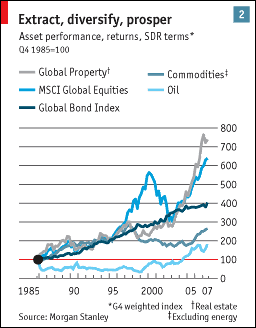
I apologize for using different time scales for comparison purposes, but it is hard to get the complete data much less prepare and size those graphs.
That fact is that governments are addicted to the revenue from oil whether that is royalties paid to producing nations or taxes levied on retail pump prices. Were we to see a super-spike in crude prices governments can lessen the blow to consumers in a stroke by rolling back taxes. But they won't because they need the money.
BigTex wrote:
$this->bbcode_second_pass_quote('', 'T')he only point I would make about economics in general when discussing peak oil (and I've made this point in various ways before) is that economic analysis simply provides red flags in the form of high prices too late. I have no suggestion regarding a better system for determining prices and how to allocate resources, but this problem of providing dramatic market signals in the form of high prices 10-20 years after the market would have needed a signal in order to actually do anything about the problem is troubling.
I suspect that an economist would say that it is the job of government to correct a market failure like this by imposing the necessary taxes to provide the appropriate price signal (which is sort of what Europse has done, I suppose) if this is in fact a market failure, but I don't think the U.S. government is anywhere near that perceptive.
So we are sort of left with a good tool (economics) when we need a great one (enlightenment?). Or maybe human nature is the real problem, and so long as humans are the ones searching for a solution, one will never be found.
Commodity Price Inflation
Commodity Price Inflation in Euros
Notice the effect of the weak US dollar pales in comparison to real inflation-adjusted prices. That is actual demand outpacing readily available supply. Note that potential demand is always greater than actual demand. High prices ration demand where as available supply is limited by natural, physical and manmade shortages.
Unfortunately, I do not have an updated version of this graph to reflect commodity price gains in the past one year. However, just looking at a regression to the mean (say around long-term bond yields) that energy and commodity prices still have much further to rise most likely at the expense of property and equity prices.
I apologize for using different time scales for comparison purposes, but it is hard to get the complete data much less prepare and size those graphs.
That fact is that governments are addicted to the revenue from oil whether that is royalties paid to producing nations or taxes levied on retail pump prices. Were we to see a super-spike in crude prices governments can lessen the blow to consumers in a stroke by rolling back taxes. But they won't because they need the money.
BigTex wrote:
$this->bbcode_second_pass_quote('', 'T')he only point I would make about economics in general when discussing peak oil (and I've made this point in various ways before) is that economic analysis simply provides red flags in the form of high prices too late. I have no suggestion regarding a better system for determining prices and how to allocate resources, but this problem of providing dramatic market signals in the form of high prices 10-20 years after the market would have needed a signal in order to actually do anything about the problem is troubling.
I suspect that an economist would say that it is the job of government to correct a market failure like this by imposing the necessary taxes to provide the appropriate price signal (which is sort of what Europse has done, I suppose) if this is in fact a market failure, but I don't think the U.S. government is anywhere near that perceptive.
So we are sort of left with a good tool (economics) when we need a great one (enlightenment?). Or maybe human nature is the real problem, and so long as humans are the ones searching for a solution, one will never be found.
Basically, you are right. Human nature and politics always trumps economics in the short-term. But that is true wether you are in a command and control economy or a social-democracy with a market economy. We know that we are living beyond the planet's ability to support us in the long-term. Doubling or tripling nominal prices would not make a difference to that unsustainability, and in any case much of the world's population could not afford to pay those higher real prices in any case, so the point is mute.
One can curb fossil fuel demand through higher real prices and carbon taxes, etc., but if no one can afford them that is another story. Why don't governments just mandate vehicles that get unlimited mileage with zero emmissions? You may as well blame it on the engineers for not developing a cleaner alternative to petroleum sooner, and at a reasonable cost that everyone can afford! ; - ))
The organized state is a wonderful invention whereby everyone can live at someone else's expense.
-

MrBill - Expert

- Posts: 5630
- Joined: Thu 15 Sep 2005, 03:00:00
- Location: Eurasia
Re: Coming Oil Price Superspike
by dohboi » Thu 22 May 2008, 02:56:46
Given the runup today, it looks like we're already inside your spike. But spike implies a price collapse, and that is not going to happen, or at least not for very long at all.
Post peak, hyperbolic growth of oilprices is now inevitable untill oil is no longer available at any price. How could anyother mathematical model apply at this point?
Most here and at TOD acknowledge that we are past light sweet crude peak. So there is less than half the amount available as there was.
Is that half going have a value less or more than the first half?
When there is only a quarter of all once-available oil left, will it have more or less value than the previous quarter?
How about the last eighth? The last sixteenth.....
At each point, what is left is worth more than what was pumped, and of course you can keep dividing in half mathematically for ever so you can keep increasing price or value forever.
That is the very nature of hyperbolic growth. We're on a one-way trip to infinity, and it's not going to be pretty.
Post peak, hyperbolic growth of oilprices is now inevitable untill oil is no longer available at any price. How could anyother mathematical model apply at this point?
Most here and at TOD acknowledge that we are past light sweet crude peak. So there is less than half the amount available as there was.
Is that half going have a value less or more than the first half?
When there is only a quarter of all once-available oil left, will it have more or less value than the previous quarter?
How about the last eighth? The last sixteenth.....
At each point, what is left is worth more than what was pumped, and of course you can keep dividing in half mathematically for ever so you can keep increasing price or value forever.
That is the very nature of hyperbolic growth. We're on a one-way trip to infinity, and it's not going to be pretty.
-
dohboi - Harmless Drudge
- Posts: 19990
- Joined: Mon 05 Dec 2005, 04:00:00
Re: Coming Oil Price Superspike
by yesplease » Thu 22 May 2008, 03:14:51
$this->bbcode_second_pass_quote('dohboi', 'A')t each point, what is left is worth more than what was pumped, and of course you can keep dividing in half mathematically for ever so you can keep increasing price or value forever.
That is the very nature of hyperbolic growth. We're on a one-way trip to infinity, and it's not going to be pretty.
Not exactly. Energy is energy, and there comes a point, around $200-300/bbl for most, and right now for those who are handy, where it's cheaper to utilize alternatives, since the vast majority of oil use is incredibly wasteful.That is the very nature of hyperbolic growth. We're on a one-way trip to infinity, and it's not going to be pretty.
$this->bbcode_second_pass_quote('Professor Membrane', ' ')Not now son, I'm making ... TOAST!
-

yesplease - Intermediate Crude
- Posts: 3765
- Joined: Tue 03 Oct 2006, 03:00:00
 For instance, most oil consumption in agriculture is for transportation, so more expensive oil means marginally more potatoes, rice, and beans, and less meat, fresh salads, etc... Of course, that being said, for the amount we'll likely spend w/ Iraq, we could build everyone in America a small efficient electric car and enough renewable energy to power them all, as well as enough to fix Carbon for on-highway goods transportation that actually needs the energy density of liquid fuels as well as expand the passenger and freight rail network. So, on one hand, we could actually free ourselves of our oil "addiction", or we could destabilize the ME, increase oil use, drive up prices, and make bank. Which one did we do? Clearly we're very concerned about our oil "addicition".