


PeakOil is You
Postponing Peak Oil or Perfect Storm
Re: Postponing Peak Oil or Perfect Storm
 by LoneSnark » Wed 23 Jan 2008, 14:25:19
Heineken, it sounds like you believe oil will just vanish one day. On monday we produced 83 million barrels of crude, on tuesday we produced 0 million barrels of crude, and so everything collapsed and we all had to go stand in bread lines.
-

LoneSnark - Tar Sands

- Posts: 514
- Joined: Thu 15 Nov 2007, 04:00:00
Re: Postponing Peak Oil or Perfect Storm
by Heineken » Wed 23 Jan 2008, 14:55:07
$this->bbcode_second_pass_quote('LoneSnark', 'H')eineken, it sounds like you believe oil will just vanish one day. On monday we produced 83 million barrels of crude, on tuesday we produced 0 million barrels of crude, and so everything collapsed and we all had to go stand in bread lines.
Snark buddy, you just don't get it. The entire world economy is based on producing 83 million barrels on Tuesday and 84 million barrels on Wednesday.
Oil doesn't have to "just vanish one day" for all the horrors I've envisioned to come to pass. The difficulties begin with the downslope and the inability of alternatives and efficiency campaigns to fully compensate. We are perilously close to that point right now.
Any possible net gains achieved through alternatives and efficiency measures are immediately wiped out by population increases. We continue to fall behind even as we become more bloated . . . until the whole nutty structure collapses of its own weight.
It stabilizes again . . . after dieoff.
"Actually, humans died out long ago."
---Abused, abandoned hunting dog
"Things have entered a stage where the only change that is possible is for things to get worse."
---I & my bro.
---Abused, abandoned hunting dog
"Things have entered a stage where the only change that is possible is for things to get worse."
---I & my bro.
-

Heineken - Expert

- Posts: 7051
- Joined: Tue 14 Sep 2004, 03:00:00
- Location: Rural Virginia
Re: Postponing Peak Oil or Perfect Storm
by benzoil » Wed 23 Jan 2008, 15:44:00
$this->bbcode_second_pass_quote('Tyler_JC', '1').Your inflated $600 billion figure is roughly what we already spend on cars every year.
I am perfectly content to devote $600 billion a year towards automobile consumption because...we already do it.
2. I never said they have to pay it off in one year. I said that the cost to build enough plants to build 16 million cars a year is $64 billion.
I often hear from doomers that retrofitting our industry is impossible because it would cost trillions of dollars. Well I've just proven that building the plants is cheap. Even if I'm off by 100 billion dollars, it's still cheaper than Bush's economic stimulus plan.
3. I don't care what the taxes are, what the design fees are, building costs, production costs, etc. All of that stuff is already included in every single other car on the road today. I'm not saying that electric cars will be free, I'm saying that they are going to cost the same amount of money (or less money) than every other car on the road RIGHT NOW.
The only difference between an electric car and a Chevy Suburban is that we have the plants to build a Suburban, we don't have the plants to build a Volt. Fine, spend the $64 billion and build a 16 million car/year capacity to do just that.
4. The average sticker price on a new car was $30,000 in 2004. The Chevy Volt will retail for something similar. Even if the Volt was as inefficient as your average Chevy Trailblazer, the world wouldn't be significantly worse off because the money is already being spent. Instead, we can redirect it towards far more efficient cars and cut down on wasted energy expenses dramatically.
As for 5 years being a long time to wait...is oil going to run out tomorrow? Next year?
And that 5 years assumes new construction, the more likely scenario is a cheaper and faster retrofit of existing infrastructure.
I am perfectly content to devote $600 billion a year towards automobile consumption because...we already do it.
2. I never said they have to pay it off in one year. I said that the cost to build enough plants to build 16 million cars a year is $64 billion.
I often hear from doomers that retrofitting our industry is impossible because it would cost trillions of dollars. Well I've just proven that building the plants is cheap. Even if I'm off by 100 billion dollars, it's still cheaper than Bush's economic stimulus plan.
3. I don't care what the taxes are, what the design fees are, building costs, production costs, etc. All of that stuff is already included in every single other car on the road today. I'm not saying that electric cars will be free, I'm saying that they are going to cost the same amount of money (or less money) than every other car on the road RIGHT NOW.
The only difference between an electric car and a Chevy Suburban is that we have the plants to build a Suburban, we don't have the plants to build a Volt. Fine, spend the $64 billion and build a 16 million car/year capacity to do just that.
4. The average sticker price on a new car was $30,000 in 2004. The Chevy Volt will retail for something similar. Even if the Volt was as inefficient as your average Chevy Trailblazer, the world wouldn't be significantly worse off because the money is already being spent. Instead, we can redirect it towards far more efficient cars and cut down on wasted energy expenses dramatically.
As for 5 years being a long time to wait...is oil going to run out tomorrow? Next year?
And that 5 years assumes new construction, the more likely scenario is a cheaper and faster retrofit of existing infrastructure.
I never said it was impossible or too expensive, merely that it's going to be harder and more expensive than simply throwing $64 billion at it. And yes, five years is a long time to wait. I don't think we'll get started on anything like the correct scale until we see actual hardships related to the decline in production. While we're waiting to pay off our current cars or otherwise get in a position to buy an electric car, we'll make other plans. We'll adapt and (god forbid) get used to being less mobile. Things will change.
TANSTAAFL
-

benzoil - Coal

- Posts: 443
- Joined: Fri 26 Aug 2005, 03:00:00
- Location: Windy City No Longer
Re: Postponing Peak Oil or Perfect Storm
by alokin » Thu 24 Jan 2008, 01:27:28
We must not discuss the one future model there are several, hybrids, electric etc. If everything goes on like that, there is no economic downturn etc. most people in developed countries might buy such a car.
But I don't think so. There are definitively too much problems around which should have been fixed years ago: PO, overpopulation, soil loss. etc etc. and the marode financial system.
The stock market has recovered a bit but I guess it will crash. And it is not true that high oil prices is the only reason, because other economies always paid their crude much more expensive as oil is (was?) pegged to the dollar and they're better off now.
I think it was such a big illusion that a non producing economy could work. New economy was a complete failure. Because you have to produce something to exchange it with other countries.
The US industry is simply not more able to produce competitive stuff. White goods, cars, tools, machines, appliances - are you able to sell anything in Europe?? (Two cars are seen: Ford Transit and sometimes a small Ford I forgot the name). I never ever saw a US fridge washing machine in the stores of Europe but I saw it in Colombia.
Maybe there will be a financial crash, and the oil in the ground simply will be forgotten. Our culture like every other culture is not eternally and we're in the twilight.
But I don't think so. There are definitively too much problems around which should have been fixed years ago: PO, overpopulation, soil loss. etc etc. and the marode financial system.
The stock market has recovered a bit but I guess it will crash. And it is not true that high oil prices is the only reason, because other economies always paid their crude much more expensive as oil is (was?) pegged to the dollar and they're better off now.
I think it was such a big illusion that a non producing economy could work. New economy was a complete failure. Because you have to produce something to exchange it with other countries.
The US industry is simply not more able to produce competitive stuff. White goods, cars, tools, machines, appliances - are you able to sell anything in Europe?? (Two cars are seen: Ford Transit and sometimes a small Ford I forgot the name). I never ever saw a US fridge washing machine in the stores of Europe but I saw it in Colombia.
Maybe there will be a financial crash, and the oil in the ground simply will be forgotten. Our culture like every other culture is not eternally and we're in the twilight.
-

alokin - Heavy Crude

- Posts: 1255
- Joined: Fri 24 Aug 2007, 03:00:00
Re: Postponing Peak Oil or Perfect Storm
by LoneSnark » Thu 24 Jan 2008, 01:49:04
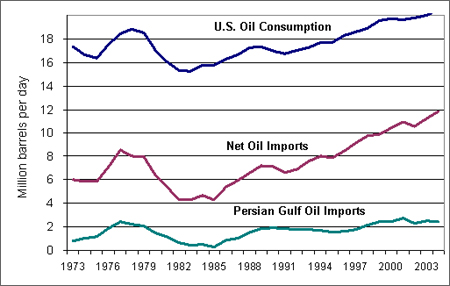
Heineken, my good friend, for you to be right then all the horrors you've envisioned must have come to pass way back in 1980 when oil consumption started falling fast. By 1983 U.S. oil consumption had fallen by 21%. By your reasoning I guess 21% of us died off, right?
-
LoneSnark - Tar Sands
- Posts: 514
- Joined: Thu 15 Nov 2007, 04:00:00
Re: Postponing Peak Oil or Perfect Storm
by seldom_seen » Thu 24 Jan 2008, 02:17:39
$this->bbcode_second_pass_quote('LoneSnark', 'B')y 1983 U.S. oil consumption had fallen by 21%
...and the economy was in recession and unemployment had risen to 10%, the highest unemployment rate registered since the great depression. Oil consumption resumed in force and the economy righted itself.
Fast forward 25 years. Millions of more people, living off loans and credit cards. The economy fully outsourced to China and India, and insourced to Mexico. The US producing about 4 million less barrels of oil a day than 1980 and hopelessly dependent on oil imports. With no prospect of a falling oil consumption rate ever to recover.
If you extrapolate from there I think Heineken has a pretty good point.
- seldom_seen
- Intermediate Crude

- Posts: 2229
- Joined: Tue 12 Apr 2005, 03:00:00
Re: Postponing Peak Oil or Perfect Storm
by Tyler_JC » Thu 24 Jan 2008, 02:45:04
Between 1980 and 1990, US oil consumption fell by 4 or 5%.
And yet the US population grew by 10%.
Real, inflation-adjusted manufacturing output increased by 38% between 1980 and 1989 despite a 6% loss in jobs (productivity soared!)
Total employment grew by 19 million.
The energy intensity of the US economy plummeted.

Source
And most importantly, we are no where near 1980 levels of energy expenditure as a share of GDP.

And yet the US population grew by 10%.
Real, inflation-adjusted manufacturing output increased by 38% between 1980 and 1989 despite a 6% loss in jobs (productivity soared!)
Total employment grew by 19 million.
The energy intensity of the US economy plummeted.
Source
And most importantly, we are no where near 1980 levels of energy expenditure as a share of GDP.
"www.peakoil.com is the Myspace of the Apocalypse."
- Tyler_JC
- Expert
- Posts: 5438
- Joined: Sat 25 Sep 2004, 03:00:00
- Location: Boston, MA
Re: Postponing Peak Oil or Perfect Storm
by mos6507 » Thu 24 Jan 2008, 06:40:04
US oil consumption is still a huge chunk of global oil consumption and is unlikely to follow an unpressured downward slope rapid enough to avoid PO hardships.
- mos6507
Re: Postponing Peak Oil or Perfect Storm
by Heineken » Thu 24 Jan 2008, 10:46:48
$this->bbcode_second_pass_quote('Tyler_JC', 'B')etween 1980 and 1990, US oil consumption fell by 4 or 5%.
And yet the US population grew by 10%.
Real, inflation-adjusted manufacturing output increased by 38% between 1980 and 1989 despite a 6% loss in jobs (productivity soared!)
Total employment grew by 19 million.
The energy intensity of the US economy plummeted.
Source
And most importantly, we are no where near 1980 levels of energy expenditure as a share of GDP.
And yet the US population grew by 10%.
Real, inflation-adjusted manufacturing output increased by 38% between 1980 and 1989 despite a 6% loss in jobs (productivity soared!)
Total employment grew by 19 million.
The energy intensity of the US economy plummeted.
Source
And most importantly, we are no where near 1980 levels of energy expenditure as a share of GDP.
Yes, but total energy use by the US has increased over the period from 1980 onward. Total energy use is what really counts. Also, all optimistic economic projections rely on continuing increases in total energy use.
All your graphs demonstrate is the shift of the US from a primarily manufacturing to a primarily service economy. Much of the manufacturing got sent overseas, shifting the industrial energy intensity there. Now we produce hamburgers, housing tracts, and illness care. The fact that total US energy use has actually increased despite this shift is really significant and shows how incredibly vulnerable we are.
But: Does it really matter whether China now uses the energy the US formerly used to manufacture a toaster? The energy gets used, and subtracted from the total pool.
A service and housing economy like the US, with its huge inelastic energy consumption, is fantastically vulnerable going forward. As much as---more than---an industrial economy.
Last edited by Heineken on Thu 24 Jan 2008, 11:03:17, edited 1 time in total.
"Actually, humans died out long ago."
---Abused, abandoned hunting dog
"Things have entered a stage where the only change that is possible is for things to get worse."
---I & my bro.
---Abused, abandoned hunting dog
"Things have entered a stage where the only change that is possible is for things to get worse."
---I & my bro.
-
Heineken - Expert
- Posts: 7051
- Joined: Tue 14 Sep 2004, 03:00:00
- Location: Rural Virginia


