I kinda come to your defense after 6 pages of top-to-bottom dismissal of everything you're talking about and that's how you react?
The bit about cooling fans was more of a facetious statement. Didn't quite come out that way I see. Oh well, now you know. We had a guy here whose signature was a disclaimer about being a sarcastic cynic. Bet that saved some time.


PeakOil is You
All problems solved! No need to worry.........NanoRobots!
Re: All problems solved! No need to worry.........NanoRobot
 by TheDude » Fri 06 Apr 2007, 02:37:28
Cogito, ergo non satis bibivi
And let me tell you something: I dig your work.
And let me tell you something: I dig your work.
-

TheDude - Expert

- Posts: 4896
- Joined: Thu 06 Apr 2006, 03:00:00
- Location: 3 miles NW of Champoeg, Republic of Cascadia
Re: All problems solved! No need to worry.........NanoRobot
by jbeckton » Fri 06 Apr 2007, 09:18:16
$this->bbcode_second_pass_quote('Heineken', '
')As for researching "going on," well, of course, people with your cornucopian mindset believe that all the human institutions will go on indefinitely, ever-enlarging and ever-progressing until we occupy every corner of known space.
')As for researching "going on," well, of course, people with your cornucopian mindset believe that all the human institutions will go on indefinitely, ever-enlarging and ever-progressing until we occupy every corner of known space.
Show me my post that claims that all the human institutions will go on indefinitely, ever-enlarging and ever-progressing until we occupy every corner of known space.
I'll save you some time, I never said that and you know it.
By the way, classical universities weren't 1 room school houses. You have watched too much little house on the prairie.
not

-

jbeckton - Expert
- Posts: 2082
- Joined: Fri 05 Jan 2007, 04:00:00
Re: All problems solved! No need to worry.........NanoRobot
by Heineken » Fri 06 Apr 2007, 09:42:27
$this->bbcode_second_pass_quote('JasonHam', '[')i]It would be nice if intelligence could deal with global warming simply by turning up its cooling fans. Will these things have cooling fans? I'm curious about nano but this topic is just more static.[b]
That question shows how little you know.
That question shows how little you know.
I'm suspicious of people who go about asserting how little others know.
All we can ever really know is how woefully little we know.
One does not have to be an expert on nanotechnology, or any technology, to offer worthwhile opinions on how it relates, or might relate, to the world and its problems.
For example, I am not an expert on the internal combusion engine---far from it---but I can see reasonably clearly what it has done to us.
-

Heineken - Expert
- Posts: 7051
- Joined: Tue 14 Sep 2004, 03:00:00
- Location: Rural Virginia
Re: All problems solved! No need to worry.........NanoRobot
by jbeckton » Fri 06 Apr 2007, 09:52:10
$this->bbcode_second_pass_quote('Heineken', '
')One does not have to be an expert on nanotechnology, or any technology, to offer worthwhile opinions on how it relates, or might relate, to the world and its problems.
')One does not have to be an expert on nanotechnology, or any technology, to offer worthwhile opinions on how it relates, or might relate, to the world and its problems.
Do you have to be an expert to express your opinion? Of course not but then again you are only expressing the opinon of someone who does not understand the technology and therefore, you must accept that your opinion doesn't hold much weight with someone who has atempted to, or does understand the technology.
Think about people that dismiss PO because they don't really understand the situation and you might see where I am comming from. Is it ok for them to dismiss it because from the outside everything looks warm and fuzzy?
Sure but I don't put much weight in their opinion on PO, just as i don't out much weight in your opinion of nanotech.
Fair enough?
-
jbeckton - Expert
- Posts: 2082
- Joined: Fri 05 Jan 2007, 04:00:00
Re: All problems solved! No need to worry.........NanoRobot
by Heineken » Fri 06 Apr 2007, 09:52:27
$this->bbcode_second_pass_quote('jbeckton', '')$this->bbcode_second_pass_quote('Heineken', '
')As for researching "going on," well, of course, people with your cornucopian mindset believe that all the human institutions will go on indefinitely, ever-enlarging and ever-progressing until we occupy every corner of known space.
')As for researching "going on," well, of course, people with your cornucopian mindset believe that all the human institutions will go on indefinitely, ever-enlarging and ever-progressing until we occupy every corner of known space.
Show me my post that claims that all the human institutions will go on indefinitely, ever-enlarging and ever-progressing until we occupy every corner of known space.
I'll save you some time, I never said that and you know it.
By the way, classical universities weren't 1 room school houses. You have watched too much little house on the prairie.
not
Your position is classic straw-man stuff.
You are trying to bolix up the discussion by confusing higher education (universities) with grade school (one-room schoolhouses).
Nanotech research isn't likely to happen in one-room schoolhouses, right? My position is that formal education is likely to devolve to that level. The huge universities that foster such research are going bye-bye because they are no more sustainable than yer local mall.
Also, I never said you claimed that human institutions would go on indefinitely etc. I said that such beliefs are typical of the cornucopian mindset, which you appear to evince. If you're a doomer or something in-between, please enlighten us.
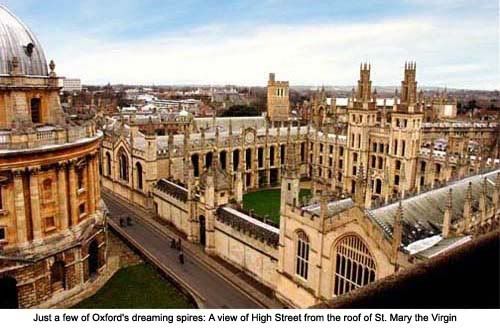
Yes, the picture of venerable Oxford is impressive, but there were only a handful of such institutions centuries ago, and they weren't building cyclotrons or researching how to turn the world into gray goo. They didn't have Olympic-size stadiums etc.
As I said, they were far fewer, far smaller, and far simpler than today's academic monuments to complexity, consumption, luxury, and excess.
In fact, most of their energies were devoted to teaching Latin and Greek! Until the late 1700s/early 1800s (and the time the fossil-fuel age started fulminating), scientific research was happening primarily at the fringes.
-
Heineken - Expert
- Posts: 7051
- Joined: Tue 14 Sep 2004, 03:00:00
- Location: Rural Virginia

