For the companies in question given they would be able to recover all exploration and development costs from the State in exchange for ~18% royalties I think it would still be an economically decent project. The field had a reasonable GOR so my guess is the gas lift comes from re-injection of produced and separated gas.
Just looking at the production from 2005 through 2011 (all I could find from the Alaska gov't) the NPV10 (using WTI pricing at the time) would be in the order of $3.6 billion gross or ~$3.2 billion net. Of course this assumes all costs are recoverable (I can't remember what the exact deal was with similar concessions but I seemed to remember this was the case).
Production from 2006 onwards gradually decreased and in 2014 BP sold off the majority of it's interests in Northstar and a couple of other fields to Hilcorp (which at the time was a Houston based company concentrating in Lousiana E&P). The press from BP stated that for smaller fields like the ones they farmed down to Hilcorp it made more sense to be in the hands of a small company who could get more out of the field whereas BP was concentrating on their bigger fields elsewhere.



PeakOil is You
Declining Production in Alaska
Re: Declining Production in Alaska
 by rockdoc123 » Sun 22 Jan 2017, 15:53:00
-

rockdoc123 - Expert

- Posts: 7685
- Joined: Mon 16 May 2005, 03:00:00
Re: Declining Production in Alaska
by JimBof » Sun 22 Jan 2017, 20:39:03
$this->bbcode_second_pass_quote('ROCKMAN', 'b')aha - That's why I'll tease an explorationist (if I think he can take) as to why he includes an economic analysis of his wildcat prospect: in the ernture history of the oil patch no one has ever submitted an economic analysis of an exploration project that didn't look viable.
Which is why I never look at those numbers. As your mother understood each project is given a probability of success. That times the reserves target yields the RRE...Risked Reserve Economics. Every exploration hand knows what the RRE has to look like for management to buy the idea. Even for relatively dumb managers you can't put a Ps of 80% on a risky project. But you can push the limits on reservoir size. After all if the target hasn't been drilled you don't know how big it is.
Thus comes the wonderful world of Excel spreadsheets: one can vary the Ps with reserve size using limits that are defendable. With just a few clicks the exploration hand can find that sweet spot of the reasonable risk (and a tad optimism is allowed because he knows something others have missed) and reasonable target size.
What I'll dig deepest into is target size. More then a few times I've seen targets that would represent the top 5% percentile of what has been discovered in a trend that has been explored for decades. That way even using a low Ps the RRE don't look too bad. And yes: a few times I've seen target numbers larger the anything ever discovered in the trend.
Most understand what I've described by the kind phrase: reverse engineering. Less kind: f*cking made up numbers. LOL. And if you notice a touch of bitterness in my tone there's a good reason: I've functioned as a development/reservoir geologist most of my career. You outsiders should understand that exploration hands will be forgiven for a number of dry holes. But development wells are expected to always work.
My first project at Mobil Oil in 1975: exploration drilled two wells that found a variety of different pay sands in a field with numerous fault blocks. Using seismic data projected those reserves to all those untested fault blocks. And not overly optimistic Ps...20% to 35%. Being a new development geologist fresh out of school all I did was push the paper work thru, give target coordinates to the drilling engineer and go log the wells. Wells drilled from the platform set over the site of one of the two discovery wells which had been plugged and abandoned. So started out with risked reserves of 20 million bbls and 100 bcf. And then my first 5 "very low risk" development wells were DRY HOLES. For instance the well the platform was set over found a 120' thick NG reservoir which was projected to exist in numerous offset fault blocks. Not only did that sand not contain NG in it in those fault blocks we never even saw the sand again.
So reserves went from 20 million bbls to 1 million and 100 bcf to 20. And only because we found a small fault block at the edge of the lease that the operator of that offset lease discovered. Our exploration department didn't even project reserves there originally.
And yes: I was nicknamed the "undevelopment geologist". LOL. Funny now...not then.
And that really isn't a condemnation of explorationists...without their efforts there would be no need for development geologists. LOL. But just some insight to just how difficult the process is. And that there was never been any f*cking "easy oil". If that field were analyzed today we would know what is and isn't there...seismic data has improved greatly from 40+ years ago. It is much easier to identify viable prospects today then ever before. If there is ever a time of "easy" oil/NG then it's today. The success rate today is much higher then it was decades ago...that's not the problem today. The problem is the limited number of conventional prospects left to find. IOW lots of conventional prospects decades ago that were difficult to find vs few conventional prospects today which are relatively easy to find.
Which is why I never look at those numbers. As your mother understood each project is given a probability of success. That times the reserves target yields the RRE...Risked Reserve Economics. Every exploration hand knows what the RRE has to look like for management to buy the idea. Even for relatively dumb managers you can't put a Ps of 80% on a risky project. But you can push the limits on reservoir size. After all if the target hasn't been drilled you don't know how big it is.
Thus comes the wonderful world of Excel spreadsheets: one can vary the Ps with reserve size using limits that are defendable. With just a few clicks the exploration hand can find that sweet spot of the reasonable risk (and a tad optimism is allowed because he knows something others have missed) and reasonable target size.
What I'll dig deepest into is target size. More then a few times I've seen targets that would represent the top 5% percentile of what has been discovered in a trend that has been explored for decades. That way even using a low Ps the RRE don't look too bad. And yes: a few times I've seen target numbers larger the anything ever discovered in the trend.
Most understand what I've described by the kind phrase: reverse engineering. Less kind: f*cking made up numbers. LOL. And if you notice a touch of bitterness in my tone there's a good reason: I've functioned as a development/reservoir geologist most of my career. You outsiders should understand that exploration hands will be forgiven for a number of dry holes. But development wells are expected to always work.
My first project at Mobil Oil in 1975: exploration drilled two wells that found a variety of different pay sands in a field with numerous fault blocks. Using seismic data projected those reserves to all those untested fault blocks. And not overly optimistic Ps...20% to 35%. Being a new development geologist fresh out of school all I did was push the paper work thru, give target coordinates to the drilling engineer and go log the wells. Wells drilled from the platform set over the site of one of the two discovery wells which had been plugged and abandoned. So started out with risked reserves of 20 million bbls and 100 bcf. And then my first 5 "very low risk" development wells were DRY HOLES. For instance the well the platform was set over found a 120' thick NG reservoir which was projected to exist in numerous offset fault blocks. Not only did that sand not contain NG in it in those fault blocks we never even saw the sand again.
So reserves went from 20 million bbls to 1 million and 100 bcf to 20. And only because we found a small fault block at the edge of the lease that the operator of that offset lease discovered. Our exploration department didn't even project reserves there originally.
And yes: I was nicknamed the "undevelopment geologist". LOL. Funny now...not then.
And that really isn't a condemnation of explorationists...without their efforts there would be no need for development geologists. LOL. But just some insight to just how difficult the process is. And that there was never been any f*cking "easy oil". If that field were analyzed today we would know what is and isn't there...seismic data has improved greatly from 40+ years ago. It is much easier to identify viable prospects today then ever before. If there is ever a time of "easy" oil/NG then it's today. The success rate today is much higher then it was decades ago...that's not the problem today. The problem is the limited number of conventional prospects left to find. IOW lots of conventional prospects decades ago that were difficult to find vs few conventional prospects today which are relatively easy to find.
You mean it is not that there aren't more needles in the haystack, it is that some barstool made the haystack bigger?
- JimBof
- Peat

- Posts: 69
- Joined: Fri 20 Jun 2014, 07:34:56
Re: Declining Production in Alaska
by Alaska_geo » Sun 22 Jan 2017, 22:20:12
$this->bbcode_second_pass_quote('pstarr', '')$this->bbcode_second_pass_quote('MD', 'T')he elephant: That pipeline is approaching "paper thin" status along much of its length. Between that and declining flow rates, I am surprised it hasn't been shut down yet. How much of what flows down that pipe is now just hot water?
The declining flow rate results in a colder flow, and so paraffin wax (found in petroleum) builds up inside the pipe . . . constricting flow even more. Cooler pipe. That's one of those unfortunate/nasty positive feedback loops.
Normally they'd run a scaper pig down the pipe. But not with think rusty walls??????
sarc on Since economics trumps geology (and demand creates supply) they will just have to helicopter the oil out. One barrel at a time. Who ever said peak oil impacts flow rate? sarc off
Lot of BS going down here.
While paraffin does create problems for TAPS, in can be and is removed by regular pigging. The biggest issue is with water. Pipeline grade oil still contains minute amounts of water (I seem to recall the figure of around 1% or less). At the high flow rates TAPS was designed for, this tiny amount of water remains in suspension in the oil. Note that TAPS is still full of oil, it just moves much more slowly down the pipe. At slower flow rates, that minute amount of water tends to settle out at low point along the pipeline. Another consequence of low flow rates is that the oil has more time to cool on its way South to Valdez. So that water which has settled in low spots can freeze. The ice is much more problematic to clear out than paraffin. And note that while there is some wall loss in spots due to corrosion, TAPS is no where near "paper thin".
The oil companies continue to propagandize that the minimum feasible flow for TAPS is around 300,000 bbl/day. (This is the company party line, to argue against state production taxes.) However, some years back some internal BP documents emerged during a court case regarding taxes. These documents showed that BP's own internal estimate of minimum flow for TAPS was around 100,000 bbl/day. They showed in fact that BP has been booking reserves under the assumption that TAPS could operated down to that lower rate.
It should be noted that the 100,000 bbl/day rate was assuming that modifications were made to TAPS, principally adding heat at strategic locations. The economic feasibility of that obviously depends on oil prices. My understanding is that some, but not all, of that work has been done.
To paraphrase Mark Twain, rumors of the imminent demise of TAPS are greatly exaggerated.
"Toto, I've a feeling we're not in Kansas any more."
-Dorothy, in The Wizard of Oz
-Dorothy, in The Wizard of Oz
- Alaska_geo
- Wood
- Posts: 39
- Joined: Tue 16 Dec 2014, 21:56:22
- Location: Alaska
Re: Declining Production in Alaska
by Alaska_geo » Sun 22 Jan 2017, 22:33:37
$this->bbcode_second_pass_quote('rockdoc123', ' ')Production from 2006 onwards gradually decreased and in 2014 BP sold off the majority of it's interests in Northstar and a couple of other fields to Hilcorp (which at the time was a Houston based company concentrating in Lousiana E&P). The press from BP stated that for smaller fields like the ones they farmed down to Hilcorp it made more sense to be in the hands of a small company who could get more out of the field whereas BP was concentrating on their bigger fields elsewhere.
Hilcorp seems to be doing fairly well with the N Slope assets they bought from BP Regarding Northstar. As is so often the case, small nimble independents like Hilcorp can operate declining fields like Northstar much more efficiently that big companies like BP. See
http://www.petroleumnews.com/pnads/571846916.shtml
"Cumulative production at the Northstar unit was 159.6 million barrels by the start of 2014, according to the AOGCC. The unit produced 3.2 million barrels that year for a total of 162.8 million by the start of 2015. Annual productions declined to 2.2 million barrels in 2015, for a total of 165 million by the start of this year. The unit produced 1 million barrels in the first six months of this year, suggestion a slowdown in the decline rate."
"Toto, I've a feeling we're not in Kansas any more."
-Dorothy, in The Wizard of Oz
-Dorothy, in The Wizard of Oz
- Alaska_geo
- Wood
- Posts: 39
- Joined: Tue 16 Dec 2014, 21:56:22
- Location: Alaska


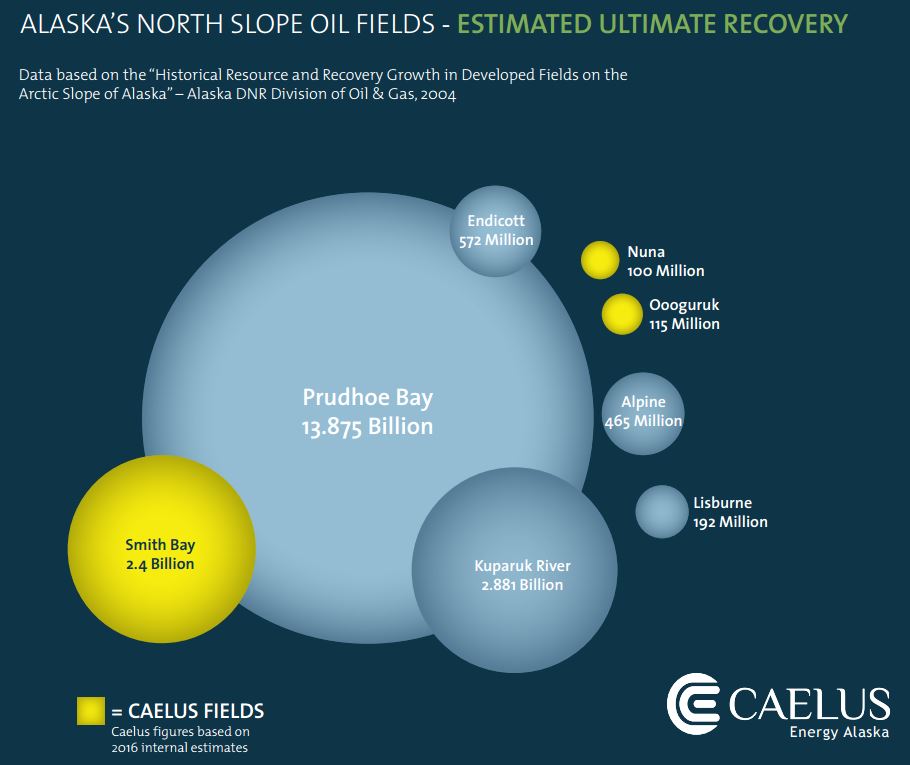 Smith River is the largest oil discovery in Alaska in four decades.

