Speaking of untapped reserve thank goodness before President Obama has left office he finally got his Interior Dept. to get its act together and develop the regs allowing us to go forward with plans to develop all our Arctic reserves:
US Interior finalizes Arctic exploratory drilling regulations
07/07/2016
The US Department of the Interior on July 7 announced final regulations for exploratory drilling activities on the US Arctic Outer Continental Shelf (OCS) that require firms to have plans in place should a safety or environmental issue arise during operations.
The final rule focuses solely on floating vessels within the US Beaufort and Chukchi seas, requiring firms to implement proper internal controls and planning for oil-spill prevention, containment, and responses—issues identified by previous Interior reports on Royal Dutch Shell PLC’s 2012 exploration activities in the Arctic.



PeakOil is You
America now has more untapped oil than any other country
Re: America now has more untapped oil than any other country
 by ROCKMAN » Fri 08 Jul 2016, 19:23:06
-

ROCKMAN - Expert

- Posts: 11397
- Joined: Tue 27 May 2008, 03:00:00
- Location: TEXAS
Re: America now has more untapped oil than any other country
by ROCKMAN » Fri 08 Jul 2016, 19:33:11
And just in the nick of time:
US oil well completions fell 69% in the second quarter compared with year-ago levels, the American Petroleum Institute estimates in its 2016 Quarterly Well Completion Report. Estimated exploratory gas well completions in the second quarter decreased 84% year-over-year. So far this year, development well footage has declined 53% while exploratory well footage has declined 64%, the report indicates.
Some may recall how some cornucopians were bragging back in 2015 about how completion counts were still not looking too terrible. Remember Rockman's response: LAG TIME. IOW wait until the last half of 2016 and first half of 2017.
Not difficult to be correct when one has lived with the lag dynamics for 41+ years. LOL.
US oil well completions fell 69% in the second quarter compared with year-ago levels, the American Petroleum Institute estimates in its 2016 Quarterly Well Completion Report. Estimated exploratory gas well completions in the second quarter decreased 84% year-over-year. So far this year, development well footage has declined 53% while exploratory well footage has declined 64%, the report indicates.
Some may recall how some cornucopians were bragging back in 2015 about how completion counts were still not looking too terrible. Remember Rockman's response: LAG TIME. IOW wait until the last half of 2016 and first half of 2017.
Not difficult to be correct when one has lived with the lag dynamics for 41+ years. LOL.
-
ROCKMAN - Expert
- Posts: 11397
- Joined: Tue 27 May 2008, 03:00:00
- Location: TEXAS
Re: America now has more untapped oil than any other country
by ROCKMAN » Fri 08 Jul 2016, 19:51:48
Z - And for your continuing education: if you can't beleive the estimates from a writer you never heard of who works for a national oil company well known for its lack of transparency. And notice this is a negative piece describing a DECREASE in the rate of reserves growth:
DECLINE IN ANNUAL RATE OF INCREASE
07/04/2016
Gongming Yu Yijun Wang. China National Petroleum Corp.
"Recoverable reserves of hydrocarbon liquids will grow 614 billion bbl from 2014 to 2044. Natural gas reserves will increase 87 trillion cu m (tcm) in the same 30-year period. This estimate results from a new region-specific model for assessing global reserve growth. The model reflects regional conditions and resource characteristics in estimating reserve growth by using a new method called "segment-accumulation multiplier." This methodology can forecast reserve growth more accurately than previous means, given its focus on region-specific factors. "
Wow...a better "multiplier"! I wonder if that's something like billions of oil times X = Y bbls...the number management told him he had to calculate. LOL. But don't laugh too hard: I've seen exactly done more then once in US companies.
DECLINE IN ANNUAL RATE OF INCREASE
07/04/2016
Gongming Yu Yijun Wang. China National Petroleum Corp.
"Recoverable reserves of hydrocarbon liquids will grow 614 billion bbl from 2014 to 2044. Natural gas reserves will increase 87 trillion cu m (tcm) in the same 30-year period. This estimate results from a new region-specific model for assessing global reserve growth. The model reflects regional conditions and resource characteristics in estimating reserve growth by using a new method called "segment-accumulation multiplier." This methodology can forecast reserve growth more accurately than previous means, given its focus on region-specific factors. "
Wow...a better "multiplier"! I wonder if that's something like billions of oil times X = Y bbls...the number management told him he had to calculate. LOL. But don't laugh too hard: I've seen exactly done more then once in US companies.
-
ROCKMAN - Expert
- Posts: 11397
- Joined: Tue 27 May 2008, 03:00:00
- Location: TEXAS
Re: America now has more untapped oil than any other country
by AdamB » Fri 08 Jul 2016, 23:17:34
$this->bbcode_second_pass_quote('rockdoc123', '
')$this->bbcode_second_pass_quote('', 'C')ontingent and potential have undiscovered components? I didn't know that.
')$this->bbcode_second_pass_quote('', 'C')ontingent and potential have undiscovered components? I didn't know that.
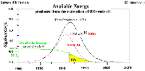
The definitions are clearly outlined by SEC and other securities exchanges. The following chart shows the probability distributions for reserves and resources and shows (as I pointed out) that resources are divided into discovered but sub-commercial (Contingent) and undiscovered (Prospective). The “technically recoverable resources “ would fall into these categories.

Interesting that the USGS doesn't buy into the "unrecoverable" angle, any more than the EIA paper does. It is only a matter of cost, because from a technical standpoint, everything can be recovered, the creation of the wellbore itself being the most basic mining operation. Can you see wringing out sample bags to recover all the oil? It'll cost ya, but it can be done!
I don't like the entire "low estimate", "high estimate" language either. It doesn't properly capture the uncertainty involved, probability doesn't require the kind of scenario modeling implied by those words. Scenario's are a poor mans probability estimate, hell, it doesn't even have to be a probability estimate, you can just lay down 3 guesses, and label them with probabilities, with zero knowledge if, in fact, those are really the probabilities for your scenarios.
Plant Thu 27 Jul 2023 "Personally I think the IEA is exactly right when they predict peak oil in the 2020s, especially because it matches my own predictions."
Plant Wed 11 Apr 2007 "I think Deffeyes might have nailed it, and we are just past the overall peak in oil production. (Thanksgiving 2005)"
Plant Wed 11 Apr 2007 "I think Deffeyes might have nailed it, and we are just past the overall peak in oil production. (Thanksgiving 2005)"
-

AdamB - Volunteer

- Posts: 11018
- Joined: Mon 28 Dec 2015, 17:10:26
Re: America now has more untapped oil than any other country
by rockdoc123 » Fri 08 Jul 2016, 23:48:22
$this->bbcode_second_pass_quote('', 'I')'ve said this before: I never look at the economics presented on an exploration well? Why would I: every one, with not one exception ever, shows a very juicy profit potential. Just as every one of the dry holes I've seen drilled. I've always based my recommendations on the logic supporting a prospect...not the economic outcome proposed. I've drilled many profitable wells but seldom have they found 100% of the projected reserves.
when you have limited choices or are looking at one offs it ends up being a bit of a seat of the pants game. However when you are at a bigger company with a number of potential opportunities you absolutely have to consider a few things regarding economics...1. risked NPV (ie the chance of success multiplied by the NPV10 of the project), 2. time to payout (waiting more than 3 or so years to get paid back doesn't make sense unless it is a huge project), 3. return on investment (I always used discounted profit to investment ration DPR but there are other measure). When you have a number of opportunities and need to compare them an economic comparison is essential. At the same time you need to take risk into the equation. The analyses that Pete Rose always pushed are the best for that. So unlike your experience I always looked at the economics on a risked basis and then looked for the key potential failure and whether or not it could be mitigated. The play might make sense geologically and from a engineering perspective but even if it is successful and has a low chance of making money .....well thats a fools errand.
-
rockdoc123 - Expert
- Posts: 7685
- Joined: Mon 16 May 2005, 03:00:00
Re: America now has more untapped oil than any other country
by ROCKMAN » Sat 09 Jul 2016, 00:05:24
Adam - It's also important to understand the process. When I evaluate a prospect and GUESS a probability of succces I study the specific structure map, stratigraphic distribution map, log analysis of critical wells, production history of critical offset wells, any seismic data available and another half dozen or so data sets. And that's to come up with the Ps just for that one prospect.
And if has been drilled, completed and produced for some period of time I use that data and all the pre-drill I mentioned above to generate a URR estimate. But neither the EIA, AEI or any other "think tank" has tha data on even a handful of wells in a trend let alone a miningful number of them because companies don't supply that data. All they have is audited reserve reports (just for US pubcos and nothing from private companies like mine). The Feds and most state regulators get much of that data. But understand the volume of that data: it would take all the personnel of all those agencies decades to evaluate the data they receive in just one year.
Now ask yourself how those numbers are generated by non-govt groups if they don't have specific data. And then ask how they can then come up with a number for risked reserves. With that in mind folks might want to dig a little deeper into their "process".
And if has been drilled, completed and produced for some period of time I use that data and all the pre-drill I mentioned above to generate a URR estimate. But neither the EIA, AEI or any other "think tank" has tha data on even a handful of wells in a trend let alone a miningful number of them because companies don't supply that data. All they have is audited reserve reports (just for US pubcos and nothing from private companies like mine). The Feds and most state regulators get much of that data. But understand the volume of that data: it would take all the personnel of all those agencies decades to evaluate the data they receive in just one year.
Now ask yourself how those numbers are generated by non-govt groups if they don't have specific data. And then ask how they can then come up with a number for risked reserves. With that in mind folks might want to dig a little deeper into their "process".
-
ROCKMAN - Expert
- Posts: 11397
- Joined: Tue 27 May 2008, 03:00:00
- Location: TEXAS
Re: America now has more untapped oil than any other country
by AdamB » Sat 09 Jul 2016, 07:26:15
$this->bbcode_second_pass_quote('ROCKMAN', 'A')dam - It's also important to understand the process. When I evaluate a prospect and GUESS a probability of succces I study the specific structure map, stratigraphic distribution map, log analysis of critical wells, production history of critical offset wells, any seismic data available and another half dozen or so data sets. And that's to come up with the Ps just for that one prospect.
Why do you need to guess to assemble the probabilities? Assembling a calculation based on the parameters you mention is easy, and then the probabilities are delivered to you.
Just as RocDoc does a risked value (who doesn't?), this volume potential then has a probabilistic risking structure dropped on top of it. While I've discussed these things with Pete before, I am not familiar with his software at all, generally you can build these types of models from scratch to keep all the calculations honest.
There is no need then for scenarios because the given probabilities fall right out of the calculation.
This also works for a probabilistic calculation of composite probability, another approach that some are more familiar with because it doesn't require the type of fully integrated probabilistic modeling capabilities I am describing.
$this->bbcode_second_pass_quote('Rockman', '
')And if has been drilled, completed and produced for some period of time I use that data and all the pre-drill I mentioned above to generate a URR estimate. But neither the EIA, AEI or any other "think tank" has tha data on even a handful of wells in a trend let alone a miningful number of them because companies don't supply that data.
All they have is audited reserve reports (just for US pubcos and nothing from private companies like mine).
The EIA can require of you, and anyone else operating here in the US, your reserve information. There is no restriction on their authority to collect information from only public companies. And of course they use DI data or IHS data just like everyone else, any log information required to be turned into the state.
But they also aren't worried about doing 1 well EUR answers, the systems from the science/analytical organizations all concentrate on doing tens of thousands of wells at a time because that is what they do. The law of large numbers underpins quite a bit of that type of work.
$this->bbcode_second_pass_quote('Rockman', '
')The Feds and most state regulators get much of that data. But understand the volume of that data: it would take all the personnel of all those agencies decades to evaluate the data they receive in just one year.
Amazing that they have done so well, with so few people. You are making me feel better about how my tax dollars are used.
$this->bbcode_second_pass_quote('Rockman', '
')Now ask yourself how those numbers are generated by non-govt groups if they don't have specific data. And then ask how they can then come up with a number for risked reserves. With that in mind folks might want to dig a little deeper into their "process".
Easy...their P90 won't be the same as yours. There is no "right" P90, there is the way someone with full access to proprietary information and the ability to use it P90, and then there is a P90 from someone else using less information, and not being able to use it as well. Both are reserve calculations, one is of higher quality.
But if you do 1 P90 using your method, and an organization can do 1,000,000 P90's using their system, one is more useful at the macro scale, and the other is not.