PeakOil is You
Peak oil is here and it will 'break economies'
Re: Peak oil is here and it will 'break economies'
 by ROCKMAN » Wed 19 Feb 2014, 10:12:18
T - "...why is it so hard for some people to understand?" It may not be so much about understanding as accepting. We all have similar blind spots about something in our lives. For me it's about eating too much Blue Bell ice cream being bad for me. How the hell can that be?!? Yeah...I understand it. But does that mean I have to accept it?
-

ROCKMAN - Expert

- Posts: 11397
- Joined: Tue 27 May 2008, 03:00:00
- Location: TEXAS
Re: Peak oil is here and it will 'break economies'
by Lore » Wed 19 Feb 2014, 11:37:55
$this->bbcode_second_pass_quote('Tanada', 'P')eak or not, people see those goofy stories about trillions of barrels of oil in the ground and think it will all be made available for $3.00 per barrel. It costs $80.00 and up for much of the current oil supply, and as more of the cheaper stuff depletes the average only has one direction to go. Either you pay more, or they will produce less. Basic common sense, why is it so hard for some people to understand?
Singing to the choir here. It's probably because the media and our politicians keep promising a brighter energy independent future and most people can't even balance their checkbook.
The things that will destroy America are prosperity-at-any-price, peace-at-any-price, safety-first instead of duty-first, the love of soft living, and the get-rich-quick theory of life.
... Theodore Roosevelt
... Theodore Roosevelt
-

Lore - Fission

- Posts: 9021
- Joined: Fri 26 Aug 2005, 03:00:00
- Location: Fear Of A Blank Planet
Re: Peak oil is here and it will 'break economies'
by Keith_McClary » Wed 19 Feb 2014, 20:38:01
$this->bbcode_second_pass_quote('Tanada', 'I')t costs $80.00 and up for much of the current oil supply, and as more of the cheaper stuff depletes the average only has one direction to go.
And, of course, we don't pay the average cost, we pay the max cost. (Unless we live in a petrostate that sells it cheaper).Facebook knows you're a dog.
-

Keith_McClary - Light Sweet Crude

- Posts: 7344
- Joined: Wed 21 Jul 2004, 03:00:00
- Location: Suburban tar sands
Re: Peak oil is here and it will 'break economies'
by bobcousins » Sun 23 Feb 2014, 18:52:00
I always thought there may be an analogy with whale oil prices :

When the peak hits, prices become volatile with big spikes, but after that more or less settle into a permanently higher zone as production declines.
When the peak hits, prices become volatile with big spikes, but after that more or less settle into a permanently higher zone as production declines.
It's all downhill from here
-

bobcousins - Heavy Crude

- Posts: 1164
- Joined: Thu 14 Oct 2004, 03:00:00
- Location: Left the cult
Re: Peak oil is here and it will 'break economies'
by dolanbaker » Mon 24 Feb 2014, 03:46:33
$this->bbcode_second_pass_quote('bobcousins', 'I') always thought there may be an analogy with whale oil prices :
When the peak hits, prices become volatile with big spikes, but after that more or less settle into a permanently higher zone as production declines.
When the peak hits, prices become volatile with big spikes, but after that more or less settle into a permanently higher zone as production declines.
One thing that sticks out about the whale oil comparison, is the fact that prices hit a ceiling regardless of the supply. Most likely due to the fact that there was an alternative on the horizon.
Chances are the same will be true of (crude) oil, but this time the alternatives will be of inferior rather than superior quality & quantity.
In other words the demand for those alternatives will drive their prices up as well as their supply is also limited, plus the fact that much more is needed to produce the same amount of work that oil can.
Religion is regarded by the common people as true, by the wise as false, and by rulers as useful.:Anonymous
Our whole economy is based on planned obsolescence.
Hungrymoggy "I am now predicting that Europe will NUKE ITSELF sometime in the first week of January"
Our whole economy is based on planned obsolescence.
Hungrymoggy "I am now predicting that Europe will NUKE ITSELF sometime in the first week of January"
-

dolanbaker - Intermediate Crude

- Posts: 3855
- Joined: Wed 14 Apr 2010, 10:38:47
- Location: Éire
Re: Peak oil is here and it will 'break economies'
by M_B_S » Mon 24 Feb 2014, 08:43:19
http://www.rsc.org/chemistryworld/2014/ ... h-fracking
Peak oil is not a myth
20 February 2014Chemistry World
One might have the impression that hydraulic fracturing (fracking) of shale deposits is the answer to world energy security. Certainly fracking has received much attention and investment, but its prospects must be considered in a broader context.1
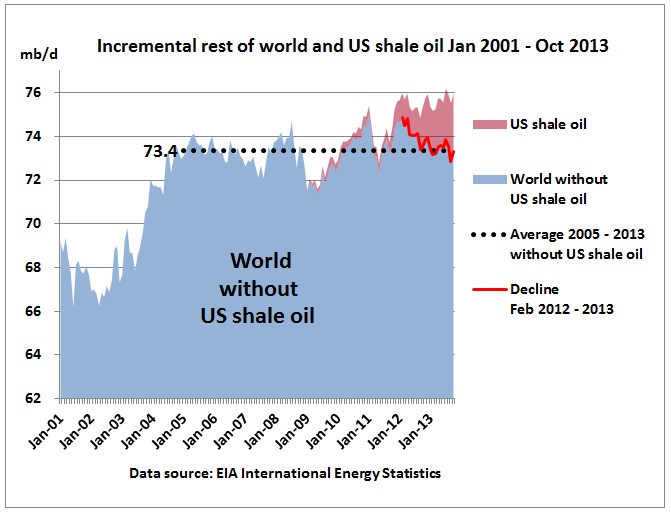
In the US, where practically all such operations have been conducted to date, fracking now accounts for 40% of domestic gas production and 30% of oil production. The price of natural gas has plummeted, and overall US oil production has increased for the first time since 1970, which had otherwise been falling in accordance with the predictions M King Hubbert made in 1956.
********************
You think Peak Oil is dead? Bloody Idiot!
You can print Money but no oil nor soil=food !
M_B_S
M_B_S
Peak oil is not a myth
20 February 2014Chemistry World
One might have the impression that hydraulic fracturing (fracking) of shale deposits is the answer to world energy security. Certainly fracking has received much attention and investment, but its prospects must be considered in a broader context.1
In the US, where practically all such operations have been conducted to date, fracking now accounts for 40% of domestic gas production and 30% of oil production. The price of natural gas has plummeted, and overall US oil production has increased for the first time since 1970, which had otherwise been falling in accordance with the predictions M King Hubbert made in 1956.
********************
You think Peak Oil is dead? Bloody Idiot!
You can print Money but no oil nor soil=food !
M_B_S
M_B_S
-

M_B_S - Intermediate Crude
- Posts: 3770
- Joined: Sat 20 Aug 2005, 03:00:00
Re: Peak oil is here and it will 'break economies'
by ROCKMAN » Mon 24 Feb 2014, 08:57:56
MBS - Actually Hubbert's prediction has proved to be very accurate. His prediction for future production was only for those trends he based his statistical analysis...not all future US oil production. He clearly states he wasn't predicting future production from new and undeveloped trends such as the Deep Water GOM and the shales.
A small point that many miss. He was predicting the future production/development of all those major conventional oil trends that had been developed prior to his projection. And production from those fields has never exceeded his forecast date.
A small point that many miss. He was predicting the future production/development of all those major conventional oil trends that had been developed prior to his projection. And production from those fields has never exceeded his forecast date.
-
ROCKMAN - Expert
- Posts: 11397
- Joined: Tue 27 May 2008, 03:00:00
- Location: TEXAS
Re: Peak oil is here and it will 'break economies'
by Tanada » Mon 24 Feb 2014, 11:15:38
Whale oil gets pulled out of the hat to explain Peak Oil frequently, but it is a horribly flawed analogy at best. Whale oil lamps were only used by the upper middle class and upper class, the average person used alcohol mixed with turpentine. Everyone like Whale oil because it smelled pleasant when burnt, unlike Alcohol/Turpentine or Kerosene lamps. Alcohol made up most of the fuel and turpentine was added to it to give a yellow flame instead of the nearly invisible flame of pure alcohol. The main competitor was coal oil aka kerosene made by converting coal into coke for blast furnaces. The vapor driven off from the coke ovens was reverse distilled condensing out different useful chemicals at different temperatures, the bulk being Kerosene.
Drake started searching for oil when he learned that a Polish scientist has figured out a distillation process to convert the bulk of Petroleum into Kerosene at a cost about half that of the Coal Oil version. He didn't do it because we ran out of whales that luxury good smelling lamp oil was made from. Whale oil was ALWAYS an expensive luxury oil, that is why the Whales were hunted nearly to extinction even after Drake made kerosene cheaper than alcohol/turpentine lamp oil.
Drake started searching for oil when he learned that a Polish scientist has figured out a distillation process to convert the bulk of Petroleum into Kerosene at a cost about half that of the Coal Oil version. He didn't do it because we ran out of whales that luxury good smelling lamp oil was made from. Whale oil was ALWAYS an expensive luxury oil, that is why the Whales were hunted nearly to extinction even after Drake made kerosene cheaper than alcohol/turpentine lamp oil.
$this->bbcode_second_pass_quote('Alfred Tennyson', 'W')e are not now that strength which in old days
Moved earth and heaven, that which we are, we are;
One equal temper of heroic hearts,
Made weak by time and fate, but strong in will
To strive, to seek, to find, and not to yield.
Moved earth and heaven, that which we are, we are;
One equal temper of heroic hearts,
Made weak by time and fate, but strong in will
To strive, to seek, to find, and not to yield.
- Tanada
- Site Admin

- Posts: 17094
- Joined: Thu 28 Apr 2005, 03:00:00
- Location: South West shore Lake Erie, OH, USA