
Peak Oil is You

Donate Bitcoins ;-) or Paypal :-)


Page added on April 18, 2018

Heinberg: Getting Past Trump

This a 3-part essay. Parts one and three is also cross-posted on Truthout.
Part 1: This Is How Democracies Die
Donald Trump’s 13-month tenure (so far) as president of the United States has been an exhausting sprint for onlookers concerned about the state of the global ecosystem and the fate of industrial civilization. Nearly every day begins with a new outrage — whether Trump’s gutting of the Environmental Protection Agency, his announcement of the US exit from the Paris climate accord, his selling off of national parks, his opening of coastal waters for offshore drilling, his easing of regulations on fracking, or his seeking subsidies for coal mining and coal power plants. Among my environmentalist friends and colleagues, “Trump fatigue” is a real and common ailment.
But much the same could be said for millions of citizens who are only peripherally interested in environmental issues. They awake each morning to read about the Stormy Daniels scandal, the Rob Porter scandal, the Anthony Scaramucci hiring/firing scandal, the Mike Flynn scandal, the James Comey firing scandal, the Tom Price scandal, the White House nepotism and security clearance scandal. The list could go on and on; who can possibly keep up?
The Tweeter-in-chief is monopolizing attention at a moment in history when there are plenty of other things we really should be attending to, including climate change, resource depletion, plastic pollution in the oceans, mass species extinction, the fate of US labor unions, racial and social injustice, and worsening economic inequality. These are the sorts of unaddressed problems that could cause even history’s “greatest” civilization to crack up. But the conversation never seems to get past Trump, who obdurately obstructs action on these issues while commanding everyone’s constant adoring or horrified attention through divisive words and actions.
Naturally, many people are speculating about how the Trump nightmare might end. Two possibilities include Democrats obtaining majorities in Congress in the 2018 elections and initiating impeachment proceedings, or a presidential resignation following indictments of staff and family.
But Trump may not be dislodged so easily: A war or terrorist incident could give him the pretext to at least partly shut down the apparatus of democracy (including the Mueller investigation). An Italian friend reminds me that Trump shares many characteristics with Silvio Berlusconi — who, despite frequent scandals, has managed to dominate national politics in Italy for nearly 20 years.
While I’m not prepared to make a prediction about Trump’s fate (there are just too many variables and unknowns), I have come to an unpleasant conclusion: While Trump will certainly be gone at some point — whether next month or years from now — we’re never going to return to the pre-Trump status quo. The system is irremediably broken. Trump is both a symptom and an agent of that brokenness. What we can do is begin to reconnoiter and assess our new, unstable, still-emerging reality.
To even begin to understand this new reality, it is first essential to recognize its context. The United States, and industrial societies generally, are approaching the end of a decades-long fiesta of rapid economic and population growth founded upon cheap fossil energy. I’ve discussed this grand trajectory in several books, notably The Party’s Over and The End of Growth, so it’s unnecessary to go into much detail here, except to note that absolute production figures for oil, coal and natural gas (which have been rising in recent years) are less crucial than the accelerating decline in the amount of energy that society receives in return for each unit of energy it invests in procuring more energy. This erosion of energy return on energy investment is unavoidable, given the method by which fossil fuels are harvested, with low-hanging fruit always being picked first. Energy is the prime mover of civilization; therefore, as net energy declines, so does society’s capacity to build complex infrastructure, and increase production and consumption.
Everyone feels this diminishing systemic dynamism, but — since surprisingly few people pay attention to slow but decisive shifts in our energy economy — almost nobody understands it, including the most exalted economists. So, feeling symptoms of malaise but unable to diagnose the cause, most people are driven simply to find someone to blame — whether Wall Street bankers, immigrants, international competitors (for the US, that would include China), “lazy” poor people, entrenched Washington lobbyists and bureaucrats, or “socialists” in the mainstream media.
The waning of the world’s energy return on investment isn’t a sudden development. Our energy regime grew, matured and weakened in stages. Back in the years when it was “great,” the US was the engine of the global fossil fuel power train. Prior to World War II, it was the world’s top producer and exporter of petroleum; it was also the foremost producer of coal and natural gas. But that gradually changed. In the 1970s, US oil and gas production began to decline (this was decades before the fracking boom — a subject to which we’ll return shortly); the nation was already importing more and more of its energy supplies. In the 1980s, globalization began, and the amount of debt in the US economy started growing much faster than the economy itself. Real (inflation-adjusted) incomes of most US workers stagnated or declined. Debt was effectively being used to purchase the services that energy provides, with the understanding that payment would be made later with interest. The use of debt to mask flagging economic momentum is an old trick, and — as economists and historians have discovered — it works for only a relatively short time before precipitating financial collapse.
Parenthetically, some readers may be wondering whether renewable energy might shift the curve of falling energy profitability. Unfortunately, the energy return on energy invested for solar and wind energy systems, once energy storage to make up for intermittency is included, is probably no higher than that of shale gas or tight oil: The energy return from commercial photovoltaic panels is estimated at 10:1 in most US locations (without factoring the energy cost of batteries), whereas during much of the 20th century, oil provided a 50:1 energy payback or better. Further, according to one recent study, installation rates for renewable energy would need to be roughly 10-times current rates in order to accomplish the transition to solar and wind before fossil fuel depletion and climate change undermine the current global industrial system.
By the first decade of the new millennium, it was clear to quickly growing ideological groups on the further ends of the political spectrum that the US was headed off the rails. An insulated and arrogant foreign policy establishment in Washington was initiating costly, disastrous, illegal and unwinnable wars in Afghanistan and Iraq (with later detours to Libya and Syria). Government and private debt was accumulating to truly frightening levels, with entitlements like Social Security and Medicare on track to boost government deficits exponentially in decades ahead. Rates of annual GDP growth were slowly but surely dwindling. Levels of economic inequality were approaching those of the fabled Gilded Age, when Marxists and anarchists riled the disgruntled masses. The nation’s manufacturing base continued to erode due to globalization. Massive industrial and transport infrastructure, built mostly during the high-energy decades of the mid-to-late 20th century, was aging and rusting. Following the Vietnam War and the collapse of the Soviet Union, it became harder to feel pride in being an American. Instead of bringing democracy to the world, we were more concerned with protecting our access to global oil supplies, distracting ourselves with comic book hero movies and exporting a culture of celebrity worship. An empire, built on the extraction of nonrenewable energy resources and on domination of world trade, was losing its grip.
Understandably, blame for unmet expectations fell largely upon elites — whether in government, the media, academia, the financial sector, science or the arts. But resentment toward immigrants and other easily scapegoated minority groups was also increasing in some quarters.
Enter Donald J. Trump, real estate developer and reality-television star. According to later reporting by Michael Wolff and others, Trump — who lacked experience in electoral politics — had no realistic expectation of winning the presidential race of 2016; he mainly hoped to increase his visibility and the value of his brand. This meant he was free to say anything, however politically incorrect or factually erroneous, to rouse his audiences. Trump, with help from self-styled political theorist Steve Bannon, promised to destroy the “administrative state” — the human bureaucracy and mass of regulations that propped up the failing status quo. He would “shake things up” by shredding global trade agreements and renegotiating bilateral trade treaties to the US’s advantage. He would radically reduce taxes. He would rebuild the nation’s fraying infrastructure. He would reduce both undocumented and documented immigration. He would prevent the US from getting involved in more needless, costly wars. He would “drain the swamp” in Washington, DC. And by doing these things, he would “Make America Great Again.”
When, to nearly everyone’s surprise (reportedly including his own), Trump won the presidency, he found himself in a tough spot: His team did not include enough competent people to fill newly emptied positions in the various agencies of the executive branch of government. The few available personnel consisted mostly of ideologues, hangers-on and fellow grifters — often evincing as little relevant job experience as Trump himself — as well as people avowedly dedicated to the destruction of the agencies to which they would be appointed. Over time, the new president and his team generated more and more dysfunction, resulting in a string of firings and resignations. As government, it was a trainwreck; but as reality TV, it was as riveting.
Meanwhile, the status of the nation’s all-important energy economy was more hidden from view than ever due to the temporary spectacle of soaring US oil and gas production from fracking. Rates of domestic shale gas and tight oil production were soaring, leading the new president to speak of US “energy dominance.” But companies specializing in producing these fuels were — and are — doing so at an overall financial loss, propped up by cheap debt and investor hype. Their inability to turn a profit is a clear symptom of eroding energy return on investment, but is rarely understood as such. Inevitably, as interest rates rise and investors start demanding returns, the fracking bubble will pop even more quickly than it inflated.
What Trump has done politically is somewhat analogous to the country’s fracking frenzy. He spoke a politically forbidden truth — that the United States is headed toward the graveyard of empires; he then promised a return to “greatness.” But just as fracking has failed to reverse the nation’s slide toward energy bankruptcy, Trump’s means of reviving its greatness (a budget-busting tax cut and divisive rhetoric) have only accelerated the US’s nosedive into economic, moral, social and political ruin.
Part 2: The Russia Connection
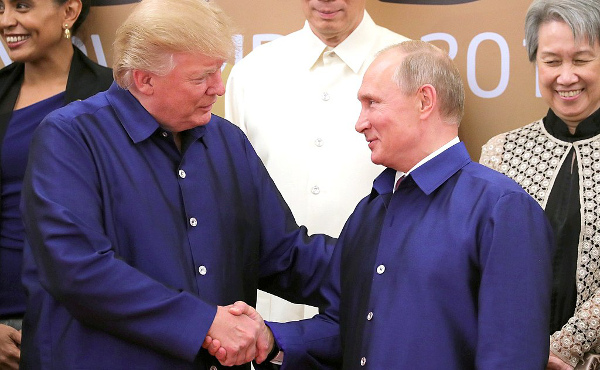
In Part 1 of this essay we surveyed the historical, economic, and cultural context for the upset victory of Donald Trump in the 2016 presidential election. I did not mention Russian interference in that election. That’s because it is a subject that deserves to be treated on its own. It is, of course, a source of heated controversy: leaders of the national security agencies and the FBI are unanimous in saying that Russia made a concerted effort to impact the election, while denial that such interference took place has emanated from the White House, Fox News, and some Republicans in Congress. The latter’s motivation is fairly transparent: questioning the legitimacy of the election shines an unfavorable light on the Trump administration and the Republican Party. Interestingly, however, voices on the far left have likewise argued that the Mueller investigation is a “witch hunt” that should be shut down. This peculiar state of affairs deserves attention, and I’ll be discussing it at some length. Even though we will be focusing on a very small subsection of the U.S. population, the shifts there are illustrative of trends with wide impacts.
Journalist Glenn Greenwald and ex-CIA analyst/political activist Ray McGovern, both favorites of the left, have penned articles arguing there is no direct evidence of conspiracy between the Trump campaign and Russia; they also suggest that the Mueller investigation is in effect an effort by the Deep State to expel an irritant (Trump) from the body politic—an effort that runs roughshod over the Constitution and thereby imperils American democracy. Several of my leftist acquaintances are of the same opinion. Why would vociferous critics of Trump and the Republican Party be singing from the same song sheet as Trump in this instance?
Once again, a little background helps. The American left is permanently and understandably enraged at the U.S. national security apparatus (the Pentagon, CIA, NSA, FBI, and State Department) following decades of military invasions and bombings in Vietnam, Iraq, Afghanistan, Libya, Syria, Yemen, and Somalia, etc.; the overthrow of elected governments in Iran, Guatemala, Congo, Dominican Republic, Brazil, and Chile; and support for dictators in the Philippines, Haiti, Guatemala, and elsewhere. By extension, many on the far left also hold the centrist, Clinton-led dominant wing of the Democratic Party in utter contempt. In the view of some leftists, the United States is pursuing a global plan for war that will never cease until all rivals to Washington are under heel. Accordingly, they have viewed the rise of Russia on the world stage as a necessary counterbalance to Washington’s imperial overreach. Meanwhile Russia (through RT and other outlets) has provided exposure for far-left intellectuals in the West whom the U.S. mainstream media often shuts out.
Leftist commentators frequently point out that Russia has a genuine gripe against America: after the breakup of the Soviet Union, the U.S. treated Russia miserably by expanding NATO (which Western leaders had promised they would not do). Further, the U.S. has routinely interfered in other nations’ elections, including (reputedly) the 1996 Russian presidential election. For these reasons complaints about Russia tipping the scales in the 2016 American election ring somewhat hollow.
For most far-leftists, it is not just the U.S. intelligence community that is to be distrusted, but the mainstream media as well: the New York Times and other prominent outlets were wrong about Afghanistan, wrong about Iraq, wrong about Libya, wrong about Syria. So why should we now believe them with regard to Trump and Russia? Hence at least some far-leftists seem as likely to link and tweet articles by Russian apologists like Alexander Mercouris and Moon Of Alabama as those by Noam Chomsky or Cornel West.
The problem with all this is that, however useful Russia may be as a check on U.S. warmongering foreign policy, it is nevertheless a fairly ruthless dictatorship. Russia is clearly promoting far-right and far-left political voices in Europe in an effort to destabilize the West, and appears to be doing the same in the United States. Evidence cited in one Mueller indictment suggests that Moscow’s agents worked not just on behalf of Trump, but Bernie Sanders and Jill Stein as well—though no one has claimed so far that either of these candidates actively conspired with Russia. Even if understandable or somehow justifiable, Russia’s efforts to influence elections in the U.S. and elsewhere won’t result in any advantage to the people of the countries targeted—any more than America’s longstanding similar efforts have done.
I won’t go into great detail summarizing the evidence that Russia did in fact interfere in the election on Trump’s behalf, and that the Trump campaign encouraged and likely conspired in those efforts. James Risen, Luke Harding, and Michael Isikoff have already done a good job in this regard. Russia and the Trump campaign had motive, means, and opportunity, and there is direct and indirect evidence for both interference and conspiracy. That evidence is increasingly contained in indictments, confessions, and guilty pleas. Yes, it is surely possible that U.S. intelligence agencies have doctored or even fabricated evidence of Russian election tampering. In that regard, there are remaining questions about the DNC email hack and the Steele dossier. But remove the hack and the dossier from discussion, and there’s still an impressive pile of evidence that virtually no one (other than clear Russia apologists) disputes.
Prior to the election campaign, Trump had financial relationships with shady Russians and did business in Moscow. During the campaign, he surrounded himself with advisers who had similar contacts and entanglements. On the campaign stump, he repeatedly praised Putin. During the campaign, Trump’s surrogates traveled to Moscow, exchanged frequent telephone calls with Russian officials and agents, and responded “I love it!” when illegally offered compromising information about Clinton by Russian sources. Trump publicly called for the Russians to “find” Clinton’s “lost” emails (one of his many profoundly unfunny “jokes”).
Meanwhile, we now know that Russia employed organizations to hack secure websites; organized scores of social media trolls and ad buys; paid teams to gather sensitive voter information at the state level; and even organized pro- and anti-Trump public rallies. Facebook has estimated that about 10 million people saw Russian ads targeting users in Michigan and Wisconsin—states Trump won by roughly 10,000 votes and 22,000 votes, respectively.
Once in office, Trump promptly divulged classified information to the Russian ambassador. He met with or telephoned Vladimir Putin repeatedly with no American present to record the conversation (which was utterly unprecedented). He appointed a Secretary of State with close ties to Moscow. And he has refused to implement sanctions on Russia that were passed overwhelmingly by Republican-dominated Congress and that he was more or less forced to sign.
In response to this litany, far-right and far-left commentators insist there is no definitive proof of collusion yet. But we should not expect to have such evidence in the public record at this stage. That’s the point of an investigation: to find what culprits seek to hide. The process involves subpoenaing witnesses and getting little fish to flip on big fish until the truth is revealed in sworn testimony. Recall Watergate: clear evidence of Nixon’s personal involvement wasn’t forthcoming until late in the two-year investigation, after the release of tapes of Oval Office conversations. Also, it’s entirely possible that many charges ultimately brought against Trump’s innermost circle will relate to financial crimes rather than conspiracy against the United States or obstruction of justice.
In my view, the Russian effort to influence the 2016 U.S. presidential election was likely the most successful low-budget covert operation in history. At least one of its aims (if not the primary one) was to disrupt the internal political system of the U.S., and in this it succeeded beyond any reasonable expectation. The operation probably couldn’t have worked so well without Facebook, but it probably could have worked just fine without direct help from the Trump campaign. Yet perhaps that was itself a crucial part of the plan: Moscow’s intelligence operatives may have been careful to get some of the Trump team’s fingerprints on the election interference process so that, when an investigation eventually uncovered those clues, the entire American political system would erupt in recriminations, with charges of treason and counter-charges of “deep-state coup” leading to system meltdown.
I probably won’t change many minds about Trump/Russia in what I’ve written above. Some will probably conclude that I’ve sold my soul to the Clintonites (for the record, I did not support Clinton in the election), or that I’ve bought into anti-Russian propaganda emanating from the neoconservative foreign policy establishment. But that’s also part of the story: we are entering a post-truth era in which tribal alignment matters far more than mere facts, which are becoming ever harder to establish to everyone’s agreement. Jennifer Kavanagh calls this “truth decay,” and notes that it makes the job of informing and mobilizing the public much harder—not just with regard to Trump-Russia or politics in general, but also when it comes to climate change and the other collective survival threats.
Some caveats: I’m not suggesting that war brinkmanship with Russia would be a good idea. And I’m not in favor of demonizing anyone in the U.S. who has connections with, or good things to say about Russia (as Matt Taibbi argues is happening). Nor am I arguing that Russia was entirely or even primarily responsible for the Trump victory. It was a close race due to the factors unpacked in Part 1 of this essay. Russian interference may have played a crucial role in tipping the scales, but that would never have been possible if Americans were not already turning against their perceived political elites due to perceived failures.
Again, the real point here is that this is how democracies die. The rot begins within, but there are often external players who take advantage of the situation, or hasten the decay (as occurred also in the case in ancient Rome).
Even if Trump himself were gone tomorrow, the nation still faces simmering crises (falling energy return on investment, increasing economic inequality, over-reliance on debt, climate change) that appear to be leading toward collapse of government and the economy; meanwhile, as a result of political polarization, social fragmentation, plain old corruption (see NRA), and truth decay we are losing whatever ability we ever had to address those crises.
Part 3: The Futility of “Big Green” Activism: A Conversation With Tim DeChrisopher
If environmentalists hope to have any real success in the age of Trump, they will have to change strategies and tactics in response to a transformed political and social context.
Back in the long-ago, hard-to-recall days before Trump became president, environmental (as well as peace and human rights) nonprofit organizations engaged in a routine, ritualized two-part dance of raising money from contributors, and then trying to convince policy makers to do something to save the world — or at least reduce the scale of harms being done. What was actually accomplished was never enough to actually turn society in the direction of sustainability, but the effort was in some respects its own reward: Activists felt useful, and in some cases, fundraising produced enough to pay salaries. And there were occasional victories to celebrate.
Now the United States is led by an authoritarian who is steadily undermining our democratic norms and institutions, and a Congress that is either bought and paid for by moneyed interests, or is too scared to challenge them meaningfully. It’s clear that no amount of cajoling, wheedling, imploring, threatening or explaining will convince Congress or the executive branch of the federal government to do anything whatsoever to address the panoply of do-or-die problems confronting us. Why even bother asking them?
Recall it was the failure of elites to address real underlying problems that contributed to the advent of Trump in the first place. Now, of course, at least from environmentalists’ perspective, Trump is making everything much, much worse: It’s probably fair to say that the Trump administration has never met an environmental regulation it didn’t want to kill.
What should environmentalists do under these changed circumstances? What strategies should environmental organizations pursue?
In order to get some helpful perspective, I recently corresponded with activist Tim DeChristopher, cofounder of Climate Disobedience Center. I respect DeChristopher for two important reasons: He has a good understanding of the range of overshoot issues humanity currently faces, and he has the courage of his convictions (he spent nearly two years in federal prison for a creative act of civil disobedience recounted in the documentary film Bidder 70).
What follows is a lightly edited transcript of my conversation with DeChristopher.
I first asked Tim what he thought about the actions of the big mainstream environmental organizations in the context of the new Trump administration.
Tim DeChristopher: I really don’t think that most mainstream climate environmental organizations are operating with any kind of intentional strategy in which they think that what they are doing will lead to positive change. When groups are mobilizing their members to “send a message” or “make their voices heard” to [US Secretary of the Interior Ryan] Zinke, [Environmental Protection Agency Administrator Scott] Pruitt or Trump, I doubt any staffers in those groups actually think that what they are doing has any potential of working. I think they are hemmed-in by the norms of social movement organizing. Those norms demand relentless optimism and positivity, so there is very little room for open reflection on our mistakes, changing direction or acknowledging that certain goals are no longer possible. Those norms also define leadership around knowing what to do and giving people tangible and immediate things to do.
I think most organizations and leaders would feel extremely nervous about saying to their community, “I don’t know what needs to be done in this unprecedented situation.” There is a mainstream assumption that they would no longer be justified in their leadership position if they expressed that uncertainty. But I think one of our most critical needs for a future of climate chaos is to develop a model of uncertain leadership. This is a kind of leadership that can hold space for sitting with uncertainty and empower a broader community of people to actively think and work in that space of vulnerability. Such leadership is embodied not in one’s ability to control a situation, but in one’s courage to engage with and relate to the situation.
RH: Historically, nonviolent protest and civil disobedience have developed as successful strategies for social change mostly within the context of liberal democracies. For example, there has been some discussion about whether [Mahatma] Gandhi’s efforts would have been as successful if Britain had not had a free press and other democratic institutions. Without a free press, regimes can simply imprison and kill protesters with minimal public awareness of either the protest or its repression. How do you think protest might evolve if the US continues its trajectory toward authoritarianism?
TDeC: I think that Trump has certainly changed the dynamics of civil disobedience at the federal level. It’s worth noting that Erica Chenoweth’s research has shown that nonviolent civil resistance is often more effective under authoritarian regimes, but I think Trump represents a very rare kind of power. Part of the efficacy of civil disobedience is often that it pulls back the facade of decency or democracy to reveal power that is actually rooted in violence. The police violence at Standing Rock was an embarrassment to Obama because he had hinged his authority on lofty ideals, but in fact his real power was the state’s monopoly on violence. Even Bush Jr. ran on a platform of being a “compassionate conservative.” It was a lie, but he needed that lie. Trump, however, never tried to project a facade of compassion or even decency. His power is based on ruthlessness and the breaking of taboos. If he is put into a position in which he has to violently repress nonviolent dissent, it may actually strengthen his power rather than undermine it.
In terms of media, I think our trajectory is not one of outright suppression of a free press to the point of avoiding public awareness, but rather a bifurcation of the press and social media to the point that no one has to accept anything they don’t want to believe. This is a serious challenge not only for civil disobedience, but for all social change efforts regardless of strategy. It is further exacerbated by new video manipulation technologies. It is very hard to see how we avoid either nihilism or civil war.
RH: So, what to do?
TDeC: My current thinking is that our best bet to overcome these challenges is making protest far more diffuse and widespread. With the lack of a central narrative or even a consensus reality, big iconic protests with famous people will likely continue to become less effective. But we all have a small circle of people whom we can influence in ways that are not dependent on media. Because our current culture has such justifiable skepticism of manipulation, one’s own willingness to sacrifice is more critical than ever for using our influence effectively, so I think civil disobedience will continue to play an important role for that. So perhaps this is to say that protest needs to follow the path that needs to be followed for so many other changes we need to make: more localized, more diverse, more people involved, more experimentation. No goddamn mono-crop social movements!
RH: How is your own organization, the Climate Disobedience Center, dealing with these issues and challenges? What concrete actions are your taking that different from the strategies of the ‘Big Green’ groups?
TDeC: The Climate Disobedience Center began as a resource and support center for folks doing civil disobedience against the fossil fuel industry. At the time, a certain brand of safe and limited civil disobedience was being increasingly embraced by the mainstream of the climate movement. We felt that there was an opportunity to work with those folks who were engaging in direct action and help them manifest the full potential of vulnerable and transformative civil disobedience. We primarily ended up filling the particular void in the movement around supporting folks after the point of arrest as they engage with the court system. Over time, we realized that rather than providing a plug-in service that could easily interface with a mainstream model, we were approaching this work with a fundamentally different paradigm that demanded a holistic structure. So we refocused our efforts on building small praxis groups of holistic support, like a cross between an affinity group and a small group ministry. These are groups of folks who support one another to live with integrity in a time of climate crisis. One piece of that is the moral responsibility to act to mitigate whatever harms can still be avoided, but we believe that work cannot be detached from the need to build resilient communities as well as grieve for that which is already being lost. As these are largely unprecedented challenges, we are trying to create the practices of mutual support that allow for as much experimentation and creativity as possible.
* * *
DeChristopher emphasizes that simply getting rid of Trump as first priority will not solve the environmental crisis. If the system wasn’t sufficiently self-correcting before, and if the status quo is irreparably broken, then it’s clear that some other change in strategy is needed.
He also calls for more local and experimental activism and civil disobedience, warning that large-scale protests could simply become indiscernible components of the noise being generated by the implosion of the US political system.
My own tendency is to look at the big picture. In that regard, my gut and intellect both tell me that the Trump interval is best understood as a stage in societal collapse. Each stage of that process will no doubt follow its own internal logic. As the stages progress, larger scales of societal organization (international institutions, then nation states) will tend to fail first. Therefore the usefulness of national and global strategies for resistance and repair will tend to gradually diminish.
If we want to minimize human suffering and protect ecosystems, then working locally to build community resilience is probably the best strategy available. The reasons are plentiful and the rationale only grows stronger as our context evolves.
122 Comments on "Heinberg: Getting Past Trump"
Davy on Thu, 19th Apr 2018 6:03 am
“Germany Recession Indicator Flashes Yellow”
https://tinyurl.com/ybpk437t
“The ECB will soon be in a bind as the European economy slows. Germany leads the slowdown…Gustav Horn, one of Germany’s most-experienced business-cycle analysts, says the Possibility of German Recession Increases Noticeably. https://tinyurl.com/y89bcvsw”
“The uncertainty in the economy and especially in the financial markets, which was largely triggered by US trade policy, is having an effect: the risk of Germany falling into recession over the next three months has increased noticeably from March to April. This is signaled by the economic indicator of the Institute for Macroeconomics and Business Cycle Research (IMK) of the Hans Böckler Foundation. For the period from April to the end of June, the early warning tool, which brings together the latest available data on the economic situation, has a median recession probability of 32.4 percent. In March, the recession risk was only 6.8 percent. The indicator, which operates according to the traffic light system, jumps from “green” to “yellow” and thus signals increased uncertainty (recession probability from 30 percent). The IMK explains the significant increase in recession risk with a mix of three factors: the recent noticeable decline in industrial production, increased volatility on the stock markets and a deterioration in sentiment indicators.”
MASTERMIND on Thu, 19th Apr 2018 6:14 am
Renewable’s are a mass delusion to ensure that the hordes think that “they’re working on it” and everything is OK.
Darrell Cloud on Thu, 19th Apr 2018 6:58 am
Der, had you taken the time to note the source of my post at the bottom of my post, you would have discovered that it was a simple cut and paste from the named source. Your vitriol pretty well exposes the divide I am speaking of. We are in fact two or more countries that are cleaving along the major divide between the blue string of urban centers and the red sea that surrounds them.
The city of New York compels the state legislature to pass the New York Safe Act and the state has a 4% compliance rate. Ninety Six percent of gun owners outside the city choose to become criminals rather than comply with the precursor that will usher in confiscation.
While the moneyed interests control the urban centers, the food, fuel and water that enables these urban centers is taken from the red counties that surround them. As the end of growth continues its trajectory, urban centers become untenable. Look at the population charts of the Rome over the last two millennia and you will come to understand the fate of urban centers after collapse, they depopulate. A serious look at metropolitan budgets should tell you that the insolvency of these city centers is a growing concern.
Cities like Detroit are already in the process of depopulating.
Most of us sitting out here in fly over country do not see cities such as Detroit or Boston as assets. We see them as potential threats. Once the diaspora begins those hungry hordes are going to come into our little counties and demand to be fed.
Davy on Thu, 19th Apr 2018 7:07 am
Darrel, great post keep them coming!
MASTERMIND on Thu, 19th Apr 2018 7:31 am
China’s Economic Numbers Have a Credibility Problem
https://www.bloomberg.com/news/articles/2018-04-19/china-s-economic-stats-have-a-credibility-problem?cmpid=socialflow-twitter-businessweek&utm_content=businessweek&utm_source=twitter&utm_campaign=socialflow-organic&utm_medium=social
China’s GDP numbers are all bullshit!
TheNationalist on Thu, 19th Apr 2018 8:24 am
Oh fuck off!, this self righteous cunt and all the other elitists will never get over Trump.
They will be blaming Russia for climate chnage and killing off the dinosaurs for the next two thousand years at this rate.
TheNationalist on Thu, 19th Apr 2018 8:32 am
*change
If CNN hurries they can pin the GFC, 11//Sep and maybe the death of Michael Jackson on the ‘evil’ Russian/Syrians too!
I hear that Syria now has the ‘weapon of the mass destruction thingy’ and must be bombed to compliance with lots of weapons that cause mass destruction!
TurningPoint on Thu, 19th Apr 2018 9:20 am
As if Heinberg isn’t part of the far Left. I did like his books on peak oil but I think he’s now having a nervous breakdown over Trump. I think he’s confused between people who are pragmatic and those who are idealistic. Our foreign policy regarding Russia is dangerous and stupid. Washington is the crux of the problem. It’s obvious we are using NATO to try to contain the Russians. We are also attacking them economically. No country of their size would allow that nonsense to occur without a response. Putin may be a minor thug, but he’s no Stalin. Eventually our stupid policy could end up in a Cuban missile style Crisis. If we were to let up, I’m sure the Russians would too. Russia doesn’t want this Cold War. This never ending tit-for-tat will continue to escalate until there’s a crisis. Does anyone believe the Chinese would allow what we are doing to Russia happen to them without a response?
This is not Far Right or Far Left lunacy. This is a fight between neocons, neoliberals (or Liberal interventionists) and people who are pragmatic and logical.
JuanP on Thu, 19th Apr 2018 9:33 am
The USA is the problem, not Russia! Heinberg is just one more confused American! LOL! Back to doing something useful; see you all later!
Davy on Thu, 19th Apr 2018 10:00 am
Good comment turning point. While I put the majority of the bad blood with Russia down to turning points comment, I also believe Russia is pushing boundaries of geopolitical and economic status quo that have allowed these unsavory elements of the US government to expand with conflict and extremism. It is Russia’s fault too. There is no fairness at these levels. There is the hard cold reality of realpolitik.
Cloggie on Thu, 19th Apr 2018 10:30 am
Renewable’s are a mass delusion to ensure that the hordes think that “they’re working on it” and everything is OK.
Actually it IS ok, if you don’t waste your time on doomer blogs, spamned by idiots like millimind:
https://www.zmescience.com/ecology/renewable-energy-ecology/portugal-renewable-energy-11042018/
Silently, Portugal just produced 100% of its electricity from renewables for a whole month
Good old Europe, the cradle of science and technology, is showing the way.
MASTERMIND on Thu, 19th Apr 2018 10:34 am
CLogg
Peak oil is a liquids fuel issue. Not an electricity issue that renewables can solve. we need liquid fuels for 90 percent of our worlds transportation and machinery. And solar and wind last year made up 1 percent of total world energy -IEA
https://imgur.com/a/pYxKa
Cloggie on Thu, 19th Apr 2018 10:34 am
The USA is the problem, not Russia! Heinberg is just one more confused American! LOL! Back to doing something useful; see you all later!
I am so utterly done with this gamma male Richard Heinberg, who is now trying a second career in Trump and Russia bashing. Heinberg is such a guy who goes to feminist congresses to help buttering the rolls.
MASTERMIND on Thu, 19th Apr 2018 10:36 am
Clogg
One of the smallest countries on earth produced 100 percent of their electricity, for one month! LOL How laughable! What about the other 11 months? LOL And what about the other 190 countries on earth? LOL
Renewables are a mass delusion to ensure that the hordes think that “they’re working on it” and everything is OK.
https://imgur.com/a/pYxKa
MASTERMIND on Thu, 19th Apr 2018 10:38 am
Clogg
Heinbergs books are on Google Scholar! And when the oil shortages hit soon. He will become lionized!
https://imgur.com/a/pYxKa
Cloggie on Thu, 19th Apr 2018 10:39 am
Peak oil is a liquids fuel issue.
No it isn’t.
40 ton Swiss e-truck:
http://www.manager-magazin.de/unternehmen/autoindustrie/tesla-elektro-truck-semi-hat-bereits-schweizer-konkurrenz-a-1178152.html
Daimler truck as of 2021:
http://www.manager-magazin.de/unternehmen/autoindustrie/daimler-elektro-lastwagen-ab-2021-in-serie-a-1194661.html
MASTERMIND on Thu, 19th Apr 2018 10:39 am
Global debt now worse than before financial crisis, says IMF
https://www.theguardian.com/business/2018/apr/18/global-debt-now-worse-than-before-financial-crisis-says-imf
And when the peak oil shortages hit in a few years. Its game over for the global economy. You can’t increase global GDP without enough oil ie ENERGY! ANARCHY IS COMING!
https://imgur.com/a/pYxKa
MASTERMIND on Thu, 19th Apr 2018 10:41 am
CLogg
E trucks wont work because the batteries make them too heavy…A Tesla uses a 1200 lb battery. And we don’t have the minerals and metals to convert the entire worlds transportation.
https://imgur.com/a/pYxKa
Cloggie on Thu, 19th Apr 2018 10:43 am
E trucks wont work because the batteries make them too heavy
Really and the technicians of the car companies have no clue?
Besides you can work with fuel cells as well. I tip 60-40 they will win.
https://deepresource.wordpress.com/2017/08/17/future-of-e-vehicles-batteries-or-fuel-cell/
Davy on Thu, 19th Apr 2018 10:47 am
When one digs deeper into the neder’s statements of glory and grander we see as usual he is being slimy and deceptive.
Portugal has a population of 10.3MIL and a GDP of 204BIL. The biggest reason for Portugal’s 100% renewable for a whole month is massive rains and hydropower not the wind and solar idea neder is trying to sell. Good old fashion hydro old tech decades old investments.
“Silently, Portugal just produced 100% of its electricity from renewables for a whole month”
https://tinyurl.com/yb5sh34v
“Unbeknownst to many, Portugal has become a leader in terms of renewable energy production. Thanks to its geographical location and ambitious, healthy policies, Portugal has consistently produced a sizeable part of its electricity through renewables. In March, massive rain brought a boom to renewable energy production, allowing the European country to produce more energy than it consumed through wind, solar, bioenergy, and hydro energy alone.”
“Renewable energy in Portugal”
https://tinyurl.com/yb8jycnp
“Wind power with 21.6%”
“Solar power with 1.6%”
“Portugal Country Analysis Brief – Global Energy Network Institute”
https://tinyurl.com/ybb4fto5
“Portugal holds no proven commercially viable oil reserves. In 2002, the country consumed 351,000 barrels per day (bbl/d), all of which was imported. Oil made up 64% of the total Portuguese primary energy consumption for that year.Jun 2, 2003”
joe on Thu, 19th Apr 2018 10:53 am
Have to say, heiny is gone off the deep end with that diatribe. He points out so much that is obvious but never mentions that Trump is potus cause Killary torpedoed Sanders nomination by buying up superpac votes. Fuck the Dems they threw it away by supporting an email deleting criminal. What did she have to hide? Maybe truth of 9-11 libya attack? Who knows. The guy is dead now anyway, not coming back.
Trump couldn’t get staff cause Paul Ryan and McCain told everyone not to apply cause Trump kept telling them they were sellouts. Fuck the Reps.
You think you have it bad America? We have 4 million people if even 10% are potential jihadis waiting to get in would spell the end of Europe. We rely on the islamist dictator Erdogan to keep us sage in our Atheist beds.
Cloggie on Thu, 19th Apr 2018 11:27 am
Portugal has a population of 10.3MIL and a GDP of 204BIL.
So what? Population size has NOTING to do with the viability of renewable energy. Small countries like Portugal and Denmark and Scotland can achieve a lot and so can mid-size countries like Germany and giants like China. It is a matter of policy choice and nothing else.
America doesn’t want to invest in renewable energy but prefers to invest in weapons in a futile attempt to subjugate the entire world (a project that is going to fail btw).
In fact the prospects for renewable energy to succeed are the best for Europe, because they no longer need a growing energy consumption; Europe is already economically mature, very much unlike China, that although it is open for renewable energy, it also wants to copy the West and lift life standards of its citizens. America’s prospects are less good as it consumes twice as much energy as Europeans and hence it is twice as difficult to replace existing fossil capacity with renewable capacity, just to stay on the same level
Dredd on Thu, 19th Apr 2018 11:40 am
Trump has given new meaning to porn (Pole Dancing In The Lab – 2).
Davy on Thu, 19th Apr 2018 11:45 am
Neder, the US wants to invest in renewables. The government may not care. We are less socialist then you. You think that government policy is all that counts. That shows what you know about the US which is very little despite your obsessive anti-American agenda. Please for the audience tell us what is the aggregate solar and wind in the US and Europe…now…..not your fantasy future. And yes, population does matter in comparison. I get so tired of your slimball ways of hazing the US and praising the EU. Do you have a self-confidence issue?
Anonymouse1 on Thu, 19th Apr 2018 2:38 pm
Amerika is full of fake, or pseudo ‘leftists’, for those that prefer simplistic amerikan labels. Whineberg, is one of them. His (new) job, is to join in on never-ending choruses of the Russia-gate crowd. He has plenty of like-minded company. Watching the fake ‘liberals'(like rick here) in the uS squeal and moan non-stop is kind of funny though. Does no one find it odd, how ‘Mr Sustainability’, suddenly began weighing in with all his newfound ‘concerns’ about supposed Russian malfeasance around the world? Or specifically, in amerika itself? In truth, I suspect whineberg never cared much for the wider world and is at core, a uS exceptionalist. Under the previous WH figurehead, whineberg was a see-no-evil, hear-no-evil kind of faux-liberal, at least when it came to larger issues of empire.
Who knew he was such a closet ‘liberal-interventionist’ all along? Richard will have to learn to deal with the fact that president hairpiece will do all the things his beloved obama, and his evil step-sister killary (would) have done, but with much poorer taste. Short of all the ‘liberals’ and the so-called ‘intelligence’ community getting together and giving drumpf the JKF treatment, richard should just learn to deal. In the meantime, I am sure he will let us know all about the Russians he finds hiding under his bed.
Who know, maybe richards prayers will be answered and trumpf will choke on a chicken wing during a WH dinner. Lots can happen.
Davy on Thu, 19th Apr 2018 2:50 pm
“Amerika is full of fake, or pseudo ‘leftists’, for those that prefer simplistic amerikan labels. Whineberg, is one of them. “
I guess you are the real deal leftist anti-American Canadian dumbass that prefers obfuscation of reality.
‘In truth, I suspect’
There is zero truth about you. You are a fake and an unintellectual Canadian snob who perpetuates hate and discontent. You stalk and prick Americans exclusively and redundantly. You are a true ambassador of the worst of Canada.
“whineberg never cared much for the wider world and is at core, a uS exceptionalist.
LIAR
“Who know, maybe richards prayers will be answered and trumpf will choke on a chicken wing during a WH dinner. Lots can happen.”
I wish you would. Lots can happen.
Davy on Thu, 19th Apr 2018 3:10 pm
Billy 3rd world, did you happen to see this article?
“Boracay: Paradise islanders fear tourist shutdown”
https://tinyurl.com/ya6yg4jb
“The Philippine island of Boracay will be closed to tourists for six months following concerns over the environmental health of the island. President Rodrigo Duterte said Boracay was turning into a “cesspool”, but the interruption is a huge worry for the people who earn their money from visiting tourists.”
makati1 on Thu, 19th Apr 2018 5:17 pm
In other news: trade is moving East. “China-Russia trade volume surges in 2018”
http://thebricspost.com/china-russia-trade-volume-surges-in-2018/#.WtkTX3–mUk
Asia is where the real GDP growth is. More than half of the world’s consumers live there. The East is the up and coming market for trade because that is where the money is and will be. Americans will be buying less and less as their incomes continue to shrink and their debts grow.
makati1 on Thu, 19th Apr 2018 5:22 pm
Davy, of course I saw it last week in the newspaper here. There are several other countries also closing down tourist sites for the same reason. Clean up the environment. A good thing. And the closings are already being adjusted to shorter times and some will reopen sooner. Why is that a big deal? Many of the displaced tourists will just go to another area of the Ps.
BTW: The Ps government is also providing alternate jobs and income to help the displaced employees. Old news.
Davy on Thu, 19th Apr 2018 5:29 pm
Bric post, lol, billy 3rd world google Russia and Chinese trade volume and compare that to US trade levels with China then get back to me on that surge you described.
MASTERMIND on Thu, 19th Apr 2018 5:45 pm
Good one davy! Madkat is easily duped because he is quick to hope! Dont worry though he will just call you uneducated and brainwashed. He is a very paranoid and mentally ill person.
makati1 on Thu, 19th Apr 2018 6:15 pm
Davy, the Us is going down the shitter. The coming stock market crash will be the last nail in the empire’s coffin. The rest of the world knows that even if the Us denies it.
You and MM have a very brainwashed view of the world. Too bad. The hand of fate is getting ever closer to that lever. No empire lasts forever and the Us is in its last days. Trump is killing it bit by bit. Be patient. LMAO
makati1 on Thu, 19th Apr 2018 6:18 pm
BTW Davy, no rebuttal to my comment about the Ps? You always post some bullshit and then when you are rebuffed, you slip to another topic because you have no rebuttal. Your mental state is getting worse, Davy. You and MM should share a room at the funny farm.
MASTERMIND on Thu, 19th Apr 2018 6:31 pm
And the planet may go astray
In a million years they’ll say,
those motherfuckers were all deranged
It’s evolution…
Just evolution…
https://www.youtube.com/watch?v=m8fm3Z7jgWM
MASTERMIND on Thu, 19th Apr 2018 6:32 pm
Madkat
Without the west and America you wouldn’t have science and you wouldn’t have the arts…It would be a whole society of yak yaks like China….
makati1 on Thu, 19th Apr 2018 6:57 pm
Hmmm. Better do some research on that hilarious comment, MM.
Science? The word is new but the concept is at least as old as ancient Egypt. wIKI
Arts? Hmm… they go back to cave paintings of over 10,000 years ago. WIKI
If the West never existed, both would have progressed in the East and other locations as they do today. Neither are the creation of America or the West. Nor are they the sole domain of either the arts or science.
Your education was a very narrow one, Mm.
onlooker on Thu, 19th Apr 2018 7:03 pm
Yeah Makati. One of the more ignorant statements by MM, I have read on this site since I started here in 2013
Davy on Thu, 19th Apr 2018 7:17 pm
“BTW Davy, no rebuttal to my comment about the Ps?”
billy 3rd world, why did you not post the article to begin with? That is my rebuttal. Could it be you are biased and only interested in talking about the good things and leaving the bad things out. Flip that over and all you do is talk about the bad things in the US and the good things in the P’s.
Davy on Thu, 19th Apr 2018 7:20 pm
“You and MM have a very brainwashed view of the world.”
Translation: Davy got me when he asked me to verify my assertion so all I have left is call him and MM brainwashed.
Davy on Thu, 19th Apr 2018 7:21 pm
“If the West never existed, both would have progressed in the East and other locations as they do today. Neither are the creation of America or the West. Nor are they the sole domain of either the arts or science.”
old man jibber jabber.
MASTERMIND on Thu, 19th Apr 2018 7:30 pm
Madkat and onlooker
What would you people know? I am an actual scientist..The US is the technology hub of the entire world which is fueled by Science. The US publishes the most peer reviewed scientific papers every year. And has the most prestigious science academy in the world. People in Asia are all mindless zombies who work in sweat shops for dictators and slave lords. They will never rise up because they are totally controlled from cradle to grave.
MASTERMIND on Thu, 19th Apr 2018 7:32 pm
IMF warns shadow banking poses high risk to China’s financial stability
http://www.scmp.com/news/china/economy/article/2142365/imf-warns-shadow-banking-poses-high-risk-chinas-financial
Shadow banking is going to bring China down. And their GDP numbers are all bullshit. And they are the worlds largest oil importer and oil is going to be running short soon. So they are totally fucked. All the US has to do is take control of Russia’s oil and gas and we will cruise while the rest of the world dies….It won’t be pretty!
makati1 on Thu, 19th Apr 2018 7:44 pm
MM you are an actual unemployed boy who lives in his mom’s basement and spews bullshit on the internet. Nothing more. You prove your lack of education with every post. Delusional just like Dayy. You live in a fantasy word, not the real one.
MASTERMIND on Thu, 19th Apr 2018 8:07 pm
Madkat
Why do you assume things without any evidence? I am noticing a pattern with you. Just like you assume just the US will collapse and you will be safe and sound. You are an enemy of reason.
Davy on Thu, 19th Apr 2018 8:08 pm
billy 3rd world you are actually a lazy old man who does nothing and spews bullshit on the internet. Nothing more. You prove your lack of education with every post. Delusional just like nedernazi. You live in a fantasy word, not the real one.
MASTERMIND on Thu, 19th Apr 2018 8:13 pm
Madkat
Those black helicopters are going to come get you! The powers that be don’t like you spreading the “Truth”…LOL You are obviously mentally ill and have extreme paranoia. Oh well you will be dead in the next decade anyways…You can run from Malthus but you can’t hide!
https://imgur.com/a/pYxKa
MASTERMIND on Thu, 19th Apr 2018 8:21 pm
What if humanity faces a total extinction event?
What if the threat is so evil and bad that you prefer suicide before facing it?
What if your chances are next to nothing to survive, but the torture you are facing will be so excruciating that life as you know it just have no meaning, but death is not an outcome.
Because of the danger facing you and everyone else,what if everything you know is just a lie and everything will fall apart before your eyes, and you realize there’s no way out.
makati1 on Thu, 19th Apr 2018 8:45 pm
MM, you are an unemployed boy living in your mom’s basement. Why do you think you are important or even know anything? You are not and you don’t. Pretending doen’t work when every post proves otherwise. You and Davy constantly prove what others here have already commented on. Your delusions and immaturity/immorality. Buy that pistol and end it all if your future is going to be so terrible. Mine isn’t and I plan to enjoy all of it for many years to come.
MASTERMIND on Thu, 19th Apr 2018 8:58 pm
Madkat
You have no guts…Plain and simple….You fucking do gooder..Too bad you couldn’t do good at marriage! LOL
makati1 on Thu, 19th Apr 2018 9:23 pm
Resorting to your 12 year old persona, MM?
I was married for 28 years and raised a family.
You, on the other hand, cannot even hold down a job at McDonalds. You live off of your mom and your GF, IF you have one. I doubt it. LMAO