
Peak Oil is You
Donate Bitcoins ;-) or Paypal :-)


Page added on April 18, 2018

Heinberg: Getting Past Trump

This a 3-part essay. Parts one and three is also cross-posted on Truthout.
Part 1: This Is How Democracies Die
Donald Trump’s 13-month tenure (so far) as president of the United States has been an exhausting sprint for onlookers concerned about the state of the global ecosystem and the fate of industrial civilization. Nearly every day begins with a new outrage — whether Trump’s gutting of the Environmental Protection Agency, his announcement of the US exit from the Paris climate accord, his selling off of national parks, his opening of coastal waters for offshore drilling, his easing of regulations on fracking, or his seeking subsidies for coal mining and coal power plants. Among my environmentalist friends and colleagues, “Trump fatigue” is a real and common ailment.
But much the same could be said for millions of citizens who are only peripherally interested in environmental issues. They awake each morning to read about the Stormy Daniels scandal, the Rob Porter scandal, the Anthony Scaramucci hiring/firing scandal, the Mike Flynn scandal, the James Comey firing scandal, the Tom Price scandal, the White House nepotism and security clearance scandal. The list could go on and on; who can possibly keep up?
The Tweeter-in-chief is monopolizing attention at a moment in history when there are plenty of other things we really should be attending to, including climate change, resource depletion, plastic pollution in the oceans, mass species extinction, the fate of US labor unions, racial and social injustice, and worsening economic inequality. These are the sorts of unaddressed problems that could cause even history’s “greatest” civilization to crack up. But the conversation never seems to get past Trump, who obdurately obstructs action on these issues while commanding everyone’s constant adoring or horrified attention through divisive words and actions.
Naturally, many people are speculating about how the Trump nightmare might end. Two possibilities include Democrats obtaining majorities in Congress in the 2018 elections and initiating impeachment proceedings, or a presidential resignation following indictments of staff and family.
But Trump may not be dislodged so easily: A war or terrorist incident could give him the pretext to at least partly shut down the apparatus of democracy (including the Mueller investigation). An Italian friend reminds me that Trump shares many characteristics with Silvio Berlusconi — who, despite frequent scandals, has managed to dominate national politics in Italy for nearly 20 years.
While I’m not prepared to make a prediction about Trump’s fate (there are just too many variables and unknowns), I have come to an unpleasant conclusion: While Trump will certainly be gone at some point — whether next month or years from now — we’re never going to return to the pre-Trump status quo. The system is irremediably broken. Trump is both a symptom and an agent of that brokenness. What we can do is begin to reconnoiter and assess our new, unstable, still-emerging reality.
To even begin to understand this new reality, it is first essential to recognize its context. The United States, and industrial societies generally, are approaching the end of a decades-long fiesta of rapid economic and population growth founded upon cheap fossil energy. I’ve discussed this grand trajectory in several books, notably The Party’s Over and The End of Growth, so it’s unnecessary to go into much detail here, except to note that absolute production figures for oil, coal and natural gas (which have been rising in recent years) are less crucial than the accelerating decline in the amount of energy that society receives in return for each unit of energy it invests in procuring more energy. This erosion of energy return on energy investment is unavoidable, given the method by which fossil fuels are harvested, with low-hanging fruit always being picked first. Energy is the prime mover of civilization; therefore, as net energy declines, so does society’s capacity to build complex infrastructure, and increase production and consumption.
Everyone feels this diminishing systemic dynamism, but — since surprisingly few people pay attention to slow but decisive shifts in our energy economy — almost nobody understands it, including the most exalted economists. So, feeling symptoms of malaise but unable to diagnose the cause, most people are driven simply to find someone to blame — whether Wall Street bankers, immigrants, international competitors (for the US, that would include China), “lazy” poor people, entrenched Washington lobbyists and bureaucrats, or “socialists” in the mainstream media.
The waning of the world’s energy return on investment isn’t a sudden development. Our energy regime grew, matured and weakened in stages. Back in the years when it was “great,” the US was the engine of the global fossil fuel power train. Prior to World War II, it was the world’s top producer and exporter of petroleum; it was also the foremost producer of coal and natural gas. But that gradually changed. In the 1970s, US oil and gas production began to decline (this was decades before the fracking boom — a subject to which we’ll return shortly); the nation was already importing more and more of its energy supplies. In the 1980s, globalization began, and the amount of debt in the US economy started growing much faster than the economy itself. Real (inflation-adjusted) incomes of most US workers stagnated or declined. Debt was effectively being used to purchase the services that energy provides, with the understanding that payment would be made later with interest. The use of debt to mask flagging economic momentum is an old trick, and — as economists and historians have discovered — it works for only a relatively short time before precipitating financial collapse.
Parenthetically, some readers may be wondering whether renewable energy might shift the curve of falling energy profitability. Unfortunately, the energy return on energy invested for solar and wind energy systems, once energy storage to make up for intermittency is included, is probably no higher than that of shale gas or tight oil: The energy return from commercial photovoltaic panels is estimated at 10:1 in most US locations (without factoring the energy cost of batteries), whereas during much of the 20th century, oil provided a 50:1 energy payback or better. Further, according to one recent study, installation rates for renewable energy would need to be roughly 10-times current rates in order to accomplish the transition to solar and wind before fossil fuel depletion and climate change undermine the current global industrial system.
By the first decade of the new millennium, it was clear to quickly growing ideological groups on the further ends of the political spectrum that the US was headed off the rails. An insulated and arrogant foreign policy establishment in Washington was initiating costly, disastrous, illegal and unwinnable wars in Afghanistan and Iraq (with later detours to Libya and Syria). Government and private debt was accumulating to truly frightening levels, with entitlements like Social Security and Medicare on track to boost government deficits exponentially in decades ahead. Rates of annual GDP growth were slowly but surely dwindling. Levels of economic inequality were approaching those of the fabled Gilded Age, when Marxists and anarchists riled the disgruntled masses. The nation’s manufacturing base continued to erode due to globalization. Massive industrial and transport infrastructure, built mostly during the high-energy decades of the mid-to-late 20th century, was aging and rusting. Following the Vietnam War and the collapse of the Soviet Union, it became harder to feel pride in being an American. Instead of bringing democracy to the world, we were more concerned with protecting our access to global oil supplies, distracting ourselves with comic book hero movies and exporting a culture of celebrity worship. An empire, built on the extraction of nonrenewable energy resources and on domination of world trade, was losing its grip.
Understandably, blame for unmet expectations fell largely upon elites — whether in government, the media, academia, the financial sector, science or the arts. But resentment toward immigrants and other easily scapegoated minority groups was also increasing in some quarters.
Enter Donald J. Trump, real estate developer and reality-television star. According to later reporting by Michael Wolff and others, Trump — who lacked experience in electoral politics — had no realistic expectation of winning the presidential race of 2016; he mainly hoped to increase his visibility and the value of his brand. This meant he was free to say anything, however politically incorrect or factually erroneous, to rouse his audiences. Trump, with help from self-styled political theorist Steve Bannon, promised to destroy the “administrative state” — the human bureaucracy and mass of regulations that propped up the failing status quo. He would “shake things up” by shredding global trade agreements and renegotiating bilateral trade treaties to the US’s advantage. He would radically reduce taxes. He would rebuild the nation’s fraying infrastructure. He would reduce both undocumented and documented immigration. He would prevent the US from getting involved in more needless, costly wars. He would “drain the swamp” in Washington, DC. And by doing these things, he would “Make America Great Again.”
When, to nearly everyone’s surprise (reportedly including his own), Trump won the presidency, he found himself in a tough spot: His team did not include enough competent people to fill newly emptied positions in the various agencies of the executive branch of government. The few available personnel consisted mostly of ideologues, hangers-on and fellow grifters — often evincing as little relevant job experience as Trump himself — as well as people avowedly dedicated to the destruction of the agencies to which they would be appointed. Over time, the new president and his team generated more and more dysfunction, resulting in a string of firings and resignations. As government, it was a trainwreck; but as reality TV, it was as riveting.
Meanwhile, the status of the nation’s all-important energy economy was more hidden from view than ever due to the temporary spectacle of soaring US oil and gas production from fracking. Rates of domestic shale gas and tight oil production were soaring, leading the new president to speak of US “energy dominance.” But companies specializing in producing these fuels were — and are — doing so at an overall financial loss, propped up by cheap debt and investor hype. Their inability to turn a profit is a clear symptom of eroding energy return on investment, but is rarely understood as such. Inevitably, as interest rates rise and investors start demanding returns, the fracking bubble will pop even more quickly than it inflated.
What Trump has done politically is somewhat analogous to the country’s fracking frenzy. He spoke a politically forbidden truth — that the United States is headed toward the graveyard of empires; he then promised a return to “greatness.” But just as fracking has failed to reverse the nation’s slide toward energy bankruptcy, Trump’s means of reviving its greatness (a budget-busting tax cut and divisive rhetoric) have only accelerated the US’s nosedive into economic, moral, social and political ruin.
Part 2: The Russia Connection
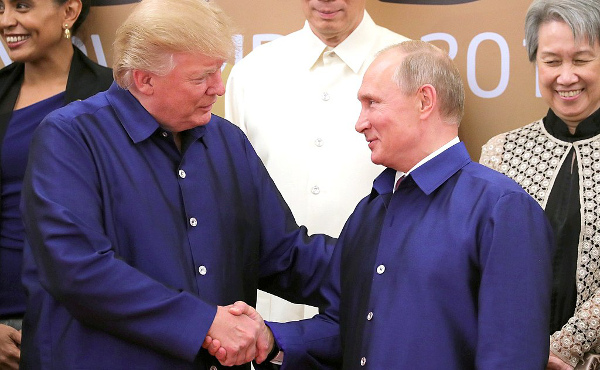
In Part 1 of this essay we surveyed the historical, economic, and cultural context for the upset victory of Donald Trump in the 2016 presidential election. I did not mention Russian interference in that election. That’s because it is a subject that deserves to be treated on its own. It is, of course, a source of heated controversy: leaders of the national security agencies and the FBI are unanimous in saying that Russia made a concerted effort to impact the election, while denial that such interference took place has emanated from the White House, Fox News, and some Republicans in Congress. The latter’s motivation is fairly transparent: questioning the legitimacy of the election shines an unfavorable light on the Trump administration and the Republican Party. Interestingly, however, voices on the far left have likewise argued that the Mueller investigation is a “witch hunt” that should be shut down. This peculiar state of affairs deserves attention, and I’ll be discussing it at some length. Even though we will be focusing on a very small subsection of the U.S. population, the shifts there are illustrative of trends with wide impacts.
Journalist Glenn Greenwald and ex-CIA analyst/political activist Ray McGovern, both favorites of the left, have penned articles arguing there is no direct evidence of conspiracy between the Trump campaign and Russia; they also suggest that the Mueller investigation is in effect an effort by the Deep State to expel an irritant (Trump) from the body politic—an effort that runs roughshod over the Constitution and thereby imperils American democracy. Several of my leftist acquaintances are of the same opinion. Why would vociferous critics of Trump and the Republican Party be singing from the same song sheet as Trump in this instance?
Once again, a little background helps. The American left is permanently and understandably enraged at the U.S. national security apparatus (the Pentagon, CIA, NSA, FBI, and State Department) following decades of military invasions and bombings in Vietnam, Iraq, Afghanistan, Libya, Syria, Yemen, and Somalia, etc.; the overthrow of elected governments in Iran, Guatemala, Congo, Dominican Republic, Brazil, and Chile; and support for dictators in the Philippines, Haiti, Guatemala, and elsewhere. By extension, many on the far left also hold the centrist, Clinton-led dominant wing of the Democratic Party in utter contempt. In the view of some leftists, the United States is pursuing a global plan for war that will never cease until all rivals to Washington are under heel. Accordingly, they have viewed the rise of Russia on the world stage as a necessary counterbalance to Washington’s imperial overreach. Meanwhile Russia (through RT and other outlets) has provided exposure for far-left intellectuals in the West whom the U.S. mainstream media often shuts out.
Leftist commentators frequently point out that Russia has a genuine gripe against America: after the breakup of the Soviet Union, the U.S. treated Russia miserably by expanding NATO (which Western leaders had promised they would not do). Further, the U.S. has routinely interfered in other nations’ elections, including (reputedly) the 1996 Russian presidential election. For these reasons complaints about Russia tipping the scales in the 2016 American election ring somewhat hollow.
For most far-leftists, it is not just the U.S. intelligence community that is to be distrusted, but the mainstream media as well: the New York Times and other prominent outlets were wrong about Afghanistan, wrong about Iraq, wrong about Libya, wrong about Syria. So why should we now believe them with regard to Trump and Russia? Hence at least some far-leftists seem as likely to link and tweet articles by Russian apologists like Alexander Mercouris and Moon Of Alabama as those by Noam Chomsky or Cornel West.
The problem with all this is that, however useful Russia may be as a check on U.S. warmongering foreign policy, it is nevertheless a fairly ruthless dictatorship. Russia is clearly promoting far-right and far-left political voices in Europe in an effort to destabilize the West, and appears to be doing the same in the United States. Evidence cited in one Mueller indictment suggests that Moscow’s agents worked not just on behalf of Trump, but Bernie Sanders and Jill Stein as well—though no one has claimed so far that either of these candidates actively conspired with Russia. Even if understandable or somehow justifiable, Russia’s efforts to influence elections in the U.S. and elsewhere won’t result in any advantage to the people of the countries targeted—any more than America’s longstanding similar efforts have done.
I won’t go into great detail summarizing the evidence that Russia did in fact interfere in the election on Trump’s behalf, and that the Trump campaign encouraged and likely conspired in those efforts. James Risen, Luke Harding, and Michael Isikoff have already done a good job in this regard. Russia and the Trump campaign had motive, means, and opportunity, and there is direct and indirect evidence for both interference and conspiracy. That evidence is increasingly contained in indictments, confessions, and guilty pleas. Yes, it is surely possible that U.S. intelligence agencies have doctored or even fabricated evidence of Russian election tampering. In that regard, there are remaining questions about the DNC email hack and the Steele dossier. But remove the hack and the dossier from discussion, and there’s still an impressive pile of evidence that virtually no one (other than clear Russia apologists) disputes.
Prior to the election campaign, Trump had financial relationships with shady Russians and did business in Moscow. During the campaign, he surrounded himself with advisers who had similar contacts and entanglements. On the campaign stump, he repeatedly praised Putin. During the campaign, Trump’s surrogates traveled to Moscow, exchanged frequent telephone calls with Russian officials and agents, and responded “I love it!” when illegally offered compromising information about Clinton by Russian sources. Trump publicly called for the Russians to “find” Clinton’s “lost” emails (one of his many profoundly unfunny “jokes”).
Meanwhile, we now know that Russia employed organizations to hack secure websites; organized scores of social media trolls and ad buys; paid teams to gather sensitive voter information at the state level; and even organized pro- and anti-Trump public rallies. Facebook has estimated that about 10 million people saw Russian ads targeting users in Michigan and Wisconsin—states Trump won by roughly 10,000 votes and 22,000 votes, respectively.
Once in office, Trump promptly divulged classified information to the Russian ambassador. He met with or telephoned Vladimir Putin repeatedly with no American present to record the conversation (which was utterly unprecedented). He appointed a Secretary of State with close ties to Moscow. And he has refused to implement sanctions on Russia that were passed overwhelmingly by Republican-dominated Congress and that he was more or less forced to sign.
In response to this litany, far-right and far-left commentators insist there is no definitive proof of collusion yet. But we should not expect to have such evidence in the public record at this stage. That’s the point of an investigation: to find what culprits seek to hide. The process involves subpoenaing witnesses and getting little fish to flip on big fish until the truth is revealed in sworn testimony. Recall Watergate: clear evidence of Nixon’s personal involvement wasn’t forthcoming until late in the two-year investigation, after the release of tapes of Oval Office conversations. Also, it’s entirely possible that many charges ultimately brought against Trump’s innermost circle will relate to financial crimes rather than conspiracy against the United States or obstruction of justice.
In my view, the Russian effort to influence the 2016 U.S. presidential election was likely the most successful low-budget covert operation in history. At least one of its aims (if not the primary one) was to disrupt the internal political system of the U.S., and in this it succeeded beyond any reasonable expectation. The operation probably couldn’t have worked so well without Facebook, but it probably could have worked just fine without direct help from the Trump campaign. Yet perhaps that was itself a crucial part of the plan: Moscow’s intelligence operatives may have been careful to get some of the Trump team’s fingerprints on the election interference process so that, when an investigation eventually uncovered those clues, the entire American political system would erupt in recriminations, with charges of treason and counter-charges of “deep-state coup” leading to system meltdown.
I probably won’t change many minds about Trump/Russia in what I’ve written above. Some will probably conclude that I’ve sold my soul to the Clintonites (for the record, I did not support Clinton in the election), or that I’ve bought into anti-Russian propaganda emanating from the neoconservative foreign policy establishment. But that’s also part of the story: we are entering a post-truth era in which tribal alignment matters far more than mere facts, which are becoming ever harder to establish to everyone’s agreement. Jennifer Kavanagh calls this “truth decay,” and notes that it makes the job of informing and mobilizing the public much harder—not just with regard to Trump-Russia or politics in general, but also when it comes to climate change and the other collective survival threats.
Some caveats: I’m not suggesting that war brinkmanship with Russia would be a good idea. And I’m not in favor of demonizing anyone in the U.S. who has connections with, or good things to say about Russia (as Matt Taibbi argues is happening). Nor am I arguing that Russia was entirely or even primarily responsible for the Trump victory. It was a close race due to the factors unpacked in Part 1 of this essay. Russian interference may have played a crucial role in tipping the scales, but that would never have been possible if Americans were not already turning against their perceived political elites due to perceived failures.
Again, the real point here is that this is how democracies die. The rot begins within, but there are often external players who take advantage of the situation, or hasten the decay (as occurred also in the case in ancient Rome).
Even if Trump himself were gone tomorrow, the nation still faces simmering crises (falling energy return on investment, increasing economic inequality, over-reliance on debt, climate change) that appear to be leading toward collapse of government and the economy; meanwhile, as a result of political polarization, social fragmentation, plain old corruption (see NRA), and truth decay we are losing whatever ability we ever had to address those crises.
Part 3: The Futility of “Big Green” Activism: A Conversation With Tim DeChrisopher
If environmentalists hope to have any real success in the age of Trump, they will have to change strategies and tactics in response to a transformed political and social context.
Back in the long-ago, hard-to-recall days before Trump became president, environmental (as well as peace and human rights) nonprofit organizations engaged in a routine, ritualized two-part dance of raising money from contributors, and then trying to convince policy makers to do something to save the world — or at least reduce the scale of harms being done. What was actually accomplished was never enough to actually turn society in the direction of sustainability, but the effort was in some respects its own reward: Activists felt useful, and in some cases, fundraising produced enough to pay salaries. And there were occasional victories to celebrate.
Now the United States is led by an authoritarian who is steadily undermining our democratic norms and institutions, and a Congress that is either bought and paid for by moneyed interests, or is too scared to challenge them meaningfully. It’s clear that no amount of cajoling, wheedling, imploring, threatening or explaining will convince Congress or the executive branch of the federal government to do anything whatsoever to address the panoply of do-or-die problems confronting us. Why even bother asking them?
Recall it was the failure of elites to address real underlying problems that contributed to the advent of Trump in the first place. Now, of course, at least from environmentalists’ perspective, Trump is making everything much, much worse: It’s probably fair to say that the Trump administration has never met an environmental regulation it didn’t want to kill.
What should environmentalists do under these changed circumstances? What strategies should environmental organizations pursue?
In order to get some helpful perspective, I recently corresponded with activist Tim DeChristopher, cofounder of Climate Disobedience Center. I respect DeChristopher for two important reasons: He has a good understanding of the range of overshoot issues humanity currently faces, and he has the courage of his convictions (he spent nearly two years in federal prison for a creative act of civil disobedience recounted in the documentary film Bidder 70).
What follows is a lightly edited transcript of my conversation with DeChristopher.
I first asked Tim what he thought about the actions of the big mainstream environmental organizations in the context of the new Trump administration.
Tim DeChristopher: I really don’t think that most mainstream climate environmental organizations are operating with any kind of intentional strategy in which they think that what they are doing will lead to positive change. When groups are mobilizing their members to “send a message” or “make their voices heard” to [US Secretary of the Interior Ryan] Zinke, [Environmental Protection Agency Administrator Scott] Pruitt or Trump, I doubt any staffers in those groups actually think that what they are doing has any potential of working. I think they are hemmed-in by the norms of social movement organizing. Those norms demand relentless optimism and positivity, so there is very little room for open reflection on our mistakes, changing direction or acknowledging that certain goals are no longer possible. Those norms also define leadership around knowing what to do and giving people tangible and immediate things to do.
I think most organizations and leaders would feel extremely nervous about saying to their community, “I don’t know what needs to be done in this unprecedented situation.” There is a mainstream assumption that they would no longer be justified in their leadership position if they expressed that uncertainty. But I think one of our most critical needs for a future of climate chaos is to develop a model of uncertain leadership. This is a kind of leadership that can hold space for sitting with uncertainty and empower a broader community of people to actively think and work in that space of vulnerability. Such leadership is embodied not in one’s ability to control a situation, but in one’s courage to engage with and relate to the situation.
RH: Historically, nonviolent protest and civil disobedience have developed as successful strategies for social change mostly within the context of liberal democracies. For example, there has been some discussion about whether [Mahatma] Gandhi’s efforts would have been as successful if Britain had not had a free press and other democratic institutions. Without a free press, regimes can simply imprison and kill protesters with minimal public awareness of either the protest or its repression. How do you think protest might evolve if the US continues its trajectory toward authoritarianism?
TDeC: I think that Trump has certainly changed the dynamics of civil disobedience at the federal level. It’s worth noting that Erica Chenoweth’s research has shown that nonviolent civil resistance is often more effective under authoritarian regimes, but I think Trump represents a very rare kind of power. Part of the efficacy of civil disobedience is often that it pulls back the facade of decency or democracy to reveal power that is actually rooted in violence. The police violence at Standing Rock was an embarrassment to Obama because he had hinged his authority on lofty ideals, but in fact his real power was the state’s monopoly on violence. Even Bush Jr. ran on a platform of being a “compassionate conservative.” It was a lie, but he needed that lie. Trump, however, never tried to project a facade of compassion or even decency. His power is based on ruthlessness and the breaking of taboos. If he is put into a position in which he has to violently repress nonviolent dissent, it may actually strengthen his power rather than undermine it.
In terms of media, I think our trajectory is not one of outright suppression of a free press to the point of avoiding public awareness, but rather a bifurcation of the press and social media to the point that no one has to accept anything they don’t want to believe. This is a serious challenge not only for civil disobedience, but for all social change efforts regardless of strategy. It is further exacerbated by new video manipulation technologies. It is very hard to see how we avoid either nihilism or civil war.
RH: So, what to do?
TDeC: My current thinking is that our best bet to overcome these challenges is making protest far more diffuse and widespread. With the lack of a central narrative or even a consensus reality, big iconic protests with famous people will likely continue to become less effective. But we all have a small circle of people whom we can influence in ways that are not dependent on media. Because our current culture has such justifiable skepticism of manipulation, one’s own willingness to sacrifice is more critical than ever for using our influence effectively, so I think civil disobedience will continue to play an important role for that. So perhaps this is to say that protest needs to follow the path that needs to be followed for so many other changes we need to make: more localized, more diverse, more people involved, more experimentation. No goddamn mono-crop social movements!
RH: How is your own organization, the Climate Disobedience Center, dealing with these issues and challenges? What concrete actions are your taking that different from the strategies of the ‘Big Green’ groups?
TDeC: The Climate Disobedience Center began as a resource and support center for folks doing civil disobedience against the fossil fuel industry. At the time, a certain brand of safe and limited civil disobedience was being increasingly embraced by the mainstream of the climate movement. We felt that there was an opportunity to work with those folks who were engaging in direct action and help them manifest the full potential of vulnerable and transformative civil disobedience. We primarily ended up filling the particular void in the movement around supporting folks after the point of arrest as they engage with the court system. Over time, we realized that rather than providing a plug-in service that could easily interface with a mainstream model, we were approaching this work with a fundamentally different paradigm that demanded a holistic structure. So we refocused our efforts on building small praxis groups of holistic support, like a cross between an affinity group and a small group ministry. These are groups of folks who support one another to live with integrity in a time of climate crisis. One piece of that is the moral responsibility to act to mitigate whatever harms can still be avoided, but we believe that work cannot be detached from the need to build resilient communities as well as grieve for that which is already being lost. As these are largely unprecedented challenges, we are trying to create the practices of mutual support that allow for as much experimentation and creativity as possible.
* * *
DeChristopher emphasizes that simply getting rid of Trump as first priority will not solve the environmental crisis. If the system wasn’t sufficiently self-correcting before, and if the status quo is irreparably broken, then it’s clear that some other change in strategy is needed.
He also calls for more local and experimental activism and civil disobedience, warning that large-scale protests could simply become indiscernible components of the noise being generated by the implosion of the US political system.
My own tendency is to look at the big picture. In that regard, my gut and intellect both tell me that the Trump interval is best understood as a stage in societal collapse. Each stage of that process will no doubt follow its own internal logic. As the stages progress, larger scales of societal organization (international institutions, then nation states) will tend to fail first. Therefore the usefulness of national and global strategies for resistance and repair will tend to gradually diminish.
If we want to minimize human suffering and protect ecosystems, then working locally to build community resilience is probably the best strategy available. The reasons are plentiful and the rationale only grows stronger as our context evolves.
122 Comments on "Heinberg: Getting Past Trump"
Duncan Idaho on Wed, 18th Apr 2018 9:59 am
“that the Trump interval is best understood as a stage in societal collapse”
Bingo!
We have a winner—–
Darrell Cloud on Wed, 18th Apr 2018 11:13 am
This is a war between the blue archipelago and the red sea that surrounds it.
“There are 3,141 counties in the United States.
Trump won 3,084 of them.
Clinton won 57.
There are 62 counties in New York State.
Trump won 46 of them.
Clinton won 16.
Clinton won the popular vote by approx. 1.5 million votes.
In the 5 counties that encompass NYC (Bronx, Brooklyn, Manhattan, Richmond & Queens) Clinton received over 2 million more votes than Trump.
In other words, these five counties alone, more than accounted for Clinton winning the popular vote for the entire country. The five counties comprise 319 square miles. The United States is comprised of 3,797,000 square miles. When you have a country that encompasses close to 4 million square miles of territory it would be somewhat ludicrous to allow the vote of those who inhabit a mere 319 square miles to dictate the outcome of a national election. Large, densely populated cities (NYC, Chicago, LA, etc.) do not and logically should not speak for the rest of our country.
Somehow, perhaps divine wisdom, the geniuses who founded our country created a system to avoid that circumstance.”
http://gop-tea-pub.tumblr.com/post/170131820302/the-brilliance-of-the-electoral-college-did-the
John Brown on Wed, 18th Apr 2018 12:06 pm
Excellent Darrell. The communist author should be denouncing us deplorables, not trump!
eugene on Wed, 18th Apr 2018 12:18 pm
What we are seeing today is what America has always been. I am greatly amused by the Russian issue. The cries from a nation that has assassinated leaders, over thrown governments, illegally invaded countries, been ruled by elites, etc, etc are simply silly. And if you are naïve enough to believe we don’t hack the hell out of other countries with every effort to steal everything we can, you need to just admit your ignorance of our history. We are simply another of a long line of empires with all the brutality that goes with it. To me, we are just starting to see what others have all along.
MASTERMIND on Wed, 18th Apr 2018 12:27 pm
The left is being scaremongered with Russia nonsense. While the right is being scaremongered with illegal immigrant nonsense…Both of these issues are non issues and a way of censoring important topics.
Boat on Wed, 18th Apr 2018 3:55 pm
Mm
And it’s about time. Drill baby drill along with abortion topics were long in the tooth. Not to forget the pivot to Asia.
Darrell Cloud on Wed, 18th Apr 2018 5:56 pm
John do not be like your namesake and show up too early for the fight. That being said, the political fracture between the blue archipelago and the red sea around it will only deepen if Heinberg’s premise is correct. Trump is a symptom not a cause of the current crisis. Populism is a default position when people come to realize that there is not enough.
As the contest for resources intensify localism and tribalism will continue its resurgence.
makati1 on Wed, 18th Apr 2018 6:57 pm
“Americans may -and do- think that they are still no. 1, and the most powerful, economically, politically, militarily, but that’s no longer what the rest of the world sees. …
The Russians know that they can, at will within a few minutes, sink the entire US fleet, destroy every US airplane & ship in the ME & within range of the ME, completely destroy all of Israel’s military capability & wipe out the military of the two-bit punk state of Saudi Arabia. …
A difference that explains how Russia can, with one tenth of American defense spending, still be militarily superior, or at least make any wars against it unwinnable. …
That is, in the US the focus is not on making the best weapons, it’s on making the most money on weapons. Boeing, Raytheon, Lockheed will develop those weapons that are most profitable, not those that are most effective. …
What the world sees is bluster emanating from a deeply divided nation (and we haven’t even tackled Britain). It sees that less than 48 hours after the airstrikes, a former FBI chief talks about his former boss in terminology that nobody would dare use in most countries, and throughout most of history,
James Comey is beyond Shakepeare. And in America, the issue is who’s right in the Comey-Trump conflict. In Russia, China et al it’s not. They see a house, a country divided. A weak country has no diplomacy.”
https://www.theautomaticearth.com/2018/04/every-kingdom-divided-against-itself/
“Every kingdom divided against itself is brought to desolation.” AMRN
MASTERMIND on Wed, 18th Apr 2018 7:28 pm
Here’s how hackers could cause chaos in this year’s US midterm elections
https://www.technologyreview.com/s/610774/heres-how-hackers-could-cause-chaos-in-this-years-us-midterm-election/
MASTERMIND on Wed, 18th Apr 2018 7:31 pm
The US, UK, France, and Israel have a military budget 30 times the size the Russia. And GDP almost 30 times the size..Putin is a sitting duck! He is going to get nuked into the stone ages and have a blade shoved up his asshole, like Gadafi! We need his oil and gas reserves! Sorry Putin..Adapt of die! Just one more false flag away!
Davy on Wed, 18th Apr 2018 7:45 pm
Billy 3rd world is hitting the Hedge hard tonight.
Boat on Wed, 18th Apr 2018 8:01 pm
Clog is gonna fence in the gulf and mak thinks the Russians can take out the Saudi, Israel and the middle east in a few minutes. You should give the Russian military to Assad. He has the guts to try it. Putin backs down a lot.
makati1 on Wed, 18th Apr 2018 8:14 pm
Boat, maybe you should be glad that Putin has patience. You may not be alive today if he was like Trump. Be careful what you wish for.
makati1 on Wed, 18th Apr 2018 8:21 pm
“The US, UK, France, and Israel have a military budget 30 times the size the Russia.”
MM, it is not what you spend, it is what you get for that money. Russia gets quality and effectiveness at reasonable prices. The Us gets over priced, ineffective junk at exorbitant prices.
You probably pay $12 or more for a haircut. I pay $2 for one of equal or better quality. You pay $50+ for a doctor appointment. I pay $6. You pay $1,200+ for a root canal and crown. I pay $120. It’s called PPP.
DerHundistlos on Wed, 18th Apr 2018 8:23 pm
Darell Cloud,
What’s the point of your nonsense? The article accurately outlines the extent to which Trump and his Republican enablers are destroying the natural world.
To begin, your “facts” are wrong. Clinton won by just under 3 million votes, not 1.5 million as you allege. Any fool can easily verify this. The fact that the information you provide is a lie, discredits all your other nonsense.
Your facile analysis proves what? That majority, the underlying foundation of democracy, should not rule, but rather sparsely populated geographic areas?
I can make the arguement that the areas that are centers of economic activity should decide, not those states and counties that receive more in federal handouts then are paid in taxes, in which case the Trump states “should not logically speak for other areas”.
Question: What is a metastasizing cancer to do when there is only healthy tissue to infect and consume?
Answer: Trump and his Republican enablers in congress move to sell off 3.3 million acres of public land; an area the size of the State of Connecticut is targeted for, “disposal to the highest bidder” in a bill before the Republican-controlled House of Reps. What say you, Teddy Roosevelt, founder of America’s park system, of
Boat on Wed, 18th Apr 2018 8:31 pm
Mak,
If you want to be president and survive you have to never back down or be percieved as never having backed down. Just the way it is since WWII. Putin is just another bad actor on the world stage trying to figure how to save face.
DerHundistlos on Wed, 18th Apr 2018 8:32 pm
Darell Cloud-
I fact checked your by county data. More stupid lies. You say Clinton won just 57 counties in the US. The fact is Clinton won 527 counties.
Why do people lie about easily verifiable information?
https://brilliantmaps.com/2016-county-election-map/
makati1 on Wed, 18th Apr 2018 8:36 pm
Boat, your brainwashing is showing. Try to think outside the Us MSM Iron Curtain. Putin is a perfect example of what a country’s leader should be. The Us Prez is a perfect example of the opposite. Trumpet is destroying the Us. You will begin to see eventually, thru that propaganda smoke screen.
makati1 on Wed, 18th Apr 2018 8:39 pm
Der, most in the Us never question anything. They are so mind numb that they barely manage to do what is necessary to survive. They are losing that ability also.
MASTERMIND on Wed, 18th Apr 2018 8:49 pm
Who cares about Putin he will soon be dead. The US has their eyes on him. He is on the shit list! Trump will turn on him in a heartbeat! Putin will have a blade shoved up his ass! Gadifi style! LOL
MASTERMIND on Wed, 18th Apr 2018 8:55 pm
Amongst the top 100 papers in the US by circulation, not a single editorial board opposed Trump’s airstrikes on Syria
https://fair.org/home/out-of-20-major-editorials-on-trumps-syria-strikes-zero-opposed/
MASTERMIND on Wed, 18th Apr 2018 9:20 pm
What a fake ass country the US has become…
makati1 on Wed, 18th Apr 2018 9:33 pm
MM, do you EVER think for yourself? A KGB agent has survived all these years and the Us is not able to touch him. You fantasize all this bullshit because you are scared shitless.
MASTERMIND on Wed, 18th Apr 2018 9:41 pm
Russia has a $1.56 trillion economy. How pathetic. California has a $2.4 trillion GDP. Fuck you Russia you pathetic weak trolling little shits. You have a weaker economy than California and you’re trying to take the world stage? Fuck you Putin and all of Russia. You are the most pathetic, narcissistic mother fuckers I’ve ever seen
https://www.investopedia.com/articles/investing/022415/worlds-top-10-economies.asp
http://www.politifact.com/california/statements/2016/jul/26/kevin-de-leon/does-california-really-have-sixth-largest-economy-/
makati1 on Wed, 18th Apr 2018 9:41 pm
MM, those 100 top papers are owned/controlled by 15 men. They are part of the group who are your masters.
https://www.forbes.com/sites/katevinton/2016/06/01/these-15-billionaires-own-americas-news-media-companies/#7ae38276660a
http://www.businessinsider.com/these-6-corporations-control-90-of-the-media-in-america-2012-6
Brainwashing is easy in America when a few people control the newspapers, movies, magazines, TV, etc. Wake up.
makati1 on Wed, 18th Apr 2018 9:51 pm
MM, it is not what you have, it is what you do with it. Russians do more with less. The Us does less with more. Apples and oranges.
Russia is ~17% in debt.
California is about 16%.
https://www.statista.com/statistics/271357/national-debt-of-russia-in-relation-to-gross-domestic-product-gdp/
http://www.usdebtclock.org/state-debt-clocks/state-of-california-debt-clock.html
Where is the ‘yuge’ difference? Russia has a bright future, California does not. 10+% of Californians are on welfare/food stamps. California spends more than it takes in. I could list another hundred negative about Cali, but you get the picture I hope.
MASTERMIND on Wed, 18th Apr 2018 9:54 pm
Iran switches from dollar to euro for official reporting currency
https://www.reuters.com/article/us-iran-currency-euro/iran-switches-from-dollar-to-euro-for-official-reporting-currency-idUSKBN1HP25W
HOLY SHIT! MADKAT ARE YOU READING THIS!
makati1 on Wed, 18th Apr 2018 10:27 pm
Old news, MM. The world is moving away from the USD and American control of the world’s finances. They re pulling the plug on America’s ability to print and spend. Give that some thought.
MASTERMIND on Wed, 18th Apr 2018 10:28 pm
Madkat
It was nice knowing Iran…They are going to get the Syria treatment!
MASTERMIND on Wed, 18th Apr 2018 10:37 pm
Madkat
You really think US does not control the world right now?
I assure you that it does.
makati1 on Wed, 18th Apr 2018 10:47 pm
MM, I assure you that the Us thinks it does but current events say different. The Us knew it could not kill even one Russian in it’s latest temper tantrum with out serious repercussions. Russia holds the upper hand now. Partnered with China they hold the keys to the empire, not Dc. The US still has the ability to commit suicide with nukes, but not win anything or control anything else.
I keep telling you that you have to think for yourself and not parrot the latest imperial propaganda. China and Russia have existed far longer than the US and will exist long after the Us is gone, barring a nuclear exchange. Then we are ALL losers.
makati1 on Wed, 18th Apr 2018 10:57 pm
MM, the Us has been threatening Iran for decades but does noting. Paper tiger America. The Us would not be able to win a war with Iran, because, as in Syria, Iran has powerful allies. Russia and China. Not to mention that the Us cannot even beat goatherds in Afghanistan or anywhere in the ME. The Us has not won a war since, well, maybe the Spanish-American war of 1898. Americans are losers all the way around. Bragging liars and hypocrite.
MASTERMIND on Wed, 18th Apr 2018 11:14 pm
Madkat
Russia and China are not going to do shit to the US.Europe, Israel…Are you insane? And they are not ever close allies. LOL You are just hoping! We have a GDP 20 times the size of Russia..LOL we already have their border surrounded! They are going down hard!
WE DO NOT FUCK AROUND! LOOK WHAT HAPPENED TO IRAQ AND LIBYA! BITCH!
makati1 on Wed, 18th Apr 2018 11:28 pm
MM, reason is not your forte is it? Nor is reality part of your world. You confine to parrot Us bullshit as truth with no rational thought to back it up.
GDP means nothing. It is fake numbers to distract the sheeple from reality. The Us is dying. It is propped up by an agreement over 40 years old (petrodollar) which is being destroyed by China, Russia, Iran and many other countries.
https://www.forbes.com/forbes/welcome/?toURL=https://www.forbes.com/sites/energysource/2014/05/29/the-colder-war-and-the-end-of-the-petrodollar/&refURL=https://search.yahoo.com/&referrer=https://search.yahoo.com/
or:
https://oilprice.com/Energy/Energy-General/Why-The-Petrodollar-Is-Facing-Its-End.html
or:
https://www.bloomberg.com/news/articles/2015-04-13/oil-rich-nations-burn-through-petrodollar-assets-at-record-pace
or:
https://www.newstarget.com/2016-04-22-u-s-currency-in-slow-collapse-as-chinese-yuan-quietly-replaces-the-petrodollar.html
or:
https://dailyreckoning.com/prepare-for-the-death-of-the-petrodollar/
etc.
makati1 on Wed, 18th Apr 2018 11:33 pm
MM, Iraq and Libya. Wars that the Us lost. They cannot leave either, forever, if they want to keep some measure of control. Is that “wining”? The world outside the empire doesn’t think so. The Us cannot win anywhere. All they can do is destroy and kill innocent women and children. They make Hitler look good.
makati1 on Wed, 18th Apr 2018 11:33 pm
LOL Reverting to name calling when cornered, MM? Childish!
MASTERMIND on Wed, 18th Apr 2018 11:44 pm
Madkat
Currency doesn’t really matter. The world is going to run short of oil soon and collapse. China is the worlds largest importer so they are fucked the most! It wont matter they cant ditch the dollar in time to matter. And when the global economy collapses you are going to die a horrifying death. and your kids will eat your grand-kids for dinner…
https://imgur.com/a/pYxKa
MASTERMIND on Wed, 18th Apr 2018 11:45 pm
Madkat
If I was you I would call your kids and talk to your grand kids! Before they are thrown on the barbecue. Or sold as slaves to the government for food.
Cloggie on Wed, 18th Apr 2018 11:52 pm
It was nice knowing Iran…They are going to get the Syria treatment!
No shit millimind, is Iran going to become yet another Russian client state? I thought they already were?
Russia and China are not going to do shit to the US.Europe, Israel…Are you insane? And they are not ever close allies.
Close allies? Um, actually no. France and Germany refused to join the US in its failed Iraq safari (remember “freedom fries” and “cheese eating surrender monkeys”.lol). It was the birth hour of Paris-Berlin-Moscow under Chirac, Schroeder and Putin, although currently suffering a setback under Merkel:
https://www.counter-currents.com/2011/08/boreas-risingwhite-nationalism-the-geopolitics-of-the-paris-berlin-moscow-axis-part-1/
(3 parts)
But Putin (and Schroeder) still support this.
https://documents1940.wordpress.com/2017/12/03/paris-berlin-moscow/
The only way to bring this about is through war, so let’s patiently wait until John Bolton is ready to write America’s suicide note and becomes the enemy of the entire world:
https://www.rt.com/news/387313-us-losing-leadership-eu-mogherini/
makati1 on Thu, 19th Apr 2018 12:05 am
MM, the world is NOT going to run short of oil before the Us collapses. Nor after. The oil is going to be there for those who have the money to buy it. It may cost $50 per gallon, but it will be there. Governments and military will have oil until there is none to pump at any price. Your “I want everyone to go down with me” dream is just that. A dream. Didn’t all those supposed years of education teach you how to think independently? Oh, that’s right they were all spent in American ‘schools’ where independent thought is discouraged.
Cloggie on Thu, 19th Apr 2018 12:05 am
Russia has a $1.56 trillion economy. How pathetic.
In dollar terms perhaps but who cares about the dollar. In real terms they have $4T (PPP)
https://en.wikipedia.org/wiki/Russia
Together with Europe that would be $23T, with 640 million the largest political, economic and military entity on earth.
Please start a war against Iran, millimind, I have so immensely enough of the empire. We Europeans want to rule again like we have done since 1492, when we made the mistake of inventing you.lol
Just role over and die. We can create a white republic on North-American soil for ya and you are allowed to join the godly white world, just like that. But for that we need to flatten your (((Washington))) first and you with it.lol
https://www.telegraph.co.uk/content/dam/olympics/2016/08/18/aamedal2_trans_NvBQzQNjv4BqU2GvAG2Cwz-Neg5MBd2qSgx2ZFCyj-JjneDwujU_5aI.png?imwidth=450
https://documents1940.wordpress.com/2017/09/26/origin-scientific-accomplishments/
World map after “Operation Enduring Europeanness”:
http://tinyurl.com/y8ydx6a9
You’re toast. Now go attack Iran and find yourself trapped in a a war against Russia and China and provoke a white nationalist uprising in the US.
makati1 on Thu, 19th Apr 2018 12:08 am
There you go again, MM. A 12 year response to bad news. You are all tax slaves already. How can that be worse? You will never be free. You only have the illusion of being so. I AM free.
As for my family, they can choose just as I did. They choose to stay and be serfs. I didn’t.
makati1 on Thu, 19th Apr 2018 12:11 am
Cloggie, MM doesn’t understand anything outside of his narrow vision of the world. I saw an old quote today: “Failure to prepare is preparing to fail.” That is his problem. Failure to prepare for what is coming. And it IS coming, no matter how much he is in denial.
Cloggie on Thu, 19th Apr 2018 12:13 am
In the news today:
China grows with 6.8% in Q1
https://www.nu.nl/economie/5225453/chinese-economie-groeit-in-eerste-kwartaal-2018-weer-met-68-procent.html
(China is destined to become the #1 economy on earth by far)
First European air taxi in Amsterdam Arena
https://www.nu.nl/233840/video/drone-taxi-maakt-eerste-europese-testvlucht-in-johan-cruijff-arena.html
Chinese manufacturing giant AliBaba works on self-driving cars as well
https://www.nu.nl/gadgets/5225243/chinese-webgigant-alibaba-werkt-zelfrijdende-autos.html
France government prohibits WhatsApp for government service, fear for spionage, comes with an app of its own
https://www.nu.nl/internet/5225108/frankrijk-komt-met-eigen-whatsapp-alternatief-angst-spionage.html
Davy on Thu, 19th Apr 2018 5:22 am
“GDP means nothing. It is fake numbers to distract the sheeple from reality.”
Billy 3rd world, if that is true why do you always parade your little Island’s GDP like it is special? Seems you like GDP when it makes you look good and when it doesn’t not so much.
Davy on Thu, 19th Apr 2018 5:25 am
“It was the birth hour of Paris-Berlin-Moscow under Chirac, Schroeder and Putin, although currently suffering a setback under Merkel”
Macron and Syria proved PBM is nonsense. Nothing to it but fantasy based on nationalistic delusions.
Davy on Thu, 19th Apr 2018 5:27 am
“Failure to prepare is preparing to fail.”
Saw that on the Hedge didn’t you billy 3rd world.
Davy on Thu, 19th Apr 2018 5:30 am
“(China is destined to become the #1 economy on earth by far)”
Extrapolations “by far” The world will not have the resources to allow China to grow much more. China has basically used huge amounts of credit to grow and now bad investments and empty collateral rehypothecation are coming home to roost.
Davy on Thu, 19th Apr 2018 5:33 am
“Together with Europe that would be $23T, with 640 million the largest political, economic and military entity on earth.”
Fantasy delusions
“World map after “Operation Enduring Europeanness”: http://tinyurl.com/y8ydx6a9”
Kindergarten child’s finger painting
Davy on Thu, 19th Apr 2018 5:54 am
“It’s An Ominous Sign”: Trader Reveals The “Nightmare Facing China’s Leaders”
https://tinyurl.com/yc9a6dxh
“With the market’s attention focused on how the China-US trade wars impact the US stock market, many have forgotten to check in on China’s markets. And it is here that Bloomberg commentator Kyoungwha Kim notes that things are going from bad to worse, as despite the recent spate of good economic news, the local market just can’t rally on good news, an indication of the “nightmare facing China’s leaders.” The reason: Trump may have accidentally stumbled on China’s Achilles heal: … the Shanghai Composite has failed to track the recent bounce in the S&P 500. The selloff in Chinese stocks has deepened since Xi Jinping’s speech in Boao to open up the world’s second-largest economy, increase imports and protect intellectual property rights.”
“The case of ZTE being banned from buying American tech products revealed the hurdles for the “Made in China 2025” strategy that’s supposed to upgrade the economy from a manufacturer of quantity to one of technology-driven quality. Chinese consumption is growing but not by enough to take up the slack from dwindling exports if tech industries are going to sag while “old economy” manufacturers continue to cut investment amid ongoing supply- side reform. Pessimism stems from a government stuck between a rock and a hard place. China can follow Japan’s example from decades ago by bolstering property investment and adopting other stimulative policies and somehow hope to avoid the latters 1990s collapse. Or, it can endure a low-growth period of reform in order to avert financial market bubbles. The Shanghai Composite is already 13% below January’s two-year high. One has to wonder where the next buyer will come from if the government fails to convince investors that it knows the optimal path.”