
Peak Oil is You
Donate Bitcoins ;-) or Paypal :-)


Page added on September 26, 2017

Heinberg: Energy and Authoritarianism

Could declining world energy result in a turn toward authoritarianism by governments around the world? As we will see, there is no simple answer that applies to all countries. However, pursuing the question leads us on an illuminating journey through the labyrinth of relations between energy, economics, and politics.
The International Energy Agency and the Energy Information Administration (part of the U.S. Department of Energy) anticipate an increase in world energy supplies lasting at least until the end of this century. However, these agencies essentially just match supply forecasts to anticipated demand, which they extrapolate from past economic growth and energy usage trends. Independent analysts have been questioning this approach for years, and warn that a decline in world energy supplies—mostly resulting from depletion of fossil fuels—may be fairly imminent, possibly set to commence within the next decade.
Even before the onset of decline in gross world energy production we are probably already beginning to see a fall in per capita energy, and also net energy—energy that is actually useful to society, after subtracting the energy that is used in energy-producing activities (the building of solar panels, the drilling of oil wells, and so on). The ratio of energy returned on energy invested (EROEI) for fossil energy production has tended to fall as high-quality deposits of oil, coal, and natural gas are depleted, and as society relies more on unconventional oil and gas that require more energy for extraction, and on coal that is more deeply buried or that is of lower energy content. Further, renewable energy sources, especially if paired with needed energy storage technologies, tend to have a lower (some say much lower) EROEI than fossil fuels offered during the glory days of world economic growth after World War II. And renewables require energy up front for their manufacture, producing a net energy benefit only later on.
The quantities and qualities of energy available to any society have impacts that ripple through its economy, and hence every aspect of daily life. As Lynn White, Marvin Harris, and other anthropologists have shown, the political and social institutions of every society are determined—in broad strokes, though certainly not in the details—by what Harris called its infrastructure, or its ways of obtaining energy, food, and materials. Abundant, easily transported and stored energy from fossil fuels made industrial expansion possible during the twentieth century, and especially after World War II. This period of turbo-charged economic growth had repercussions in fields as diverse as manufacturing, farming, transportation, and even music (via the electrification of live performance as well as the flourishing of the recording industry). That’s right: your favorite rock band is an epiphenomenon of fossil fuels.
Further, as archaeologist Joseph Tainter has pointed out, societies often use complexity (an increase in the variety of tools and institutions) as a means of solving problems. But complexity carries energy costs, and the deployment of complexity as a problem-solving strategy is subject to diminishing returns. Tainter argues that this is a comprehensive explanation for the historic collapse of civilizations—one that has obvious implications for our own society: clearly, if its energy supplies are compromised, its capacity to successfully deploy complexity to solve problems will be impaired.
All of which suggests that if and when energy sources decline, industrial societies will face systemic challenges on a scale far beyond anything seen in recent decades. In this essay, I propose to examine just one area of impact—the realm of politics and governance. Specifically, I address the question of whether (and which) societies will have a high probability of turning toward authoritarian forms of government in response to energy challenges. However, as we will see, energy decline is far from being the only possible driver of authoritarian political change.
The Anthropology and History of Authoritarianism and Democracy
It is often asserted that democracy began in ancient Greece. While there is some truth to the statement, it is also misleading. Many pre-agricultural societies tended to be highly egalitarian, with most or all members contributing to significant decisions. Animal-herding societies were an exception: they tended to be patriarchal (men made most decisions), and, among men, elders and those with more property (women, children, and captives were treated as chattel) held sway. (Herders, whose social relations reflect the harshness of their environment, typically live in places unfit for farming, such as deserts.) A good example of democracy completely independent of the Greek tradition is the Iroquois confederacy of the American northeast, whose inclusive decision-making system incorporated checks and balances; it served as an inspiration for colonists seeking to design a democratic government for themselves as they threw off the yoke of British rule.
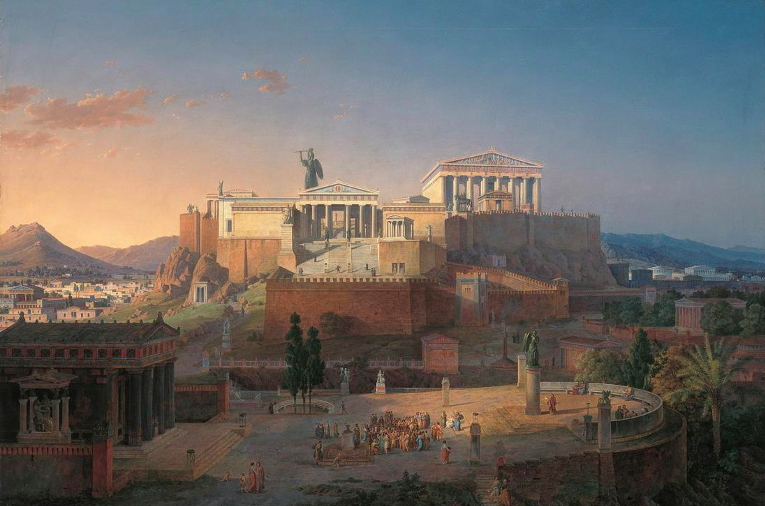
Early agricultural societies were often rigidly authoritarian. Marvin Harris explained this development in infrastructural terms: stored grain surpluses required management and distribution authority, as did irrigation systems. But the appropriation of so much power by an individual or family required further justification; hence new sky-god religions emerged, valorizing kings and pharaohs as wielders of divine power. Greece, however, differed from Egypt and other “hydraulic” civilizations (i.e., ones based on huge irrigation systems): it enjoyed enough rainfall so that irrigation wasn’t required. Farmers could grow diverse crops independently, without relying on state controls over water and grain. Hence it was in Athens that democracy emerged (or re-emerged) as a political system—imperfect though it may have been (Attica’s total population was likely between 150,000 and 250,000, but free citizens numbered only 20,000 to 30,000: women, slaves, and foreigners could not participate in the public process of making decisions).
Prior to the fossil fuel era, Europe enjoyed a significant injection of wealth from its sail-based pillaging of much of the rest of the world. Merchants, as a social class, began to jostle against the aristocracy and clergy, previous holders of political power. Wealth and abundant energy supported the development of science and philosophy, which—when combined with newer technologies like the printing press—helped usher in the age of reason. The autocratic rationale for rule, “because God granted me divine power,” no longer seemed reasonable. In Britain, the monarchy began reluctantly to cede some of its authority to parliament during the mid-seventeenth century; then, a little over a century later, thirteen of Britain’s colonies in North America rebelled and formed a federated republic. Revolution in France further stoked demands throughout Europe and elsewhere—by philosophers and commoners alike—for wider distribution of political power.
In modern times, industrial expansion based on abundant energy from fossil fuels has led to urbanization and to the employment of much of the population in factory, sales, and managerial positions. This detachment of people from land has in turn produced greater geographic and social mobility, as well as opportunities to organize collective demands for power sharing (via trade unions and political organizations of all kinds), including women’s suffrage. Democracy has spread to more and more nations—always kept at least partly in check by centralized economic and military power. Meanwhile, an ever-greater mobility of capital, goods, information, and people has also led to the geographic expansion of polities—nations of larger size, alliances between nations, trade blocs, and an intergovernmental organization offering membership to all countries (the United Nations).
Now, in all likelihood, comes an era of declining and reversing economic growth, as well as reduced mobility. Existing forms of government will be challenged. Ultimately, larger political units may tend to break up into smaller ones, and many democracies may be vulnerable to authoritarian takeover. But the risks will vary significantly by country, based on geography and local history.
How Nations Succumb to Authoritarian Takeover
Before exploring those risks, it may be helpful to review the four main ways in which democracies have changed into authoritarian regimes in recent history.
- Election of a dictator. Mussolini initially came to power in Italy through election, as did Hitler in Germany, Ferdinand Marcos in the Philippines, and “Papa Doc” Duvalier in Haiti. Why do people elect authoritarians? Typically, they do so because they feel threatened—by a foreign or domestic enemy, or by hard times—and want a strong man to take charge. Usually the elected authoritarian-in-waiting only assumes dictatorial power later, without asking the consent of the electorate. For example: in a recent essay, Ugo Bardi recounts how declining exports of British coal to Italy after World War I led to an energy famine, which in turn resulted in riots, shifting political alliances, and the rise of Mussolini and the Fascists.
The following brief representative picture of how an authoritarian leader can take total power following election is from journalist Tim Rogers, recounting Nicaraguan leader Daniel Ortega’s ascendancy:
“When Daniel Ortega was elected president in 2006 with a twiggy 38 percent victory, Nicaragua had a constitutional ban on consecutive reelection as a safeguard against dictatorship. . . . Eleven years later, Ortega is starting his third consecutive term as president after rewriting the constitution, banning opposition parties, and consolidating all branches of government under his personal control. Ortega orchestrated his power grab by polarizing the country, dividing the opposition, attacking congress, demonizing the press, forbidding protest, demanding personal loyalty from all government workers, and turning all his public appearances into campaign rallies for his core base of supporters. He institutionalized his cult of personality and normalized . . . threats of violence and chaos. . . .”
- Military coup. The list of military dictatorships in recent decades is long. Clayton Thyne and Jonathan Powell maintain a coup dataset, according to which there were 457 coup attempts worldwide from 1950 to 2010, most by military factions. Of these, about half were successful. The reason military putsches are so common is not hard to discern: the taking of power by armed force is likely to be most often—and most successfully—attempted by those who are already professionalized wielders of weaponry.
- Foreign interference or foreign support for a coup. If a powerful nation wishes to exert near-total control over a weaker country, one of the most effective ways to do so is to install a puppet dictator who can then be bribed and threatened. This is a strategy the United States has deployed often, beginning early in the twentieth century with its support for dictators in Central and South America. Also, in the early 1950s, the U.S. supported Shah Pahlevi over Iran’s elected President Mohammad Mossadegh, leading to decades of dictatorship there. However, the U.S. is far from the only country to have ruled other nations by remote control: Britain, France, and Russia/USSR did the same in one instance or another.
- Revolution. Most revolutions are fought against authoritarian regimes or foreign rulers. On rare occasions, however, the people—typically a rambunctious faction of the people—attempt to overthrow an elected government in favor of a would-be dictator. Such revolutions are usually more accurately described as civil wars. Coups in which an elected leader is overthrown in favor of an authoritarian with the help of foreign influence can be stage-managed to appear as revolutions (this happened in the case of Mossadegh in Iran). More frequently, however, revolutions that are widely intended to result in democratic reforms eventually result in the coalescing or emergence of an authoritarian regime (for example, in France at the end of the 18th century, in Russia in 1917, in China in 1949, in Cuba in 1959, and in Cambodia in 1963).
Risk Factors for Authoritarian Takeover
Economic decline led by energy decline probably won’t automatically result in despotism, just as industrialism and economic expansion didn’t everywhere lead to democracy. What are the circumstances that are likely to push nations to adopt more authoritarian governments?
Below are some notable risk factors (this is not an exhaustive list). From here on, I will occasionally refer to the Democracy Index (compiled by the UK-based Economist Intelligence Unit), which seeks to measure the state of democracy in 167 countries based on 60 indicators.
- Economic decline or instability. Periods of high joblessness, disappearing savings, and declining incomes can lead to widespread dissatisfaction with government, offering an opening for demagogues, military coups, revolutions, or foreign takeovers.
- Weak democratic institutions with a short history. Democracy is a habit that needs reinforcement. It also needs institutions—parties and election machinery (polling places, fair counting of ballots, etc.). If those institutions have shallow roots, it is easier for them to be undermined or corrupted.
- Dysfunctional media. Democracy only functions if the public is well informed with regard to issues and the actions of government. Media organizations can become weak, dominated by special interests, polarized, or suppressed by government. Their ownership can be consolidated by a few companies with similar political interests. In our current age of electronic information, media are vulnerable to outright propaganda, “fake news” (i.e., reporting characterized by ideologically spun, inaccurate, or even wholly invented stories), and the clever use of social media (bots and trolls).
- High and growing levels of economic inequality. Some of the early observers of democracies, including Toqueville, noted that procedural democracy (equality before the law, universal voting rights, the right to express oneself in the political sphere) can be undermined by the power of wealth. Rich people can buy influence in ways both obvious and subtle. This is why healthy democracy is often correlated with progressive taxation and the availability of government-run social programs for those who are unemployed, retired, or sick.
- Simmering resentments among social/racial/religious/ethnic groups, offering fodder for scapegoating. In hard times, demagogues can play upon such resentments to gain support and take power.
- Deep political polarization. Polarization drains people’s attention from areas of shared interest and potential cooperation, and focuses it instead on points of disagreement. As each party demonizes the other, former political extremists may find their way into the mainstream. Polarization can offer an opening for a demagogue who promises to trounce the opposition party once and for all, if given dictatorial powers.
- Weak financial systems heavily dependent on debt. As economic historians have shown, heavy reliance on debt always results in an eventual financial crash. See “economic decline” above.
- Special vulnerability to foreign influence or takeover. If a country is militarily weak but has a strategically significant geographic location (for example, along the route of an important oil or gas pipeline), or if the country happens to possess strategically important resources (minerals or fossil fuels), more powerful nations are likely to have a keen interest in keeping that country controllable.
- A powerful military with a history of domestic intervention. If social chaos ensues for whatever reason, the military is likely to step in; and when it does it is more inclined to install a dictator than to restore or build a democratic system. That’s because the military itself, in virtually every nation, has an authoritarian internal structure. (The Iroquois insisted that peace chiefs be different from war chiefs—an idea borrowed by the framers of the U.S. Constitution, which specifies that no acting military leader may assume the presidency).
- Special vulnerability to climate change or other environmental disasters. People don’t inevitably turn to strong leaders after natural disaster. Over the short term, they tend instead to band together. Old grievances tend to be temporarily forgotten, and distinctions between rich and poor are at least somewhat erased. However, over the longer term, ecological disruption can lead to scapegoating and either revolution or a turn toward strong men who promise to restore order. For example, the Syrian civil war, which began in 2011, was preceded by a long and devastating regional drought linked to climate change; refugees from the countryside flooded cities, straining infrastructure already burdened by the influx of some 1.5 million refugees from the Iraq War. These refugees provided recruits for the Free Syrian Army, which rebelled against the authoritarian Assad regime.
- High population growth rate. Nations with high fertility rates typically find it difficult to overcome poverty, absent a robust resource-exporting economy. Indeed, of the ten nations that currently have the highest population growth rates (Lebanon, Zimbabwe, South Sudan, Jordan, Qatar, Malawi, Niger, Burundi, Uganda, and Libya), seven have fully authoritarian regimes according to the Democracy Index, while three have “hybrid” governments; only two (Qatar and Lebanon) have a per-capita GDP higher than the world average. As world energy declines, countries with fast-growing populations will probably see higher-than-typical per-capita decline rates in energy usage, likely leading to economic and social instability.

Most of the above might be considered generic risk factors, in that they apply to all societies even without taking energy decline into account. Other risk factors are more directly related to potential energy supply problems:
- A high dependency on food imports. History has shown (for example, in Egypt in 2011) that food shortages can rapidly lead to social unrest and ultimately to revolution or authoritarian takeover. High food import dependency is therefore a point of vulnerability in societies given the likelihood that energy decline will also entail a decline in mobility, including the movement of food and other necessary goods.
- Government’s budget tied to fossil fuel export revenues. If a government derives most of its revenues from fossil fuel exports, it will eventually face a declining revenue stream. Even Saudi Arabia, which has been a top oil exporter for decades, recognizes this (it is an authoritarian monarchy; several other major oil exporters are likewise classified as authoritarian regimes by the Democracy Index). Norway has sought to prepare for the inevitable by saving its oil export revenues in a permanent investment fund; currently that nation enjoys the highest rating of any country on the Democracy Index, and its citizens also rank high in terms of per capita income and self-reported happiness.
- High per capita energy usage. Countries that have high per capita rates of energy usage have further to fall as energy becomes harder to produce. Countries with low rates of per capita usage typically already have ways of meeting basic needs relatively simply and directly—with a higher percentage of the total population engaged in food production, and a more robust informal economy.
- High dependency on energy imports. If heavy dependence on revenue from fossil fuel exports can constitute a vulnerability for democracies, heavy dependence on imports can as well. Even though the U.S. was a major oil producer throughout the twentieth century, by 1970 it was increasingly dependent on imported crude; hence it faced economic hardship due to the 1970s Arab oil embargo.
There is something missing from these lists that is hard to define but nevertheless crucial to our present discussion. Perhaps Pankaj Mishra captures it best in his recent, difficult book, The Age of Anger. There he describes how, from its beginnings in the eighteenth century, modern capitalist, urban, industrial life disrupted previous patterns of settled existence. People lost their connections with land and tribe, and traditional livelihoods, and hence some essential aspects of their identity. In return, economic liberalism promised mobility, comfort, and intellectual and moral advancement. Instead many experienced anonymity and alienation, and the result was widespread resentment. This in turn led to decades of revolution and terrorism in Europe throughout the nineteenth century, with many prominent assassinations (U.S. President McKinley, French President Marie François Sadi Carnot, Bavarian Prime Minister Kurt Eisner, Russian Czar Alexander II, Serbian King Aleksandar Obrenović, Spanish Prime Minister Juan Prim, and many others) as well as bombings and other violent events.
Today urbanization, commercialization, and technological disruption are proceeding at a faster pace than ever and reaching billions in formerly rural nations in East and South Asia, the Middle East, and Africa. Millions of young people are being educated for life as consumers and workers, yet are finding the promises of “development” ringing hollow. Unemployment rates among young males are often very high in these nations, and young men educated for urban industrial life are being attracted to militant fundamentalism. The rise of militant fundamentalism, along with high rates of immigration from fast-urbanizing countries, generates fear in the first-wave industrialized countries—a fear that leads to a rise in “traditionalism” and a turn toward authoritarian leaders who promise to suppress terrorism and reduce immigration. In effect, for both the young Islamist radical and the older Trump voter, tribalism is a powerful motivator. We will return to this subject later as we consider ways to counter or mitigate risks to democracy.
Typically, a surplus of unemployed young males also increases the likelihood of war. During wartime, the combatants gain a sharper sense of meaning and purpose. Democracy seldom flourishes during war, though it can persist and blossom anew afterward.
Clearly, nations are in widely varying circumstances, with different areas and degrees of vulnerability to energy decline; and they are thus likely to react differently to the ensuing economic stresses. Full “democracies” according to the Democracy Index (Norway, Canada, New Zealand, etc.) are probably best situated to respond in ways that preserve democratic institutions and traditions. Nations currently listed by the Democracy Index as “flawed democracies” (United States, Philippines, Indonesia, etc.) are probably most at risk of shifting further toward authoritarianism via election. Countries that are currently “hybrid states” (Turkey, Venezuela, Pakistan, etc.) or “authoritarian” (Russia, Egypt, China, etc.) are more likely to experience revolutions or coups.
Countering the Risks to Democracy
How could nations in the “democracy” or “flawed democracy” categories resist a tendency to slide toward authoritarianism? It stands to reason that, if risk factors are present, reducing vulnerability would entail countering those factors as much as possible:
- Build and support independent media. Governments and leaders should resist the temptation to favor media outlets that simply parrot their own talking points, or that disparage current leaders’ enemies. Maintain full press freedoms, including legal protections for journalists.
- Work to limit climate change and other ecological drivers of human misery. This includes not only efforts to adapt to higher sea levels, but also to reform agricultural practices (carbon farming) and dramatically reduce carbon emissions in transportation and manufacturing.
- Work to reduce extreme political polarization. Avoid wedge issues. Nations with more than two major parties sometimes fare better at avoiding polarization.
- Support and strengthen democratic institutions. Prioritize fair elections (universal voting rights, public financing of campaigns, limits to campaign contributions, plenty of accessible polling stations that are open a sufficient number of hours, transparent methods of ballot counting).
- Promote tolerance. For a nation, ethnic, religious, and cultural homogeneity can be an asset in avoiding political unrest during hard times. But many nations are ethnically, religiously, and culturally diverse, and any effort to reduce that diversity would necessarily entail human rights violations. Nations with diverse populations must simply make the best of the situation, celebrating and honoring their diversity and protecting minorities.
- Discourage inequality. Most nations already counter economic inequality through progressive taxation and social welfare programs. But economic stresses from energy decline will require more creative thinking and experimentation, including encouraging worker-owned cooperatives and discouraging shareholder-owned corporations; implementing high inheritance taxes with no loopholes; and finding ways to reduce the role of debt in society.
- Minimize power of military and intelligence agencies. Keep the military separate from governance institutions. Keep the military budget within modest bounds. Don’t over-glamorize the military. And don’t permit “black ops” or domestic surveillance.
- Build low-energy infrastructure, habits, informal economy. This implies a change of direction for most nations, which tend to be hooked on large-scale infrastructure projects (highways, airports) that lock in energy dependency. Promote low-energy ways of providing for basic human needs, such as solar hot water heaters and cookers, walking, and bicycling.
- Promote population stabilization. Support family planning and elevate the social status of women.
- Build local food production capacity. Support small farmers, local food, and agriculture that minimizes dependence on fossil fuel inputs.
- Stabilize the financial system. Reduce reliance on debt in every way possible, shrinking the size of the financial system relative to the “real” economy of goods and services.
- Decentralize both the economy and the political system. Encourage distributed energy, local currencies, and local food. Allow city and regional governments to make all decisions except those that require national or international deliberation.
- Avoid being the target of foreign political meddling. Maintain vigilance with regard to electronic and propaganda warfare. Don’t take on big international loans.
These recommendations are far easier to spell out than to carry out. And at least two of them are seemingly at odds with each other: a nation that keeps its military and defense budgets at minimum levels might be more likely to be the target of foreign meddling or intervention. Further, while most democracies are making at least some efforts along some of these lines, in many cases they are being overwhelmed by trends toward increasing polarization of politics and media, and increasing economic inequality.
Further, most of the above recommendations fall within the bounds of modern liberal norms and discourse. But, as we have seen, the entire project of industrial and social “progress,” as framed within the liberal economic tradition, has produced whole classes of casualties and rebels. The endemic risks to urban, capitalist, industrial societies stemming from the resentment and alienation described by Mishra—that lead increasingly to terrorism, religious fundamentalism, and authoritarianism—are inherently difficult to track or counter. To defuse this deep, amorphous threat to democratic values and institutions, perhaps something more is needed beyond the mere strengthening of media and democratic institutions—something that ties people back to the land and gives them both a “tribal” identity and a larger sense of purpose. A new religion might fit the need, but it is difficult to summon one at will. If advocates of democracy and cultural pluralism continue to fail to fill this void, authoritarians of various stripes will certainly seek to do so.
Are Dictatorships or Democracies Better at Responding to Energy-Economy Decline?
In the contemporary world, democracy is widely (though not universally) prized over authoritarian forms of government. This is certainly understandable: authoritarianism leads to the regimentation of thought and behavior, and often to the subjection of large segments of the population to psychological and/or physical violence. But are democracies inherently superior to authoritarian regimes in dealing with crises such as energy decline, climate change, resource depletion, overpopulation, and financial instability?
To adapt proactively to environmental limits and impending scarcity, governments may have to do some unpopular things. Restrictions on consumption (such as rationing) may be required, along with the encouraging of smaller families. Such policies cannot help but rankle, following decades of rising economic expectations. Economic redistribution could help reduce the stress of scarcity for a majority of the populace, but many will still resent the new conditions. Elected leaders may find it difficult to maintain sufficient popular support for such policies. Could authoritarian regimes fare better? A few historic examples come to mind.
During the early 1990s, Cuba saw a sharp decline in energy supply due to a cutoff of low-cost oil imports from the now-defunct Soviet Union. At the time, Cuba’s food system was highly centralized and dependent on oil-fueled farm machinery and food transport. Cuban leaders responded to the crisis by decentralizing food production, reducing fuel inputs, and encouraging urban gardening. The result was a rapid and thorough restructuring of the nation’s food system that averted widespread famine. It is unclear whether such measures would have been feasible outside a command-and-control authoritarian political context.
Both China and Iran managed to substantially reduce their nations’ high birth rates—China (beginning in the 1970s) via its compulsory one-child policy, and Iran (starting in the 1980s) through vigorous but voluntary family planning efforts. Both nations formulated and managed these programs via top-down, centralized, and authoritarian methods.
These examples might suggest that authoritarian regimes are inherently more resilient than democracies. However, there are instances where authoritarian regimes have instead proven brittle. For example, when Soviet Union failed to deal with economic decline in the 1980s the government collapsed, as did the nation’s economy. In contrast, some democracies (such as the U.S. during the Great Depression and Britain in the 1930s and ’40s) have persisted during privation, though somewhat authoritarian temporary measures were instituted, including greater control of the media by government.
Many authoritarian regimes are poorly situated to help the populace weather economic crisis simply because their leaders are too obsessed with self-enrichment, self-aggrandizement, and self-protection. It could be argued that if a society is already impoverished due to the incompetence of its authoritarian leadership, its people will have fewer expectations to be dashed, and their standard of living will not have as far to fall before hitting subsistence level. But this is faint encouragement. There must be some better recommendation for today’s nations than “crash your economy and suppress your people’s aspirations now, so that they won’t be disappointed later.”
* * *
The relationship between energy, the economy, and politics is messy and complicated. There is not a simple 1:1 correlation between energy growth and economic growth: the Great Depression occurred in the United States despite the presence of abundant energy resources. Similarly, there will probably not be a strict correlation between energy decline and economic contraction.
One important wild card is the role of debt: it enables us to consume now while promising to pay later. Debt can therefore push consumption forward in time and (for a while, at least) make up for declining energy productivity. It would appear that the “fracking” boom of the past decade, which probably delayed the world oil production peak by about a decade, depended on the power of debt. But when debt defaults cascade, an economy may decline much faster than would otherwise be the case (default-led financial crashes have occurred repeatedly in modern history). And debt defaults can cripple the financial and thus the economic system of a nation with plenty of energy resources (as happened in the U.S. in the 1930s).
As we have seen, dictatorships can sometimes adapt well to scarcity. We can only hope that, if scarcity does indeed lie in our immediate future, authoritarian leaders will minimize rather than add to their people’s suffering. Similarly, we should hope that everyone in democracies has access to information that helps them make collective choices that lead to successful adaptation to inevitable, impending scarcity. Unfortunately, flawed democracies may be particularly vulnerable when energy supplies decline. Given their political polarization and saturation with “fake news,” they are more likely to succumb to demagogues who promise to return the nation to a condition of abundance if granted extraordinary powers.
It is highly likely that, as events unfold, the causal criticality of energy decline will be hidden from the view of most observers, whose attention will be fixed instead on shocking but comparatively superficial and secondary political and social events. A more widespread understanding of the role of energy in society, and of the likely limits to future energy supplies, could be extremely beneficial in helping the general populace adapt to scarcity and avoid needless scapegoating and violence. Perhaps this essay can help in some small way to deepen that understanding.
92 Comments on "Heinberg: Energy and Authoritarianism"
Cloggie on Fri, 29th Sep 2017 4:51 am
Sure clog, golden decade of indebtedness and being overrun by immigrants, more like the golden decline and decay. Europe is falling apart like everywhere else. Heinberg talked about peak everything and he is right. The real peak oil was missed by all and to be fair it has been an evolution. Peak oil dynamics are alive and well. Since your 100% renewable golden age of Europe will likely never happen because of financial constraints and the constraints of the physics of energy, you need to worry about peak oil. It is not gone. Peak oil is alive and well and so is climate change. Both are likely longer term but there effects are now. You think you got out of jail free but you are screwed like the rest of us clogster.
You are, how very American, obsessed wit financial categories like debt. A financial system collapses and already everybody is as good as dead, well in your view. You do not believe in DNA. You do not believe in collapse as an opportunity to start all over again. The only thing that will collapse is that sleepy peaceful comfortable modus of life. But life won’t collapse. In fact a “collapse” will provide the shock necessary to mobilize the population to set up a new arrangement. 2017-levels of energy are absolutely not required for higher civilization.
In fact the opposite is true. Human life during Renaissance Italy at the end of the Middle Ages was at a far higher level than the lazy westerners of today, who simply lack the nervous system to survive in an environment of Italy 1500.
Davy on Fri, 29th Sep 2017 5:31 am
Never said “good as dead” cloggie. What I said more or less is financially we likely do not have what it takes for you to have your European golden decade of 100% renewable transition in increasing affluence. Europe is going broke. You might get part way there but all the way I seriously doubt. Your EU is awash in financial problems and in some way the worst in the world mainly stemming from your imperfect union.
I believe in DNA cloggie, today I put my bucks with my does for breeding. I know more about it than you do on a practical level. You are a racist who uses the idea of DNA to peddle racism. Clog, I am not against you wanting your white Europe but don’t want it on false pretenses that people of color are inferior. I am all for keeping races and cultures separated more. I am not happy with the homogenization of globalism. I want immigration to my country to decline significantly mainly because we already have too many people. We have enough problems. The people that are here I hope the best. I am partially for your racism but not the extremism of your racism.
Sorry, clog, life may or may not collapse. That is not a human decision that is a natural evolutionary process and our situation does not look well. Your situation and mine clog. We both have headwinds to affluence.
Davy on Fri, 29th Sep 2017 5:49 am
“Does “More Europe” Mean More Government?”
http://tinyurl.com/yadppfl2
“The EU runs the risk of falling into the glorification of centralized planning first and foremost, absolute uniformity, and obsolete interventionism that has nothing to do with the plural, free and diverse United States of America and which shows too many coincidences with the Soviet Union dependent on the politburo.”
“Juncker’s call for efficiency can be interpreted as a breath of fresh air, but it contrasts with reality. According to the Intelligent Regulation Forum and with the official data of the European Union for 2015, the member countries are subject to more than 40,000 rules by the mere fact of being part of the EU institutions . In total, including rules, directives, sectoral and industrial specifications and jurisprudence, they estimate that there are some 135,000 obligatory rules. A European Monetary Fund is clearly a subterfuge to give free rein to the uncontrolled financing of white elephants to greater glory of governments and rent-seeking sectors. Faced with the evident failure of the already forgotten “Juncker plan”, no one seems to consider the failure of constant wastefulness in industrial and stimulus plans that have led the European Union to overcapacity of more than 20% and huge financial holes. According to Transparency International, in the European Union, between 10% and up to 20% of all public contracts are lost in excess costs and 5% of the EU’s annual budget is not accounted.
“No one thought about it before… A mega Monetary Fund that finances megalomaniac projects with no real economic return with unlimited funds paid with taxpayers’ money, and a superminister that joins to the other superministers and the national and supranational superstructures. A strategy that has worked perfectly … never.”
“But no. It is not a question of correcting the evident errors of interventionism. It is not a serious debate on why Europe does not have a Google, an Amazon or an Apple while maintaining dinosaur conglomerates. It is not about improving in openness so that the investment comes to Europe. It is about imposing “dirigisme” above all, whether it works or not. It is about creating a sanctuary of adoration of bureaucracy at all costs, and covering it with unnecessary expenses and burning the printing machine when the evidence of stagnation is imposed after minimal rebounds. “
Cloggie on Fri, 29th Sep 2017 5:50 am
I believe in DNA cloggie, today I put my bucks with my does for breeding. I know more about it than you do on a practical level. You are a racist who uses the idea of DNA to peddle racism. Clog, I am not against you wanting your white Europe but don’t want it on false pretenses that people of color are inferior. I am all for keeping races and cultures separated more. I am not happy with the homogenization of globalism. I want immigration to my country to decline significantly mainly because we already have too many people. We have enough problems. The people that are here I hope the best. I am partially for your racism but not the extremism of your racism.
You admitted yesterday that you too prefer to live in a white environment, yet if somebody else wants that too, you are going to launch the racism smear, the ultimate smear of the US empire and intended Nemesis of the European race.
Grow some spine and get your story straight.
I’m not overly obsessed with “racial superiority” [*], but I do damned well want to protect our DNA and “set it up for survival”; other DNA groups do that anyway.
Oh and I also observe other DNA-groups to want to flock to white lands. Go ask them who is “superior”.
Your situation and mine clog. We both have headwinds to affluence.
That’s absolutely true, but cycling with headwind grows muscles.
[*] – Americans love to gloat about the vanquished Germans and “Masterrace”. Although some racial theoreticians (Germans and British) did exist, the truth is that Hitler never used this term. Hitler was the hero of the impoverished German worker deplorables, who could not care less about “masterrace”, but wanted work and bread. And he gave it to them. In fact, Jesse Owens got a far better treatment in Germany than in the US.
http://www.ozy.com/the-huddle/which-leader-snubbed-jesse-owens-hint-it-wasnt-hitler/71998
Cloggie on Fri, 29th Sep 2017 6:06 am
“Does “More Europe” Mean More Government?”
Few Americans realize how thin this EU upper layer really is: budget 1% of EU GDP. Compare that with 36% in the US and you get the difference:
https://www.usgovernmentspending.com/percent_gdp
For sure, everything is ready to get the “United States of Europe” going: euro currency, parliament, commission as proto-government, EU legislation that applies to member states, open borders, Europol, ESA, EADS, etc., etc.
Most of the European political elite quietly backs the USE.
The problem is with the population, who do appreciate the EU as a peace project, but at the same time in great majority are still attached to their nations.
I’m very ambivalent too. If the EU continues to be a cultural Marxist project, a consequence of 1945, I would like to keep it as small as possible. If we however can return to, let’s say 19th century values, I would probably support the USE and finally undo the embarrassing situation of being dominated by a former colony, the idea is to reverse this situation which is a real possibility with Russia included and white America getting ever more desperate with Washington.
I want “Old Europe”: beautiful architecture, men being men and women being women, not too much obsession with money and material values, kings/emperors, pride in ancestry and bloodlines. Anti-egalitarian.
Davy on Fri, 29th Sep 2017 6:11 am
Just moderate cloggie and quite promoting the destruction of my country. Your problem is you want your cake and eat it. You want me to agree with your solution to your American problem with large loss of life and economic destruction. Go screw yourself if you think I am going to allow you to promote my destruction especially when it is an extreme version of what is really happening. Your Europe is a mess likewise so I am not going to listen to your Eurotard chauvinism. Own your own problems from your own people and quit blaming everyone else.
Davy on Fri, 29th Sep 2017 6:15 am
“Few Americans realize how thin this EU upper layer really is: budget 1% of EU GDP. Compare that with 36% in the US and you get the difference:”
Please cloggie it is the upper layers that connect the extremely bloated national layers that make Europe the worst in the world for government intrusion into everyday life. You are a very socialistic land and the stagnation it is bringing on is the wrong thing to be investing in at the moment. In fact from a doom point of view Europe would be better at decentralization instead of its drive to centralization.
Antius on Fri, 29th Sep 2017 6:20 am
Civilisations are not conquered from without, until they have destroyed themselves from within. As societal stresses build, it is the natural instinct of elites to try and extend their level of control. The dominant political powers become progressively less tolerant of those with different ideas, seeing them as a threat to social stability (i.e. their own established authority). We see it in Europe, Britain, America and Australia – there are restrictions on freedom of speech, belief and association that would have appeared unthinkable a few decades ago. We are not slipping into totalitarianism, we are in it already.
The collapse of the Western world will be all the more certain and intractable, because it will occur in a climate of zero political flexibility, where the most useful ideas cannot be said, where people are discouraged from thinking for themselves and punished when they encourage others to do so. It will be a culture demanding blind submission and unconditional acceptance. We already see in Britain especially, that the government is not there to serve the people, but to oppress and control them; to tell them what to think, to examine their every move and to force them to work as the predictable little machines that they are supposed to be. Even trying to suggest a course of action that is different to the prevailing dogma will make you the subject of brutal oppression. This is what collapse ultimately inevitable: as problems build, societal flexibility declines.
Hello on Fri, 29th Sep 2017 6:21 am
>>>>> make Europe the worst in the world for government intrusion into everyday life
Reminds me of the joke american engineers tell each other about germany:
If you want to tighten a screw in germany, what do you need?
1. a licence to operate a screwdriver
2. a permit to tighten the screw
That is pretty funny, if it weren’t also pretty accurate. 🙂
Hello on Fri, 29th Sep 2017 6:24 am
>>>>>> We already see in Britain especially, that the government is not there to serve the people, but to oppress
Can you give examples, Antius? How is what oppressed?
Antius on Fri, 29th Sep 2017 6:29 am
‘Please cloggie it is the upper layers that connect the extremely bloated national layers that make Europe the worst in the world for government intrusion into everyday life. You are a very socialistic land and the stagnation it is bringing on is the wrong thing to be investing in at the moment. In fact from a doom point of view Europe would be better at decentralization instead of its drive to centralization’
Exactly so Davy. The EU is centralised, highly authoritarian and highly regulated. It is an entity designed to bring local systems in line with a common dogma. This is by its nature less efficient and discourages local innovation – it will not be useful in allowing adaptation to rising societal stresses.
The most helpful solutions in times of social stress are those that allow increased flexibility and innovation to changing conditions. This never happens, because existing power elites always attempt to correct the situation with greater centralised control and attempt to maintain existing political dogmas by force. This makes the decline far more rapid and painful than it needs to be.
Antius on Fri, 29th Sep 2017 6:42 am
“‘>>>>>> We already see in Britain especially, that the government is not there to serve the people, but to oppress’
Can you give examples, Antius? How is what oppressed?”
I gave you a good example of British government oppression earlier. Since the 1990s, legislation has effectively criminalised any speech or dissemination of ideas that might be considered offensive or threatening to anyone else. This makes it very difficult to express a political opinion that challenges the dogma of cultural Marxism.
Since the early 2000s, anti-terrorism legislation has been brought into force, that allows the government to close down and criminalise any organisation that does not conform to the ‘British Values’ defined by the power elites (basically cultural Marxism).
Since the early 2000s, the power elites have also enacted legislation that allows them to arbitrarily spy on all communications by all individuals.
School children are now carefully monitored for the development of ‘extremist’ or ‘radical’ opinions, to make sure that their developing political beliefs conform with acceptable ‘British Values’. Express the wrong opinion or call a dark skinned person a naughty name and they are basically reported to the police.
The police themselves are increasingly a political organisation, charged with punishing political crimes. They are concerned not just with what people do, but what they say and think and critically, what they encourage others to think.
Britain is a higher-tech version of George Orwell’s 1984. It is every bit as totalitarian and possesses means of control and surveillance that Orwell couldn’t even conceive of. It is not in any way a good example of a free and democratic society.
Davy on Fri, 29th Sep 2017 6:47 am
“Civilisations are not conquered from without, until they have destroyed themselves from within. As societal stresses build, it is the natural instinct of elites to try and extend their level of control.”
Exactly, but it is happening everywhere because the civilization is global. We are late term civilization and suffering diminishing returns with population and systematic centralization. The initial increase in efficiency eventually becomes a drag as ever greater control is needed. Populations grow and the needs of control grows. This will continue as long as these ingredients and affluence continue.
We are suffering stagflation now as evidence. It is an illusionary stagflation because growth is present everywhere but how good is that growth long term? Increasingly the rising debt is a sign of imbalances. It is a sign of malinvestment and bad debt. Rising debt cannot keep on forever because of limits to servicing such debt. Extend and pretend of monetary repression and quantitative easing has limits. The debt problem is also related to unfunded liabilities which are little more than promises. These promises involve a safety net that surely will become ever more difficult to maintain increasing social tension.
This global economy is now bordering on a Ponzi arrangement because growth is not covering growth. What is meant by that statement is we are reporting profits that are not real and based upon those unreal profits, we are investing poorly and promising too much. That is ok around the margins and typically human. The problem is when the system does it for years and pushes the systematic envelope past thresholds of stability. The imbalances this situation create then get distributed throughout the system like metastasizing cancer.
It is unclear how long this can go on. Some of us old guys might not see a fantastic crash. I am pretty sure the younger ones here are going to be a part of a radically different world. This overextension may be allowed to continue for years because of wealth transfer and extenders. Renewables are extenders. Techno innovation is extenders. Financial instruments and systems are extenders. Militaries and paramilitary police forces are extenders. Society is focused on survival so we are likely going to manage to keep this going if we can. That is if we can avoid killing ourselves in the process. A big war will stop us in our tracks.
Hello on Fri, 29th Sep 2017 6:48 am
Seems to me that all those measures you talking about are there to make a wonderful multi-kulti society work. Because otherwise (as Clog often states), they don’t work.
It’s not that much about the elites trying to protect themselves from the peons, but more about protecting the native and import sludge from cutting each others throat.
Antius on Fri, 29th Sep 2017 8:11 am
“Seems to me that all those measures you talking about are there to make a wonderful multi-kulti society work. Because otherwise (as Clog often states), they don’t work.
It’s not that much about the elites trying to protect themselves from the peons, but more about protecting the native and import sludge from cutting each others throat.”
I don’t doubt it. In so many different ways, these people have set us up for a brutal end game. As European governments increasingly struggle to raise taxes to fund overbearing police forces, the unstable situation they have created is likely to lapse into full scale civil unrest, otherwise known as civil war. Delaying the reckoning on the core fallacies of cultural Marxism, only makes that reckoning worse in the end.
Cloggie on Fri, 29th Sep 2017 8:41 am
Reminds me of the joke american engineers tell each other about germany:
If you want to tighten a screw in germany, what do you need?
1. a licence to operate a screwdriver
2. a permit to tighten the screw
That is pretty funny, if it weren’t also pretty accurate.
American engineers should laugh less and work harder:
Trade balance 2016:
1. Germany +$297B (82m)
2. China +$222B (1300m)
3. Japan
…
220. USA -$478B (330m)
http://www.spiegel.de/wirtschaft/unternehmen/deutschland-hat-wieder-den-groessten-exportueberschuss-der-welt-a-1132312.html
Americans love to think that regulation is “bureaucratic” and hence superfluous. If that were true, third world countries would be on top as they hardly have any regulation in place at all.
The opposite is true, you can only have a high civilization with many rules, provided these are intelligent rules and not invented from ideology, like in the USSR of former fame.
Here the export figures:
1. EU $2.7T
2. China $2.0T
3. USA $1.5T
https://en.wikipedia.org/wiki/List_of_countries_by_exports
Note, this does NOT include inner European trade.
For the world economy Europe has become the most important economy by far. China does the Walmart stuff (hammer and nails), Europe all the high end stuff like machines, planes, cars, trains, IT-hardware.
Keep laughing American engineers and beware not to become a joke yourself.
Hello on Fri, 29th Sep 2017 8:59 am
Ouch, Clog. Don’t take a joke well? Lighten up, it’s Friday, beer time.
Maybe that’s the reason you’re grouchy? You’ve got belgium with its excellent beers just sitting next to you, but NL only has industrial grade heineken?
BTW, I have another one:
Did you know there are 2 major systems of measurement in the world?
One was used to go to the moon, the other one is the metric system. Hahaha. I just love that one.
BTW, I explained already a few times why a nation that holds reserve currency status is destined to have a trade deficit. Yet you keep bringing it up. Why?
Cloggie on Fri, 29th Sep 2017 9:02 am
Please cloggie it is the upper layers that connect the extremely bloated national layers that make Europe the worst in the world for government intrusion into everyday life. You are a very socialistic land and the stagnation it is bringing on is the wrong thing to be investing in at the moment.
I disagree that the European nation states are very bloated. Yes we have a welfare state, but it is absolutely not “socialist” as right-wing Americans love to sneer. The truth is that America has so many parasites that it can’t even afford a welfare state on a European level. The result is 50 million or so food stamp folks and tent cities, a phenomenon absolutely unseen in Europe.
I have no problems with entrepreneurs who are millionaires.
Billionaire oligarchs though are a danger to democracy and society and should be disowned.
Nobody is so productive and meritoriously that he deserves to be a billionaire. The first thing that should be done after a revolution (if any) is disowning the Rothschild’s, Bezos, Wall street CEO’s, etc. and strip them naked financially (50 million is enough so they can keep their yachts and 2nd villa).
Would keep them from buying up US politics.
Davy on Fri, 29th Sep 2017 9:07 am
Clog, you don’t understand the nuances of economics and finance very well or you don’t want to. You want agenda power points just like m-may. The US has a huge internal market. The US has a reserve currency which has influence trade in adverse ways. You are all about unsupported numbers. Who is in the top 5 of exports? Who has the highest GDP? Try harder diminishing the US and talking up Europe. There is more to it than your Eurotard agenda.
Davy on Fri, 29th Sep 2017 9:11 am
Good one hello! I hate having two sets of tools and measuring devices. We almost made the switch in the seventies but were too exceptional and lazy to change so now it is a nuisance.
Cloggie on Fri, 29th Sep 2017 9:16 am
Did you know there are 2 major systems of measurement in the world?
One was used to go to the moon, the other one is the metric system. Hahaha. I just love that one.
The ones who went to the moon would never have gotten there without decisive “help” from those people who use the metric system.
Hahaha. I just love that one, I’m wetting my pants.LOL.ROFL.WHOA
https://en.wikipedia.org/wiki/Operation_Paperclip
https://www.nasa.gov/sites/default/files/6901060.jpg
(He looks a bit like Drumpf btw)
And now for the Swiss jokes:
1. An American walks into a Swiss bank with a giant, heavy sack in each of his hands. He goes to the teller, brings his face close to the glass and whispers, “I have two million dollars with me. I urgently need to open a secret Swiss bank account!”
The Swiss bank teller replies in a normal volume, “Sir, there’s no need to whisper. Poverty is nothing to be ashamed of in Switzerland.”
2. Why do many Swiss people have such big noses?
The air is free!
3. Somebody asked Roger Federer what was good about being Swiss. He replied, “Well, the flag is a big plus!”
4. A Texan is taking a walking holiday through the Swiss mountains and is amazed to see what appears to be so many very small farms. He sees a farmer leaning on a gate sucking on his pipe so he approaches him and asks just how big his farm his.
The farmer takes his pipe out of his mouth and points to his apple tree, his barn and his house and tells the Texan that that is the extent of his farm.
The Texan proudly tells the Swiss farmer that back home it takes him over one day to drive round his farm in his truck.
The Swiss farmer sucks on his pipe and nods.
“Yah, I used to have a truck like that”
Cloggie on Fri, 29th Sep 2017 9:17 am
Clog, you don’t understand the nuances of economics and finance very well or you don’t want to. You want agenda power points just like m-may. The US has a huge internal market. The US has a reserve currency which has influence trade in adverse ways. You are all about unsupported numbers. Who is in the top 5 of exports? Who has the highest GDP? Try harder diminishing the US and talking up Europe. There is more to it than your Eurotard agenda.
Poor Davy, even the facts are anti-American.
Hello on Fri, 29th Sep 2017 9:22 am
>>>> I hate having two sets of tools and measuring devices
I love it. Makes the world interesting. What’s a world that does a way with all it’s local uniqness? Same money, some products, some food, same cloth, same everything? Sad.
That’s why I want that evil EU gone. It does upon europe exaclty what the US did upon america. Destroy any local identity.
Hello on Fri, 29th Sep 2017 9:24 am
Clog. LOL.
Good ones, I have to share them with friends.
“Yah, I used to have a truck like that”
Hahahaha.
Antius on Fri, 29th Sep 2017 9:24 am
Excellent post, Cloggie. I agree that EU export volumes are impressive. Europe is the cradle of high civilisation and has been for centuries. As Europeans ourselves we can be proud of that. One would hope it can continue, in spite of the problems of global resource depletion and Middle Eastern / African colonisation.
But I would have to question how much of the European countries success is due to the existence of the EU and how much occurs in spite of it, for the simple reason that European infrastructure and technological advancement largely predates the rest of the world and is still in some ways more advanced. If you had presented the same comparisons a decade before the EU existed, Europe would still dominate the world.
Germany has clearly done well out of the EU, it has enormous trade surplus. In the past, the relative strength of the Deutsche Mark would have kept German exports and imports in better balance. By trading in Euros, the Germans can effectively dump exports on other EU countries and the rest of the world. This is a tidy little arrangement for them. But can the same be said of Greece, Spain, Italy, Netherlands, Sweden, etc.? I do not believe that Britain has done at all well out of the arrangement. I am not so sure that your native Holland has done that well either. From EU statistics:
“The largest trade deficits for extra-EU trade in goods were recorded in the Netherlands (EUR 115.9 billion) and the United Kingdom (EUR 89.7 billion).”
http://ec.europa.eu/eurostat/statistics-explained/index.php/International_trade_in_goods
The huge Netherlands trade deficit is surprising. It could be an anomaly resulting the huge volumes of trade that pass through Rotterdam. Or it could mean weak exports to the rest of the world possibly due to being an oil and gas producer for too long. Perhaps you can clarify.
It is also worth remembering that the EU is home to 510 million people. That is about 60% more than the US. One would expect EU exports to be bigger.
Cloggie on Fri, 29th Sep 2017 9:26 am
BTW, I explained already a few times why a nation that holds reserve currency status is destined to have a trade deficit. Yet you keep bringing it up. Why?
Because it is not true. After the war the US had the world reserve currency but still a trade surplus until 1970. From then on it was literally downhill:
http://www.econdataus.com/tragdp06.jpg
Now the entire world is busy depriving the US of that privilege and once that has been achieved and international trade will need to be conducted on a more equal footing, the US will find out the hard way what it means to be a country somewhere between Sweden and Nigeria.
Over and out with hegemony.
Hello on Fri, 29th Sep 2017 9:35 am
>>> Now the entire world is busy depriving the US of that privilege
Will be brutal for europe. Once US looses (and they no doubt will sometimes) reserve status, they can finally start manufacturing and exporting again. Better watch out europe. The US already once was a manufacturing powerhouse, could happen again.
>> Because it is not true
Of course it is. If you need a $ you need to crawl up to the US and give them some “thing”. In exchange you get your $.
Antius on Fri, 29th Sep 2017 9:39 am
“BTW, I explained already a few times why a nation that holds reserve currency status is destined to have a trade deficit. Yet you keep bringing it up. Why?
Because it is not true. After the war the US had the world reserve currency but still a trade surplus until 1970. From then on it was literally downhill:
http://www.econdataus.com/tragdp06.jpg
Now the entire world is busy depriving the US of that privilege and once that has been achieved and international trade will need to be conducted on a more equal footing, the US will find out the hard way what it means to be a country somewhere between Sweden and Nigeria.
Over and out with hegemony.”
From your graph it looks like US exports started coming under pressure in the 1940s-50s, about the same time as US signed Bretton Woods. They crossed into deficit in 1970, but decline started long before then.
One has to wonder how good a thing it really is to issue the world’s reserve currency. It seems to me that the US is subsidising the trade of the rest of the world at the expense of its own exports. And remember, the manufacturers of goods dominate the technologies needed to make those goods. It is far better in all sorts of ways to be a maker of things than to be a consumer of things.
Cloggie on Fri, 29th Sep 2017 9:41 am
>>>> I hate having two sets of tools and measuring devices
I love it. Makes the world interesting.
Yeah Swiss like you love double standards.
Hello on Fri, 29th Sep 2017 9:43 am
>>>>>>> One has to wonder how good a thing it really is to issue the world’s reserve currency. It seems to me that the US is subsidising the trade of the rest of the world at the expense of its own exports. And remember, the manufacturers of goods dominate the technologies needed to make those goods. It is far better in all sorts of ways to be a maker of things than to be a consumer of things.
Exactly!
Cloggie on Fri, 29th Sep 2017 9:43 am
Will be brutal for europe. Once US looses (and they no doubt will sometimes) reserve status, they can finally start manufacturing and exporting again. Better watch out Europe. The US already once was a manufacturing powerhouse, could happen again.
Are you sure? As compared to the fifties the US now has a… ahem… new population.
I’m sure they will make a killing.
Hello on Fri, 29th Sep 2017 9:46 am
>>>> As compared to the fifties the US now has a… ahem… new population.
No, I’m not sure. Also europe has a new population. Or do you think high-tech is going to come out of Amsterdam downtown?
Maybe the US and europe will be competing on a new level, the negro level. Haha!
Kind of, who can wear their jeans lower.
Antius on Fri, 29th Sep 2017 10:08 am
“Now the entire world is busy depriving the US of that privilege and once that has been achieved and international trade will need to be conducted on a more equal footing, the US will find out the hard way what it means to be a country somewhere between Sweden and Nigeria.”
The only currency that is even close to challenging dollar hegemony (66% of global reserves) is the Euro (20% of global reserves). Adopting the Euro as the global reserve currency is about the last thing the European central bank would want. A stronger Euro would suppress export volumes. Trade balance is already weak for Southern European countries, thanks largely to exports being dumped upon them by the Germans. Adopting the Euro as global reserve would literally threaten the existence of the EU as a pan-European entity.
The Chinese Yuan is practically non-existent as either a reserve currency or a source of liquidity for global trade. The reasons are (1) it is pegged to the dollar; (2) its value is necessarily weak to maintain export volumes. Adopting it as global reserve would mean allowing it to float and flooding the world with an excess of Yuan. The Chinese are in no position to do either. Right now, they are selling dollars like crazy in a desperate attempt to hold up the value of their currency as soaring debt levels lead to capital flight. The Chinese currency is in no way strong enough to be attractive as a reserve currency. Nor would it be beneficial to an export dominated economy for it to become one.
Other currencies are used as reserves to a smaller extent – the UK pound (5%) and Australian and Canadian dollars (~1.5% each). But their economies are too small to sustain the burden of supporting a truly global reserve currency; it would not be in their interests to try.
Davy on Fri, 29th Sep 2017 10:11 am
“Poor Davy, even the facts are anti-American.”
Embellished ones that are used to diminish the US and pump up Eurotard pride are.
Davy on Fri, 29th Sep 2017 10:14 am
“That’s why I want that evil EU gone. It does upon europe exaclty what the US did upon america. Destroy any local identity.”
Alright hello, but how about we preserve local culture in another less expensive way. Tools are so expensive and it’s frustrating when you are not sure what manufacturer is using what system. Sometimes on the same equipment there is both. Yea, but I get your point and I agree.
Davy on Fri, 29th Sep 2017 10:18 am
“Because it is not true. After the war the US had the world reserve currency but still a trade surplus until 1970. From then on it was literally downhill”
It’s called globalism cloggie and not a special super human European abilities. I am not cutting down Europe but I am not going to let you spit on the US. We have plenty of world class manufacturers and many European manufacturers here because we add value. Get a grip on the economics of globalism.
GregT on Fri, 29th Sep 2017 11:16 am
““Because it is not true. After the war the US had the world reserve currency but still a trade surplus until 1970. From then on it was literally downhill”
Coincidentally, right around the same time that the U.S. reached lower 49 peak oil production.
GregT on Fri, 29th Sep 2017 11:27 am
And within a few years after that, the rise of the Petrodollar.
“After the collapse of the Bretton Woods gold standard in the early 1970s, the U.S. struck a deal with Saudi Arabia to standardize oil prices in dollar terms. Through this deal, the petrodollar system was born, along with a paradigm shift away from pegged exchanged rates and gold-backed currencies to non-backed, floating rate regimes.”
“Since the most sought after commodity in the world–oil–is priced in U.S. dollars, the petrodollar helped elevated the greenback as the world’s dominant currency. In fact, according to the Bank for International Settlements (BIS) triennial survey, 87 percent of all foreign exchanges deals initiated in April 2013, involved the USD on one side. With this status, the U.S. dollar was able to enjoy, what some have asserted to be an “exorbitant privilege” of perpetually financing its current account deficit by issuing dollar denominated assets at very low rates of interest, as well as, becoming a global economic hegemony.”
http://www.investopedia.com/articles/forex/072915/how-petrodollars-affect-us-dollar.asp
Cloggie on Fri, 29th Sep 2017 11:55 am
That’s why I want that evil EU gone. It does upon Europe exaclty what the US did upon america. Destroy any local identity.
Local identity is very important, but there is also an outside world to reckon with, as Europe has painfully experienced in WW2.
I absolutely do not want a superstate with a budget of 36% GDP, like America. As a right-winger I support subsidiarity: everything that can be done locally, should be done locally. For all sorts of cooperation you do not need an EU-commission (European proto-government). The EEC was good enough: round table of national ministers, gathering every 6 months or so.
But I do support Macron that we need a mighty European military, based on 4th generation warfare, including a nuclear strike force, at least on par with America, minus a costly superfluous navy of large sitting duck vessels, obsolete in the 21st century.
Cloggie on Fri, 29th Sep 2017 11:57 am
Coincidentally, right around the same time that the U.S. reached lower 49 peak oil production.
Coincidentally, right around the same time that the U.S. began to import large numbers of third-worlders (after 1965).
GregT on Fri, 29th Sep 2017 12:22 pm
“Coincidentally, right around the same time that the U.S. began to import large numbers of third-worlders (after 1965).”
Same in Canada. Ponzi schemes require growth in population numbers.
Cloggie on Fri, 29th Sep 2017 12:29 pm
“The largest trade deficits for extra-EU trade in goods were recorded in the Netherlands (EUR 115.9 billion) and the United Kingdom (EUR 89.7 billion).”
http://ec.europa.eu/eurostat/statistics-explained/index.php/International_trade_in_goods
The huge Netherlands trade deficit is surprising. It could be an anomaly resulting the huge volumes of trade that pass through Rotterdam. Or it could mean weak exports to the rest of the world possibly due to being an oil and gas producer for too long. Perhaps you can clarify.
That Dutch extra-EU trade deficit is probably due to oil imports (Russia & ME). If you look at total Dutch exports we are #8 in the world, not bad for such a small country:
https://en.wikipedia.org/wiki/List_of_countries_by_exports
We (slightly) beat Italy and the UK and are only slightly behind France; all three countries have four times our population size. You could even argue that we beat the glorious Germans: they have five times our population and only three times our exports. Not for nothing are we the largest net per capita payer per capita in the EU, which is still a bargain, because if we weren’t net payers, the receiver countries would be foolish if they didn’t close their borders to protect their own industries. I don’t think Britain did itself a favor by excluding itself from the most lucrative market in the world. It was a pure emotional decision based on nostalgia for imperial days gone by. Lord Heseltine correctly called Brexit a strategic disaster. For Britain that is:
https://www.politicshome.com/news/uk/house/house-magazine/84510/lord-heseltine-%E2%80%9Cgermany-lost-war-brexit-hands-them-chance-win
A conflict emanating from a hard-Brexit is the once in-a-lifetime chance to force a breakup of the West and turn to Russia that is patiently waiting to be accepted as a major European nation.
Passionate Russian call for a European-Russian alliance.
https://www.youtube.com/watch?v=PPnVqeTGYqI
Once the Euro-Siberian confederation is in place we can set ourselves up as the guarantors of the Europeans living in North-America and begin the struggle with the (((US deep state))) over the future of European America.
Purpose: the creation of a global pan-European Eurosphere, obviously still the first address on the planet, much to chagrin of the George Sorosses of this planet, who can lick his wounds in NY State.
Once that is achieved, expect Britain to reapply for membership of the European confederation.lol They will probably be readmitted.
As a last step we are going to close down the UN and replace it with an institution taylor-made for a multipolar world order a la Samuel Huntington. My suggestion: in Astana, Kazachstan, halfway Greater Europe and China, the two carrying pillars of the coming new world order, not to be confused with the NWO of former fame.
http://tinyurl.com/yaqguroa