
Peak Oil is You

Donate Bitcoins ;-) or Paypal :-)


Page added on September 26, 2017

Heinberg: Energy and Authoritarianism

Could declining world energy result in a turn toward authoritarianism by governments around the world? As we will see, there is no simple answer that applies to all countries. However, pursuing the question leads us on an illuminating journey through the labyrinth of relations between energy, economics, and politics.
The International Energy Agency and the Energy Information Administration (part of the U.S. Department of Energy) anticipate an increase in world energy supplies lasting at least until the end of this century. However, these agencies essentially just match supply forecasts to anticipated demand, which they extrapolate from past economic growth and energy usage trends. Independent analysts have been questioning this approach for years, and warn that a decline in world energy supplies—mostly resulting from depletion of fossil fuels—may be fairly imminent, possibly set to commence within the next decade.
Even before the onset of decline in gross world energy production we are probably already beginning to see a fall in per capita energy, and also net energy—energy that is actually useful to society, after subtracting the energy that is used in energy-producing activities (the building of solar panels, the drilling of oil wells, and so on). The ratio of energy returned on energy invested (EROEI) for fossil energy production has tended to fall as high-quality deposits of oil, coal, and natural gas are depleted, and as society relies more on unconventional oil and gas that require more energy for extraction, and on coal that is more deeply buried or that is of lower energy content. Further, renewable energy sources, especially if paired with needed energy storage technologies, tend to have a lower (some say much lower) EROEI than fossil fuels offered during the glory days of world economic growth after World War II. And renewables require energy up front for their manufacture, producing a net energy benefit only later on.
The quantities and qualities of energy available to any society have impacts that ripple through its economy, and hence every aspect of daily life. As Lynn White, Marvin Harris, and other anthropologists have shown, the political and social institutions of every society are determined—in broad strokes, though certainly not in the details—by what Harris called its infrastructure, or its ways of obtaining energy, food, and materials. Abundant, easily transported and stored energy from fossil fuels made industrial expansion possible during the twentieth century, and especially after World War II. This period of turbo-charged economic growth had repercussions in fields as diverse as manufacturing, farming, transportation, and even music (via the electrification of live performance as well as the flourishing of the recording industry). That’s right: your favorite rock band is an epiphenomenon of fossil fuels.
Further, as archaeologist Joseph Tainter has pointed out, societies often use complexity (an increase in the variety of tools and institutions) as a means of solving problems. But complexity carries energy costs, and the deployment of complexity as a problem-solving strategy is subject to diminishing returns. Tainter argues that this is a comprehensive explanation for the historic collapse of civilizations—one that has obvious implications for our own society: clearly, if its energy supplies are compromised, its capacity to successfully deploy complexity to solve problems will be impaired.
All of which suggests that if and when energy sources decline, industrial societies will face systemic challenges on a scale far beyond anything seen in recent decades. In this essay, I propose to examine just one area of impact—the realm of politics and governance. Specifically, I address the question of whether (and which) societies will have a high probability of turning toward authoritarian forms of government in response to energy challenges. However, as we will see, energy decline is far from being the only possible driver of authoritarian political change.
The Anthropology and History of Authoritarianism and Democracy
It is often asserted that democracy began in ancient Greece. While there is some truth to the statement, it is also misleading. Many pre-agricultural societies tended to be highly egalitarian, with most or all members contributing to significant decisions. Animal-herding societies were an exception: they tended to be patriarchal (men made most decisions), and, among men, elders and those with more property (women, children, and captives were treated as chattel) held sway. (Herders, whose social relations reflect the harshness of their environment, typically live in places unfit for farming, such as deserts.) A good example of democracy completely independent of the Greek tradition is the Iroquois confederacy of the American northeast, whose inclusive decision-making system incorporated checks and balances; it served as an inspiration for colonists seeking to design a democratic government for themselves as they threw off the yoke of British rule.
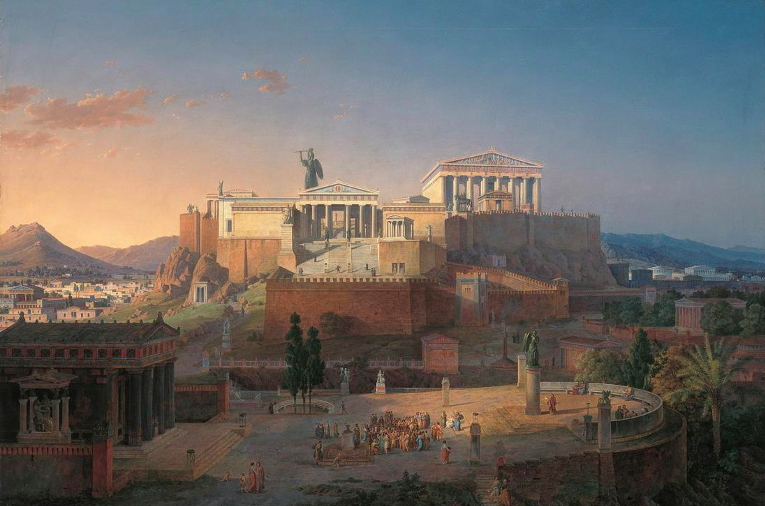
Early agricultural societies were often rigidly authoritarian. Marvin Harris explained this development in infrastructural terms: stored grain surpluses required management and distribution authority, as did irrigation systems. But the appropriation of so much power by an individual or family required further justification; hence new sky-god religions emerged, valorizing kings and pharaohs as wielders of divine power. Greece, however, differed from Egypt and other “hydraulic” civilizations (i.e., ones based on huge irrigation systems): it enjoyed enough rainfall so that irrigation wasn’t required. Farmers could grow diverse crops independently, without relying on state controls over water and grain. Hence it was in Athens that democracy emerged (or re-emerged) as a political system—imperfect though it may have been (Attica’s total population was likely between 150,000 and 250,000, but free citizens numbered only 20,000 to 30,000: women, slaves, and foreigners could not participate in the public process of making decisions).
Prior to the fossil fuel era, Europe enjoyed a significant injection of wealth from its sail-based pillaging of much of the rest of the world. Merchants, as a social class, began to jostle against the aristocracy and clergy, previous holders of political power. Wealth and abundant energy supported the development of science and philosophy, which—when combined with newer technologies like the printing press—helped usher in the age of reason. The autocratic rationale for rule, “because God granted me divine power,” no longer seemed reasonable. In Britain, the monarchy began reluctantly to cede some of its authority to parliament during the mid-seventeenth century; then, a little over a century later, thirteen of Britain’s colonies in North America rebelled and formed a federated republic. Revolution in France further stoked demands throughout Europe and elsewhere—by philosophers and commoners alike—for wider distribution of political power.
In modern times, industrial expansion based on abundant energy from fossil fuels has led to urbanization and to the employment of much of the population in factory, sales, and managerial positions. This detachment of people from land has in turn produced greater geographic and social mobility, as well as opportunities to organize collective demands for power sharing (via trade unions and political organizations of all kinds), including women’s suffrage. Democracy has spread to more and more nations—always kept at least partly in check by centralized economic and military power. Meanwhile, an ever-greater mobility of capital, goods, information, and people has also led to the geographic expansion of polities—nations of larger size, alliances between nations, trade blocs, and an intergovernmental organization offering membership to all countries (the United Nations).
Now, in all likelihood, comes an era of declining and reversing economic growth, as well as reduced mobility. Existing forms of government will be challenged. Ultimately, larger political units may tend to break up into smaller ones, and many democracies may be vulnerable to authoritarian takeover. But the risks will vary significantly by country, based on geography and local history.
How Nations Succumb to Authoritarian Takeover
Before exploring those risks, it may be helpful to review the four main ways in which democracies have changed into authoritarian regimes in recent history.
- Election of a dictator. Mussolini initially came to power in Italy through election, as did Hitler in Germany, Ferdinand Marcos in the Philippines, and “Papa Doc” Duvalier in Haiti. Why do people elect authoritarians? Typically, they do so because they feel threatened—by a foreign or domestic enemy, or by hard times—and want a strong man to take charge. Usually the elected authoritarian-in-waiting only assumes dictatorial power later, without asking the consent of the electorate. For example: in a recent essay, Ugo Bardi recounts how declining exports of British coal to Italy after World War I led to an energy famine, which in turn resulted in riots, shifting political alliances, and the rise of Mussolini and the Fascists.
The following brief representative picture of how an authoritarian leader can take total power following election is from journalist Tim Rogers, recounting Nicaraguan leader Daniel Ortega’s ascendancy:
“When Daniel Ortega was elected president in 2006 with a twiggy 38 percent victory, Nicaragua had a constitutional ban on consecutive reelection as a safeguard against dictatorship. . . . Eleven years later, Ortega is starting his third consecutive term as president after rewriting the constitution, banning opposition parties, and consolidating all branches of government under his personal control. Ortega orchestrated his power grab by polarizing the country, dividing the opposition, attacking congress, demonizing the press, forbidding protest, demanding personal loyalty from all government workers, and turning all his public appearances into campaign rallies for his core base of supporters. He institutionalized his cult of personality and normalized . . . threats of violence and chaos. . . .”
- Military coup. The list of military dictatorships in recent decades is long. Clayton Thyne and Jonathan Powell maintain a coup dataset, according to which there were 457 coup attempts worldwide from 1950 to 2010, most by military factions. Of these, about half were successful. The reason military putsches are so common is not hard to discern: the taking of power by armed force is likely to be most often—and most successfully—attempted by those who are already professionalized wielders of weaponry.
- Foreign interference or foreign support for a coup. If a powerful nation wishes to exert near-total control over a weaker country, one of the most effective ways to do so is to install a puppet dictator who can then be bribed and threatened. This is a strategy the United States has deployed often, beginning early in the twentieth century with its support for dictators in Central and South America. Also, in the early 1950s, the U.S. supported Shah Pahlevi over Iran’s elected President Mohammad Mossadegh, leading to decades of dictatorship there. However, the U.S. is far from the only country to have ruled other nations by remote control: Britain, France, and Russia/USSR did the same in one instance or another.
- Revolution. Most revolutions are fought against authoritarian regimes or foreign rulers. On rare occasions, however, the people—typically a rambunctious faction of the people—attempt to overthrow an elected government in favor of a would-be dictator. Such revolutions are usually more accurately described as civil wars. Coups in which an elected leader is overthrown in favor of an authoritarian with the help of foreign influence can be stage-managed to appear as revolutions (this happened in the case of Mossadegh in Iran). More frequently, however, revolutions that are widely intended to result in democratic reforms eventually result in the coalescing or emergence of an authoritarian regime (for example, in France at the end of the 18th century, in Russia in 1917, in China in 1949, in Cuba in 1959, and in Cambodia in 1963).
Risk Factors for Authoritarian Takeover
Economic decline led by energy decline probably won’t automatically result in despotism, just as industrialism and economic expansion didn’t everywhere lead to democracy. What are the circumstances that are likely to push nations to adopt more authoritarian governments?
Below are some notable risk factors (this is not an exhaustive list). From here on, I will occasionally refer to the Democracy Index (compiled by the UK-based Economist Intelligence Unit), which seeks to measure the state of democracy in 167 countries based on 60 indicators.
- Economic decline or instability. Periods of high joblessness, disappearing savings, and declining incomes can lead to widespread dissatisfaction with government, offering an opening for demagogues, military coups, revolutions, or foreign takeovers.
- Weak democratic institutions with a short history. Democracy is a habit that needs reinforcement. It also needs institutions—parties and election machinery (polling places, fair counting of ballots, etc.). If those institutions have shallow roots, it is easier for them to be undermined or corrupted.
- Dysfunctional media. Democracy only functions if the public is well informed with regard to issues and the actions of government. Media organizations can become weak, dominated by special interests, polarized, or suppressed by government. Their ownership can be consolidated by a few companies with similar political interests. In our current age of electronic information, media are vulnerable to outright propaganda, “fake news” (i.e., reporting characterized by ideologically spun, inaccurate, or even wholly invented stories), and the clever use of social media (bots and trolls).
- High and growing levels of economic inequality. Some of the early observers of democracies, including Toqueville, noted that procedural democracy (equality before the law, universal voting rights, the right to express oneself in the political sphere) can be undermined by the power of wealth. Rich people can buy influence in ways both obvious and subtle. This is why healthy democracy is often correlated with progressive taxation and the availability of government-run social programs for those who are unemployed, retired, or sick.
- Simmering resentments among social/racial/religious/ethnic groups, offering fodder for scapegoating. In hard times, demagogues can play upon such resentments to gain support and take power.
- Deep political polarization. Polarization drains people’s attention from areas of shared interest and potential cooperation, and focuses it instead on points of disagreement. As each party demonizes the other, former political extremists may find their way into the mainstream. Polarization can offer an opening for a demagogue who promises to trounce the opposition party once and for all, if given dictatorial powers.
- Weak financial systems heavily dependent on debt. As economic historians have shown, heavy reliance on debt always results in an eventual financial crash. See “economic decline” above.
- Special vulnerability to foreign influence or takeover. If a country is militarily weak but has a strategically significant geographic location (for example, along the route of an important oil or gas pipeline), or if the country happens to possess strategically important resources (minerals or fossil fuels), more powerful nations are likely to have a keen interest in keeping that country controllable.
- A powerful military with a history of domestic intervention. If social chaos ensues for whatever reason, the military is likely to step in; and when it does it is more inclined to install a dictator than to restore or build a democratic system. That’s because the military itself, in virtually every nation, has an authoritarian internal structure. (The Iroquois insisted that peace chiefs be different from war chiefs—an idea borrowed by the framers of the U.S. Constitution, which specifies that no acting military leader may assume the presidency).
- Special vulnerability to climate change or other environmental disasters. People don’t inevitably turn to strong leaders after natural disaster. Over the short term, they tend instead to band together. Old grievances tend to be temporarily forgotten, and distinctions between rich and poor are at least somewhat erased. However, over the longer term, ecological disruption can lead to scapegoating and either revolution or a turn toward strong men who promise to restore order. For example, the Syrian civil war, which began in 2011, was preceded by a long and devastating regional drought linked to climate change; refugees from the countryside flooded cities, straining infrastructure already burdened by the influx of some 1.5 million refugees from the Iraq War. These refugees provided recruits for the Free Syrian Army, which rebelled against the authoritarian Assad regime.
- High population growth rate. Nations with high fertility rates typically find it difficult to overcome poverty, absent a robust resource-exporting economy. Indeed, of the ten nations that currently have the highest population growth rates (Lebanon, Zimbabwe, South Sudan, Jordan, Qatar, Malawi, Niger, Burundi, Uganda, and Libya), seven have fully authoritarian regimes according to the Democracy Index, while three have “hybrid” governments; only two (Qatar and Lebanon) have a per-capita GDP higher than the world average. As world energy declines, countries with fast-growing populations will probably see higher-than-typical per-capita decline rates in energy usage, likely leading to economic and social instability.

Most of the above might be considered generic risk factors, in that they apply to all societies even without taking energy decline into account. Other risk factors are more directly related to potential energy supply problems:
- A high dependency on food imports. History has shown (for example, in Egypt in 2011) that food shortages can rapidly lead to social unrest and ultimately to revolution or authoritarian takeover. High food import dependency is therefore a point of vulnerability in societies given the likelihood that energy decline will also entail a decline in mobility, including the movement of food and other necessary goods.
- Government’s budget tied to fossil fuel export revenues. If a government derives most of its revenues from fossil fuel exports, it will eventually face a declining revenue stream. Even Saudi Arabia, which has been a top oil exporter for decades, recognizes this (it is an authoritarian monarchy; several other major oil exporters are likewise classified as authoritarian regimes by the Democracy Index). Norway has sought to prepare for the inevitable by saving its oil export revenues in a permanent investment fund; currently that nation enjoys the highest rating of any country on the Democracy Index, and its citizens also rank high in terms of per capita income and self-reported happiness.
- High per capita energy usage. Countries that have high per capita rates of energy usage have further to fall as energy becomes harder to produce. Countries with low rates of per capita usage typically already have ways of meeting basic needs relatively simply and directly—with a higher percentage of the total population engaged in food production, and a more robust informal economy.
- High dependency on energy imports. If heavy dependence on revenue from fossil fuel exports can constitute a vulnerability for democracies, heavy dependence on imports can as well. Even though the U.S. was a major oil producer throughout the twentieth century, by 1970 it was increasingly dependent on imported crude; hence it faced economic hardship due to the 1970s Arab oil embargo.
There is something missing from these lists that is hard to define but nevertheless crucial to our present discussion. Perhaps Pankaj Mishra captures it best in his recent, difficult book, The Age of Anger. There he describes how, from its beginnings in the eighteenth century, modern capitalist, urban, industrial life disrupted previous patterns of settled existence. People lost their connections with land and tribe, and traditional livelihoods, and hence some essential aspects of their identity. In return, economic liberalism promised mobility, comfort, and intellectual and moral advancement. Instead many experienced anonymity and alienation, and the result was widespread resentment. This in turn led to decades of revolution and terrorism in Europe throughout the nineteenth century, with many prominent assassinations (U.S. President McKinley, French President Marie François Sadi Carnot, Bavarian Prime Minister Kurt Eisner, Russian Czar Alexander II, Serbian King Aleksandar Obrenović, Spanish Prime Minister Juan Prim, and many others) as well as bombings and other violent events.
Today urbanization, commercialization, and technological disruption are proceeding at a faster pace than ever and reaching billions in formerly rural nations in East and South Asia, the Middle East, and Africa. Millions of young people are being educated for life as consumers and workers, yet are finding the promises of “development” ringing hollow. Unemployment rates among young males are often very high in these nations, and young men educated for urban industrial life are being attracted to militant fundamentalism. The rise of militant fundamentalism, along with high rates of immigration from fast-urbanizing countries, generates fear in the first-wave industrialized countries—a fear that leads to a rise in “traditionalism” and a turn toward authoritarian leaders who promise to suppress terrorism and reduce immigration. In effect, for both the young Islamist radical and the older Trump voter, tribalism is a powerful motivator. We will return to this subject later as we consider ways to counter or mitigate risks to democracy.
Typically, a surplus of unemployed young males also increases the likelihood of war. During wartime, the combatants gain a sharper sense of meaning and purpose. Democracy seldom flourishes during war, though it can persist and blossom anew afterward.
Clearly, nations are in widely varying circumstances, with different areas and degrees of vulnerability to energy decline; and they are thus likely to react differently to the ensuing economic stresses. Full “democracies” according to the Democracy Index (Norway, Canada, New Zealand, etc.) are probably best situated to respond in ways that preserve democratic institutions and traditions. Nations currently listed by the Democracy Index as “flawed democracies” (United States, Philippines, Indonesia, etc.) are probably most at risk of shifting further toward authoritarianism via election. Countries that are currently “hybrid states” (Turkey, Venezuela, Pakistan, etc.) or “authoritarian” (Russia, Egypt, China, etc.) are more likely to experience revolutions or coups.
Countering the Risks to Democracy
How could nations in the “democracy” or “flawed democracy” categories resist a tendency to slide toward authoritarianism? It stands to reason that, if risk factors are present, reducing vulnerability would entail countering those factors as much as possible:
- Build and support independent media. Governments and leaders should resist the temptation to favor media outlets that simply parrot their own talking points, or that disparage current leaders’ enemies. Maintain full press freedoms, including legal protections for journalists.
- Work to limit climate change and other ecological drivers of human misery. This includes not only efforts to adapt to higher sea levels, but also to reform agricultural practices (carbon farming) and dramatically reduce carbon emissions in transportation and manufacturing.
- Work to reduce extreme political polarization. Avoid wedge issues. Nations with more than two major parties sometimes fare better at avoiding polarization.
- Support and strengthen democratic institutions. Prioritize fair elections (universal voting rights, public financing of campaigns, limits to campaign contributions, plenty of accessible polling stations that are open a sufficient number of hours, transparent methods of ballot counting).
- Promote tolerance. For a nation, ethnic, religious, and cultural homogeneity can be an asset in avoiding political unrest during hard times. But many nations are ethnically, religiously, and culturally diverse, and any effort to reduce that diversity would necessarily entail human rights violations. Nations with diverse populations must simply make the best of the situation, celebrating and honoring their diversity and protecting minorities.
- Discourage inequality. Most nations already counter economic inequality through progressive taxation and social welfare programs. But economic stresses from energy decline will require more creative thinking and experimentation, including encouraging worker-owned cooperatives and discouraging shareholder-owned corporations; implementing high inheritance taxes with no loopholes; and finding ways to reduce the role of debt in society.
- Minimize power of military and intelligence agencies. Keep the military separate from governance institutions. Keep the military budget within modest bounds. Don’t over-glamorize the military. And don’t permit “black ops” or domestic surveillance.
- Build low-energy infrastructure, habits, informal economy. This implies a change of direction for most nations, which tend to be hooked on large-scale infrastructure projects (highways, airports) that lock in energy dependency. Promote low-energy ways of providing for basic human needs, such as solar hot water heaters and cookers, walking, and bicycling.
- Promote population stabilization. Support family planning and elevate the social status of women.
- Build local food production capacity. Support small farmers, local food, and agriculture that minimizes dependence on fossil fuel inputs.
- Stabilize the financial system. Reduce reliance on debt in every way possible, shrinking the size of the financial system relative to the “real” economy of goods and services.
- Decentralize both the economy and the political system. Encourage distributed energy, local currencies, and local food. Allow city and regional governments to make all decisions except those that require national or international deliberation.
- Avoid being the target of foreign political meddling. Maintain vigilance with regard to electronic and propaganda warfare. Don’t take on big international loans.
These recommendations are far easier to spell out than to carry out. And at least two of them are seemingly at odds with each other: a nation that keeps its military and defense budgets at minimum levels might be more likely to be the target of foreign meddling or intervention. Further, while most democracies are making at least some efforts along some of these lines, in many cases they are being overwhelmed by trends toward increasing polarization of politics and media, and increasing economic inequality.
Further, most of the above recommendations fall within the bounds of modern liberal norms and discourse. But, as we have seen, the entire project of industrial and social “progress,” as framed within the liberal economic tradition, has produced whole classes of casualties and rebels. The endemic risks to urban, capitalist, industrial societies stemming from the resentment and alienation described by Mishra—that lead increasingly to terrorism, religious fundamentalism, and authoritarianism—are inherently difficult to track or counter. To defuse this deep, amorphous threat to democratic values and institutions, perhaps something more is needed beyond the mere strengthening of media and democratic institutions—something that ties people back to the land and gives them both a “tribal” identity and a larger sense of purpose. A new religion might fit the need, but it is difficult to summon one at will. If advocates of democracy and cultural pluralism continue to fail to fill this void, authoritarians of various stripes will certainly seek to do so.
Are Dictatorships or Democracies Better at Responding to Energy-Economy Decline?
In the contemporary world, democracy is widely (though not universally) prized over authoritarian forms of government. This is certainly understandable: authoritarianism leads to the regimentation of thought and behavior, and often to the subjection of large segments of the population to psychological and/or physical violence. But are democracies inherently superior to authoritarian regimes in dealing with crises such as energy decline, climate change, resource depletion, overpopulation, and financial instability?
To adapt proactively to environmental limits and impending scarcity, governments may have to do some unpopular things. Restrictions on consumption (such as rationing) may be required, along with the encouraging of smaller families. Such policies cannot help but rankle, following decades of rising economic expectations. Economic redistribution could help reduce the stress of scarcity for a majority of the populace, but many will still resent the new conditions. Elected leaders may find it difficult to maintain sufficient popular support for such policies. Could authoritarian regimes fare better? A few historic examples come to mind.
During the early 1990s, Cuba saw a sharp decline in energy supply due to a cutoff of low-cost oil imports from the now-defunct Soviet Union. At the time, Cuba’s food system was highly centralized and dependent on oil-fueled farm machinery and food transport. Cuban leaders responded to the crisis by decentralizing food production, reducing fuel inputs, and encouraging urban gardening. The result was a rapid and thorough restructuring of the nation’s food system that averted widespread famine. It is unclear whether such measures would have been feasible outside a command-and-control authoritarian political context.
Both China and Iran managed to substantially reduce their nations’ high birth rates—China (beginning in the 1970s) via its compulsory one-child policy, and Iran (starting in the 1980s) through vigorous but voluntary family planning efforts. Both nations formulated and managed these programs via top-down, centralized, and authoritarian methods.
These examples might suggest that authoritarian regimes are inherently more resilient than democracies. However, there are instances where authoritarian regimes have instead proven brittle. For example, when Soviet Union failed to deal with economic decline in the 1980s the government collapsed, as did the nation’s economy. In contrast, some democracies (such as the U.S. during the Great Depression and Britain in the 1930s and ’40s) have persisted during privation, though somewhat authoritarian temporary measures were instituted, including greater control of the media by government.
Many authoritarian regimes are poorly situated to help the populace weather economic crisis simply because their leaders are too obsessed with self-enrichment, self-aggrandizement, and self-protection. It could be argued that if a society is already impoverished due to the incompetence of its authoritarian leadership, its people will have fewer expectations to be dashed, and their standard of living will not have as far to fall before hitting subsistence level. But this is faint encouragement. There must be some better recommendation for today’s nations than “crash your economy and suppress your people’s aspirations now, so that they won’t be disappointed later.”
* * *
The relationship between energy, the economy, and politics is messy and complicated. There is not a simple 1:1 correlation between energy growth and economic growth: the Great Depression occurred in the United States despite the presence of abundant energy resources. Similarly, there will probably not be a strict correlation between energy decline and economic contraction.
One important wild card is the role of debt: it enables us to consume now while promising to pay later. Debt can therefore push consumption forward in time and (for a while, at least) make up for declining energy productivity. It would appear that the “fracking” boom of the past decade, which probably delayed the world oil production peak by about a decade, depended on the power of debt. But when debt defaults cascade, an economy may decline much faster than would otherwise be the case (default-led financial crashes have occurred repeatedly in modern history). And debt defaults can cripple the financial and thus the economic system of a nation with plenty of energy resources (as happened in the U.S. in the 1930s).
As we have seen, dictatorships can sometimes adapt well to scarcity. We can only hope that, if scarcity does indeed lie in our immediate future, authoritarian leaders will minimize rather than add to their people’s suffering. Similarly, we should hope that everyone in democracies has access to information that helps them make collective choices that lead to successful adaptation to inevitable, impending scarcity. Unfortunately, flawed democracies may be particularly vulnerable when energy supplies decline. Given their political polarization and saturation with “fake news,” they are more likely to succumb to demagogues who promise to return the nation to a condition of abundance if granted extraordinary powers.
It is highly likely that, as events unfold, the causal criticality of energy decline will be hidden from the view of most observers, whose attention will be fixed instead on shocking but comparatively superficial and secondary political and social events. A more widespread understanding of the role of energy in society, and of the likely limits to future energy supplies, could be extremely beneficial in helping the general populace adapt to scarcity and avoid needless scapegoating and violence. Perhaps this essay can help in some small way to deepen that understanding.
92 Comments on "Heinberg: Energy and Authoritarianism"
Anonymouse1 on Tue, 26th Sep 2017 4:44 pm
Richard should just come and say it, rather than pen this long essay.
Richard clearly feels, his new nemesis, the semi-retarded current figurehead-in-chief of the united snakes of amerika, is a de-facto dictator. Or, if you catch richard in a more charitable mood, a wannabe dictator perhaps. This is the real purpose of his essay, to imply, in a very roundabout way, the uS is run by a dictator, but only because of what is arguably, the greater of two evils (shillary) didn’t win the in the most recent round of political theatre in the uS.
Had shillary ahem, ‘won’ the role of president as was originally intended, I doubt he would have taken to time to write this. Again, I cant help but note, Mr heinberg only found his inner Paul Craig Roberts, *after* trump landed in washindum.
So, in Mr Heinberg’s rarified world*….
Trump = De facto dictator
Hillary = Sweetness and light, peace and democracy, EV and a Wind Turbine in every driveway and backyard.
*Heinberg does not exactly say this of course, but he doesn’t have to.
Had shillary ‘won’, Mr Heinberg could have gone on pretending the uS is not a brutal military-corporatocracy and a permanent war-state with a fake veneer of ‘democracy’ on top. He only mentions the ‘trump’ once, but the article is really all about the idiot. Richard cant come to grips with the fact that ‘president’ trump, is no more, or less dictatorial, than his predecessor, and just as powerless. Nor can he accept his preferred figurehead, shillary, was no ‘democrat’ or friend of the environment either, or whatever wish- projection attributes he felt she may have possessed.
Aside: Interesting that the ‘liberal’ heinberg spends time in this trashing Daniel Ortega of Nicaragua as some kind of heartless ruthless and (illegitimate) dictator. Washindum would agree with richard on that point, and spent a lot of energy trying to undermine him back in the day. Washindum questioned his legitimacy constantly, just like richard does here….
rockman on Tue, 26th Sep 2017 5:42 pm
A – “Trump = De facto dictator”. Yes, hilarious. President Trump’s party controls both houses of Congress, the R’s have control of most governorships and state legislatures, he’s backed by mucho billionaires and huge corporations, commander in chief of one of the world’s largest militaries which has a fairly strong leaning to the right and, lastly, the solid support of many tens of millions Americans who collectively are more heavily armed then many countries.
And yet he has gotten almost nothing of substance accomplished of all the promises he made. And even with that poor showing so far he appears to be sliding further backwards of late.
My two miniature schnauzers are more dictators in my house then President Trump. LOL.
Plantagenet on Tue, 26th Sep 2017 5:57 pm
Hahaha!
Rockman is right as usual.
Cheers!
Cloggie on Tue, 26th Sep 2017 6:18 pm
The only institution Trump is in charge off is his twitter account.
During the campaign Trump declared war on The Swamp.
https://www.youtube.com/watch?v=IsLZk2OvqtM
Now the result is in: the Swamp won or at least got the upper hand.
The Swamp, that is entire Washington, that intends to keep the US empire growing until it is stopped. And the (((Sanhedrin))) in the middle of it all. Just google “Nixon Billy Graham taped conversation” to get a first hand account of how Washington ticks. Nixon was Watergated for his attitude, JFK even murdered. Wonder how they will manage to get rid of Trump, “the dictator”.
But beta male PC libtard idiots like Heinberg have zero understanding of the Israel Lobby, oligarchs… all they see is “evil whitey”.
Election of a dictator. Mussolini initially came to power in Italy through election, as did Hitler in Germany, Ferdinand Marcos in the Philippines, and “Papa Doc” Duvalier in Haiti. Why do people elect authoritarians? Typically, they do so because they feel threatened—by a foreign or domestic enemy, or by hard times—and want a strong man to take charge. Usually the elected authoritarian-in-waiting only assumes dictatorial power later, without asking the consent of the electorate. For example: in a recent essay, Ugo Bardi recounts how declining exports of British coal to Italy after World War I led to an energy famine, which in turn resulted in riots, shifting political alliances, and the rise of Mussolini and the Fascists.
Zero understanding of history. Heinberg rambles on about dictators, but ignores the 600 pound gorilla in the room: Bolshevism. Between 1917-1922 a civil war raged in Russia and in the end the Bolsheviks won. Their victory represented a lethal threat for Europe and communist parties sprang up in every country. THAT and nothing else was the reason for the rise of fascism and national-socialism.
Kill rate
USSR (1917-1939) – tens of millions
NS Germany (1933-1939) – a few hundred
Fascist Italy (1923-1943) – less than 10
No further questions your honor.
But modern naive/self-serving Americans ignore that, because they needed the USSR to destroy Europe and take its place and hence need to whitewash the unspeakable crimes committed by their de facto Soviet ally of 1933-1945. Instead they ramble on about “fascism” 24/7 without having a single clue what it was really about or the context of the drama.
For most Americans history writing is an act of American product placement, an act of self-aggrandizing, just another add… “we are the greatest, the noblest, the best there is”.
Darrell Cloud on Tue, 26th Sep 2017 6:28 pm
Heinberg subscribes to the notion that we have reached the end of growth and that the devolution of our political and economic systems is inevitable. Then he puts out the idea that dictatorships may be better at managing shortages than democracies. I agree with that. When the Bolsheviks wrecked Russian agriculture with their collectivization, they simply declared food to be state property and made it illegal for large swaths of the population to possess it. So, the dictators and their cronies ate while the rest of the country starved. That is the way it is with all dictators. They determine who eats and who starves.
How, with a collapsed infrastructure resulting from a collapsed economy are you going to be able to put together a force strong enough and mobile enough to subjugate this country? Unless you get the populace to willingly embrace your psychopathy, you cannot subdue us. To subdue Americans, you have to go door to door to disarm 100 million people. Any such effort would be immediately viewed by the gun owning public as illegitimate.
MASTERMIND on Wed, 27th Sep 2017 8:31 am
Just wait until we experience a 10% or 20% drop in oil supplies. In a few years or sooner we certainly will. When it hits the economic and social damage will be catastrophic. The end of Western Civilization, from China to Europe, to the US, will not occur when oil runs out. The economic and social chaos will occur when supplies are merely reduced sufficiently
paulo1 on Wed, 27th Sep 2017 9:21 am
Good one Rockman.
It isn’t that Trump would not relish being a dictator (like he ran his businesses, and often into the ground to boot), it is simply that he is too dumb to be one. From an outsider looking in, listening to the man speak it absolutely astounds me that he was elected in the first place?!!. The fact that he was, demonstrates how limited the options were this past decade. Clintons? Really!!
From my sister (American): “Oh Paul, when I listen to him speak I am just so embarassed”.
I really am concerned about a North Korean false flag incident, or an outright blunder into war. IMHO, this would lead into a finacial crash and perhaps millions dying as a result. Trump’s response, “It wasn’t my fault”, and then delete the tweets. Unrest or protest? Why knock ’em on the heads, of course. Call in the police.
Hopefully, the generals will be able to head off disastor with their professionalism and pledge to honour the Constitution. Isn’t that rich?
Hopefully, Heinberg is wrong.
Antius on Wed, 27th Sep 2017 1:45 pm
“Could declining world energy result in a turn toward authoritarianism by governments around the world?”
Already has. Here in the UK, there are cameras everywhere. You can go to prison just for saying the wrong thing – there is no freedom of speech, people are afraid of having conversations on controversial topics. There are armies of government snoopers that troll the internet, looking for people that break the rules. These people use 1984 and Brave New World as instruction manuals. They have gone far beyond anything that George Orwell could have foreseen.
fmr-paultard on Wed, 27th Sep 2017 1:50 pm
antius, i was a paultard and freedom and liberty were just excuses to drink to excess and enslaving people. meet teh new boss, just like the old boss but 1000x times worse.
i don’t like tard nazi preachers extremists. while we can still afford it, we should whine constantly.
i’m not going to risk my life for liberty anymore. the lead poisoning is more likely from my compatriots.
Sissyfuss on Wed, 27th Sep 2017 2:07 pm
Trumps latest tweet, ” Take a knee-gra.”
rockman on Wed, 27th Sep 2017 3:21 pm
Master – “Just wait until we experience a 10% or 20% drop in oil supplies. In a few years or sooner we certainly will. When it hits the economic and social damage will be catastrophic”. I don’t follow your reasoning: in 2011 oil supplies were 20% lower then they are today and I don’t recall a catastrophe. Lots of folks couldn’t afford oil then just as there are millions today who can’t afford $50/bbl oil.
http://peakoilbarrel.com/wp-content/uploads/2015/05/A-World1.jpg
MASTERMIND on Wed, 27th Sep 2017 3:46 pm
Rockman – You’ll see You dumb Hillbilly!
Boat on Wed, 27th Sep 2017 4:14 pm
clog,
And the winners write history. Why do you never mention countries like India, Canada, US, Austraila, Sout Africa etc helping to grind the evil axis into capitulation?
Cloggie on Wed, 27th Sep 2017 4:18 pm
“Could declining world energy result in a turn toward authoritarianism by governments around the world?”
Already has. Here in the UK, there are cameras everywhere. You can go to prison just for saying the wrong thing – there is no freedom of speech, people are afraid of having conversations on controversial topics. There are armies of government snoopers that troll the internet, looking for people that break the rules. These people use 1984 and Brave New World as instruction manuals. They have gone far beyond anything that George Orwell could have foreseen.
This is Orwell’s world map from 1984.
Orwellian “Oceania”, that’s largely Anglosphere.
Orwell clearly believed in “Paris-Berlin-Moscow” and in the Caliphate.
The only real mistake was that he apparently didn’t foresee that Turkey would shake-off Kemalism and would return to Islam.
And of course he foresaw the rise of China.
This world map is a distinct possibility. It is either this or this (amended Samuel Huntington map):
http://tinyurl.com/yaqguroa
For Eurosphere to materialize it is needed that Trump supporters revolt AND Paris-Berlin-Moscow intervenes.
Brexit is a clear step away from US hegemony to either Orwell or Huntington.
rockman on Wed, 27th Sep 2017 5:08 pm
Sissy – I understand it’s just my dark sense of humor but I find the knee controversy hugely funny just based on the hypocrisy alone. So you understand where I come: I find kneeling during the national anthem disrespectful. And burning our flag more so. And I’m filled with a bit of perverse pride when I witness either. It’s the right of every American to take such disrespectful actions for what ever their motivation.
My perspective: I once worked in an African country where a citizen caught talking politics with a foreigner was subject to imprisonment. And eventually El Presidente change the constitution granting him the right to execute anyone he chose without a trial. You think there much protesting in Equatorial Guinea?
But it cuts both ways: if a football player wants to express his rights by taking a knee so be it. And if the owner of that team wants to fire that player that’s also his right…it’s a business he owns. And the NFL commission is worthless: it supports taking a knee during the anthem and banned a player from wearing a 9/11 patch on the anniversary? As someone said on a news show: just because it’s your right to do or say something doesn’t void the rights of someone else to disagree.
The great hypocrisy I see comes from both sides of the issue. President Trump’s comments certainly just didn’t help unify the country but also poured salt into open wound. OTOH the players protesting during the anthem did likewise. The anthem takes about 2 minutes. The rest of the game takes about 180 minutes. Why pick those 2 minutes other then create controversy? How about a protest before or after? At half time? Why pick that one moment that was certain to alienate many tens of millions of citizens? Was that going to improve race relations? The relationship between cops and minorities? What was that suppose to accomplish other then causing more division in the country in addition to some notoriety for the protestors? But both the president and the players exercised their right of free speech. As Dr. Phil would ask: “How’s that working for you”. Looks like it ain’t accomplishing one damn thing. And don’t say it highlighted the problem: if the problem wasn’t already obvious to a person it never will be. But maybe I missed something: what have you seen POSITIVE come on out of the situation? Maybe NASCAR coming out anti-NFL which will likely lead to anti-NASCAR comments coming out of the NFL. A unifying moment for the country? LOL.
But that doesn’t mean it wasn’t a very bad idea for any of them to do it. And the MSM didn’t help: the liberal media reported many citizens supporting the players and condemning the president while the conservative media reported many citizens supporting the president and condemning the players. Which was the media’s prerogative. And none of it, from either side, is what this country needs right now. So, I say a pox on all their houses. LOL.
It just occurred to me: I can’t think of anything the Russians could have done to disrupt the American political landscape as much as generating this latest fake drama. That’s!!! It’s all a commie plot. LOL.
Boat on Wed, 27th Sep 2017 5:09 pm
You EU voters need to stand up and get your free speech back
“For Eurosphere to materialize it is needed that Trump supporters revolt AND Paris-Berlin-Moscow intervenes”.
Trump and Putin are not free speech supporters. These are the type of politicians that want to think for rest of us.
Cloggie on Wed, 27th Sep 2017 5:28 pm
Trump and Putin are not free speech supporters. These are the type of politicians that want to think for rest of us.
Give me an example of Trump “suppressing free speech”?
Putin is indeed a little different, but you always need to see things in historic perspective. Russia is freer than it has been ever before. Nobody is sent to Siberia or to the Gulag anymore for “exercising free speech”.
You EU voters need to stand up and get your free speech back
We in Europe can say anything we want in public, except some opinions on the holocaust.
We can even say that we want less Moroccans in the Netherlands. Okay you get convicted but with no punishment or fine:
https://www.youtube.com/watch?v=BaB75uznT8o
(Wilders, leader 2nd party in parliament)
[0:46] Wilders discusses legal consequences of the question he is about to ask…
[1:09] Wilders: do you want in this town and this country more or less Moroccans?
[1:15] Crowd: minder, minder, minder (less, less, less)
[1:26] Wilders: OK, we will organize that
Boat on Wed, 27th Sep 2017 5:51 pm
clog,
“Give me an example of Trump “suppressing free speech”?
The current nfl to take a knee to protest black deaths and oppression during national anthem prompted cheeto to suggest that owners should fire them. What happened? Several owners joined more players in the protest at more games. lol
Follow cheeto, he is currently trying to drive a wedge like you want. He demands loyalty and will fire opposing views. Trump is anything but Free speech.
Davy on Wed, 27th Sep 2017 5:56 pm
Boat, try harder dummy.
Boat on Wed, 27th Sep 2017 7:24 pm
clog,
President-elect Donald Trump demonstrated his authoritarian impulses once again on Tuesday with a call for the criminalization of dissent. In the early morning, he took to Twitter – his favorite platform for exercising his own right to
freedom of expression – to proclaim that burning a U.S. flag should be punished by “perhaps loss of citizenship or year in jail!” This was reportedly inspired by news that someone had burned a flag at an anti-Trump protest on a college campus.
http://www.rollingstone.com/politics/features/donald-trumps-dictatorial-approach-to-free-speech-w452918
Boat on Wed, 27th Sep 2017 7:30 pm
davy,
“I love free press. I think it’s great,” he said Saturday on Fox News Channel, before quickly adding, “We ought to open up the libel laws, and I’m going to do that.”
The changes envisioned by the celebrity businessman turned Republican front-runner would mean that “when they write purposely negative and horrible and false articles, we can sue them and win lots of money,” he said at a rally Friday in Fort Worth, Texas.
Trump added that, should he win the election, news organizations that have criticized him will “have problems.” He specifically cited The New York Times and The Washington Post.
Trump last month threatened to sue the Post after the newspaper wrote an article about the bankruptcy of his Atlantic City casino. On Twitter, Trump has routinely criticized reporters who cover him and their news organizations, including The Associated Press.
http://www.pbs.org/newshour/rundown/trump-threatens-to-weaken-first-amendment-protections-for-reporters/
Davy on Wed, 27th Sep 2017 7:43 pm
Try harder boat. He he he
Sissyfuss on Wed, 27th Sep 2017 8:14 pm
Rock, Trump is a polemic and he’s doing a masterful job as one. Nothing anyone does at this point will placate those on either side. A bit like 1864.
GregT on Wed, 27th Sep 2017 10:42 pm
http://www.pbs.org/newshour/rundown/trump-threatens-to-weaken-first-amendment-protections-for-reporters/
Nice find Boat. Written by Jeff Horwitz. Much more of his stuff can be found here:
https://www.timesofisrael.com/writers/jeff-horwitz/
The Associated ‘Free’ Press, AKA, The Swamp.
Cloggie on Wed, 27th Sep 2017 10:53 pm
Boat is sure that Horrorwitz is just another biped, who just like boat, wants to eat his Swedish smorgasbord on Sunday and afterwards wave his Confederate flag in his own backyard to get some exercise.
Cloggie on Wed, 27th Sep 2017 11:16 pm
“The current nfl to take a knee to protest black deaths and oppression during national anthem prompted cheeto to suggest that owners should fire them. What happened? Several owners joined more players in the protest at more games. ”
“Black Death” is good.
When are they going to protest white deaths at the hands of blacks, who are ten times more murderous then whites?
Blacks are no longer going to bow for Yankee symbols, they feel that their time is coming because they feel the weakness and spinelessness of the white cucks like you boat or former tard, who will always give in to their demands.
But they are wrong and in the end will place themselves outside the white world. Because everybody except George Soros, Davy and NFL players want to see America go, including white America.
https://goo.gl/images/Cbbrkk
GregT on Wed, 27th Sep 2017 11:23 pm
“White men can’t jump.”
Boat’s NFL idols are mostly black, except for the quarterbacks, who are mostly white. And Cloggie, Swedes don’t do southern boils, with ‘shrimp’ imported from Asia.
Boat on Thu, 28th Sep 2017 4:24 am
Trump Is on Track to Insult 650
People, Places and Things on
Twitter by the End of His First Term
https://www.nytimes.com/interactive/2017/07/26/upshot/president-trumps-newest-focus-discrediting-the-news-media-obamacare.html?mcubz=0
Trump has a history of insulting women based on their appearances and it has continued throughout his presidential campaign and presidency.
http://www.hollywoodreporter.com/lists/trump-sexist-timeline-insults-attacks-women-appearances-1018198/item/trump-women-attacks-aug-7-2015-megyn-kelly-1018192
Boat on Thu, 28th Sep 2017 4:29 am
Here Are All the Times Donald Trump Insulted Mexico
http://time.com/4473972/donald-trump-mexico-meeting-insult/
Davy on Thu, 28th Sep 2017 4:37 am
yawn, trump is so passé now, boat. You sound like planter used to be with obuma. IOW, we have bigger fish to fry.
Boat on Thu, 28th Sep 2017 4:55 am
Trump’s speeches and tweets are part of the public record. His drive to insult anything and everything that he perceives as a problem is so mak like and childish. Just an observation.
Individual issues/legislation I judge one at a time. I actually support a few of his ideas. Can he get them into law is another thing.
But is he a jerk? Yea.
GregT on Thu, 28th Sep 2017 7:42 am
Trump is your democratically elected President Boat, and a very wealthy, influential, and powerful man. I’m sure that he lies awake at night worrying about what you think of him.
Just an observation.
Boat on Thu, 28th Sep 2017 8:17 am
As you keep repeating.
Davy on Thu, 28th Sep 2017 8:19 am
Boat has the right to his opinion does’t he grehg? Why do you stalk him and make it difficult for him to get his message out while you talk your hypocrisy about an open forum.
fmr-paultard on Thu, 28th Sep 2017 8:25 am
i forgot, i think i said i’m a fan of boat.
fmr-paultard on Thu, 28th Sep 2017 8:34 am
this article is extremist tard preachers’ wet dream. i was hoping professor Heinberg flatly reject dictatorship and extremism. Even Jesus was against Israelites having a king. It’s so easy to capture the bastard and put him on the chopping block like Louis 16th.
anyways, tard extremist nazi preachers have high sex drive and when they have a partner, they commit suicide together. very pointless. we need to help them before they go to all that trouble.
Cloggie on Thu, 28th Sep 2017 9:23 am
“i forgot, i think i said i’m a fan of boat”
This will considerably upgrade the status of boat.
rockman on Thu, 28th Sep 2017 2:36 pm
Master – “Rockman – You’ll see You dumb Hillbilly!” I have no problem seeing such a future now: my memory is slipping a tad but 2011 when the world was being supplied with 20% less oil is still rather clear. Sorry to hear it’s slipping away from you. LOL.
rockman on Thu, 28th Sep 2017 2:45 pm
Sissy – Polemic!!! For Dog’s sake stop doing that sh*t. I hate to have to look up the meaning of words so I can understand what the f*ck someone is saying. To same the rest of you dummies the time:
When polemic was borrowed into English from French polemique in the mid-17th century, it referred (as it still can) to a type of hostile attack on someone’s ideas. The word traces back to Greek polemikos, which means “warlike” or “hostile” and in turn comes from the Greek noun polemos, meaning “war.” Other, considerably less common descendants of polemos in English include polemarch (“a chieftain or military commander in ancient Greece”), polemoscope (a kind of binoculars with an oblique mirror), and polemology (“the study of war”).
Polemoscope? Is that the thing the doctor stuck up my ass a few years ago? Seemed pretty f*cking hostile to me at the time.
Antius on Thu, 28th Sep 2017 5:26 pm
What the British government did today should confirm to anyone that the British government is not a democratic organisation. It is not so different in it’s use of arbitrary power as the likes of the Chinese government.
http://www.telegraph.co.uk/news/2017/09/28/national-action-aliases-scottish-dawn-ns131-banned-terror-laws/
Whatever one thinks of the politics of Scottish Dawn, they are a political protest organisation. To my knowledge, they do not carry out assassinations or plant bombs. That didn’t deter the British government from banning them as a terrorist organisation. As such, anyone found to be a member or promoting or associating with them in any way, faces a long prison sentence.
The Home Secretary Amber Rudd gave the following reasons for banning the organisation:
‘National Action is a vile racist, homophobic and anti-Semitic group which glorifies violence and stirs up hatred while promoting their poisonous ideology, and I will not allow them to masquerade under different names.
“By extending the proscription of National Action, we are halting the spread of a poisonous ideology and stopping its membership from growing – protecting those who could be at risk of radicalisation.’
In other words, they were banned and criminalised not because of anything they did, but because the UK’s despotic Home Secretary doesn’t like their ideology, and in her typical oafish way, decided to crush something she didn’t agree with, probably without even understanding the significance of what she was doing.
This effectively makes the UK a totalitarian state. We still go through the motions of having elections. But political parties are not free to present radically different policies to those of the powers that be. If you don’t bow down to the ideals of cultural Marxism, then you are a terrorist and a criminal. People are not free to express opinions – if your opinion is offensive to anyone, you can be arrested and charged with inciting hatred in Britain. One has to wonder what the point of elections actually is under conditions like this.
The same Home Secretary recently brought into power a bill that allows the UK police, MI5 and other government agencies, unlimited access to the online activities and phone calls of any individual. From now on, anything you say, write, search for, or read can be intercepted and used against you.
According to the Sun newspaper, here are some of the activities the British government will imprison you for:
‘Being a member of, or inviting support for a banned terror organisation is a criminal offence carrying a sentence of up to 10 years in prison.
Arranging or assisting in arrange a meeting of a banned group or speaking to a meeting can also be punished with a decade long prison term.
Wearing clothing or carrying something that arouses suspicion you are a member or supporter of a banned group is punishable by six months inside or a fine of up to £5,000.
Any group can be banned by the Home Secretary if she believes it is concerned in terrorism.
This includes committing a terrorist act, preparing a terrorist act, encouraging terrorism, or being otherwise concerned in terrorism.’
https://www.thesun.co.uk/news/4569388/banned-terror-groups-uk-scottish-dawn-ns131/
Apparently, you can now go to prison for wearing the wrong clothing, failing to avert suspicion that you aren’t a member of a group the government doesn’t agree with; wearing the wrong symbols; arranging a meeting for people they don’t like; even talking to a group of them.
This sort of corruption goes far beyond Orwell’s most Dystopian fantasy. The sort of nightmares he dreamed of are now real life. The greatest enemy of any thinking Briton, is his own government. How can these people presume to lecture the likes of North Korea when their own policies are based on such complete oppression of their own people?
Cloggie on Thu, 28th Sep 2017 6:20 pm
This sort of corruption goes far beyond Orwell’s most Dystopian fantasy. The sort of nightmares he dreamed of are now real life. The greatest enemy of any thinking Briton, is his own government. How can these people presume to lecture the likes of North Korea when their own policies are based on such complete oppression of their own people?
And is this absolutely not going to get better after Brexit will be realized. On the contrary. In continental Europe it is still possible for organized patriotic groups to organize and capture seats in parliament: FN in France, PVV in Holland, AfD in Germany and similar parties in Austria, Sweden, Norway, Finland.
And entire Eastern Europe is immune for cultural Marxism. Massive anti-Islam demonstration in Poland:
https://www.youtube.com/watch?v=a7xqwm_c1_k
Britain will be stuck in the US-empire after Trump, where continental Europe is gradually emancipating from said empire. When Trump will be gone, all registers will be pulled open by the Washington establishment to ensure that this temporary coup won’t be repeated and immigration will accelerated to finish the Euro’s off once and for all.
Orwellistan-1984 = Oceania = Anglosphere
http://assets1.bigthink.com/system/idea_thumbnails/21115/size_1024/George_Orwell_map.jpg?1469219803
Washington government = London government = Anglosphere deep state
Euro-Siberia = Christianity
Anglosphere = Judaism
China = Confucinism
Disputed territories = Islam.
That could very well be the identitarian future of the 21st century.
The only way to create another future is for the Euro’s in the US to revolt (forget about the rest of Anglosphere) and next get support from Euro-Siberia, like in 1776. If that fails, white Anglos will be history and race-mixed and mongrelized in a totalitarian society.
Antius on Thu, 28th Sep 2017 6:51 pm
There is one ray of hope. The next financial crisis is on its way. Very soon the British government are going to find themselves with a lot less money and with so much debt already, it will be difficult to borrow their way out. I’m betting that hungry and desperate people are less likely to swallow bullship than wealthy complacent people. Maybe some sort of revolution is possible?
The UK government and their not so secret police are basically an extortion racket that rob their own people. I dream of the day that they face justice for their crimes.
onlooker on Thu, 28th Sep 2017 7:17 pm
Antius it goes way beyond the British Govt. The Wealthy elites of this planet have basically set up rackets and money making schemes everywhere and then to add insult to injury, they can and do hide their money in all sorts of convenient tax havens etc. The wealthy are extorting money as part of Corporations, Govts and private wealthy individuals. You can even say the Stock markets are just a gambling and extortion sting or setup
Antius on Thu, 28th Sep 2017 7:34 pm
Onlooker, thanks. I know that corruption is everywhere. But at least the US has a written constitution that protects its citizens against arbitrary power. The UK does not – we are subjects, not citizens.
Although we have elections, the UK government is subject to the queen, not the people. Really, it is just a despotism, because people are not free to express and disseminate views without persecution and the press are subject to heavy political censorship. So elections are a bit pointless. That puts the UK in a similar position to China, where dissent against the government is a criminal offence. It is really no different and it’s officials are criminals and deserve no respect.
GregT on Thu, 28th Sep 2017 8:31 pm
“Boat has the right to his opinion does’t he grehg? Why do you stalk him and make it difficult for him to get his message out while you talk your hypocrisy about an open forum.”
Boat is entitled to his opinion about your President Davy, but his opinion in no way negates what I stated above, now does it. Sorry if you can’t handle the truth. Trump doesn’t give a shit about you either, BTW.
makati1 on Thu, 28th Sep 2017 9:30 pm
Antius, you are correct. The US does have a piece of paper. That is all it is these days. Ditto for the Bill of Rights. Just paper. Like its money. Just paper. Worthless. You only have the illusion of freedom.
Do you need me to list the various ‘freedoms’ you no longer have?
How about the police being able to take anything they want from you with no warrant or reason?
http://www.washingtonpost.com/sf/investigative/2014/09/06/stop-and-seize/?utm_term=.8ce36a1f4ad6
That swat teams can break down your door in the middle of the night, shoot your dog and then harass you without a warrant?
https://www.inquisitr.com/598463/swat-team-invades-wrong-home-breaks-door-and-windows/
That the prez can have you killed anywhere in the world without a warrant?
http://www.telegraph.co.uk/news/worldnews/barackobama/9913615/Barack-Obama-has-authority-to-use-drone-strikes-to-kill-Americans-on-US-soil.html (Is that a dictatorship or not?)
As any whistle-blower about the lack of freedom of speech, Ask Edward Snowden or Bradly Manning,
Does the IRS control you. Yep! April 15th is your reporting date every year.
Does the hundreds of ‘security’ firms that gather your personal data control you? Yep! They have every law you have ever broken on record for their use if…
Can you leave the US without being practically strip/cavity searched? Nope! Even children, and old ladies have to submit. At one time, you could buy your ticket, walk to the steps of the plane with your friends and family to say goodbye. No security at all. And that was when Cubans were hijacking planes regularly.
Does your bank control your money? Yep! And you home, if mortgaged, etc. And you car and…
You are a slave with an invisible collar and chain, but it is there. Freedoms? LMAO
makati1 on Thu, 28th Sep 2017 9:32 pm
Ant, the UK is the same, just different names for the paper. You are controlled.
Davy on Fri, 29th Sep 2017 2:00 am
mkat, we are doing fine. We have problems but most people are getting by. We are doing better than most of Asia. Glad I am not in China that is a real police state and culture.
Cloggie on Fri, 29th Sep 2017 2:29 am
There is one ray of hope. The next financial crisis is on its way. Very soon the British government are going to find themselves with a lot less money and with so much debt already, it will be difficult to borrow their way out. I’m betting that hungry and desperate people are less likely to swallow bullshit than wealthy complacent people. Maybe some sort of revolution is possible?
Exactly. The mean reason for my contempt for Richard Heinberg is that the f* didn’t deliver with his peak oil story. A gigantic opportunity for the breakup of the status quo that did not materialize. Now we are stuck with a “Golden Decade” for Europe first.
Davy on Fri, 29th Sep 2017 3:04 am
“Exactly. The mean reason for my contempt for Richard Heinberg is that the f* didn’t deliver with his peak oil story. A gigantic opportunity for the breakup of the status quo that did not materialize. Now we are stuck with a “Golden Decade” for Europe first.”
Sure clog, golden decade of indebtedness and being overrun by immigrants, more like the golden decline and decay. Europe is falling apart like everywhere else. Heinberg talked about peak everything and he is right. The real peak oil was missed by all and to be fair it has been an evolution. Peak oil dynamics are alive and well. Since your 100% renewable golden age of Europe will likely never happen because of financial constraints and the constraints of the physics of energy, you need to worry about peak oil. It is not gone. Peak oil is alive and well and so is climate change. Both are likely longer term but there effects are now. You think you got out of jail free but you are screwed like the rest of us clogster.