
Peak Oil is You

Donate Bitcoins ;-) or Paypal :-)


Page added on June 3, 2015

US Crude oil production heading 11 to 15 million barrels per day

When US crude oil production gets past 10.1 million barrels per day then it will have passed the old production peak in 1970.
This will take a further increase of about 500,000 barrels per day. About 5% more production.
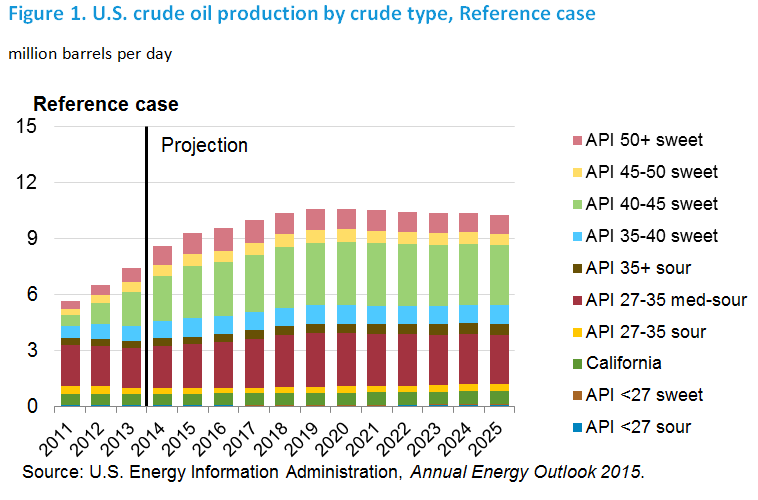
Getting to 11 million barrels per day is the the low oil price case.
The High Oil and Gas Resource case in AEO2015 was developed using assumptions that result in higher estimates of technically recoverable crude oil and natural gas resources than those in the Reference case. Estimates of technically recoverable tight and shale crude oil and natural gas resources are particularly uncertain and change over time as new information is gained through drilling, production, and technology experimentation. The assumptions for the High Oil and Gas Resource case are very optimistic.

Specific assumptions for the High Oil and Gas Resource case, as compared with the Reference Case, include:
• 50% higher estimated ultimate recovery (EUR) levels for tight oil, tight gas, and shale gas wells
• Additional tight oil resources, as well as 50% lower well spacing per acre (i.e., wells are closer together), with a downward limit of 40 acres per well for existing and potential future tight oil resources, to capture the possibility that additional layers or new areas of low-permeability zones will be identified and developed
• Diminishing returns on the EUR when drilling in a county exceeds the number of potential wells assumed in the Reference case, to capture the probability that greater drilling density will cause wells to interfere with each other (i.e., production from one well might reduce production from a nearby well)
• Long-term technology improvements beyond those assumed in the Reference case, represented as a 1% annual increase in the EURs for tight oil, tight gas, and shale gas wells
• 50% higher technically recoverable undiscovered resources for Alaska crude oil and the Lower 48 offshore, reflecting the uncertainty surrounding undeveloped areas where there has been little or no exploration and development activity, and where modern seismic survey data are lacking
The High Oil and Gas Resource case does not include exploration or production activity in the Arctic National Wildlife Refuge or other areas that are currently under drilling moratoria.
In the High Oil Price case, crude oil prices quickly rise to $149/bbl (Brent, 2013 dollars) in 2020 and $169/bbl in 2025 compared with $79/bbl and $91/bbl in the Reference case, respectively.
In the Low Oil Price case, the Brent crude oil price drops to $52/bbl in 2015, 7% lower than in the Reference case, and reaches $64/bbl in 2025, 30% lower than in the Reference case, largely as a result of lower non-OECD demand and higher upstream investment by OPEC
Gulf of Mexico Production is still heading up
Because of the long timelines associated with Gulf of Mexico (GOM) projects, the recent downturn in oil prices is expected to have minimal direct impact on GOM crude oil production through 2016. EIA projects GOM production to reach 1.52 million barrels per day (bbl/d) in 2015 and 1.61 million bbl/d in 2016, or about 16% and 17% of total U.S. crude oil production in those two years, respectively.
The forecasted production growth is driven both by new projects and the redevelopment and expansion of older producing fields. Five deepwater projects began in the last three months of 2014: Stone Energy-operated Cardamom Deep and Cardona projects, Chevron-operated Jack/St. Malo fields, Murphy Oil-operated Dalmatian, and Hess-operated Tubular Bells. Also occurring at the end of 2014 was the redevelopment of Mars (Mars B) and Na Kika (Na Kika Phase 3), both of which are mature fields. Cardamom Deep, Jack/St. Malo, and Tubular Bells were slated for a late 2014 start-up, as well.
Developments are forecast to boost Gulf production by 265,000 barrels per day by the end of 2015.

What about Peak oil and the peak oil theorists ?
Gail makes the case that peak oil is manifesting as a Glut of oil and a glut of all other commodities. She worries about high debt and affordability. She indicates that is a networked economy which causes the “unusual effects”.
One way of viewing our problem today is as a crisis of affordability. Young people cannot afford to start families or buy new homes because of a combination of the high cost of higher education (leading to debt), the high cost of fuel-efficient new cars (again leading to debt), the high cost of resale homes, and the relatively low wages paid to young workers.
Meanwhile, the Peak Oil diehards like Ron Patterson claims that global peak oil will happen in 2015 and US crude oil production will again stop rising in 2015.
75 Comments on "US Crude oil production heading 11 to 15 million barrels per day"
Rodster on Thu, 4th Jun 2015 5:47 pm
“350 is the agreed upon point of ppm CO2 in the atmosphere that is considered safe. We’ve blown by that one already. 450 is in all likelihood game over for the human race.”
I could be wrong but I thought I read that last year we hit 350PPM. And that this year we hit 400PPM. If that’s the case then it won’t 20 years before we hit 450PPM.
That 450PPM could be the least of our worries. Hidden in the permafrost are estimates of 50 gigatons of methane ready to be released into the atmosphere.
http://grist.org/climate-energy/how-much-should-you-worry-about-an-arctic-methane-bomb/
GregT on Thu, 4th Jun 2015 5:54 pm
Rod,
We are currently at 403ppm, but the levels fluctuate seasonally. We are at an average rate right now of around 400ppm.
http://www.esrl.noaa.gov/gmd/ccgg/trends/
Perk Earl on Thu, 4th Jun 2015 5:56 pm
Hey GregT & Newfie, if the ppm avg. 2.5 added per year from now until 2100 that will add 212.50 ppm + 400= 612.50 ppm CO2. That really ought to be enough to cook us.
2.5 ppm is used because as Earth’s systems reduce in capability to absorb and use CO2 ppm added per year will continue to increase. The average added might even end up being much more given continued ocean acidification and deforestation.
If it averages 3ppm added per annum then the total runs up to 655.
Of course that is presuming BAU will be up and running until 2100, which is of course is very doubtful.
Apneaman on Thu, 4th Jun 2015 5:59 pm
Unborn externalities
Lower birth weight associated with proximity of mother’s home to gas wells
Date:
June 3, 2015
Source:
University of Pittsburgh Schools of the Health Sciences
Summary:
Pregnant women living close to a high density of natural gas wells drilled with hydraulic fracturing were more likely to have babies with lower birth weights than women living farther from such wells, according to an analysis of southwestern Pennsylvania birth records.
http://www.sciencedaily.com/releases/2015/06/150603143610.htm
GregT on Thu, 4th Jun 2015 6:00 pm
It is believed that a 10 gigaton methane release would be equal to all of the CO2 that we have introduced into the atmosphere since the industrial revolution. A 10 gigaton release would render the planet almost completely lifeless in as little as one decade. The only things remaining would be microbes.
This is why so many people are speaking out against further fossil fuels exploitation. We are perilously close to a mass extinction event. We have less than 11 years left to curtail the use of fossil fuels. Many scientists believe that we may already be too late.
Rodster on Thu, 4th Jun 2015 6:03 pm
“We are currently at 403ppm, but the levels fluctuate seasonally. We are at an average rate right now of around 400ppm.”
But when did we reach 350PPM? I thought we hit that target last year.
Perk Earl on Thu, 4th Jun 2015 6:07 pm
http://co2now.org/current-co2/co2-now/annual-co2.html
Rodster, if you go to the link above it has CO2 ppm hitting 350 in 1987.
GregT on Thu, 4th Jun 2015 6:07 pm
But when did we reach 350PPM?
About 1990.
http://www.esrl.noaa.gov/gmd/ccgg/trends/
Rodster on Thu, 4th Jun 2015 6:07 pm
OK, according to this link, the last time we were under 350PPM was in 1987.
http://co2now.org/current-co2/co2-now/annual-co2.html
Rodster on Thu, 4th Jun 2015 6:10 pm
Beat me to it Perk Earl. On my iPad and it’s a pain searching and typing.
Based on those charts it looks like we are adding 2PPM each year. We’re phucked !
Perk Earl on Thu, 4th Jun 2015 6:14 pm
GregT, how likely is it a 10 gigaton release of methane will occur? I wonder how much is tied up in the Arctic ocean, which is the most likely place for such an event.
Perk Earl on Thu, 4th Jun 2015 6:18 pm
Yeah, 2 ppm avg. per year now, but it was less than 1 added per year when sampling first started and has inched up over the years from increasing in emissions and our planet being knocked down as a carbon sink. So an estimated avg. of 2.5 in the intervening years to 2100 is probably conservative.
Perk Earl on Thu, 4th Jun 2015 6:20 pm
http://thinkprogress.org/climate/2015/03/12/3632373/carbon-sinks-climate-action/
For those interested that’s a link to an article about the decline of Earth as a carbon sink.
GregT on Thu, 4th Jun 2015 6:45 pm
“GregT, how likely is it a 10 gigaton release of methane will occur?”
Everything that you need to know is here Perk:
https://www.youtube.com/watch?v=m6pFDu7lLV4
Since 2013 the scientific community has even more alarming news.
HARM on Thu, 4th Jun 2015 7:58 pm
“Time will tell if it was Hubbert who made the bad prediction 50 years ago”
Wow. Hubbert correctly predicted the U.S. conventional peak would occur ~1970, which it did –steadily falling for 40 years thereafter. The only thing that caused that decline to (temporarily) reverse was $140/BL oil and the fracking/shale oil boom, which itself will peak and decline.
http://blogs-images.forbes.com/jessecolombo/files/2014/06/ENRG-US-Crude-Oil-Production-at-25-Year-High-01102014-lg.gif
I wish I could make a “wrong” prediction that good.
Davy on Thu, 4th Jun 2015 8:18 pm
Planter, dream on with a new 2020 U.S. Peak. That will likely never happen. Said Bill Clinton to George H.W. Bush “it is the economy stupid”
GregT on Thu, 4th Jun 2015 8:24 pm
If we don’t stop burning all fossil fuels before 2030, the chances are very good that we will cause a mass extinction event within most of our lifetimes.
Davy on Thu, 4th Jun 2015 8:29 pm
Greg, I guess 5BIL deaths from a collapse from a global system without fossil fuels is better than extinction.
Nony on Thu, 4th Jun 2015 8:41 pm
Actually Hubbert did not make the caveats Rock so often says. Go back and read the actual 1956 paper. The pdf is on the net. Rather than circle jerking on the little board here with commenter crap.
Also, if he had, then his predictions are pretty uninteresting as oil has a huge pattern of finding new sources even at Hubbert’s time. And as the ability to do this takes away from the Malthusian scariness. Then again logical consistency is not a high tendency of peaker nutters.
GregT on Thu, 4th Jun 2015 8:42 pm
Kind of brings a whole new level to the word predicament doesn’t it Davy.
With every passing year that we keep pursuing BAU, the size of the coming die off grows exponentially.
Nony on Thu, 4th Jun 2015 8:43 pm
Let’s crash the trains together.
HARM on Thu, 4th Jun 2015 9:27 pm
@Nony,
I challenge you to make a prediction about the distant future and come anywhere near as close to accurate as Hubbert did. No, he did not anticipate that fracking would bring on huge amounts of non-conventional oil (for a time). But U.S. production did not shoot to the moon past 1970 like the oil industry shills predicted either.
I’ll take Hubbert over the perpetual-growth cargo cult cheerleaders any day.
dissident on Thu, 4th Jun 2015 11:01 pm
Anyone who takes this EIA rubbish seriously, is seriously ignorant. Their reference case is some sort of joke. Since when does production equilibrate to a constant level in any region? This is ludicrous make believe finger painting and not analysis. Look at those API numbers, there is no shift from conventional to non-conventional over a span of 10 years. Where is all this miraculous conventional oil coming from?
Perk Earl on Thu, 4th Jun 2015 11:39 pm
Anyone follow golf, i.e. Tiger Woods? Well for those that have not, he hasn’t won a major since his wife took an iron to his windshield and he drove into a tree. He has 15 and the record is Nicklaus’ 18, so he keeps trying to win more to break the record.
When he shot a 73 today (way over par) in the US Open (a major) it struck me there is an analogy between him and BAU. His extend and pretend to his career is much the same as the central banks and govt’s around the world doing to the same for BAU.
I keep wondering when Tiger and the CB’s will give up the ghost.
joe on Fri, 5th Jun 2015 10:54 am
All kinds of stories are coming out in the propaganda war. Opec says ‘death to shale’. Big oil is saying it can take it. Ok big oil is right as long as QE goes on and interest rates are low and corporate borrowing is at massive levels. In all of this though, where is the consumer? Are they hoping that at some point people will just start absorbing risk again and things will be like 05/06? Let’s start rolling out that old word, Stagflation, we’ve had it more or less within limits for almost 6yrs, consumer prices don’t rise because China can absorb inflation exported in the form of QE dollars. Seems odd that almost as soon as Russia joined WTO the world went nuts and we find ourselves sanctioning them instead of just excluding them. The Central bankers know that at some point they have to get uncle Sam to turn off the money spigot, at that point, the oil spigot must go for shale. An investor is promised a 10% return max, with a 3/4% risk outlay as debt (maybe less for special investors) the real return is 7%, why buy that risk when I know China and India are doing that as natural growth without trying. When interest rates start to rise, and they must, shale is doomed without some kind of government intervention to help big oil. The epa statement on fraking is but a drop in the ocean. Basically shale relies on cheap money, the US consumer is keeping shale alive by saving money and paying debt, but market forces are cyclical, when the wheel turns the US consumer will be hammered, as will the European one, when TPP is passed. Double down, that how bankers roll.