
Peak Oil is You

Donate Bitcoins ;-) or Paypal :-)


Page added on June 3, 2015

US Crude oil production heading 11 to 15 million barrels per day

When US crude oil production gets past 10.1 million barrels per day then it will have passed the old production peak in 1970.
This will take a further increase of about 500,000 barrels per day. About 5% more production.
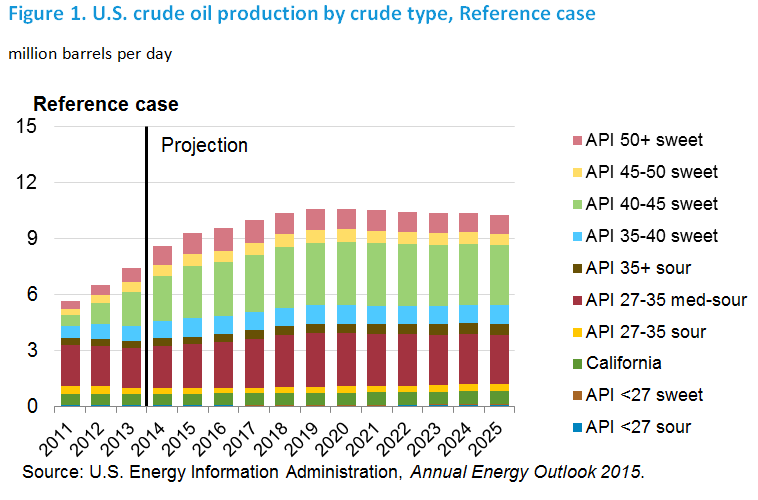
Getting to 11 million barrels per day is the the low oil price case.
The High Oil and Gas Resource case in AEO2015 was developed using assumptions that result in higher estimates of technically recoverable crude oil and natural gas resources than those in the Reference case. Estimates of technically recoverable tight and shale crude oil and natural gas resources are particularly uncertain and change over time as new information is gained through drilling, production, and technology experimentation. The assumptions for the High Oil and Gas Resource case are very optimistic.

Specific assumptions for the High Oil and Gas Resource case, as compared with the Reference Case, include:
• 50% higher estimated ultimate recovery (EUR) levels for tight oil, tight gas, and shale gas wells
• Additional tight oil resources, as well as 50% lower well spacing per acre (i.e., wells are closer together), with a downward limit of 40 acres per well for existing and potential future tight oil resources, to capture the possibility that additional layers or new areas of low-permeability zones will be identified and developed
• Diminishing returns on the EUR when drilling in a county exceeds the number of potential wells assumed in the Reference case, to capture the probability that greater drilling density will cause wells to interfere with each other (i.e., production from one well might reduce production from a nearby well)
• Long-term technology improvements beyond those assumed in the Reference case, represented as a 1% annual increase in the EURs for tight oil, tight gas, and shale gas wells
• 50% higher technically recoverable undiscovered resources for Alaska crude oil and the Lower 48 offshore, reflecting the uncertainty surrounding undeveloped areas where there has been little or no exploration and development activity, and where modern seismic survey data are lacking
The High Oil and Gas Resource case does not include exploration or production activity in the Arctic National Wildlife Refuge or other areas that are currently under drilling moratoria.
In the High Oil Price case, crude oil prices quickly rise to $149/bbl (Brent, 2013 dollars) in 2020 and $169/bbl in 2025 compared with $79/bbl and $91/bbl in the Reference case, respectively.
In the Low Oil Price case, the Brent crude oil price drops to $52/bbl in 2015, 7% lower than in the Reference case, and reaches $64/bbl in 2025, 30% lower than in the Reference case, largely as a result of lower non-OECD demand and higher upstream investment by OPEC
Gulf of Mexico Production is still heading up
Because of the long timelines associated with Gulf of Mexico (GOM) projects, the recent downturn in oil prices is expected to have minimal direct impact on GOM crude oil production through 2016. EIA projects GOM production to reach 1.52 million barrels per day (bbl/d) in 2015 and 1.61 million bbl/d in 2016, or about 16% and 17% of total U.S. crude oil production in those two years, respectively.
The forecasted production growth is driven both by new projects and the redevelopment and expansion of older producing fields. Five deepwater projects began in the last three months of 2014: Stone Energy-operated Cardamom Deep and Cardona projects, Chevron-operated Jack/St. Malo fields, Murphy Oil-operated Dalmatian, and Hess-operated Tubular Bells. Also occurring at the end of 2014 was the redevelopment of Mars (Mars B) and Na Kika (Na Kika Phase 3), both of which are mature fields. Cardamom Deep, Jack/St. Malo, and Tubular Bells were slated for a late 2014 start-up, as well.
Developments are forecast to boost Gulf production by 265,000 barrels per day by the end of 2015.

What about Peak oil and the peak oil theorists ?
Gail makes the case that peak oil is manifesting as a Glut of oil and a glut of all other commodities. She worries about high debt and affordability. She indicates that is a networked economy which causes the “unusual effects”.
One way of viewing our problem today is as a crisis of affordability. Young people cannot afford to start families or buy new homes because of a combination of the high cost of higher education (leading to debt), the high cost of fuel-efficient new cars (again leading to debt), the high cost of resale homes, and the relatively low wages paid to young workers.
Meanwhile, the Peak Oil diehards like Ron Patterson claims that global peak oil will happen in 2015 and US crude oil production will again stop rising in 2015.
75 Comments on "US Crude oil production heading 11 to 15 million barrels per day"
rockman on Wed, 3rd Jun 2015 9:04 pm
“Meanwhile, the Peak Oil diehards like Ron Patterson claims that global peak oil will happen in 2015…” In that case we should classify the EIA as a “peak oil diehard” since they are predicting GPO just a few years later (during 2019) then Ron’s.
If one is good with the EIA projection for US production then they should accept the prediction that global peak oil is just down the road. A rather critical point given the US will, according to the same EIA, still be importing a significant volume of oil.
Plantagenet on Wed, 3rd Jun 2015 9:33 pm
Looks the EIA is predicting the actual US oil production peak will happen in 2020—–exactly 50 years after the date M. K. Hubbert predicted for the US peak, i.e. in 1970.
GregT on Wed, 3rd Jun 2015 10:10 pm
Don’t you ever get tired of spewing complete nonsense planter? I mean seriously, do you enjoy making yourself look like a complete idiot?
Makati1 on Wed, 3rd Jun 2015 10:11 pm
EIA: A branch of the Empire’s ministry of BS. The Empire’s economy will be lucky to last until 2019. Or even post the 2017 change of puppets in the White House.
BC on Wed, 3rd Jun 2015 10:23 pm
@Plant: “Looks the EIA is predicting the actual US oil production peak will happen in 2020—–exactly 50 years after the date M. K. Hubbert predicted for the US peak, i.e. in 1970.”
Still at it, eh?
US peak oil per capita peaked in 1970 and a secondary peak in 1985. Since then, US oil production per capita is down 40-45% since 1970 and 25% since 1985.
US oil production per capita is at the level of 1945-50.
No surprise then that US deindustrialization and financialization began after US Peak Oil in 1970-85, resulting in unprecedented debt to wages and GDP and a perpetual rentier claim by the top 0.001-1% owners of the debt/assets on US output in perpetuity.
Nony on Wed, 3rd Jun 2015 10:25 pm
“If one is good with the EIA projection for US production then they should accept the prediction that global peak oil is just down the road. A rather critical point given the US will, according to the same EIA, still be importing a significant volume of oil.”
Nah. SA has plenty of oil. Even the US has a lot if prices go up. You are confusing price driven leveling in US production versus running out of resource.
coffeeguyzz on Wed, 3rd Jun 2015 10:46 pm
As eye-catching as the headline numbers in this article may be, it is not so surprising to those of us who have been closely monitoring ongoing developments in the shale fields.
It was only a year or so back that Eagle Ford operators started ‘high/low’ placement of wellbores spaced vertically 100’/120′ apart and a few hundred feet laterally with generally favorable results. COP and others are now starting ‘triple stacking’ targeting the upper and lower EF to evaluate its feasibility.
The increasing precision of fracs are producing highly complex near wellbore fractures that extend no more than 300′ laterally.
In a few days, Statoil will conduct its first CO2 Frac job in the Bakken, accompanied with keen anticipation from industry observers/participants.
The surprising findings recently announced by the University of North Dakota’s Energy and Research Center that ethane provides far superior ‘oil movement’ in the Bakken’s 110C temperature shales may have widespread ramifications in the EOR world as well as in field re-pressurization efforts.
The much anticipated results of Cimarex’s initial test well in eastern Kentucky’s Rogersville shale will be announced in a few weeks. If the frenzied leasing activities that have been ongoing there these past few months are any indication, we may be ‘off to the races’ with another shale play.
Although the Marcellus/Utica formations do not seem to garner as much attention as the oil boys, the demonstrated output is almost incredible.
Rice’s monster Utica well – Bigfoot 9H – has surpassed 5 Bcf its first year.
Rice has several other monster wells whose daily output is actually greater than Bigfoot’s.
Range just announced the highest 24hr IP from the Marcellus at 43MMcf. This well is only a few miles from the Utica’s highest IP – also from Range, at 59MMcf.
Stacked payzones much?
EQT has permitted a 27 well pad.
Highest number of gas wells drilled from a single, 5 acre pad was the 51 wells ( actually 52 … one non producing) in 2011 by Encana in the Piceance, NW Colorado.
Love it, hate it … the hydrocarbon output from these shales has barely begun.
GregT on Wed, 3rd Jun 2015 10:53 pm
Global conventional oil production has already peaked. We’ve tried to save our economies by replacing the shortfall with tar sands and other unconventional sources. It bought us a few more years but has cost us dearly.
Economies continue to contract, countries are collapsing, and societal unrest, breakdown and wars are increasing around the world.
On the flip side, we have more than enough fossil fuels left to render the planet Earth, for all intents and purposes, dead.
HMMS BAU is taking on water and listing to one side. There are not enough lifeboats available for everyone. Get to your lifeboat ‘stations’ now people, while there is still space available.
The last things that will be heard above the sounds of the end of modern industrial society, will be; but, but but, the mighty Marcellus? And oil glut, oil glut, oil glut, oil glut, oil glut.
Chris Hill on Wed, 3rd Jun 2015 10:54 pm
The question comes down to price. All the technology in the world won’t do a bit of good to solve any problem if it is unaffordable. Shale is nothing but Fed QE that was dying for a place to go. If that runs out, things will get interesting.
GregT on Wed, 3rd Jun 2015 10:58 pm
You can only put so many layers of lipstick on a pig Chris, before people finally realize that it is indeed a pig. Either that, or you just run out of lipstick.
Nony on Thu, 4th Jun 2015 3:51 am
Peak oil has gotten its butt kicked by shale. Especially peak gas.
What a joke. Remember this?
http://4.bp.blogspot.com/-JAEw3NIdZ0o/UfkFsYS7xeI/AAAAAAAAAlQ/wbjjJa2R4Ag/s1600/screenshot_10.jpg
Nutter Malthusians. Radical greenies. Who won’t admit they were wrong. Anyhow…at least the whole movement is dying. TOD is dead, dead, dead. Terminal embarrassment.
Davy on Thu, 4th Jun 2015 6:49 am
Chris said “The question comes down to price.” And price comes down to the economy and the resource. We must not forget that oil must be used in an economy. Sounds simple and everyone knows this but it is the cornucopians here that just expect demand as if it is a given.
The dynamics of oil supply currently are more than ever dependent on the global economy. This economy is not healthy if it were healthy we would not have the dysfunctional financial system we have today with repressed rates and huge debt. We have unfunded liabilities and latent insolvency at every level.
Everything is still operating and indicators, though manipulated by an obviously corrupt system, still acceptable. The deeper situation in the economy is at best a bumpy plateau at worst a bumpy descent. Demand is not where it should be. Bank of England just reported rates will remain at historic lows there. We know China is struggling with maintaining its growth. I believe we are entering a required business cycle down turn. Even cornucopians understand that economies cycle are normal and one is due. They can’t deny that.
This time will be different because of all the damage that has been done to the financial system by QE and rate repression. The bubbles that were created, damage to Main Street and damage to middle class will intensify in a downturn. The equity markets are near a point where further levitation is hitting limits. Main Street is a mess and the middle class struggling. The insolvencies across the globe are going to increase especially in China where the bad debt can has been kicked down the road for years. Once confidence takes a hit in this environment of uncertainty because of all the global central bank interventions liquidity will take a hit in an already deflationary period.
That was a long story but the point is oil price will not grow if demand is not. If demand is unhealthy an oil spike for any reason of oil price dynamics will be even more damaging and surely cause more demand destruction. We may be in a cycle of descent with demand and supply being destroyed in a cycle of destruction. We have had cycles of growth but never longer term cycles of demand destruction.
I think it is difficult for either the corns or the dooms to claim a current direction but I feel the corns need to acknowledge this is possible now because of all the above financial problems. The corns have a point that there is allot of oil resources that can be brought to market but the price must be right. The corns should admit the price must be right for the consumer and it is ever more apparent the higher range is too high. It is ever more apparent the higher range is what it takes to bring oil to market.
If we get into a cycle of demand and supply destruction this might cascade considering the oil supply situation of higher prices required to bring supply to markets. Personally I think this is a very unstable time of a bumpy plateau on some levels and a descent on others. There are too many factors in play now for a good picture but a descent appears on the horizon with the continued market manipulation maintaining the status quo. Hang on.
Dredd on Thu, 4th Jun 2015 7:13 am
100 barrels of poison
on the wall
100 barrels of poison
take one down
pass it around
99 barrels of poison
on the wall
99 barrels of poison
on the wall
99 barrels of poison
take one down
pass it around
98 barrels of poison
on the wall
…
Kinda catchy
in the U.S.eh?
“Mr. Poison Man, tear down this wall …”
Mark Ziegler on Thu, 4th Jun 2015 8:02 am
15 million barrels a day will almost be enough to supply the us. Meanwhile global oil supplies will steadily decline causing price spikes. Weather the US can isolate itself from the increasing costs will be unlikely.
viewcrafters
Boat on Thu, 4th Jun 2015 8:45 am
Technology gets no respect around here. multiple wells on a pad, multiple horizontal lines at multiple depths with much better results and lower costs. Meanwhile semis will eventually get 15 mph instead of 5. Cars are mandated to get better mph. Say it ain’t so. I believe the bridge to natural gas and renewables will is about built and much of the fear of a crash will be eased. The next big trick is to export this tech around the world to other nat and oil fields. Did our window grow to 30 years? Go electric and solar.
GregT on Thu, 4th Jun 2015 8:59 am
Mark,
It was the price spikes that occurred already which allowed us to go after shale oil and tar sands bitumen. At $60 a barrel oil much of those resources are not profitable. ~$25 a barrel oil is needed to reverse the trend of economic contraction that the world is currently experiencing. In the meantime conventional fields continue to be depleted.
There is a spread between the cost of extracting the oil, and the affordability of that same said
oil to our economies. Some people foolishly believe that the price of gasoline at the pumps is the only price that we are paying. They are ignoring the costs of QE, wars, societal degradation, and failing infrastructure. They refuse to see the forest through the trees, because they fear the truth.
rockman on Thu, 4th Jun 2015 9:33 am
Mark – You need to watch closely what those numbers mean. For instance US citizens don’t consume oil. They consume refinery products. Refineries consume oil and sell the refined products. When numbers are given for “US oil consumption” they are talking about refinery purchases…not consumer purchases. And some of the oil that is produced in the US is exported despite all the bullsh*t about an “oil export ban”: according to the EIA on 29 May 2015 the US was exporting oil at the rate of 161 MILLION BBLSPER YEAR. But more important: on that same date the US was exporting refinery products at the rate of 1.2 BILLION BBLS PER YEAR.
IOW 1.2 billion bbls of refinery products cracked from oil in the US is sold to overseas buyers. Refinery products US consumers could buy if it weren’t exported.
As I asked before and no one has answered yet: how is it different for US consumers if 1.2 billion bbls of oil are exported per year compared to the refinery products made from a billion bbls oil exported per year? I see very little difference when it comes to the pricing of refinery products in the US. But it’s a huge difference for the refinery industry: they have a market capable of absorbing much more oil than the US economy…at the price the refiners want to sell for. This allows them a greater ability to raise prices for their products both domestically and overseas.
Bottom line that many don’t appreciate: the US doesn’t consume nearly as much oil as most think when they see the numbers. They are not differentiating between the consumption of US citizens and consumption by US refineries. Those are two very different animals.
So next time when you see a statement as to how much oil the US consumes you need to ask yourself: it that the consumption of just the US consumers or their consumption + the consumption of US refineries?
GregT on Thu, 4th Jun 2015 9:37 am
“Technology gets no respect around here.”
Oil is what fuels technology Boat, not the other way around.
“Meanwhile semis will eventually get 15 mph instead of 5.”
So eventually we’ll be able to postpone the inevitable for what? Another couple of years? Eventually?
“Cars are mandated to get better mph.”
How’s that worked out so far? More cars, more miles driven. More fossil fuels consumed. Exponentially more. Jevons paradox.
“I believe the bridge to natural gas and renewables will is about built and much of the fear of a crash will be eased.”
What ‘fear of the crash’ would you be referring to? The vast majority of people have no idea what is going on. Natural gas also happens to be a finite resource, and contributes to climate change. There are no such thing as renewables. The never ending search for perpetual motion will never ever end. It is a myth.
“The next big trick is to export this tech around the world to other nat and oil fields.”
We can’t afford to burn the reserves that we are already exploiting, if we have any hope of the continuation of our species on this planet. If by ‘next trick’ you are referring to a disappearing act, you are on the right trajectory.
“Did our window grow to 30 years?”
You are completely ignoring exponential growth. The entire reason for the desire to hang on to BAU, is to allow growth to continue. In 30 years time the population is projected to exceed 10 billion people. So much for your window. It has been broken.
“Go electric and solar.”
Go get yourself some solar panels, and install them on your roof. If you are far enough away from densely populated areas, you might be able to keep the lights on for a few more decades, if you have learned to grow your own food. If you are expecting somebody else to do it for you, expect to be seriously disappointed, and hungry.
Chris Hill on Thu, 4th Jun 2015 10:12 am
What a booming economy http://www.abc17news.com/news/roofing-company-cancels-plans-to-build-facility-in-moberly/33397374
Davy on Thu, 4th Jun 2015 11:01 am
Well, as usual corns like Boat expect the global economy to hum along like it always has. All the problems since 08 are not an issues and will be corrected. Energy affordability will not be an issue because of efficiency and better technology. Oh, and then we also hear about the substitutes just in case that being NatGas and renewables.
Come on Boat don’t you think your are reachin there? Will you admit to a hopium long shot for your wish list to save the day. All this as the global population continues to grow and governments globally are going insolvent. Please boat get real at least meet me half way because I see a shit load of doom immediately ahead.
Tom S on Thu, 4th Jun 2015 12:24 pm
Hi GregT,
“There are no such thing as renewables. The never ending search for perpetual motion will never ever end. It is a myth.”
Do you really think that renewables are perpetual motion machines, or are akin to perpetual motion machines?
-Tom S
GregT on Thu, 4th Jun 2015 12:36 pm
TomS,
There are no such things as renewables Tom. The closest that we have is hydro electric. Hydro electric dams are built with massive fossil fuel inputs and they have useful lives, at the end of which they require fossil fuels to upgrade and repair. Eventually, when not maintained for a period of time, they will erode back into the natural landscape, just like every single thing that mankind has ever built.
Even the Sun is not renewable, it will eventually run out of energy, and die.
It is already very well known and understood Tom, that you are in an extreme state of denial.
Davy on Thu, 4th Jun 2015 12:52 pm
Tommy S, renewables are not self replicating so they have no future without fossil fuels and a complex economy beyond an entropic lifecycle period. Renewable’s production is dirty and require a complex global system of just-in-time production, distribution, and global finance. In this sense and in comparison to what you think they are I would agree with Greg they are equivalents to perpetual motion machines in a sense of technological fantasies of the mind.
Do I want them yes. Do I have them yes. Are we screwed yes. No amount of AltE will save us. They will not scale in time from their current low energy market penetration of around 5% for wind and solar.
Tommy S you are as bad as the NOo/Marm on this board being under the BAUtopian spell of all will work out through technology and markets. You are just green and the NOo/Marm a shit color brown. Get real Tommy S.
Apneaman on Thu, 4th Jun 2015 12:55 pm
Tommy boy, you know how you are always going on about experts and peaker/doomers are just a cult of amateurs etc,etc? Well I found an expert, Professor George Mobus and I see you found him too over on his blog, question everything. You tried all your lame assed nonsensical arguments with him and he cleaned your clock, whooped your ass real good, mopped the fucking floor with you. Take a look in the comment section he spanks Tommy boy a few times – didn’t stick obviously, since Tommy’s brain won’t allow him to question anything within his econ 101 worldview; it’s gospel and always will be even as it is all falling apart. Ape psychology.
http://questioneverything.typepad.com/question_everything/2015/05/civilization-collapse-30.html
GregT on Thu, 4th Jun 2015 1:01 pm
I also have an AltE solar system installed TomS, and I will be installing another within the next couple of months. I am all for alternate energy production, and have put my money where my mouth is. However, I have no illusions that they are self replicating, and plan on stocking up on parts. When that inverter wears out, I won’t be trying to carve one out of wood with my cordless electric drill.
GregT on Thu, 4th Jun 2015 1:11 pm
And while we’re at it, my cordless electric drill also, is not renewable. So even if my solar system came alive, and started replicating and maintaining itself, eventually I wouldn’t have anything to power with electricity anyways.
Somewhat redundant.
Tom S on Thu, 4th Jun 2015 1:41 pm
Apneaman:
“Well I found an expert, Professor George Mobus”
Then you don’t know what an expert is.
“You tried all your lame assed nonsensical arguments with him and he cleaned your clock, whooped your ass real good, mopped the fucking floor with you.”
Are you kidding? He just purposefully misunderstood what I was saying to him, over and over again. Then I pointed out that his mathematics were just severely mistaken, using just arithmetic, and he didn’t even respond to it.
Here, I’ll quote from the comment section:
“[George Mobus:] So with slowing net energy increase and increasing total population the amount of usable energy for the economy per individual is in decline.”
“[Me:] No, that’s clearly wrong. Let’s do the math. According to the EIA’s numbers, world energy consumption has increased from 480×10^15 to 524×10^15 btu, between 2009 and 2013 (inclusive). At the same time, world population increased from 6.83×10^9 to 7.08×10^9 people (http://www.geohive.com/earth/his_history3.aspx). That means that per-capita energy consumption has increased from 70.27×10^6 btu/capita to 74.01×10^6 btu/capita in that time. In other words, per capita energy consumption increased by 5.3% in 4 years, which is a compound growth rate of ~1.3% per year.”
“…The straightforward conclusion from this, is that per capita energy consumption is increasing, and the rate of increase has sped up, no matter what you think happened to EROI (within reason)…I don’t know how you arrived at the conclusion that “usable energy … per individual is in decline”. Your statement is not compatible with the data…”
There was no response from him. Is that what you mean by “cleaning my clock”?
-Tom S
Apneaman on Thu, 4th Jun 2015 1:49 pm
“Tommy’s brain won’t allow him to question anything within his econ 101 worldview; it’s gospel and always will be even as it is all falling apart. Ape psychology.”
Apneaman on Thu, 4th Jun 2015 1:55 pm
Tommy here is just another typical example of your beloved non existent free market at work cannibalising the plebs while being cheerleaded by your BAU econ-priests. Won’t be long now.
,,,,,,,,,,,,,,,,,,,,,,,,,,,,,,,,,,,,,,,,,
How Your Taxes Help Inflate The Value Of Coastal Properties Threatened By Climate Change
“The Ponzi scheme has created a trillion-dollar bubble that American taxpayers are on the hook for. Increasingly, government officials and coastal property homeowners are either denying reality or hoping they aren’t around when the whole thing collapses, as all Ponzi schemes must.”
“Just how big are these subsidies? The study explains, “Between 1995 and 2002, the U.S. federal government spent $787 million on beach nourishment and has historically subsidized two-thirds of total nourishment costs to coastal communities.”
http://thinkprogress.org/climate/2015/06/04/3655491/peak-sand-coastal-property-bubble/
Tom S on Thu, 4th Jun 2015 2:01 pm
GregT:
“Even the Sun is not renewable, it will eventually run out of energy, and die.”
That’s more than a billion years away. I thought you said civilization was going to collapse within the next 4 years or something.
GregT, when people say “renewable” they mean renewable within the next billion years until the Sun explodes. They are not claiming those things are perpetual motion machines.
“However, I have no illusions that they (renewable sources of power) are self replicating”
Well, no, they’re not self-replicating by themselves, that’s true. Neither are fossil fuel technologies. None of them just self-replicate if left to their own devices. Fossil fuel extraction equipment doesn’t just spawn more equipment. Trucks don’t give birth. We use the energy from fossil fuels and renewables, to build additional fossil fuel and renewable sources of power.
“And while we’re at it, my cordless electric drill also, is not renewable. So even if my solar system came alive, and started replicating and maintaining itself”
That’s true. The drill you have does not just self-replicate or renew itself. It’s constructed in a factory.
I think they’re saying that we can run the drill factory off renewable sources of power. They aren’t saying that the drill will just self-replicate or will renew itself even after the Sun explodes.
-Tom S
Tom S on Thu, 4th Jun 2015 2:12 pm
Hi Davy,
“Renewables are not self replicating so they have no future without fossil fuels and a complex economy beyond an entropic lifecycle period.”
The factories which build solar panels use electricity as their main input. Why can’t the electricity come from other solar panels? I realize solar panels aren’t self-replicating in the sense of just spawning more solar panels by themselves. However, why can’t the power from solar panels be used in a factory to build more solar panels?
“Tommy S you are as bad as the NOo/Marm on this board being under the BAUtopian spell of all will work out through technology and markets. You are just green and the NOo/Marm a shit color brown. Get real Tommy S.”
It seems you’re just name-calling here.
-Tom S
GregT on Thu, 4th Jun 2015 2:30 pm
Ok Tom,
Please explain to everyone the process and equipment used to build solar panels and electric drills utilizing only electricity generated from solar panels themselves. From start to finish.
Apneaman on Thu, 4th Jun 2015 2:38 pm
Tommy boy, here again is another example of pretend and extend. A little over ten years ago this would have been laughed at as a fool’s game (because it is), but it’s the new normal and it is also what blind cheerleaders like you point to as evidence that everything is back to normal. Look Look car sales are awesome – everything is awesome! Tell yourself Tommy.
New-car loans keep getting longer
http://www.usatoday.com/story/money/cars/2015/06/01/new-car-loans-term-length/28303991/
Tom S on Thu, 4th Jun 2015 2:57 pm
GregT,
Okay, here goes. I think we could manufacture solar cells using the electricity from other solar cells. I think about 80% of the power used in manufacturing solar cells is used during the Siemens process for making PV grade silicon. The Siemens process uses electricity only as its energy input, and I think that electricity could come from solar and wind power with battery backup and with occasional natural gas backup when renewables are inadequate during the winter.
I also think we could electrify a large fraction of transportation using overhead wires for railroads etc. Electric railroads are already common in many parts of the world.
We could also use renewable electricity for electric arc furnaces to make the the steel for your drill. Also, we could use renewable electricity to power the factory for the drill, which runs mostly off electricity. The aluminum used for solar panel frames relies almost entirely on electricity already which could come from renewable sources also.
Obviously I haven’t covered everything. There would still be fossil fuels used. Things like steelmaking, cement making, glassmaking, and last-mile shipping still require at least some fossil fuels. There would also be a few long lulls in renewable power during windless and overcast periods which would require fossil fuel backup. As a result I think we could only transition about 70% of the economy to renewables right now before we start hitting big roadblocks. Still, I think doing that would gain us at least a century until fossil fuels are inadequate even to provide the remaining 30% of power.
I think the economy will automatically and gradually transition to renewables for the 70% of energy which is easiest to transition. I think that will buy us at least a century. What happens after that depends upon technological developments in the mean time.
-Tom S
Davy on Thu, 4th Jun 2015 3:05 pm
Tommy, the energy equation is much more complex then electricity from solar can power solar plants. Well daaa what about solar running the rest of the process all the ways to the mines for material. What about the whole community and nation being supported by solar.
Tommy that is just not likely at least for the real world we have today and the time we have left to do it in. We shot our wad Tommy. There are no more happy endings. This is the end game now for our stupidity and hubris. Except your punishment for being a dumb ass human like the rest of us will. We are done and toast.
Why not put our wasted hopium energy into concrete adaptation strategies and mitigation efforts to make for less pain and suffering. Tommy would that not be more enlightened and real?
GregT on Thu, 4th Jun 2015 3:06 pm
Speaking from personal experience Tom, having sat down and brainstormed with a workgroup on a similar problem, after countless hours of research we came to the conclusion that it is a lesson in futility. The closer you examine all of the separate components and processes, the bigger the problem becomes, and every step requires more and more fossil fuel energy inputs.
You are ignoring the first law of thermodynamics. We will never replace tens of millions of years worth of stored solar energy with current sunlight.
As I have said before, I am an advocate of AltE power generation and infrastructure, and I believe that we should be using our remaining fossil fuels to build out as much AltE as possible, but AltE will never replace even a small percentage of what fossil fuels currently do for us. In many cases there are no substitutes even available for fossil fuels.
Even with a dramatic reduction in our population, AltE is not the solution going forward. We need to return to living off of, and in harmony with, the Earth. All natural systems are completely reliant on one another. We have already upset the natural balance of the Earth’s ecosystems so badly, that at this point it is highly questionable as to whether or not our species can be sustained into the future.
HARM on Thu, 4th Jun 2015 3:33 pm
Hubbert got the peak exactly right –for conventional oil. Exactly where and when the secondary peak for non-conventional (shale/frack) oil will occur has yet to be seen.
Tom S on Thu, 4th Jun 2015 3:42 pm
GregT:
“As I have said before, I am an advocate of AltE power generation and infrastructure, and I believe that we should be using our remaining fossil fuels to build out as much AltE as possible”
Well at least we agree on that.
I live near San Francisco and there are lots of good places for solar plants and wind farms nearby. We have a law to get 33% of electricity generation from renewables by 2020 in this state and we’re on track to meet it.
Personally I like the electric buses in SF powered by overhead wires. There have been overhead wires in SF for buses since at least 1970 when I was a kid. I find the overhead wires to be beautiful. That’s the kind of thing I think we should be deploying much more widely. I don’t like the black smoke belching diesel buses.
-Tom S
Plantagenet on Thu, 4th Jun 2015 4:02 pm
@HARM
M.K. Hubert predicted ALL oil production in the USA would peak in 1970.
Clearly he was wrong.
Now the EIA is predicting the actual peak of US oil production will come in 2020.
Get it now?
GregT on Thu, 4th Jun 2015 4:27 pm
If you haven’t already done so Tom, a stand alone PV system is a must, and get as far away from SF now, while you still can. Just some friendly advice.
Speculawyer on Thu, 4th Jun 2015 4:35 pm
Oh really? They don’t think the crashing rig count will slow down this fantasy? Amazing.
Plant . . . don’t count your chickens before they hatch. EIA is notorious for their bad predictions.
GregT on Thu, 4th Jun 2015 4:43 pm
Wrong yet again planter. Doesn’t it get tiring being so completely wrong about nearly everything that you say? Do you enjoy making yourself look like an idiot?
http://www.hubbertpeak.com/hubbert/1956/1956.pdf
Page 34 of Hubbert’s report clearly states that more oil could be recovered using techniques not available in 1965. His predictions were based on current known reserves with currently in use technologies.
GregT on Thu, 4th Jun 2015 4:46 pm
Ah sorry,
Techniques not available in 1956. Not 1965.
Davy on Thu, 4th Jun 2015 4:49 pm
Tommy, what Greg said and start producing and preserving food in anyway possible. Move up to the edge of Napa and grow grapes and make wine but not as they do now but as it was done pre fossil fuels. Find ways to harvest and store water.
Like JMG said collapse now. Like I say practice relative sacrifice and live with less in anticipation of a future with less then the less now IOW jump off the cliff instead of waiting for the herd. You will have a safer fall that way.
Get out of your delusional green BAUtopian fantasy of a shiny AltE world. The coming world will be about pain and suffering. Excess death over births will rebalance population.
A combined Hybrid of new and old through salvage. The utilization of tried and true current technology that fits a collapsed world not iPhones but solar ovens and dryers as an example.
This paradigm shift is going to be all about a reconnect to nature to provide food, water, and shelter. Forget the finer things in life like your Prius and get used to a grub hoe.
Newfie on Thu, 4th Jun 2015 4:57 pm
When oil peaks is irrelevant. There’s enough left to fry this planet with CO2 emissions. We just passed 400 ppm CO2. Higher than it’s been in millions of years.
Plantagenet on Thu, 4th Jun 2015 4:59 pm
@GregT
IN addition to be being a dope, you are totally delusional. I went to p. 34 of the Hubbert paper you linked to, and p.34 is a discussion of the Uranium content of various rocks. There is nothing on p.34 about how more oil can be recovered. The Hubbert document you linked to is a proposal to use NUCLEAR energy to fuel the US oil peak in 1970.
You didn’t even read it, did you?
AND, if you read on to p.38, you find a typical Hubbert plot showing US oil production peaking in 1970. But Hubbert was wrong—the EIA is now predicting US oil production will surpass the 1970 level in the next couple of years. The EIA also predicts a new peak in ca. 2020.
Why is your reading comprehension so low? I can understand that you can’t do math—most americans can’t do math—-but you also have severe reading comprehension problems, don’t you?
Is that why you are so insecure?
CHeers!
Plantagenet on Thu, 4th Jun 2015 5:02 pm
@speculawyer
You are right, of course, that the EIA often makes bad predictions.
Time will tell if it was Hubbert who made the bad prediction 50 years ago, or if the EIA is wrong this time.
Cheers!
Plantagenet on Thu, 4th Jun 2015 5:04 pm
@Newfie
Actually it makes quite a bit of difference if US oil production peaked in 1970 as Hubbert claimed, or if it peaks at a higher level in 2020 as the EIA is predicting.
Lets get the basic facts right before we launch off into wild speculation. If the facts are completely wrong then the speculation will tend to be wrong as well.
Cheers!
GregT on Thu, 4th Jun 2015 5:17 pm
Page 34 of the PDF planter, anybody, anywhere in the world that is reading our posts can read it for themselves. Which only makes you look like an even more complete idiot.
GregT on Thu, 4th Jun 2015 5:23 pm
You are absolutely correct Newfie. 350 is the agreed upon point of ppm CO2 in the atmosphere that is considered safe. We’ve blown by that one already. 450 is in all likelihood game over for the human race. If we keep burning fossil fuels at current rates, we’ll most likely reach 450 in about 20 years.