
Peak Oil is You

Donate Bitcoins ;-) or Paypal :-)


Page added on April 19, 2016

Hubbert’s Peak or Yergin’s Plateau?

In 1956, Shell geologist M. King Hubbert correctly predicted that oil production in the United States would reach a peak around 1970. Since his Peak Oil theory fits so well with the Malthusian worldview of “Progressives”, anti-capitalists and anarchists, Hubbert has become a posthumous hero to the Left, an unusual role for a scientist polluted by the filthy lucre of the oil industry.

Hubbert’s depiction of Global Peak Oil. From Wikipedia.
Peak Oil’s fundamental assumption is that the supply of oil is finite and fixed. The peak of the oil production curve is reached when half of the total resource base has been produced, so rate vs time exhibits a symmetric bell-shaped curve. Post peak, rate declines rapidly. Hubbert demonstrated a peak for oil production in Texas, and he extended his theory to correctly predict the time (but not the rate) of the peak for the U.S. World oil production is supposed to have peaked in the last five years or so.
But Daniel Yergin, chairman of IHS Cambridge Energy Research Associates and a Pulitzer Prize-winning author, argues in a WSJ.com Saturday Essay that Peak Oil theory has a fatal flaw, which is rooted in Hubbert’s blind spot: economics. (H/T to Mark J. Perry and his excellent Carpe Diem blog.)
Hubbert was imaginative and innovative,” recalled Peter Rose, who was Hubbert’s boss at the U.S. Geological Survey. But he had “no concept of technological change, economics or how new resource plays evolve. It was a very static view of the world.” Hubbert also assumed that there could be an accurate estimate of ultimately recoverable resources, when in fact it is a constantly moving target.
Hubbert insisted that price didn’t matter. Economics – the forces of supply and demand – were, he maintained, irrelevant to the finite physical cache of oil in the earth. But why would price—with all the messages that it sends to people about allocating resources and developing new technologies—apply in so many other realms but not in oil and gas production? Activity goes up when prices go up; activity goes down when prices go down. Higher prices stimulate innovation and encourage people to figure out ingenious new ways to increase supply.
The idea of “proved reserves” of oil isn’t just a physical concept, accounting for a fixed amount in the “storehouse.” It’s also an economic concept: how much can be recovered at prevailing prices. And it’s a technological concept, because advances in technology take resources that were not physically accessible and turn them into recoverable reserves.
[The emphasis is not in the original, but comes from Perry’s quote of Yergin’s text. – Ed.]
This is true on all counts. Hubbert’s forecasts were made when the U.S. was the world’s dominate oil producer, in an environment of price stability. Until the Arab Oil Embargo in 1973, oil prices were below $20 per barrel (2008 dollars), and declining in real terms.
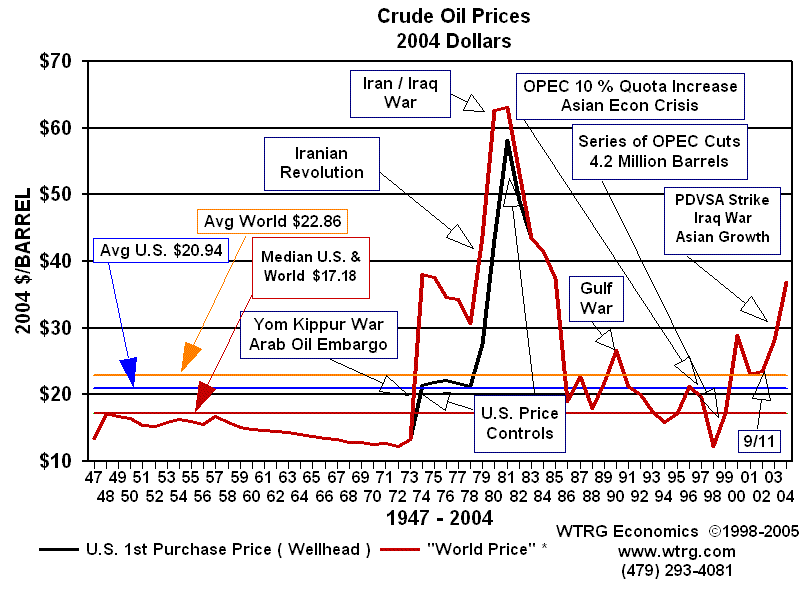
Rising prices undeniably add reserves. On a micro level, rising prices mean that a well that might be plugged making 5 barrels per day may produce profitably for several more years. Old abandoned wells may even be returned to production. A new prospect that is uneconomic at $40 per barrel may be drilled if prices reach $80.
At a macro level, higher prices extend the search for oil into areas that Hubbert never imagined. Hubbert’s original U.S. projection included no Arctic reserves, as Alaska was not a state when his forecast was made. I’m certain that Hubbert never envisioned drilling in offshore waters over a mile deep, or production from then-worthless shales like the Bakken of North Dakota.
One other point worth mentioning: Hubbert’s work was derived from the “hard-rock” mining industry, which searches for minerals such as gold, silver and platinum. A key difference between these precious metal resources and hydrocarbons. Au, Ag and Pt are elements; they occupy boxes on the Periodic Table.
Unlike elements, natural gas and oil can be created from other substances by alchemy (or, really, by chemical engineering). Gas and liquids can be manufactured from related compounds found in nature, such as coal, tar sands or kerogen. Economics also control the degree to which these technologies expand the effective oil and gas resource base.
Oil resources are not infinite, and it is unarguable that most of the easily accessed, conventionally producible oil has already been discovered. I agree with Yergin’s conclusion, that rather than “Peak Oil” we may be entering a period of “Plateau Oil”. Instead of a symmetric bell-shaped curve, we are on a limb of the curve that flatten or grow slowly for some time. Reserves will be added at the economic frontier, where the search for reserves is justified whenever the marginal cost of finding and developing is less than the current market price. Ultimately, if we let free market forces dictate, new technologies will replace hydrocarbons at such time as they achieve a lower price in the marketplace.
Or, in a more likely scenario, politicians will muck up the whole thing, thinking they will be the first beings in the history of the planet to outsmart the law of supply and demand.
81 Comments on "Hubbert’s Peak or Yergin’s Plateau?"
Davy on Tue, 19th Apr 2016 7:56 pm
Should read “Hubbert’s brilliance or Yergin’s ignorance” and say no more.
HARM on Tue, 19th Apr 2016 8:29 pm
Hubbert was way ahead of his time and will ultimately be proven right, but… back in the 1950s it was impossible to accurately estimate the amount of FFs on earth that could be economically extracted, or what new technologies might allow BAU to keep going in the 21st century. He erred on the side of caution, ended up estimating too low.
Based on the current glut and the fact both the U.S. and world are regularly breaking new production highs, we have not yet hit the peak and probably won’t for at least another decade –possibly two. The people running the show have proven to be amazingly adept at FF extraction and kicking the can. We underestimate them at our peril.
Plantagenet on Tue, 19th Apr 2016 8:44 pm
Hubert’s claim that the US oil production would peak in 1970 and then decline to lower and lower levels has been proven wrong. Starting in about 2006 US oil production began to increase rapidly again, until today it is about at 1970 levels.
Cheers!
makati1 on Tue, 19th Apr 2016 9:23 pm
HARM, it is the financial tricks that keep oil flowing today. Not tech.
paulo1 on Tue, 19th Apr 2016 9:23 pm
regarding: “if we let free market forces dictate, new technologies will replace hydrocarbons at such time as they achieve a lower price in the marketplace.”
Ah, the elusive ‘new technologies’ to the rescue. Elon Musk, riding in on his white Tesla will save us all. Just in case it doesn’t happen I continue to fill the sheds with wood and put new gardens in production. My kids can always take it over.
Northwest Resident on Tue, 19th Apr 2016 9:31 pm
Conventional oil peaked in 2005 and has been declining ever since.
Starting around 2008/9 massive US government debt — QE — combined with ZIRP and a sophisticated propaganda campaign enabled the U.S. shale industry to extract oil that had always been considered uneconomical and a losing proposition.
Together with shale and other unconventional oils, bio fuels and other substances were reclassified as “oil” and added to the barrel count.
The result was a minor blip in global “oil” production.
Continued issuance of trillion$ in debt and continued suppression of interest rates kept the party going another six years or so.
Now the party is over, shale extraction has been proven to be the PONZI scheme that it was always known to be from the very beginning, and we are left with unmanageable debt and a rapidly depleting energy supply that is destroying demand for the very product that our global economy and technological civilization is built on.
Assuming that “peak oil” won’t arrive for another decade or two is also assuming that the current global economy can continue to “grow” on continued injections of massive debt — an assumption that is demonstrably false.
Franklin the Cat on Tue, 19th Apr 2016 9:33 pm
Here’s the actual first line from the ‘Peak Oil’ entry in Wikipedia:
‘Peak oil, an event based on M. King Hubbert’s theory, is the point in time when the maximum rate of extraction of petroleum is reached, after which it is expected to enter terminal decline’
The author states ‘The peak of the oil production curve is reached when half of the total resource base has been produced’
Big difference if you ask me. But I guess if your entire article is bullshit there’s no need to accurately define the idea the article is based on.
As for your comment Plant, either your simply dense in the head, or a literal ‘Plant’ to this site meant to create distractions. The fact that we are even fracking for oil should tell all of us where we are ultimately heading.
Is there a way I can filter out any ‘Daniel Yergin’ anything on this site? Just hearing his name creeps me out.
Apneaman on Tue, 19th Apr 2016 9:54 pm
The Mongols (my heroes) would chop up their prisoners and boil them to render the human fat. Then they would use the oil in fire bombs during sieges. Gotta love that humanity ingenuity and technology. Maybe it will go retro – anything to help kick the can. It’s cheaper than fracing and there are plenty of “sweet spots” walking around merica. The people of walmart alone could extend happy motoring for another 5-7 years.
peakyeast on Tue, 19th Apr 2016 9:56 pm
If one combines hubberts fact of peak oil with Limits to Growth one will see that:
1. Technology doesnt change much
2. Doubling of the resource base doesnt change much
3. The 30year update of Limits to growth shows we are right on track to disaster – and still the greedy paid morons run around spreading urban-legends, obnoxious half-truths and outright evil manipulation. Its sad that the PO movement doesnt have a few death squads – they are sorely needed to weed out these stem-cell cancer monkeys – to use an often used description here.
We are still making poo-poo in our childrens bed. And anyone stoopid and greedy enough to promote that behaviour deserves to be put to sleep in same said bed.
dave thompson on Tue, 19th Apr 2016 10:10 pm
Yea one thing Hubert definitely overlooked was the now infamous plantaglut to the rescue of humanity.
Plantagenet on Tue, 19th Apr 2016 10:29 pm
@Franklin the cat
You are dense in the head if you think US oil production reached its peak in the year 1970 and has been declining ever since. Yes, oil production declined until about 2005—but since then US oil production has increased rapidly until it is near 1970 levels today.
The large increase in US oil production since 2005, something that Hubbert never predicted, falsifies his mathematical model that is supposed to predict the rate of oil decline after the peak.
I know math is hard for folks like you, but trust me—his equation doesn’t predict the actual amount of oil being produced today. Surely even you can understand that US oil production today is higher then it was 10 years ago—how is that possible if we hit peak oil in 1970?
Cheers!
HARM on Tue, 19th Apr 2016 11:11 pm
@Plant,
Just curious, when do you think the second oil/liquids peak might occur In the U.S.? Same question globally?
(I am of course assuming that you don’t subscribe to abiotic oil ‘theory’, still believe there is a finite limit to economically viable oil extraction, and that a peak will someday occur).
GregT on Tue, 19th Apr 2016 11:16 pm
You have been provided with links and quotes from Hubbert’s 1956 paper so many times now that it’s beyond ridiculous Planter.
Enough with the fucking bullshit already. Grow up.
James Tipper on Tue, 19th Apr 2016 11:37 pm
“US oil production has increased rapidly until it is near 1970 levels today.”
Near, but it won’t cross, not at these prices. Which proves the point that oil already peaked anyway and it will never beat that peak, even with trillions thrown in. The decline in conventional oil in America is long gone.
Comparing sweet crude to fracking is like comparing clean, filtered water with a river used as a toxic waste dump.
“The large increase in US oil production since 2005, something that Hubbert never predicted, falsifies his mathematical model that is supposed to predict the rate of oil decline after the peak.”
Yes, he didn’t predict we would be this stupid and greedy.
“Surely even you can understand that US oil production today is higher then it was 10 years ago—how is that possible if we hit peak oil in 1970?”
Accounting tricks for toxic sludge
dave thompson on Tue, 19th Apr 2016 11:56 pm
All here defying and denying the theory of endless oil growth do not understand the plantaglut non-peak-peak of current oil production.
Plantagenet on Wed, 20th Apr 2016 12:49 am
@HARM
Good question! Whats your opinion?
IMHO, a “second peak” in the US may be happening right now. If the global oil glut continues for several years US oil production is going to fall off again.
Alternatively, if the oil glut ends fairly soon and global oil prices go back up, US oil production may wind up going a bit higher then we see today.
Time will tell
Cheers!
Plantagenet on Wed, 20th Apr 2016 12:53 am
@James Tipper.
You don’t understand Hubbert’s theory of peak oil. Hubbert not only predicted US oil production would peak in 1970—he devised a mathematical model to predict the rate of decline.
Clearly Hubbert’s mathematical model is wrong—-US production did’t decline from 2006 to 2015, it INCREASED. And oil production today is far above where Hubbert’s model says it should be, i.e. his prediction was wrong.
Cheers!
Northwest Resident on Wed, 20th Apr 2016 1:02 am
Hubert was “wrong” only because he failed to account for the unconventional “boom” — a short-lived and last desperate effort at extending the age of oil, a phenomenon that was only enabled by massive debt, ZIRP and financial skullduggery on a global scale. But other than that, Hubert’s predictions were more or less accurate, as far as predictions go. He certainly got the main idea right.
Plantagenet on Wed, 20th Apr 2016 1:08 am
@nordent
You don’t understand how science works. If a mathematical model does’t accurately predict the phenomena it purports to describe then it is wrong. Hubert’s mathematical model describing the decline of oil production after the 1970 is clearly wrong. His prediction of US oil production in 2016 doesn’t even come close to US oil production. His model even got the trend wrong—US oil production INCREASED from 2005 to 2015, exactly the opposite of what Hubert predicted.
Cheers!
dave thompson on Wed, 20th Apr 2016 1:11 am
Yes Northwest Resident Hubert failed because he never could have foreseen the plantaglut the way it has been pointed out by the author and scientificy theory of the plantaglut in the peer reviwed posting here at P.O. news and message boards.
Apneaman on Wed, 20th Apr 2016 1:17 am
Planty you stupid cunt. Did the model include fracking and a new definition (2005) of crude oil?
We all know that you know Hubbert was talking about conventional oil, yet you still insist on playing your stupid fucking games. Go piss up a rope you stupid brain dead whore.
HARM on Wed, 20th Apr 2016 1:27 am
Good grief, is this what it’s come to here? Peak oil didn’t arrive at the proper moment, so half the board is arguing that the oil glut that’s clearly happening isn’t really happening (?!!?), while the other half hurls insults.
Planter is right that we’re reached and possibly exceeded the previous 1971 peak (which was forecast by Hubbert), and arguing about how the frack oil and tight oil is not “real” oil is pointless. If it can be refined into usable product and sold on the open market, it’s oil guys.
That said… it’s not like Hubbert was 100% wrong. He did after all call the 1971 peak years before it happened. However, the problem with mathematical models in general is that (a) you never have *all* the necessary data, and (b) all mathematical models are by necessity greatly simplified abstractions of reality that pare down everything to a few variables and assumptions. The real work is far too complex to model (any hyper-accurate model of the world would have to be another near-identical planet).
Reality doesn’t always precisely fit a perfect symmetrical bell curve. Of course that does not mean oil extraction is infinite or the Laws of Thermodynamics have been repealed –just that the model did not fit the data and really needs some new data & assumptions.
Hello on Wed, 20th Apr 2016 1:30 am
Plant:
No mathematical model of nature is 100% accurate. Maybe Hubert’s model is accurate enough? How accurate does it need to be?
HARM on Wed, 20th Apr 2016 1:32 am
Personally, I’d like to see a new, more sophisticated forecast model of oil production that takes into account all the new data of the past few years. Including a tally of all the marginal and/or previously “depleted” fields that were brought online due to fracking, and when the new world & U.S. production peaks might occur. Now that we know the old assumptions about “proven” reserves and EROEI were clearly wrong, how about some better models?
dave thompson on Wed, 20th Apr 2016 1:35 am
Don’t worry Harm we have a new model in the plantaglut science like theory of plantaglut post peak-peak oil cheers!
Apneaman on Wed, 20th Apr 2016 1:56 am
Harm, we have been over this with that asshole a thousand times and have explained to it exactly what you said “you never have *all* the necessary data”
Never might be rightly said as often, as sometimes it works out that a model did.
Given the known knowns at the time, Hubberts model was fine.
Conventional did peak in 2005 AND then the fracking boom happened. The shale boom does not invalidate Hubberts model in anyway. If anything it validates his conclusions. Why would anyone turn to much more expensive shale that also is a political hot potato due to the added environmental impacts if conventional oil plays were still available?
makati1 on Wed, 20th Apr 2016 1:57 am
Harm, I don’t think even god could get all of the real numbers to make any realistic forecast. The name of the game today is to lie and cheat because the real numbers would end the whole game. The investors would all jump ship and the oily Titanic would sink. Best we can do is observe what is happening and make our own forecast. I see icebergs ahead!
Apneaman on Wed, 20th Apr 2016 2:05 am
I still have not heard even 1 plausible explanation for why the definition was changed when it was. I have heard many argue that the condensate is still useful bla bla bla. That’s not answering the question. Why was the definition changed when it was? That’s the question, not the uses of condensate. Different issue. The timing matches up with the start of the shale boom, so it should be obvious why some might be suspicious.
Changing the Definition of ‘Oil’ to Make the Figures Look Better
http://oilprice.com/Energy/Crude-Oil/Changing-the-Definition-of-Oil-to-Make-the-Figures-Look-Better.html
dave thompson on Wed, 20th Apr 2016 2:13 am
This is strait from APN article above caps are my addition for emphasis;”What’s growing is a category called “total liquids” which encompasses oil, natural gas PLANTAGLUT liquids”
dave thompson on Wed, 20th Apr 2016 2:17 am
The article goes on;”Usually, when people refer to NGL, what they really mean is natural gas PLANTAGLUT liquids (NGPL)”
joe on Wed, 20th Apr 2016 2:27 am
Hubbert was wrong in the sense that obviously oil is not physically declining. He right that easy oil is declining. I agree with the bumpy plateau models of peak oil. In 20 years between age pyramids and stagnant economies we might find little use for continued growth of oil production. Crapitalism is dead without growth.
dooma on Wed, 20th Apr 2016 3:02 am
The fact that the author is completely casual about the idea of going into such amazing wilderness places such as Alaska COMBINED with the fact that fracking is seen as good for the economy, just depresses the hell out of me.
In our pursuit to sustain the unsustainable, there is no concern given to the welfare of the planet. It doesn’t really matter when oil peaks because we are going to ruin such precious resources as clean water to get every last drop out.
I truly believe that we are just as crazy as the Christmas island people and are prepared to ruin our world rather than change and adapt to a more sustainable way to live.
He who lives by the gas station will die from the gas station…
dooma on Wed, 20th Apr 2016 3:06 am
or by the gas station. My Shakespeare was never that good…
simonr on Wed, 20th Apr 2016 3:11 am
Hubbert predicted peak extraction from conventional resevoirs.
he was / is right.
peakyeast on Wed, 20th Apr 2016 3:56 am
Its a FACT that those that argue against Hubbert being correct – in spite of being show evidence again and again and again that he was correct – they are at peak idiocy or near.
The definition of oil has changed. The type of oil has been changed.
It is a fairly certain conclusion that plantagent is fact resistant to a degree that his income must be 100% dependent on him spewing out misinformation. Unfortunately for him he cant hide under the guise of stupidity – so i suppose he belongs to the extremity of psychopaths.
GregT and others has done a very good job of trying to make him (and others) understand, but he simply ignores the facts they provide in easily understood plain text.
Davy on Wed, 20th Apr 2016 5:33 am
Regardless, what has not changed is the effects of peak oil. If you want to hammer Hubert on the details fine. What model does not get hammered by antagonist or glorified by protagonist. He brought to fossil fuel man the concept with conditions that modern man has disregarded to his chagrin. We are talking a foundational resource responsible for wellbeing. A foundational resource that cannot be substituted at the scale need under the systematic conditions of population size and complexity today. We had a chance to adapt at Hubbert’s time we have no chance now. Yet, we argue semantics and timing as if peak oil is an event.
Peak oil is a condition of a dynamic systematic process. It is the approach and or the departure that matters not the event. The fact that the parameters of oil and civilization have changed is important. Look at the changes of fossil fuel man since the 50’s. We are a different civilization. We have passed several markers for the civilization of society and economy. We certainly are approaching or departing peaks across a broad spectrum of important variable including oil.
It is just a game to argue peak oil details. The conditions of peak oil are not a game. Peak oil conditions are a serious problem that cannot be solved anymore. We are in a limits of growth situation with diminishing returns and oil is a primary influence to this. It is involved in our existential predicament in quality and quantity. It does not matter glut or not nor price. What matters is a disequilibrium of economy at the level of demand and supply for oil to be properly produced and utilized. Oil in relation to supply and demand is not balance and stable today peak oil is part of this.
Peak oil is related to the ill effects of oil in the economy as oil depletes. It is related to the problems with a population in overshoot requiring cheap oil in greater quantities. Peak oil means something different today than the 50’s because population size has change dramatically and the type of economy. We are global now and rely on a global production and distribution systems that are just-in-time in nature with economies of scale that are lubricated with confidence and digital exchange. Peak oil in this new and different economy has a vastly different meaning in the regards to effect.
Hubbert was right and wrong depending on your semantics but peak oil is a deadly condition now. The approach is deadly and the departure is a sealed fate. Modern man cannot degrowth without a crash of economic activity. A crash of economic activity is a die off situation because all locals have been delocalized in regards to vital support systems and supplies. Populations is many times into overshoot. A good indication of degree of overshoot is an order of magnitude. In this regards Hubbert’s warning about oils trajectory of supply is a profoundly important warning disregarded by global leadership over and over for decades. We now have a seal fate of collapse ahead and we argue the meaning of his model. That my friends is a drink at the bar on the Titanic. Gin Fizz anyone?
rockman on Wed, 20th Apr 2016 6:48 am
And once again for those who have never studied Hubbert’s work: he didn’t predict the peak of US oil production. He makes it very clear he’s predicting the peak production of the KNOWN (and rather mature) onshore oil trends. And that peak and the subsequent slow decline of those trends have been proven correct. He specifically says his model did not factor in development of new trends such as the offshore and shale plays. Just another “inconvenient truth” some like to ignore. LOL.
So many other misstatements but I’ll hit one of the worst: symmetry of the oil production rate curve. Again Hubbert clearly states that it will never be symmetric. Which wasn’t a difficult prediction to make given that no well, field, trend or entire geologic basin has ever displayed anything close to a symmetric production curve. IN FACT JUST THE OPPOSITE: ALMOST ALWAYS VERY ASYMMETRIC. Thus the equally foolish statement that half of the ultimate recovery occurs after the peak. Has never happened and never will. All one needs do is look at the significant % of current US oil production coming from stripper wells many of which are in the trends that Hubbert based his model upon HALF A CENTURY AGO.
As far as any global prediction again that could only be based upon KNOWN trends. The huge ME trends were just beginning to be discovered when he made his projections. So once again one cannot predict a trend that hasn’t begun to develop. Of course today it would be much easier to make such a prediction given the HALF CENTURY OF NEW DATA we have today compared to what Hubbert had to work with. Many times shorty has explained the dramatic slowdown in NEW FIELDS BEING DISCOVERED in the last couple of decades so there’s no point in repeating those FACTS.
But none of those FACTS will stop some folks from trying to redefine Hubbert’s work to suite their personal agendas. Nor does it change the fact that the timing of both US and global peak oil remains one of the least important aspects of our energy dynamics. Just one more meaningless debate for folks with nothing else of importance to add to the conversation IMHO.
shortonoil on Wed, 20th Apr 2016 8:15 am
Technology has created ZERO barrels of oil in the ground. It showed up 5.7 to 300 million years to late to do any creating! What it has done is to allow oil to be discovered faster, and extracted faster; it has not increased the amount of oil available. The amount available is controlled by the energy content of a unit of oil. It is NOT controlled by some magical, mystical entity called “technology”.
The world is now finding 1 barrel of oil for every 8 it extracts. It is not necessary to have a Ph. D in mathematics to understand where that is going! The world is now in the last stages of the oil age. It is now a simple matter of how fast what has already been discovered can be extracted. M. King Hubbert’s curve was based on the extraction rate possible with technology available during his time. The extraction rate of which he was aware changed because of technology, and that changed the shape of the curve that he originally proposed. His genius laid in the recognition of the the “form” of the curve, not in his ability to see into a crystal ball.
Hubbert determined that the shape of the curve was a logistic curve, and he was correct. Unfortunately, the mathematical tools (Quantile Statistics) and the computer power needed did not exist in 1956 to calculate a “skewed” logistic curve. They do now, and we have used them to calculate what the true shape of that skewed logistic curve should be:
http://www.thehillsgroup.org/depletion2_013.htm
Skewing the curve does not change the area under the curve. It merely reflects the rate at which, what is already there, is being extracted. What Hubbert did miss is that there is a discontinuity in his function; but that is a different subject.
Mr. Yergin has fallen prey to the “technology is God” syndrome; a modern religious doctrine that seems to have affected much of humanity. He is just one of many who feel that humans have successfully scaled Mount Olympus, and have over thrown the gods.
Such hubris has always resulted in considerable retribution!
http://www.thehillsgroup.org/
Dredd on Wed, 20th Apr 2016 10:05 am
We should let Dominos Pizza decide the issue ? (The Criminally Insane Epoch Arises – 5)
Apneaman on Wed, 20th Apr 2016 10:41 am
Redefining Hubberts work.
It’s just a big straw man for those who can’t accept that oil, like all resources depletes and the living arrangements could change dramatically in their life time.
Claim his model never predicted today’s environment, therefore peak oil is bogus. Straw man.
Usually this starts with PR people who understand and have read the original work and set up the bunk argument to be knocked down. Lazy sheeple buy into it without doing their own work, because it’s what they want to hear in the first place. Confirms a world-view. Same thing has been done with Adam Smith, Marx, and many others. A million know it all parrots who have never even read the original works.
steveo on Wed, 20th Apr 2016 11:36 am
Yergin has never been right about anything he has predicted. Why give him any credit now?
HARM on Wed, 20th Apr 2016 11:38 am
Yes, Hubbert did an amazing job with 1950s data and 1950s technology (where a “computer” was less powerful than a smartphone and filled an entire room). And it’s also true that his model was based on CONVENTIONAL oil and KNOWN (in 1950s) reserves with KNOWN extraction technology.
Nonetheless, despite all the denial here about fracking liquids, NGL, tar sands, bitumen and other unconventional liquids, the mainstream press, the mainstream public, the politicians, and –evidently– the economy all view “liquids”, regardless of source, composition or purity as OIL.
This seems to be the one blindingly obvious point that many here simply won’t concede, no matter how much evidence piles up. Hubbert was right on conventional, but did not foresee the boom in unconventional causing a second peak in the U.S., and pushing out the global peak by decades.
No one (aside from maybe Plant) is disputing that Hubbert was essentially right on conventional oil. However, virtually no one outside of this blog cares about that. They only care about how much “go juice” is being extracted and how cheap it is. And right now, the world is awash in “go juice” and it’s pretty bloody cheap by historical measures.
Anonymous on Wed, 20th Apr 2016 11:47 am
So funny to have someone like ‘plantaglut’ lecture others on how they dont ‘understand’, both Hubberts theory, or science. Coming from someone with a demonstrated track record of understanding neither, is hilarious.
Plantagenet on Wed, 20th Apr 2016 11:52 am
@Hello
Your suggestion that Hubbert’s model was ‘accurate enough” when it clearly doesn’t match the real-world data on oil production since 1970 doesn’t make any sense.
Hubert predicted that oil production would go down and down and down without surcease after the 1970 peak. In actuality, US oil production went up from ca. 2005-15, reaching levels very close to the supposed 1970 peak. Hubert’s model didn’t predict that, i.e. Hubert’s model did not successfully predict the actual pattern of US oil production over the last 45 years.
Why is that so hard for people here to understand?
Sheesh!
Cheers!
Plantagenet on Wed, 20th Apr 2016 11:55 am
@HARM
Your fantasy that I am “disputing” that Hubbert was right on conventional oil is just that —-a total fantasy.
Of course Hubbert was right on conventional oil. But he seriously underestimated the productions rates that can be achieved from UNCONVENTIONAL oil.
Thats why his model doesn’t work—he failed to foresee the high oil productions rates from tight oil shales in the USA.
Isn’t that obvious?
Cheers!
PracticalMaina on Wed, 20th Apr 2016 11:59 am
If only people had heeded Hubberts warning and transitioned off fossil fuels before they started getting expensive to extract, and our atmosphere so full of carbon that there is likely no turning back.
Something cataclysmic is on the horizon for these a holes to get anything done. https://www.washingtonpost.com/news/energy-environment/wp/2016/04/20/the-senate-just-passed-overwhelmingly-an-actually-bipartisan-energy-bill/?tid=pm_business_pop_b
HARM on Wed, 20th Apr 2016 12:02 pm
@Plantagenet,
C’mon, really…
Who here is even bothering to understand your position or defend you when you’re right, other than me?
Thank you for clearly and succinctly stating your position on Hubbert and conventional vs. unconventional oil. You and I are on the same page there.
HARM on Wed, 20th Apr 2016 12:04 pm
Once again, for the record…
Planter is 100% CORRECT on this point:
“Of course Hubbert was right on conventional oil. But he seriously underestimated the productions rates that can be achieved from UNCONVENTIONAL oil.”
PracticalMaina on Wed, 20th Apr 2016 12:05 pm
Production rates? More like decline rates. Hubbert must have predicted a society where the established old money fossil fuel industry was not so corrupt and greedy that it marched us towards apocalypse.
Apneaman on Wed, 20th Apr 2016 12:06 pm
Planty is also 100% retarded.