
Peak Oil is You

Donate Bitcoins ;-) or Paypal :-)


Page added on April 19, 2016

Hubbert’s Peak or Yergin’s Plateau?

In 1956, Shell geologist M. King Hubbert correctly predicted that oil production in the United States would reach a peak around 1970. Since his Peak Oil theory fits so well with the Malthusian worldview of “Progressives”, anti-capitalists and anarchists, Hubbert has become a posthumous hero to the Left, an unusual role for a scientist polluted by the filthy lucre of the oil industry.

Hubbert’s depiction of Global Peak Oil. From Wikipedia.
Peak Oil’s fundamental assumption is that the supply of oil is finite and fixed. The peak of the oil production curve is reached when half of the total resource base has been produced, so rate vs time exhibits a symmetric bell-shaped curve. Post peak, rate declines rapidly. Hubbert demonstrated a peak for oil production in Texas, and he extended his theory to correctly predict the time (but not the rate) of the peak for the U.S. World oil production is supposed to have peaked in the last five years or so.
But Daniel Yergin, chairman of IHS Cambridge Energy Research Associates and a Pulitzer Prize-winning author, argues in a WSJ.com Saturday Essay that Peak Oil theory has a fatal flaw, which is rooted in Hubbert’s blind spot: economics. (H/T to Mark J. Perry and his excellent Carpe Diem blog.)
Hubbert was imaginative and innovative,” recalled Peter Rose, who was Hubbert’s boss at the U.S. Geological Survey. But he had “no concept of technological change, economics or how new resource plays evolve. It was a very static view of the world.” Hubbert also assumed that there could be an accurate estimate of ultimately recoverable resources, when in fact it is a constantly moving target.
Hubbert insisted that price didn’t matter. Economics – the forces of supply and demand – were, he maintained, irrelevant to the finite physical cache of oil in the earth. But why would price—with all the messages that it sends to people about allocating resources and developing new technologies—apply in so many other realms but not in oil and gas production? Activity goes up when prices go up; activity goes down when prices go down. Higher prices stimulate innovation and encourage people to figure out ingenious new ways to increase supply.
The idea of “proved reserves” of oil isn’t just a physical concept, accounting for a fixed amount in the “storehouse.” It’s also an economic concept: how much can be recovered at prevailing prices. And it’s a technological concept, because advances in technology take resources that were not physically accessible and turn them into recoverable reserves.
[The emphasis is not in the original, but comes from Perry’s quote of Yergin’s text. – Ed.]
This is true on all counts. Hubbert’s forecasts were made when the U.S. was the world’s dominate oil producer, in an environment of price stability. Until the Arab Oil Embargo in 1973, oil prices were below $20 per barrel (2008 dollars), and declining in real terms.
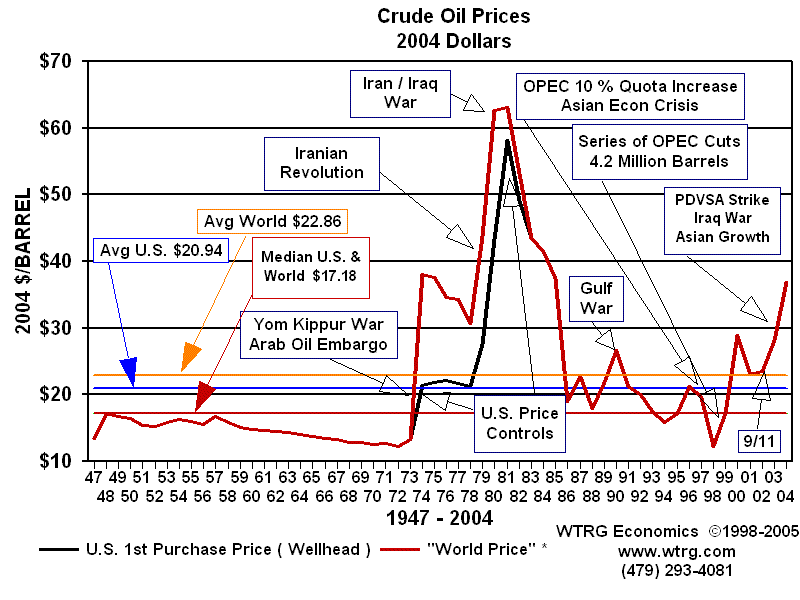
Rising prices undeniably add reserves. On a micro level, rising prices mean that a well that might be plugged making 5 barrels per day may produce profitably for several more years. Old abandoned wells may even be returned to production. A new prospect that is uneconomic at $40 per barrel may be drilled if prices reach $80.
At a macro level, higher prices extend the search for oil into areas that Hubbert never imagined. Hubbert’s original U.S. projection included no Arctic reserves, as Alaska was not a state when his forecast was made. I’m certain that Hubbert never envisioned drilling in offshore waters over a mile deep, or production from then-worthless shales like the Bakken of North Dakota.
One other point worth mentioning: Hubbert’s work was derived from the “hard-rock” mining industry, which searches for minerals such as gold, silver and platinum. A key difference between these precious metal resources and hydrocarbons. Au, Ag and Pt are elements; they occupy boxes on the Periodic Table.
Unlike elements, natural gas and oil can be created from other substances by alchemy (or, really, by chemical engineering). Gas and liquids can be manufactured from related compounds found in nature, such as coal, tar sands or kerogen. Economics also control the degree to which these technologies expand the effective oil and gas resource base.
Oil resources are not infinite, and it is unarguable that most of the easily accessed, conventionally producible oil has already been discovered. I agree with Yergin’s conclusion, that rather than “Peak Oil” we may be entering a period of “Plateau Oil”. Instead of a symmetric bell-shaped curve, we are on a limb of the curve that flatten or grow slowly for some time. Reserves will be added at the economic frontier, where the search for reserves is justified whenever the marginal cost of finding and developing is less than the current market price. Ultimately, if we let free market forces dictate, new technologies will replace hydrocarbons at such time as they achieve a lower price in the marketplace.
Or, in a more likely scenario, politicians will muck up the whole thing, thinking they will be the first beings in the history of the planet to outsmart the law of supply and demand.
81 Comments on "Hubbert’s Peak or Yergin’s Plateau?"
Apneaman on Wed, 20th Apr 2016 12:12 pm
I submitted a large sampling of planty’s comments to an online analytical tool.
She scored 99% on the moron scale.
Head of the class.
HARM on Wed, 20th Apr 2016 12:17 pm
Imagine if the time and energy here spent on trying to “prove” that condensate NGLs, tar sands and bitumen are not really “oil” (and name-calling when that fails) were redirected at producing better models that take UNCONVENTIONAL oil into account. Imagine new and better models that could accurately predict when the actual U.S. and global peaks may happen?
You could think of it as building on a brilliant man’s great legacy while acknowledging the limitations of that model –not as an insult to his memory or reputation. As many here have correctly pointed out, all models are mere abstractions/simplifications of reality, not reality itself. And no model ever gets everything right 100% of the time. Otherwise, we could all retire rich as professional oracles.
HARM on Wed, 20th Apr 2016 12:20 pm
Wait a sec… what happened to the previous 50 comments here?
HARM on Wed, 20th Apr 2016 12:28 pm
“She scored 99% on the moron scale.”
–> thank you for illustrating my point re: name-calling when empirical data proves your assertions are factually, provably wrong.
Apneaman on Wed, 20th Apr 2016 12:32 pm
What assertion is that, Beav?
I don’t recall making any assertion. You’ll have to show me the quote and prove me wrong.
marmico on Wed, 20th Apr 2016 12:46 pm
he {Hubbert] didn’t predict the peak of US oil production. He makes it very clear he’s predicting the peak production of the KNOWN (and rather mature) onshore oil trends
Bull shit.
1. Hubbert predicted URR for the continental shelf California, Texas, Louisiana.
2. Hubbert cited Rubel’s 1955 paper* that there were 2500 billion barrels shale URR in the U.S. but chose to ignore it.
*Rubel, A. C., 1955, Shale oil as a future energy resource: Mines Mag., Oct. 1955, p. 72-76.
HARM on Wed, 20th Apr 2016 12:51 pm
Since for some reason, Planter’s (and my) earlier comments have inexplicably disappeared from this thread, I’ll paraphrase what Planter said here:
Planter said that of course Hubbert was RIGHT on CONVENTIONAL oil, but WRONG on UNCONVENTIONAL OIL. Seriously underestimating the amount of unconventional oil that could be economically extracted undermined his model.
HARM on Wed, 20th Apr 2016 12:54 pm
@marmico,
Thanks for pointing that out, and for including the citation. It’s nice to debate data and not trade insults for a change.
Apneaman on Wed, 20th Apr 2016 1:04 pm
HARM, disappeared eh? If only I had a nickel for every time someone used that excuse with me.
HARM on Wed, 20th Apr 2016 1:04 pm
The folks here really need to get past the Denial, Bargaining and Depression phases and get to Acceptance re: peak oil.
Yes, FFs are finite resources and production cannot go on rising forever. No, Hubbert did not get the dates exactly right, mainly due to the fracking revolution and other sources of unconventional oil.
Anonymous on Wed, 20th Apr 2016 1:12 pm
LOL, except all that merikan ‘unconventional’ not-quite-oil is not being economically extracted at all. Its all being kept alive by the latest bubble to hit the uS, the fraking bubble. Financed by junk bonds, junk financing, and Wall St. economic voodoo. uS fraking\unconventional oil(aka strip mining for tar) is anything BUT economic.
But Ill let the PO.Com creationists and friends get back to hair-splitting and straining at gnats for the 10,000th+ time.
HARM on Wed, 20th Apr 2016 2:01 pm
@Anon,
You can decry “junk financing” all day long. At the end of the day, it does not change the reality of the situation: the U.S. has just reached or even exceeded its previous 1971 production peak, something most here had previously said was impossible. The global peak has also been pushed past all previous projections by at least a decade, possibly more.
If the billions that investors and central banks have poured into all that fracking, shale and tar sands turns out to be a colossal waste, then time will tell, won’t it? Still does not change the fact that “oil” has definitely NOT yet peaked and the old models that predicted otherwise are flawed and incomplete.
Apneaman on Wed, 20th Apr 2016 2:41 pm
HARM – 60. That’s the number of shale outfits that have filed for bankruptcy. So far. Oh and the CEO fracing posterboy offed himself because he couldn’t take the embarrassment that he was a criminal and a phoney. What are the chances that he/Chesapeake are the only ones? Asking for unreasonably amounts of evidence and proof. That’s a text book indicator one is dealing with a denier. Kinda like those climate deniers slogging around Houston today telling themselves and anyone who will listen that the record breaking rains are a one off, which is what they said two weeks ago and what they been saying after every one of the string of recent deluges before that.
Everything is just fine – Tell yourself.
Boat on Wed, 20th Apr 2016 3:14 pm
ape,
Lets talk about denial. Russia, Canada, Most of OPEC, all pumping at historical highs. A 1.5 mb/d glut. Brazil, Argentina, Mexico, Venezuela, Nigeria, Libya could all be pumping more oil cheaper than frackers. There are no depletion problems at this time. Deny that.
Apneaman on Wed, 20th Apr 2016 3:43 pm
Boat, so your main argument is based on what you personally believe, “Argentina, Mexico, Venezuela, Nigeria, Libya could all be” doing?
I “could” win the lottery tonight.
Shouldn’t you be helping the neighbours bail out their basements?
If the apes were at peak, would they be
A) At historical highs?
or
B) Below them?
peak1
pēk/Submit
noun
1.
the pointed top of a mountain.
“the snowy peaks rose against the blue of a cloudless sky”
synonyms: summit, top, crest, pinnacle, apex, crown, cap
“the peaks of the mountains”
verb
1.
reach a highest point, either of a specified value or at a specified time.
“its popularity peaked in the 1940s”
synonyms: reach its height, climax, reach a climax, come to a head
“conservative support has peaked”
adjective
1.
greatest; maximum.
“he did not expect to be anywhere near peak fitness until Christmas”
synonyms: maximum, top, greatest, highest; More
GregT on Wed, 20th Apr 2016 4:10 pm
“A million know it all parrots who have never even read the original works.”
No point in paying any attention at all to reality, when it is much more comforting to just make shit up.
For those of us who have read Hubbert’s paper, it is blatantly obvious as to who hasn’t.
Tom S on Wed, 20th Apr 2016 4:58 pm
Harm,
When you talk to Greg T or Apneaman, you’re dealing with true believers in a doomsday cult. They’ve watched prediction after prediction fail utterly, for well over a decade, but they’ve learned absolutely nothing. They don’t carry out any kind of critical thinking, ever. Don’t hold your breath.
GregT on Wed, 20th Apr 2016 5:01 pm
You don’t know shit about me TomS. Obviously.
Tom S on Wed, 20th Apr 2016 5:10 pm
Harm:
“Hubbert was right on conventional, but did not foresee the boom in unconventional causing a second peak in the U.S., and pushing out the global peak by decades.”
Unfortunately, Hubbert wasn’t right about conventional oil either. Granted, he correctly predicted the imminent peak of US oil back in 1970. However, his longer-term projections of US oil production were fairly far off. He definitely did not predict a 10+ year plateau for worldwide conventional oil–not at all. He was assuming an ultimate recovery of 1.2 trillion bbls, which was certainly far too low.
I don’t want to be too critical here, because Hubbert was clearly an extremely intelligent man. His estimates were as good as anyone’s. NOBODY had long-term projections of oil that were precisely correct. However I often hear remarks that Hubbert was “spot on” at least with regard to conventional oil, and that’s not true.
-Tom S
Tom S on Wed, 20th Apr 2016 5:13 pm
GregT,
Actually I was referring to Apneaman more than you.
-Tom S
Tom S on Wed, 20th Apr 2016 5:20 pm
Rock:
“He makes it very clear he’s predicting the peak production of the KNOWN (and rather mature) onshore oil trends.”
I agree with everything else you said, but on this point I definitely disagree with you. He was predicting all future conventional discoveries and extraction.
Hubbert was a very smart man. I don’t want to be too harsh. Nobody had precisely accurate long-term projections of oil production, and the IEA and EIA are no better in this regard. However what he said has been consistently too pessimistic in the long run.
-Tom S
Tom S on Wed, 20th Apr 2016 5:24 pm
Harm:
“Wait a sec… what happened to the previous 50 comments here?”
This site has a defective pagination system. It creates a new page of comments after 50 but has no “previous page” button. You can read the first page of comments using this url:
http://peakoil.com/geology/hubberts-peak-or-yergins-plateau-2/comment-page-1
Tom S on Wed, 20th Apr 2016 5:26 pm
GregT,
Perhaps I was too harsh. You obviously are capable of carrying out critical thought. However, you sometimes set a tone here which is uncivil.
-Tom S
Tom S on Wed, 20th Apr 2016 5:34 pm
Hello:
“No mathematical model of nature is 100% accurate. Maybe Hubert’s model is accurate enough? How accurate does it need to be?”
Hubbert’s model was excellent for its time. However, in the long run it has consistently erred in one direction and been too pessimistic. This implies that a better model is now possible.
Hubbert’s predictions are not an unbiased estimate of what will occur.
One problem with being too pessimistic is that your errors are exposed earlier than the optimistic people.
Apneaman on Wed, 20th Apr 2016 6:03 pm
Tom, want doomsday? Go to Houston. There’s your fossil fuelled future. Peak oil not needed ape doom is already in the pipe.
BTW anyone else visit your website or is it still just mom?
GregT on Wed, 20th Apr 2016 6:09 pm
“He was predicting all future conventional discoveries and extraction.”
This is not true TomS. I just finished typing out multiple quotes from his 1956 paper, and promptly lost them. I’m tired of continually doing this.
His report can be found here:
http://www.hubbertpeak.com/hubbert/1956/1956.pdf
Read it for yourself, and if you can find any references to your above falsehoods, please by all means knock yourself out and type them out for yourself.
If you aren’t willing to read the report, than stop spreading nonsense.
Apneaman on Wed, 20th Apr 2016 6:20 pm
Hooray for fracking and the cancer monkeys who love it!!! Killing your own children and grand kids, Hooray !! Another proud moment in American cancer – See Texas for the recent rewards produced by the cancer industry. Keep up the good work and maybe buy some life jackets in case your town is next.
U.S. Greenhouse Gas Emissions Climbed For the Second Straight Year
http://thinkprogress.org/climate/2016/04/19/3770317/greenhouse-emissions-higher/
makati1 on Wed, 20th Apr 2016 6:34 pm
The deniers are out in force on this one. LOL
Look at NET numbers. Not gross.
NET is dropping daily. Soon it will be zero when the energy to recover a barrel of oil, and get it to the consumer, is equal to the energy in that barrel of oil. Actually the wells will shut down before it gets anywhere near the 1:1 ratio and we are fast approaching that point. Maybe the supporting financial system will go first?
It’s fun watching the oily monkeys fighting over lies and red herrings put out by the oily cartel. $30. $40. $5. Who cares? The sooner it all ends, the better.
Pass the popcorn.
GregT on Wed, 20th Apr 2016 6:35 pm
Hubbert’s analysis was for “crude oil” only, using best available “estimates” extracted with “presently used technologies”.
He clearly differentiated between crude oil, and “liquid hydrocarbons” or “petroleum liquids”. He also clearly states that there may be as much as
2.5 trillion barrels of oil available from shale, which was also not included in his projections.
Tom S on Thu, 21st Apr 2016 2:24 am
GregT:
“Read it for yourself, and if you can find any references to your above falsehoods…
If you aren’t willing to read the report, than stop spreading nonsense.”
I’ve already read Hubbert’s papers. He’s clearly referring to all future discoveries. For example, after pp 22 of that report (pp 22 of the scanned document, not the PDF) there are several graphs with Hubbert curves. The right hand sides of the curves are labelled “FUTURE DISCOVERIES”. Similarly after pp 26, they’re labelled “future discoveries”.
When Hubbert refers to “ultimate” extraction of fossil fuels (on pp 27 and elsewhere) he means the TOTAL amount that will EVER be extracted. That’s what “ultimate” means in this context. He explictly did not include tar sands etc, but he WAS speculating what future discoveries and the resultant production would yield.
He spells this out more clearly in his 1982 paper, where he uses the technique subsequently referred to as “Hubbert Linearization” to anticipate future discoveries, and to estimate the URR.
…It wouldn’t have made any sense for him to speculate about future production from just reserves which were proved or probable already. That would have been completely uninteresting and would have offered no insight about when global oil production would peak or what oil production would look like decades in the future.
peakyeast on Thu, 21st Apr 2016 3:10 am
Hubbert also clearly writes that the numbers are very uncertain.