
Peak Oil is You

Donate Bitcoins ;-) or Paypal :-)


Page added on November 16, 2014

How Much Oil is Left?
How Much Oil is Left?
[This is a complex question, because the quality of the oil matters. We’ve gotten the good stuff, the light, easy oil. Much of the remaining oil is deep, nasty-gunky stuff, in arctic and other remote areas, and will take a lot more energy to produce and refine]
Ron Patterson. July 14, 2014. World Crude Oil Production by Geographical Area. Peakoilbarrel.com
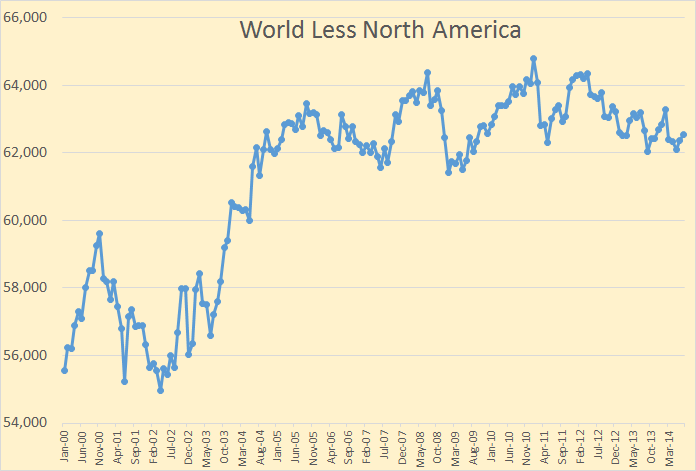
Check out the graph “World Less North America” at Peak Oil Barrel which shows world oil production minus North American production is down by 2 million barrels. Are we starting to see the petticoats of the net energy cliff? As David Hughes wrote in Drilling Deeper. A reality check on U.S. government forecasts for a lasting tight oil & Shale gas boom, both peak tight (fracked) oil and gas are likely to happen before 2020 in North America. Powers has also documented this in great detail in his book “Cold, Hungry and in the Dark: Exploding the Natural Gas Supply Myth” and Arthur Berman discusses peaking oil and gas in the November 12, 2014 James Howard Kunstler podcast #260).
The latest estimate of oil production from ASPO: June 2014 The Oil Production Story: Pre- and Post Peak Nations
In reviewing BP’s latest stats, the “Top 10″ nations still dominate the realm of oil, producing 66% of the world total. Our summary table highlights two important pieces of the oil production story:
1) Nations that are past peak (see “Peak Year,” highlighted in turquoise )–because of geologic limits (e.g., Norway, the United Kingdom) or for above-ground reasons;
2) Nations that have yet to clearly peak.
It appears that about half of the Top 20 nations have seen their all-time highs in production. In a number of others, production is currently increasing, with America the record-setting poster child. Yet during 2013, only four nations increased by over 100,000 barrels/day-year vs. 15 in 2004, while four nations experienced declines of roughly 100,000 b/d-year vs. three in 2004. And most importantly, Russia and China are likely near peak production.
Robert Rapier. Jun 25, 2012. How Much Oil Does the World Produce?
Cornucopians keep coming up with rosy predictions. This article: Don’t worry, be happy, there’s plenty of oil, natural gas, & coal left has a list of articles that rebut their arguments, good summaries of how much oil is left and why peak oil is nearly upon us.
Finding More Oil
Deffeyes dismisses proposals to simply explore more or drill deeper. Oil was created by specific circumstances, and there just isn’t that much of it. First there had to be, in the dinosaur era, a shallow part of the sea where oxygen was low and prehistoric dead fish and fish poop could not completely decompose. Then the organic matter had to “cook” for 100 million years at the right depth, with the right temperature to break down the hydrocarbons into liquid without breaking them too far into natural gas. Almost all oil, he said, comes from between the hot-coffee warmth of 7,000 feet down and the turkey-basting scald of 15,000 feet down – a thin layer under the surface, and then only in limited areas. We could drill the deepest oil, he said, back in the 1940s.
“More than 70% of remaining oil reserves are in five countries in the Middle East: Iran, Iraq, Kuwait, Saudi Arabia, Oman,” said Dean Abrahamson, professor emeritus of environment and energy policy at the University of Minnesota. “The expectation is that, within the next 10 years, the world will become almost completely dependent on those countries.”
“In 2000, there were 16 discoveries of oil ‘mega-fields,’” Aaron Naparstek noted in the New York Press earlier this year. “In 2001, we found 8, and in 2002 only 3 such discoveries were made. Today, we consume about 6 barrels of oil for every 1 new barrel discovered.”
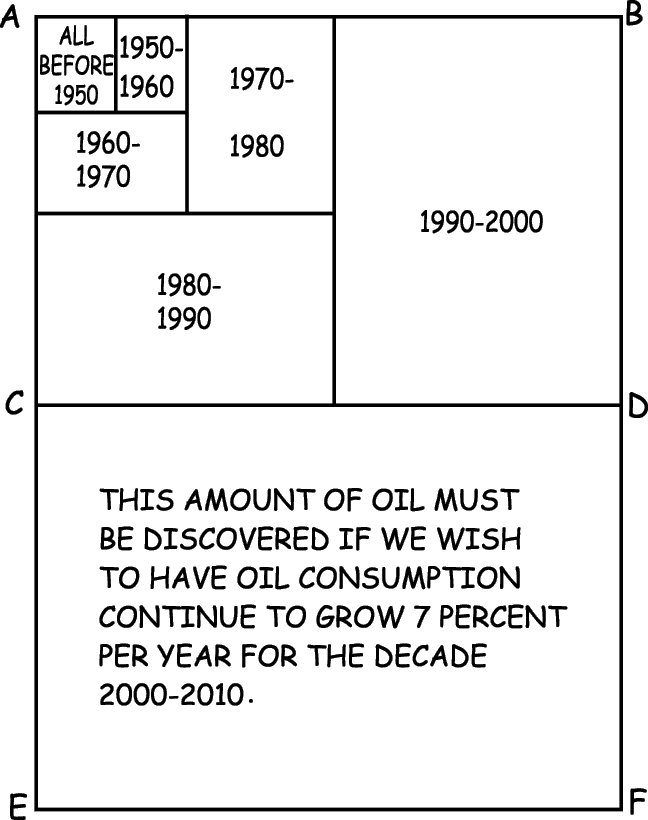
The Power of Exponential Growth: Every ten years we have burned more oil than all previous decades
Study this picture. It is why we are going to hit a brick wall, also known as the “net energy cliff”:
71 Comments on "How Much Oil is Left?"
Speculawyer on Sun, 16th Nov 2014 7:23 pm
Well, we stopped growing consumption at 7% and hence that diagram is not accurate.
But we have more work to do. I look forward to the day that we no longer need oil for our cars because electric cars are cheaper (TOC), easier, and more convenient. The oil can be used just for things like aviation and heavy long-distance hauling where you need the energy density of liquid fuels.
Makati1 on Sun, 16th Nov 2014 7:30 pm
How much? More than we will ever recover, for financial reasons, not from lack of oil in the ground.
JuanP on Sun, 16th Nov 2014 7:40 pm
This article is an editing mess. The writer needs to take ENC101 and ENC102. No beginning, no end, and a jumble of disconnected reprints in the middle. I teach people how to write and reading stuff like this is a painful experience.
JuanP on Sun, 16th Nov 2014 7:41 pm
Specu, Do you really believe in electric cars or was that a joke?
Makati1 on Sun, 16th Nov 2014 7:43 pm
Spec, you are one of the dreamers that seem to believe that electric cars are going to be the future. With over 1,000,000,000+ gas/diesel cars now on the road, all over the world, and an average replacement rate of 10+ years, how long would it take? Past the Age of Petroleum for sure and will never be more than a single digit percentage of the total cars on the road.
The average wage of the Western employed is dropping. Most, even now, cannot afford a new car. Especially one that exceeds $30K plus: taxes, insurance, inspections, interest on the loan, maintenance and fuel. You need a $60K++ annual income to afford that option. US median gross income in 2013 was $52,250.
The days of an electric car future were killed early in the last century by the oil companies. Not going to happen beyond a few million at best and then only the wealthy or the pretend wealthy. Sub-prime loans anyone?
Davy on Sun, 16th Nov 2014 8:23 pm
Speck:
Any Version of “Business As Usual” is Not Tenable
http://www.humanitystest.com/endless-layers-of-delusion/
Electric Cars Will Save Us?
About a third of the global energy supply is provided by the extraction of oil and is predominantly used in internal combustion engines to drive cars, trucks, trains, and ships. There are currently more than one billion cars in the world, with only a tiny proportion not relying upon the internal combustion engine, and the number of cars is expected to roughly double by 2020. Although there has been some reduction in miles driven in the more affluent nations, this is being more than offset by growth within developing countries such as China and India, with China already having a higher number of car sales than the United States[97]. Global car production is expected to reach 85 million in 2014, of which about 400,000 will be plug-in hybrid or fully electric vehicles, and will be above
100 million by 2018[98]. The sheer scale of the challenge to replace a significant number of gasoline-powered cars with electric ones is shown by these figures. Even if all new car production was of electric cars from 2020 onwards, it would require two decades to replace the current fleet of gasoline-powered cars. That is, of course, not taking into account ongoing growth in the number of cars, which would take up a significant amount of new car production.
Whether or not electric cars help reduce carbon dioxide emissions depends upon how the electricity that they use is generated. If it is generated predominantly with fossil fuels then an electric car could be better referred to as a fossil fuel car, the only difference being that the fossil fuels are not directly incinerated by the car, but rather in far away power stations. As the Union of Concerned Scientists states, the “electric vehicle fleet will only be as clean and sustainable as the power grid it ultimately plugs into”, and they estimate that the average current mid-size electric cars would have the same emissions as a 30 miles per gallon gasoline powered car (their estimate for natural gas is 54 mpg, but that does not take into account methane leaks which offset much, if not all, of the difference between natural gas and coal)[99]. The widespread usage of electric cars will increase electricity demand, and given the inability of renewable energy to replace fossil fuels in electricity generation by 2035, the additional electricity will have to be supplied by coal and natural gas.
dashster on Sun, 16th Nov 2014 8:37 pm
“With over 1,000,000,000+ gas/diesel cars now on the road, all over the world, and an average replacement rate of 10+ years, how long would it take? ”
What is your exact replacement rate? Let’s say it is 15. Then it would take 15 years to replace most cars if people started buying electrics exclusively on day 1. The auto industry is not prepared to produce that amount of electrics. Time wise, they could probably change over in 10 years from mostly gas to mostly electric. But it would be a huge investment that would probably need a longer time frame. But even then, I think it would happen before The Age of Petroleum ended.
At 90% production factor electric cars would get a lot cheaper – assuming that there is enough material to make all those batteries (I think I read once they cannot be recycled), and that might not be a valid assumption.
Beyond production, you have the issue of powering them. Peak Coal and Peak Natural Gas are coming and there probably isn’t enough of either to power a nation of electric cars.
Norm on Sun, 16th Nov 2014 9:15 pm
Dont’ matter how much left in the ground… what matter is how quickly you can extract it. That is why there is a Bell Curve due to increasing difficulty extracting it. At the very end there will still be oil in the ground but EROEI is too high (energy returned on the energy invested). Its Peak Oil 101.
AND if you magically speed up the extraction rate, you only INCREASE the Armageddon coefficient when it runs out it will run out even faster because you sped up the process. Like accelerating the greyhound bus up to 120 mph, before you drive it into the wall.
Ohhh but the TV Preacher-man said that God and the Republican party is firmly in control and we are Saudi America. OK I feel better now that I sent his 1-800 operators a couple hundred bux.
keith on Sun, 16th Nov 2014 9:34 pm
I keep seeing peak this and peak that: water, soil, turkey, chocolate, demand, etc, etc. Aren’t all these things just symptoms, while very little is discussed about the cause– peak population.
Norm on Sun, 16th Nov 2014 9:45 pm
What about Peak Corruption …
Could be at an all time maximum.
I heard the last recession was so bad, Exxon had to lay off 2 senators.
:o)
Speculawyer on Sun, 16th Nov 2014 10:06 pm
Oh jeez . . . a bunch of doomers. Never mind that you can buy an EV today for around $28K and that is before any subsidy. There is a $7500 tax-credit plus many state credits. Lots of $199/month leases available.
I shopped around and picked up an EV for less than $20K after incentives. I then self-installed a solar PV system for $13K (before incentives). I haven’t paid for electricity or gasoline for over a year now.
But if you are a bunch of “Can’t do” doomers then just sit back and moan. I’m a “can do” type that took matters into my own hands such that I won’t be paying for gasoline or electricity for many years to come.
Poordogabone on Sun, 16th Nov 2014 10:40 pm
“Check out the graph “World Less North America” at Peak Oil Barrel which shows world oil production minus North American production is down by 2 million barrels. Are we starting to see the petticoats of the net energy cliff? ”
The “net energy cliff” does not show up in graphs.
I yet have to see a (oil production) graph that subtract the oil used by the energy industry.
We can only guesstimate that number:
Say the present average oil well uses 1 barrel of oil to extract 15 and the world produces 75 MB of crude.
We are left with 70 MB to run BAU.
Dave Thompson on Sun, 16th Nov 2014 11:08 pm
The over looked problem of electric cars is that without oil input feedstock, electric cars can not be built, nor roads, and infrastructure to run them on.
Nony on Sun, 16th Nov 2014 11:40 pm
Juan: agreed. I may not agree with your politics or oil prognostication, but I agree your logic.
Others: I listened to the Berman podcast in the car. He seems tired. Blaming everything on finance. And not really having analysis. And Marcellus has kicked his butt more than expected.
Norm on Mon, 17th Nov 2014 12:00 am
I like Speculawyer comments. He did something important. However …
* The PV system only works in the correct climate. Can’t use in cold rainy northerly climates.
* The Electric Vehicle only works for shorter travels. It doesn’t work if you regularly drive 140 miles straight.
* It still cost a schmit-ton of money, didn’t he spend $20K + $13K PLUS a very large amount of self-install time for the PV system?
A lot of people can’t do that cause they are already trashed by the Ponzai-economy and they don’t have $33K and spare time for carpentry work.
Therefore, dooming and glooming is the better option, for some people who cannot do precisely what Speculawyer did.
toms2 on Mon, 17th Nov 2014 12:16 am
Where on earth did she get that graph? The one that shows oil consumption doubling every decade. That just doesn’t seem plausible to me at all.
World oil production hit a temporary peak of 61 mbpd in 1980 before declining slightly. If oil consumption were really growing at 7% per year then it would have hit 331 mbpd (!!) in 2005. In that case it would be 4 degrees warmer here already.
Just looking at the figures, it seems like oil production hit an inflection point around 1980 and then grew only gradually after that, and not exponentially.
-Tom S
marmico on Mon, 17th Nov 2014 4:10 am
it seems like oil production hit an inflection point around 1980
And so did U.S. petroleum consumption which was 34.2 quads in 1980 and 35.2 quads (a 3% increase) in 2013 during the time frame that U.S. real GDP rose by ~150%. The petroleum intensity of the economy has more than doubled since 1980.
Davy on Mon, 17th Nov 2014 6:08 am
Speck, good boy with the EV and the solar power system. I have a solar system on the farm and a small farm utility vehicle that is electric. It is a nice feeling to get transport from the sun. Solar transport really should be happening more often especially in the sweet spots where the sun shines bright and long.
Speck, I think you are missing the point us doomers are trying to relate. Our point is EV and all AltE are not a plan B. They are part of a possible plan B as a bridge energy source and a FF extender. One part of the many that are needed. The complexity and energy intensity of the production of the EV and the AltE power source are beyond what will be practical when complexity and energy intensity falls in a descent. IOW we must not be delusional about a EV/AltE future.
Yet, IMO, we need to build out as many as possible because they will have a niche. If we are lucky to end up in a salvage economy from a collapsing economy EV and AltE will have uses. We are currently top heavy with internal combustion we would be smart to increase EV/AltE as possible for smart economic applications.
Davy on Mon, 17th Nov 2014 6:16 am
Marm-a-stat said: And so did U.S. petroleum consumption which was 34.2 quads in 1980 and 35.2 quads (a 3% increase) in 2013 during the time frame that U.S. real GDP rose by ~150%. The petroleum intensity of the economy has more than doubled since 1980.
Marm, what a wowser. It is a wowser because you are comparing apples to the papayas I was collecting in the Bahamas yesterday. Since you are the marm-a-stat show the increase in the size of the parasitic FIRE sector of the economy. Let’s discuss the energy intensive industries that moved out of the US. Let’s discuss the relative size of the fed’s balance sheet. You really can’t use your 2 line stats to relate those two period’s energy consumption/utilization. We are in vastly different times.
Makati1 on Mon, 17th Nov 2014 6:26 am
Spec, good for you! But it was made with lots of oil, the replacement will need lots of oil to be manufactured. Ditto for solar. You are one of the Techie Dreamers that think everyone is you and has your resources.
Electric cars are a ‘dead man walking’. In a country that is drowning in every kind of debt possible, there will be fewer cars sold every year. Any kind if car. Fewer employed will be able to even buy fuel. That electric toy still needs oil and rubber and parts that require oil. Electrics are ‘wannabee’ toys, nothing more.
marmico on Mon, 17th Nov 2014 6:41 am
We are in vastly different times.
Of course, it’s called the post-industrial economy. Very few are like you Davy-boy, sleeping with your Oxen in the Ozarks praying that you get a seat in the Thunderdome. 🙂
You show me the petroleum Btu embedded in U.S. merchandise imports.
Davy on Mon, 17th Nov 2014 7:01 am
Marm, thanks for the mention of the oxen because I have been researching these for use someday.
Marm, we both know without doing a marm-a-stat search the inverted pyramid showing FIRE’s contribution to the US economy. Other services distort this even more. Services are far too high and distorts the actual productive part of US GDP and by extension the petroleum intensity of the economy. This is also global in nature and represents the wealth transfer mechanisms of the global 1%ers. It demonstrates how global FX flows are arbitraging the global productive economic base by nothing more than a skim. The big boys are taking scalps in a long story short. FIRE has turned parasitic not productive. I do not deny the efficiency increases seen in US merchandise exports. I am just doing a marm-a-stat wowser check on this:
The marm-a-stat wowser check item:
The petroleum intensity of the economy has more than doubled since 1980.
marmico on Mon, 17th Nov 2014 7:28 am
Services distort nothing. The economy is the aggregate of hundreds of billions of annual micro-decisions.
To give you a stat, FIRE has increased from 16% of U.S. GDP value added in 1980 to 20% in 2010. How can that possibly be a driver of flat petroleum consumption since 1980?
http://www.gpo.gov/fdsys/pkg/ERP-2012/pdf/ERP-2012-table12.pdf
Davy on Mon, 17th Nov 2014 8:15 am
That small increase is multiplied significantly by the size of the increase in the economy. Marm, add in a the governments increase in size. Much of that is parasitic. Marm we know heavy industry has had a migration out of the U.S. decreasing energy intensity and magnifying the appearance of efficiency increases. I still claim a wowser Marm-a-stat.
JuanP on Mon, 17th Nov 2014 9:13 am
Speculawyer, I greatly admire and respect your decision to invest in an electric car and PVs. I just don’t believe everyone in the world will be able to do it. You have an advantage going forward that will last you a while, and you deserve it for making smart purchases. I believe in solar energy at the individual level, but not at the global one.
shortonoil on Mon, 17th Nov 2014 9:27 am
[This is a complex question, because the quality of the oil matters. We’ve gotten the good stuff, the light, easy oil. Much of the remaining oil is deep, nasty-gunky stuff, in arctic and other remote areas, and will take a lot more energy to produce and refine]
We’ve been shouting this very point from the roof tops for the last two years!
How Much Oil is Left?
This question is, unfortunately, usually answered by quoting reserves, but reserves have the tendency to distort the situation. Reserves are calculated from that day’s price, and production cost. This is, in no way, an assurance that the calculated amount will be extracted. Production cost, and price change. Production cost are now going up (as they allows have) and price is going down. The total amount of petroleum that will be extracted will only be a part of the the present reserve number.
http://www.thehillsgroup.org/depletion2_022.htm
In 2000 (in the 2000 WEO) Campbell, and Leharrere estimated total extractable reserves at 1,800 Gb. This is very close to our estimate using the Etp model which gives 1,760 Gb. Recently when oil prices reached $100/barrel Leharrere revised his estimate to 2,500 Gb. It will be interesting to see, now that prices are contracting, if he revises that back to the original estimate. The use of energy dynamics to estimate reserves alleviates the production cost, price conundrum.
http://www.thehillsgroup.org/
meld on Mon, 17th Nov 2014 9:41 am
electric cars are a bad idea moving forwards. The grid is starting to fail here in the UK, another decade and I bet they are outlawed to keep the lights on.
Northwest Resident on Mon, 17th Nov 2014 9:45 am
How much rope is left?
Enough to hang ourselves with.
How much oil is left?
Enough to push us well into the extreme danger zone of CO2 atmospheric content. In other words, enough to hang ourselves with.
We can’t burn all the oil that we are capable of extracting. It would be suicidal.
dashster on Mon, 17th Nov 2014 9:51 am
“This question is, unfortunately, usually answered by quoting reserves, but reserves have the tendency to distort the situation. Reserves are calculated from that day’s price, and production cost. This is, in no way, an assurance that the calculated amount will be extracted. Production cost, and price change. Production cost are now going up (as they allows have) and price is going down. The total amount of petroleum that will be extracted will only be a part of the the present reserve number.”
That should only be a period of months, until the next reserve figure comes out, as any oil currently listed as a reserve that can no longer be produced economically at current prices should move from being a reserve to a resource. Each year on the date of the reserve amount being published it should be accurate. That may not be the case though, as I have a feeling companies are anxious to build their reserve totals and underestimate production costs and therefore economic viability.
Northwest Resident on Mon, 17th Nov 2014 10:35 am
What will Saudis do when the oil runs out?
“Early last week, an Arabic hashtag that translates to ‘Your job after oil runs out…’ begun to trend mostly in Saudi Arabia but also in neighbouring Kuwait. Citizens of these countries used it to make jokes, but there was also serious contemplation of a future without their once abundant oil wealth. Some Saudis contemplated returning to a simpler life style and perhaps becoming shepherds. Others were a bit more pessimistic about their nation’s future. “I’m unemployed and there are another million like me, so how much worse will it get when oil runs out?” one man commented on Twitter. Despite being the largest oil producer in the region, Saudi Arabia has had a longstanding issue with unemployment.”
http://www.bbc.com/news/blogs-trending-30047096
Speculawyer on Mon, 17th Nov 2014 10:42 am
Yes, EVs still require oil to build them. But remember, peak oil is not about running out of oil. We will continue having oil for hundreds of years. It is merely about the production rate peaking. We need to use the oil wisely where it is really needed (aviation, long-haul shipping, etc.) and not in places where it can easily be replaced by something cleaner and cheaper.
marmico on Mon, 17th Nov 2014 11:03 am
Marm, add in a the governments increase in size.
Government is the same size so it is not a driver of flat petroleum consumption. Next.
heavy industry has had a migration out of the U.S.
Quit blathering word salad and quantify it. Here’s the list. For instance, the U.S. is an importer of pharmaceutical preparations and cellphones to the tune of $150+ billion per year. How much embedded petroleum are in those two items?
Remember you add embedded petroleum in imports and subtract embedded petroleum in exports. Here’s a hint. Manufacturers don’t consume much petroleum. Transportation does.
shortonoil on Mon, 17th Nov 2014 11:20 am
That may not be the case though, as I have a feeling companies are anxious to build their reserve totals and underestimate production costs and therefore economic viability.
Do you mean like Saudi Arabia, who has been stating they have 270 Gb, and have been for the last 30 years. Shell, in 2004, had to cut their reserves by about 30% when it became public knowledge that they were fudging their books. The actual amount of oil that will be extracted is only a fraction of what is publicly stated by the reserve holders. 900 Gb in the Bakken, RIGHT!
The interesting part is that people who should know better, never say anything. Like the shale industries claim that the OOIP of the Bakken is 900 Gb. To have an OOIP of 900 Gb the Bakken would have to have a porosity of 47%. The last time I saw a substance with a porosity of 47% was at Walmart; it’s called a sponge. Yet the Internet is flooded with such claims, and all the people who call themselves geologist, petro-engineers, and assorted experts never mention it. If one believed all the assorted claims on reserves they would have one leg three times longer than their body.
shortonoil on Mon, 17th Nov 2014 11:27 am
For instance, the U.S. is an importer of pharmaceutical preparations and cellphones to the tune of $150+ billion per year. How much embedded petroleum are in those two items?
In 2014 – 610,000 barrels.
louis wu on Mon, 17th Nov 2014 11:33 am
To Speculawyer, even if the EV is powered entirely by wind, solar and/or hydro what about the roads you would be driving it on?What about the power distribution infrastructure?That would still require a whole hell of a lot of fossil fuel to power the type of vehicles needed to build and maintain it.Are you thinking something very much like what we have right now just with EV’s and AltE power sources?Would you agree that in the long run it would be much better to just scale back out entire civilization so that very little type of travel would even be needed?
marmico on Mon, 17th Nov 2014 11:40 am
In 2014 – 610,000 barrels.
Citation.
kenberthiaume on Mon, 17th Nov 2014 12:03 pm
Trillions of barrels left. But how will we maintain ROADS!? You can’t build a road with vehicles running on sunshine?
Everything peak oilers said has been wrong so far. 10 years ago the world was supposed to have been Mad Max by now.
turningpoint on Mon, 17th Nov 2014 12:08 pm
Speculawyer, do you understand that electricity is not a primary source of energy? It’s not a simple matter of just plugging it in. Electricity must be generated, and it’s usually generated in mass quanities by burning either coal or natural gas.
The amount of electricity generated equals the amount of electricity being consumed. Electric cars would mean we’d need to ramp up electricity generation significantly to meet an increase in demand.
Electricity does not really solve any problems anymore than hydrogen because they are enegy carriers not primary sources of energy.
Northwest Resident on Mon, 17th Nov 2014 12:12 pm
kenberthiaume — I’m sure you’ll agree with this article by Motley Fool, advising people that despite plunging oil price, Oil Stocks are still a fine and wealth-guaranteeing investment for those investors who stay invested long term.
In other words, just because fracking companies are going down hard due to lack of demand and associated price for oil, Motely Fool is saying just keep your money invested in those fracking companies — play it smart!
You agree, I’m sure?
“The reality is that you don’t need to work that hard to be a successful investor, no matter if it’s oil stocks or any other type of investment. Leave all the oil price speculation to the day traders and the people who want to show that they are the smartest ones in the room by making oil price prognostications. You just sit back and enjoy the riches provided to you from investing in great companies over the long term.”
http://www.fool.com/investing/general/2014/11/17/oil-stocks-the-dumbest-thing-you-can-do-investing.aspx
Perk Earl on Mon, 17th Nov 2014 12:15 pm
http://www.washingtonpost.com/world/japans-economy-tips-back-into-recession-in-another-blow-for-abe/2014/11/16/9a8f2e94-8c9c-44cf-a5e8-b57a470fd61f_story.html
Japan’s economy tips back into recession, in another blow for Abe
TOKYO — Japan has officially tipped back into recession, with new figures Monday showing that the world’s third-largest economy shrank for the second quarter in a row as consumers kept their yen in their pockets.
“The numbers are absolutely awful, beyond-description awful,” said Peter Tasker, a longtime analyst of Japan’s economy and a strong supporter of Abe’s economic policies. “It’s clear that the tax hikers and the fiscal hawks have tanked the economy.”
The cabinet office said Monday that the economy had shrunk by 1.6 percent in the three months to the end of September, compared with a year earlier. Economists had been expecting the statistics to show that the economy had grown by 2 percent in the quarter, according to surveys.
But the bad news didn’t end there. The official figures for the previous three months were revised to show that the economy shrank by 7.3 percent in the second quarter compared with the same period a year earlier, worse than previously thought.”
The title of this peak oil dot com article is; How much oil is left, but maybe what it should be asking is; How much oil is left that is economically producible? Just because it’s in the ground and we know it’s there doesn’t mean it can be used.
Japan which imports FF has been on the slide down for many years now and is really starting to tank. I actually think they should be surprised and grateful that the 3rd qtr. came in at -1.6%, when the 2nd qtr. was revised to -7.3%.
Japan is now officially in a recession with two consecutive qtr.’s with contraction. The EU last qtr. I think came in at +.01 or .02, just barely growth, and that’s with some countries now including estimated prostitution and illegal street drug sales included in GDP.
The world economy is flattening out, meaning the net energy available from oil is no longer driving growth, and that’s even with huge stimulus being thrown into the system that is unsustainable. As this dynamic continues we will increasingly be separated from oil sources.
Congrats by the way to Seculawyer for your self contained energy system. A lot of people cannot afford to do the same, but anyway a whole year without paying for E or fuel sure sounds nice. Our business requires occasional drives that exceeds the distance available on an EV, but when we have some extra funds we’ll start with some solar arrays. I’m thinking of getting two 14′ x 8′ standing units that auto angle/rotate to the Sun, with room to add a 3rd one later if needed. But I need to research it much more to know what will be best.
kenberthiaume on Mon, 17th Nov 2014 12:30 pm
Northwest resident, no I wouldn’t necessarily agree with that article.
I would think YOU would as since the world is running out of oil very quickly then prices should skyrocket soon. And the current downturn is temporary.
What’s your point exactly? Say your point instead of being smug and smarmy.
kenberthiaume on Mon, 17th Nov 2014 12:38 pm
And it’s not “lack of demand” for oil. The supplies have risen. Which wasn’t supposed to be possible, you know, cause we’re “post peak”.
So peak oil causes high oil prices which cause low demand and results in lower oil prices…but since the economy broke due to high oil prices no one wants oil anymore! They won’t be able to give it away. I’m sure you’d agree with that right?
Low oil prices are further proof of peak oil. As are high oil prices and constant oil prices.
Northwest Resident on Mon, 17th Nov 2014 12:52 pm
kenberthiaume — I was indeed being ingratiating and wheedling in a way that you correctly perceived as insincere or excessive. I’ve never seen you post on this forum before, and I was probing you to get a reading on your intelligence level. Having done that, you seem intelligent enough, and I like your fighting spirit — nice come-back. However, I find your total lack of understanding of Peak Oil Dynamics to be a cause for real alarm — not for me, but for you. By the way, coming onto a peak oil board and writing “Everything peak oilers said has been wrong so far” is not only so far from correct as to prove yourself to be absolutely clueless, but might also be perceived as overly confrontational and a little on the smarmy side, which in some cases, you might expect to illicit an equally smarmy response.
marmico on Mon, 17th Nov 2014 12:57 pm
The marm-a-stat wowser check item:
The petroleum intensity of the economy has more than doubled since 1980.
Oops. I missed you correctly pointing out my boo boo, Davy-boy. The sentence should read:
The petroleum intensity of the economy has more than doubledstrikeout halved since 1980. But you got the point anyway.
So how much was the fillup for jet fuel?
marmico on Mon, 17th Nov 2014 1:01 pm
Oh, Ken. Don’t worry about NWR. He is always stoned on his latest heirloom weed. 🙂
Northwest Resident on Mon, 17th Nov 2014 1:08 pm
kenberthiaume — If you do respond, please explain your “Trillions of barrels left” comment. In your opinion, is there a difference between the amount of oil trapped in rock deep below the planet’s surface and the amount of that oil that we’ll actually be able to get out of the ground and delivered to market?
marmico on Mon, 17th Nov 2014 1:17 pm
please explain your “Trillions of barrels left”
All the heavyweights in the “peak oil” business (Hubbert, Deffeyes, Laherrere, Campbell, etc.) figure that there is ~3 trillion recoverable, of which ~1.5 trillion have been recovered.
Methane hydrates, man. Burn, burn, burn.
sunweb on Mon, 17th Nov 2014 1:39 pm
spec – I have posted this before however I do have a new essay too. Solar and wind capturing devices are not alternative energy sources. For the physical devices – for wind, photovoltaices, solar hot water, hot air panels – the sun and wind are there, are green, are sustained. The devices that are used to capture the sun and wind’s energy are an extension of the fossil fuel supply system.
There is a massive infrastructure of mining, processing, manufacturing, fabricating, installation, transportation and the associated environmental assaults. There would be no sun or wind capturing devices with out this infrastructure. This infrastructure is not green, sustainable, or renewable. The making of these devices inadvertently but directly supports fracking, tar sands and deep ocean drilling because of the need for this infrastructure.
http://sunweber.blogspot.com/2011/12/machines-making-machines-making.html
http://sunweber.blogspot.com/2014/11/prove-this-wrong.html
I know you don’t want to believe this.
kenberthiaume on Mon, 17th Nov 2014 2:05 pm
I don’t really know how much is left. It probably doesn’t matter that much. As it runs out the price goes up and substitutes get made. Or maybe we’ll be permanently poorer…to some degree at least for a while.
In the 1970s I read that “economists agree that oil will go up 15%-20% a year forever and that by 2000 there will be no oil left.”
It’s an old story. Mankind has an inclination to forecast doom. It’s kind of a cult.
GregT on Mon, 17th Nov 2014 2:17 pm
” As it runs out the price goes up and substitutes get made.”
As NWR pointed out above, a total lack of understanding of Peak Oil Dynamics. You are oversimplifying a very complex subject.