
Peak Oil is You

Donate Bitcoins ;-) or Paypal :-)


Page added on October 17, 2014

Predictions Of ‘Peak Oil’ Production Prove Slippery

The dustiest portion of my home library includes the 1980s books — about how Japan’s economy would dominate the world.
And then there are the 1990s books — about how the Y2K computer glitch would end the modern era.
Go up one more shelf for the late 2000s books — about oil “peaking.” The authors claimed global oil production was reaching a peak and would soon decline, causing economic chaos.
The titles include Peak Oil and the Second Great Depression, Peak Oil Survival and When Oil Peaked.
When those books were written, worldwide oil drillers were producing about 85 million barrels a day. Now they are pumping about 93 million barrels.
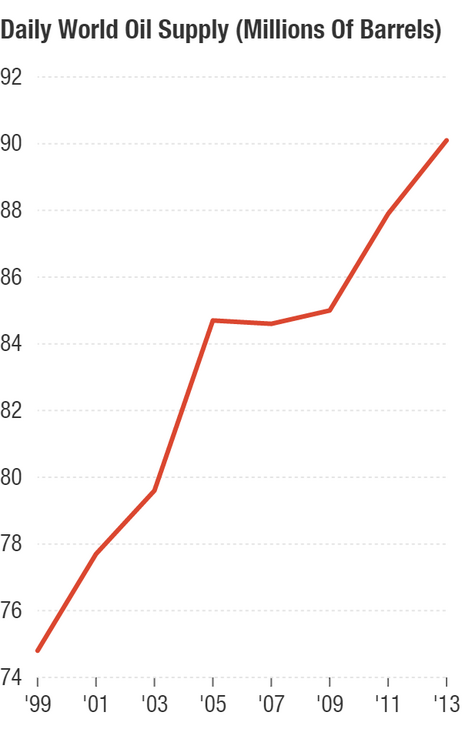
NPR/U.S. Energy Information Adminstration
Despite growing violence in the Middle East, oil supplies just keep rising.
At the same time, demand has been shrinking. This week, the International Energy Agency cut its forecast for oil-demand growth for this year and next.
Turns out, oil demand — not production — is what peaked.
Now prices are plunging, down around 25 percent since June.
What did the forecasters get so wrong? In large measure, their mistake was in failing to appreciate the impact of a relatively new technology, hydraulic fracturing, or fracking.
Because of fracking, oil is being extracted from shale formations in Texas and North Dakota. Production has shot up so quickly in those areas that the United States is now the world’s largest source of oil and natural gas liquids, overtaking Saudi Arabia and Russia.
This new competition has shocked OPEC. Members say they want to maintain their current market share, so they are keeping up production and even boosting it.
Bottom line: The peak of production is nowhere on the horizon.
So are the authors of “peaking” books now slapping themselves in the head and admitting they had it all wrong?
Some are, at least a bit.
Energy analyst Chris Nelder wrote a book in 2008 titled Profit from the Peak. The cover’s inside flap said: “There is no doubt that oil production will peak, if it hasn’t already, and that all other fossil fuels will peak soon after.”
In a phone discussion about his prediction, Nelder said “my expectation has not materialized.”
The surge in oil production in Texas and North Dakota “has really surprised everyone,” he said. “If you had told me five years ago we’d be producing more oil today, I would have said, ‘No way.’ I did not believe at all that this would happen.”
But while he acknowledges that oil has not peaked yet, he says it might soon because “oil is trapped on a narrow ledge” where it must stand on stable prices. Holding the price of a barrel steady around $110 for years allows energy companies to invest in fracking operations.
Over the past three years, those are exactly the conditions drillers have enjoyed. Oil was sitting pretty on a stable plateau of roughly $110 a barrel. But now, as global growth slows, the price is plunging, down to around $83 per barrel.
“China is cooling off quite a bit. Much of Europe is slipping back towards recession,” Nelder said. If oil prices stay low for long, frackers may need to stand down. “There is a lower level [in price] where they just can’t make money,” he said.
And with OPEC pumping so much oil now to hold down prices, maybe they are using up their supplies more quickly. “Depletion never sleeps,” he said.
So perhaps Nelder has been wrong so far, but could be right before too long.
That’s what Kenneth Worth thinks. He’s the author of Peak Oil and the Second Great Depression, a 2010 book. He says the fracking boom has been so frenzied in this decade that drillers may have extracted the cheapest oil already. With fracking, oil supplies “deplete very rapidly. You have to keep drilling really fast,” he said.
With prices now so low, the money to keep up the frenzy may not be there.
So maybe the “peaking” predictions weren’t wrong, just premature. Then again, at some point, any forecast can turn out to be right, he says. “If you take enough of a timeline, eventually we’re all dead,” Worth noted.
58 Comments on "Predictions Of ‘Peak Oil’ Production Prove Slippery"
Plantagenet on Fri, 17th Oct 2014 11:21 am
Eventually we’ll hit peak oil, but because of fracking world oil production is still growing.
louis wu on Fri, 17th Oct 2014 11:33 am
“This new competition has shocked OPEC. Members say they want to maintain their current market share, so they are keeping up production and even boosting it.”
My understanding is that very little of the oil extracted in the US is sold on world markets, and even if we sold all that we extracted how much would it be anyway, so how much can it really cut into OPEC’s market share?And wouldn’t it still make sense for OPEC to get the highest price possible? And since NPR is supposed so balanced how about we see some articles covering how the predictions of the peak oil deniers and naysayers such as Michael Lynch and Daniel Yergin have turned out.
Plantagenet on Fri, 17th Oct 2014 11:36 am
The US doesn’t have to export oil to affect OPEC and the global price of oil. Increasing US oil production has reduced US IMPORTS by 3 million bbls/day—this means there are 3 million additional bbls/day available for sale on the global markets—-hence the collapse in the oil price.
louis wu on Fri, 17th Oct 2014 11:37 am
“Eventually we’ll hit peak oil, but because of fracking world oil production is still growing.”
As rockman always happily points out the high prices is why the fracking is occuring.Without those high prices it stops and how long can it stop before any of the companies doing it simply won’t be able to restart?
yellowcanoe on Fri, 17th Oct 2014 11:46 am
I’m sure his diagram is misleading because despite the title it is actually showing production of condensates as well as crude oil. Stuff like propane and butane that has a lower energy content than crude oil and that can’t be refined into primary fuels we require for transportation (gasoline, diesel and jet fuel).
Plantagenet on Fri, 17th Oct 2014 11:48 am
Good question, lou. Thats exactly why the Saudis are pushing down oil prices and what they are hoping for.
HARM on Fri, 17th Oct 2014 11:58 am
In summary: Take THAT, doomers!
Northwest Resident on Fri, 17th Oct 2014 11:59 am
World “barrel count” may be growing due to fracking, but world energy growth is most definitely not growing due to fracking. What do you want, more barrels of oil, or more energy? The correlation between the two is not what it used to be. Also, with growing barrel count from fracking, you also get exponentially growing debt — without that debt there would be no fracking.
shortonoil on Fri, 17th Oct 2014 12:22 pm
Just a couple of graphs that indicate what is being pumped out of those ND cornfields, and WV mountains:
http://www.nrcan.gc.ca/sites/www.nrcan.gc.ca/files/energy/images/eneene/sources/petpet/images/refraf1-lrgr-eng.png
http://www.thehillsgroup.org/depletion2_011.htm
There might be enough energy in “that there stuff” to get your Honda Civic to a gas station. Of course if you want to stop a MiciDies for a burger, you better plan on walking home.
http://www.thehillsgroup.org/
Plantagenet on Fri, 17th Oct 2014 12:35 pm
@short on oil
Your plots are very interesting. I note that in the plot of refinery yields you show that condensates have a HIGHER gasoline yield than other kinds of oil—according to your plot over 70% of condensate can be refined into gasoline
http://www.nrcan.gc.ca/sites/www.nrcan.gc.ca/files/energy/images/eneene/sources/petpet/images/refraf1-lrgr-eng.png
Is this correct? A number of people posting here have suggested that the gasoline yield from condensates is very low—the exact opposite of what your plot shows.
Which is it? Is your plot accurate?
westexas on Fri, 17th Oct 2014 1:54 pm
Plant,
I think that you are confusing gasoline and distillates. Condensate is basically natural gasoline, so the gasoline yield will be quite high.
In any case, the plot shows, for the two lightest grades, 39 API Gravity and 42 API Gravity crude oil (which they describe as condensate for the 42 value). Most people put the condensate/crude dividing line between 45 and 50 API gravity.
Andrew on Fri, 17th Oct 2014 2:14 pm
those books now…….I’m sure I remember the subject of “global warming” coming up a few times
tahoe1780 on Fri, 17th Oct 2014 2:24 pm
https://rbnenergy.com/dont-let-your-crude-oil-grow-up-to-be-condensate
and when things get bad, you change the definitions
http://www.eia.gov/petroleum/workshop/ngl/pdf/definitions061413.pdf
Plantagenet on Fri, 17th Oct 2014 2:25 pm
Hi westexas.
Distillates aren’t the issue here.
Gasoline and distillates and condensates are all quite separate things—here I’ll explain it to you. Condensates are liquids obtained from condensing gas, Distillates are liquids condensed from gas during distillation, and gasoline is a fuel produced by refining. But thats not the main issue here.
Shortonoil’s bar chart of products from various sources shows condensate yielding over 70% gasoline, just as I’ve maintained in other posts at this site. However, some posters here claim that condensates obtained by fracking aren’t good sources of “energy”—for instance, see NWR’s post above. The data contradicts that—condensates are actually better than most crude oil, as shown by the fact that 70% of the material can be used for gasoline. That means a HIGHER PERCENTAGE of gasoline is obtained from condensates then is obtained from crude oil.
Plantagenet on Fri, 17th Oct 2014 2:34 pm
Hi TAHOE:
Thank you for posting the link to the EIA site where the official US government definition of oil is changed to include condensates.
This change resulted in a significant “boost” to US oil production, as the US government now counts all the condensate being produced from the Eagle Ford, Bakken, etc. as oil.
rockman on Fri, 17th Oct 2014 2:39 pm
“…their mistake was in failing to appreciate the impact of a relatively new technology, hydraulic fracturing, or fracking.” As Louis points out another uneducated person or a liar.
Well done, Grasshopper. LOL.
And again a misdirection focusing on dates instead of the actual critical factors that shorty and wt are always prepared to hammer home. Sadly I think some in our band of brothers grossly estimate how well the truth is getting out there. I suspect most of us don’t spend much time focusing on the crap the MSM puts out. But the reality is they are the source of what probably 99% of the public absorbs on the subject.
westexas on Fri, 17th Oct 2014 2:41 pm
Plant,
The energy content of a barrel of distillate is higher than a barrel of gasoline.
My point is that actual global crude oil production (45 and lower API gravity crude oil) probably peaked in 2005, while global natural gas production and associated liquids, condensate and NGL, have so far continued to increase.
westexas on Fri, 17th Oct 2014 2:46 pm
Some BTU values:
Gasoline 5.0 MMBTU per barrel
Distillate fuel oil: 5.8 MMBTU per barrel
Crude oil: 5.9 to 6.0 MMBTU per barrel
http://www.eia.gov/forecasts/aeo/pdf/appg.pdf
I remain puzzled that you seem to be surprised that condensate, basically natural gasoline, has a high gasoline yield.
Northwest Resident on Fri, 17th Oct 2014 2:48 pm
Plant — I don’t know enough and am not interested in knowing enough to make a technical claim like “condensates obtained by fracking aren’t good sources of “energy”. Once again, as you repeatedly do whenever it suits you, you are making what amounts to a false accusation — putting words into my mouth, falsely quoting — whatever you want to call it. Basically, twisting reality into a false proposition to suit your immediate ends.
Either you’re a paid troll dedicated to doing just that — using Karl Rove inspired techniques — or you’re doing it without knowing what you’re doing. Either way, you are one messed up dude.
I used to *think* that the various liquids extracted via shale were “crap” — and in many cases that is true, depends on the site being fracked. But rockman set me straight on that misperception a while back.
But, what we can say without any doubt, is that to get that barrel of “fine, high quality 70-percent-gasoline-yielding” liquid out of the ground requires a VAST amount of energy — manpower, equipment, oil, infrastructure and more — and so in the end, no matter how high-energy that barrel of best quality possible fracked liquid is, we still end up with a very insignificant energy gain (if any) on an industry-wide average.
Which explains the astronomical debt accumulated by fracking companies, and explains why their bonds are junk, and explains why they need constant investment (suckers) to keep operations going, and explains why they can’t turn a damn profit, and explains so much about why investors are bailing on fracking companies and why fracking, as an industry, is totally doomed — with perhaps a few minor insignificant exceptions.
But keep doing that fracking cheerleading routine, Plant. Keep finding minor inconsequential points to nitpick on — you’re a slam dunk loser on all the big issues, so you might as well nibble and peck at whatever you can get. Pathetic.
Plantagenet on Fri, 17th Oct 2014 2:51 pm
Hi Westexas: You are exactly right that conventional oil peaked (actually hit a plateau) in 2005. However, as Tahoe pointed out above, the Obama administration subsequently changed the definition of oil to include condensates, so the condensates are now–ipso facto—also oil.
Northwest Resident on Fri, 17th Oct 2014 2:54 pm
” I suspect most of us don’t spend much time focusing on the crap the MSM puts out.”
Not me, rock! I scan those MSM articles daily, speed read right through them and take note of the trends and the lies and the bullshit with my cup of morning coffee.
It is amazing how much you can learn about REALITY by how much the MSM (and the powers behind the MSM) are lying to conceal those realities.
Like a policeman on some show I saw once was explaining that he gets more information from listening to a suspect lie to him than he could ever get if the suspect were to attempt to tell the truth.
But your point is valid. 99% or more of “the herd” suck up the MSM and MSM-like “alternate” news sources like momma’s milk. And TPTB know that’s what they’re going to do, which is why they BRAZENLY lie — because they KNOW they can get away with it.
Damn, what a world we live in!
westexas on Fri, 17th Oct 2014 2:59 pm
Plant,
I can define myself as George Clooney’s twin, with Warren Buffet’s bank account, but that does not make it true.
Defining condensate as crude oil does not mean that it is crude oil. Just try selling a barrel of condensate for the same price as a barrel of Brent or WTI and see how far you get.
The key difference is that condensate is a by-product of natural gas production, which so far has not peaked, while 45 and lower API gravity crude oil (regardless of source, conventional or unconventional) probably did peak in 2005.
Plantagenet on Fri, 17th Oct 2014 3:09 pm
Westexas:
You know that condensates aren’t oil, and I know that condensates aren’t oil, but the mainstream media doesn’t know that condensates aren’t oil. When ABCNBCCBSNYTWPOCNN etc. reports that oil production has grown by millions of barrels since 2005, they are just repeating what the EIA is saying.
tahoe1780 on Fri, 17th Oct 2014 3:39 pm
It occurred to me that U.S. fracked tight oil may be counted twice, once at the wellhead and again in the volume of dilbit produced in Canada, as they import our stuff to dilute theirs to flow in pipes. Can anybody set me straight?
Plantagenet on Fri, 17th Oct 2014 4:43 pm
Personally, I don’t have a problem with the Obama administration changing the definition of oil so that it includes NG condensates. Oil already covered a huge range of materials, from high sulfur to low sulfur…from light to heavy oil. Maybe the EIA is right—why not lump NG condensates in there—after all, a lot of it goes to make gasoline, and maybe even a larger percentage of the condensate than you get from the heavier crudes. It really would be nice if every oil in the world was just like west texas intermediate, but it isn’t.
J-Gav on Fri, 17th Oct 2014 5:20 pm
Harm – Let’s quit with the ‘doomer’ crap shall we? Do you seriously think that anybody here wants the world to end tomorrow?
coffeeguyzz on Fri, 17th Oct 2014 6:46 pm
Some very quick, back of the envelope estimates about future Bakken production if no new wells were drilled, but the several hundred already drilled but yet to be completed are included – giving a total of about 8,000 wells. The average production is 100 barrels a day. Therefore, if no new wells were drilled for the next several decades the Bakken would still produce 800 thousand barrels per day.
redpill on Fri, 17th Oct 2014 7:32 pm
But coffee, it’s the new drilling that keeps that average up. Without new wells coming online, decline rates will whittle that 800k/day down dramatically within a few years.
Makati1 on Fri, 17th Oct 2014 8:07 pm
NPR = National Propaganda Radio.
Northwest Resident on Fri, 17th Oct 2014 8:13 pm
“Without new wells coming online, decline rates will whittle that 800k/day down dramatically within a few years.”
Much quicker than that. But yeah, excellent point.
Perk Earl on Fri, 17th Oct 2014 8:14 pm
…the Obama administration subsequently changed the definition of oil to include condensates…
Yeah, and the govt. also to did some other odd things like,
– Not include energy & food in inflation
– Add estimated illegal street drugs sold to GDP
– Carefully define unemployment to keep the number as low as possible
Obama claimed he would change government to be more transparent regarding reported numbers, but it actually has gotten worse, per the example you offered up. Part of kicking the can down the BAU road is redefining important stats to keep the goalposts shifting.
Northwest Resident on Fri, 17th Oct 2014 8:34 pm
Perk Earl — I think it all probably falls under the heading of “keeping the herd calm and unaware of the approaching dangers”. There’s benefit in that not just to the wealthy masters of the universe, but to all of us little people too. Of course it is despicable that the situation has been created where the only way to maintain order is to spread the lies and propaganda thicker than gravy, but who are we going to blame for that? Not who, probably, but what — and in my opinion, that would be the innate human traits of greed, power seeking and total lack of foresight. And here we are. At least it isn’t a boring time in human history — just trying to look at the bright side… 🙂
rockman on Fri, 17th Oct 2014 10:21 pm
Tahoe A complex answer. Here’s a bit of the flavor. If this doesn’t cause your eyes to glaze over you might want to search “dilbit valuation”. Also a serious aspect is how royalties are calculated.
“More than a year ago, major Canadian media outlets warned about disastrous financial loses from “double discounting” of Canadian unconventional crudes in US markets.
Politicians and financial analysts regularly alerted Canadians to the challenges producers face as Alberta’s ultra-heavy crude seemingly backed-up in Cushing, Oklahoma. They claimed that a supply glut was driving down prices relative to the US benchmark for conventional light, West Texas Intermediate (WTI)—because, although our oil gets to the Cushing hub, it is having difficulty getting out.
The analysts also claimed that WTI has its own problems. For decades WTI was closely aligned to Brent—another important international benchmark for oil from the North Sea mostly sold into the European market. Although moving in tandem with Brent, WTI usually maintained a slight premium price because of its slightly better quality.
In late 2010 these two benchmarks began to decouple. West Texas Intermediate was not only consistently discounted to Brent, but Brent more readily retained its resiliency because of international market conditions, often leading to a widened negative WTI to Brent differential.
As a result industry commentators talked endlessly about the “double discount” phenomenon affecting western Canadian heavy crude. Not only did bitumen sell at a discount to WTI, now the spread between WTI and Brent had widened.
Some economists, financial analysts and industry executives added to the story further. Estimates of how much the double discount is costing were fabricated. They claimed losses totaled anywhere from $50 million to $100 million a day.
Banks, federal politicians, newspapers, and pipeline lobbyists repeated these sensational losses ad nauseum. In particular pipeline lobbyists hawked the numbers to make an irrational argument. The solution to a glutted market and low prices was to add more cheap bitumen to the market with the expeditious approval of more bitumen export pipelines such as Keystone XL, Northern Gateway and Trans Mountain’s twin.
Standing in the way of prosperity and growth were radical environmentalists unreasonably concerned about climate change and working Canadians concerned about the loss of value-added products in refining and upgrading. Commercially unsophisticated citizens just didn’t understand the vulnerability of Canada’s impoverished oil sands producers.
But this story is untrue and the financial claims are false. The bogus financial losses have no basis in reality. Their repeated use in the media constitutes not only industry propaganda but also public fraud.”
coffeeguyzz on Fri, 17th Oct 2014 10:25 pm
redpill and NWR, you are correct. I did my math too hastily and should have said a couple of years of no new wells should still throw off several hundreds of thousands barrels of earl. My main point, though, with all the early, steep decline, these wells still produce for many, many years … albeit at a relatively low level.
The current pace of over 2 thousand wells per year (possibly slowing a bit if the price stays low) should ensure high production for a long time.
Anyone can pull up the North Dakota gov website (dmr.nd.gov/oilgas), click on the left-side ‘GIS map’ button and zoom into the area just to the right of Lake Sakakawea. That is where the core of the core is in this play – the Parshall field. One can readily see that there are only a few ‘retention’ wells on each of the 2 square mile Drilling Spacing Units … drilled to hold the mineral rights as per the leasing contracts.
This status is only starting to change as the companies are developing these fields in still-evolving processes regarding downspacing, completion, and stimulation techniques.
There are many more years of high production ahead for this area.
Perk Earl on Fri, 17th Oct 2014 11:58 pm
“I think it all probably falls under the heading of “keeping the herd calm and unaware of the approaching dangers.”
Move them doggies, keep them in line. Don’t let on something might be amiss. If they question anything just let them know they aren’t trying hard enough – “look at those stats man, you’ve just got to try harder!”
NWR, yes, absolutely nothing boring about this time period. Every day I get up wondering what’s the latest news. Even my wonderful cornucopian wife is astounded at the scope of odd & strange news lately. She said the other day, “It seems like all hell is breaking loose.”
And this is still before things get really wild. I can only imagine what it will develop into.
Davy on Sat, 18th Oct 2014 6:13 am
Perk, my girlfriend and daughter have bought into my doom&prep but they do not like to dwell on it. It is as though they know I am on to something. My daughter is Spanish and my girlfriend Italian and being southern European they tend to have a lite approach. They acknowledge my cries of danger but they chose to enjoy life now. I appreciate this because it is an acknowledgement of my position. I also appreciate the calming influence they give me. One can get lost in the gravity of what is ahead. We can become consumed with doom. It is better to practice risk management. Risk management approaches the problem rationally and incrementally. Management is about planning, organizing, and implementing. Emotions play a part but should not dominate the effort. My point here is if you have the support of your significant others take it and regulate the feedback. It takes a special personality to live on a crisis level. Not everyone is capable of that level. In some ways this is why we here are so important to each other. Support is critical now. The end game is near like an IED.
ghung on Sat, 18th Oct 2014 7:35 am
Yeah, Davy; Men are from Mars; Women from Venus and all that… (Translation: Women have vaginas, men have a penis)
Most of the women I know with any sense of peak everything are preparing in more spiritual and emotional ways, trying to reweave social fabrics rather than do the work of physical preparations. Nurturer vs provider I guess. That men have done most of the exploitation and damage is clearly an artifact of their gender roles in the species.
Not sure why men have been the predominant story-tellers; men have come up with some real winners over the millennia. Maybe we should have left that to the women.
We badly need new stories.
Nony on Sat, 18th Oct 2014 7:49 am
I think a lot of the price rise versus 2000 is because of China demand increase. We didn’t run out of oil or even cheap oil. If demand were back at 2000 levels, prices would crash. The story of price rise is demand increase in Asia, not “peak oil dynamic”.
Davy on Sat, 18th Oct 2014 8:03 am
Damn G-man, thanks for enlightening me on the female species…I need all the help I can get!! grin
Kenz300 on Sat, 18th Oct 2014 8:53 am
Higher demand for oil from China and India is not going away. It grows every year.
Any temporary drop in oil prices will help the world recover from the Great Recession but it will only be temporary.
This time should be used to speed up the transition away from fossil fuels.
Boat on Sat, 18th Oct 2014 9:31 am
Kenz, The world is doing a transition to renewables. Price is always the main factor, not desire. Once the tech improves and clean is cheaper than dirty the idea of renewables will explode. The tech is moving fast in the right direction, just hang on a couple of decades and this site will disappear as oil will no longer be nearly as relevant.
ghung on Sat, 18th Oct 2014 10:03 am
Boat: ” The world is doing a transition to renewables.
Not really, if one looks at the global stats. Over the last 25 years, the vast majority of energy usage increases have been in fossil fuels. From 1990-2008 fossil fuel consumption increased about 33700 terawatt-hours while renewables increased ~5400 terawatt-hours (includes some massive hydro-electric projects). In terms of percentages, fossil fuel usage increased at a slightly higher rate than renewables. Since then, renewables have increased at about the same rate (%) relative to fossil fuels, globally. There is no “transition”, as such. Gains in renewables have been ‘in addition to’.
During the same period, my family’s energy use has gone from all grid power and fossil fuels (for transportation) to nearly all renewables (around 98% in the home) and a much lower level of fossil fuel use for transportation, etc…. for all the good it’ll do. Kind of frustrating, but I never had any pipe dreams about changing the world. Humans are burning shit at the highest rate ever. Some transition, eh?
Boat on Sat, 18th Oct 2014 10:42 am
Don’t look at the last 25 years and look at the last 2 years. Change has started and will accelerate.
ghung on Sat, 18th Oct 2014 11:55 am
Gosh, Boat, maybe your concept of ‘transition’ differs from mine, and 2014 numbers aren’t in yet, but consumption of petroleum products and coal continued to increase in 2012 and 2013. I would submit that any slowing in those growth rates are related to economics and geology rather than substitution of renewables for fossil fuels. I agree that some countries have made great strides in transitioning, but they are in the minority.
While I believe that humans should be in a full court press for moving to renewables, it just isn’t happening at a rate that will make a difference, environmentally and economically, before we humans are forced by circumstances to admit we barely made a dent as far as any reasonable transition goes.
Please share with us the basis of your optimism. I would love to share in that. My research leads me to conclude that a great oh shit moment is in our relatively near future. Collectively, greed and growth trump sapience every time.
Kenz300 on Sat, 18th Oct 2014 12:51 pm
The transition to safer, cleaner and cheaper alternative energy continues to grow every year.
———————————
IEA Report Predicts Solar Power Domination by 2050
http://www.renewableenergyworld.com/rea/news/article/2014/10/iea-report-predicts-solar-power-domination-by-2050
—————————-
German Renewables Output Tops Lignite
http://www.renewableenergyworld.com/rea/news/article/2014/10/german-renewables-output-tops-lignite
——————————
New Cost Analysis Shows Unsubsidized Renewables Increasingly Rival Fossil Fuels « Breaking Energy – Energy industry news, analysis, and commentary
http://breakingenergy.com/2014/09/25/new-cost-analysis-shows-unsubsidized-renewables-increasingly-rival-fossil-fuels/
ghung on Sat, 18th Oct 2014 1:25 pm
Kenz: “The transition to safer, cleaner and cheaper alternative energy continues to grow every year.”
Again, I ask you guys to put your idea of “transition” into some sort of context that I can make sense of. Both the IEA and EIA project overall fossil fuel use to increase even as growing renewables take a larger role in the overall energy mix, globally. The EIA projects energy consumption to increase from about 540 quadrillion BTUs today to over 820 quadrillion BTUs by 2040. Even if renewables account for a large percentage of that increase, we have a huge problem. Of course, the more pragmatic thinkers here know that ain’t happening any more than we’re going to feed 9-11 billion humans; any more than my personal transition to renewables will mean a hill of beans to a world of 7.3 billion souls utterly committed to burning stuff.
ghung on Sat, 18th Oct 2014 1:31 pm
It’s sort of like saying my family is transitioning to renewables because I bought my kid an EV, while I’ll increase driving my SUV an additional 2.4% per year.
JuanP on Sat, 18th Oct 2014 3:10 pm
I completed my transition by getting snipped!
Transition can only be personal, local, regional, or national at most.
Expectations of a successful global transition will not be fulfilled. Human nature will get in the way. The more energy of whatever king we use, the more damage we will cause to the biosphere.
We may be the “smartest” species on Earth, but we are not smart enough to stop catastrophic Climate Change and environmental damage.
Rivaz Ahmed on Sat, 18th Oct 2014 6:14 pm
All that glitters is not a Gold
Similarly all that is called Oil is not oil.
Biofuels : The plants have to be sowed , grown harvested and certainly this does not belong to Oil.
Tar Sands : Sands containing Oil is mined like coal and then heat is applied to extract tar like substance and then natgas is mixed to get transport fuels like Gasoline, Diesel, Kerosene.
Natgas Liquids (NGL) : Hydrocarbons like Ethane, Propane, Butane are mostly obtained from Natgas and these are clubbed under Oil.
Shale Oil : You can call this as Oil, but they are obtained first by drilling vertically and then horizontally.
If you just take the vertically drilled liquid fuel, they we have PEAK OIL.
Boat on Sun, 19th Oct 2014 7:37 am
I will use the US for my example. Even though the US adds over a million people per for decades the amount of fuel used for transportation has flat lined.
Many new tec is just hitting the market like semi trucks getting 11-13 mph vrs 5.5 like the normal truck.
You site the small amount electricity from renewables and that is true but the new paradime shift is at the doorstep. Most of the growth in electricity in the last few years has come from sources other than coal in the US.
There has been a concerted effort to make buildings more efficient and as long as the cost of energy goes up this trend will continue. CHP tech is a large industry and gets few head lines but is growing and utilizes fuels so much more efficient.
As far as population goes most of the developed nations self regulate their populations and would be shrinking if it were not for immigration. I will admit these is no easy answer for populations in underdeveloped areas.
I am not so optimistic as these are just facts and trends on the ground so to speak. Many more examples exist if you want a longer list