
Peak Oil is You
Donate Bitcoins ;-) or Paypal :-)


Page added on October 17, 2014

Predictions Of ‘Peak Oil’ Production Prove Slippery

The dustiest portion of my home library includes the 1980s books — about how Japan’s economy would dominate the world.
And then there are the 1990s books — about how the Y2K computer glitch would end the modern era.
Go up one more shelf for the late 2000s books — about oil “peaking.” The authors claimed global oil production was reaching a peak and would soon decline, causing economic chaos.
The titles include Peak Oil and the Second Great Depression, Peak Oil Survival and When Oil Peaked.
When those books were written, worldwide oil drillers were producing about 85 million barrels a day. Now they are pumping about 93 million barrels.
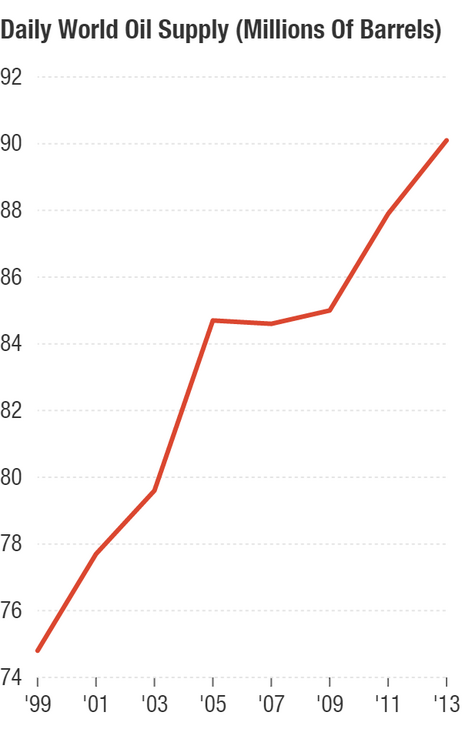
NPR/U.S. Energy Information Adminstration
Despite growing violence in the Middle East, oil supplies just keep rising.
At the same time, demand has been shrinking. This week, the International Energy Agency cut its forecast for oil-demand growth for this year and next.
Turns out, oil demand — not production — is what peaked.
Now prices are plunging, down around 25 percent since June.
What did the forecasters get so wrong? In large measure, their mistake was in failing to appreciate the impact of a relatively new technology, hydraulic fracturing, or fracking.
Because of fracking, oil is being extracted from shale formations in Texas and North Dakota. Production has shot up so quickly in those areas that the United States is now the world’s largest source of oil and natural gas liquids, overtaking Saudi Arabia and Russia.
This new competition has shocked OPEC. Members say they want to maintain their current market share, so they are keeping up production and even boosting it.
Bottom line: The peak of production is nowhere on the horizon.
So are the authors of “peaking” books now slapping themselves in the head and admitting they had it all wrong?
Some are, at least a bit.
Energy analyst Chris Nelder wrote a book in 2008 titled Profit from the Peak. The cover’s inside flap said: “There is no doubt that oil production will peak, if it hasn’t already, and that all other fossil fuels will peak soon after.”
In a phone discussion about his prediction, Nelder said “my expectation has not materialized.”
The surge in oil production in Texas and North Dakota “has really surprised everyone,” he said. “If you had told me five years ago we’d be producing more oil today, I would have said, ‘No way.’ I did not believe at all that this would happen.”
But while he acknowledges that oil has not peaked yet, he says it might soon because “oil is trapped on a narrow ledge” where it must stand on stable prices. Holding the price of a barrel steady around $110 for years allows energy companies to invest in fracking operations.
Over the past three years, those are exactly the conditions drillers have enjoyed. Oil was sitting pretty on a stable plateau of roughly $110 a barrel. But now, as global growth slows, the price is plunging, down to around $83 per barrel.
“China is cooling off quite a bit. Much of Europe is slipping back towards recession,” Nelder said. If oil prices stay low for long, frackers may need to stand down. “There is a lower level [in price] where they just can’t make money,” he said.
And with OPEC pumping so much oil now to hold down prices, maybe they are using up their supplies more quickly. “Depletion never sleeps,” he said.
So perhaps Nelder has been wrong so far, but could be right before too long.
That’s what Kenneth Worth thinks. He’s the author of Peak Oil and the Second Great Depression, a 2010 book. He says the fracking boom has been so frenzied in this decade that drillers may have extracted the cheapest oil already. With fracking, oil supplies “deplete very rapidly. You have to keep drilling really fast,” he said.
With prices now so low, the money to keep up the frenzy may not be there.
So maybe the “peaking” predictions weren’t wrong, just premature. Then again, at some point, any forecast can turn out to be right, he says. “If you take enough of a timeline, eventually we’re all dead,” Worth noted.
58 Comments on "Predictions Of ‘Peak Oil’ Production Prove Slippery"
Davy on Sun, 19th Oct 2014 8:16 am
Boat, I want to believe you. I want my wonderful life to last. I cannot get past the blaringly apparent condition of diminishing returns and limits of growth at almost every level of society. We have run out of the most important variable and that is time. We have run out of economic resources needed to make the transition. We are in an energy trap that is a predicament. We do not have the money, for a better term, to finance the transition. We barely have the money to maintain and service what we have now. Systematically we are near and inflection point that could be a serious bifurcation. This inflection point includes the systematic with the financial system. It includes food and liquid fuel at the level of resources. Then there are the numerous vultures disguised as black swans circling waiting for carrion. I find it hard to have optimism except at some locals. The global appears to be doomed.
JuanP on Sun, 19th Oct 2014 9:07 am
Boat, I want to know what meds you are taking. I want to see things like you do. I envy your optimism.
If you widen your perspective to a planetary scale, you will find the following facts override your local observations. Every day we have more people consuming more resources and producing more pollution and environmental destruction.
Go plant a tree or change a window if you want and it helps you feel good. I’ve done it many times, but don’t think for a minute that anything you do can help make things better on a planetary scale.
You will be lucky if you can save yourself, but, the world? Give me a break and get real, man.
Boat on Sun, 19th Oct 2014 9:45 am
I see changes every day in Houston. Smaller and more efficient cars. My company builds McMansions equipped with the latest tech in windows, foam insulation, LED lighting, AC etc. they spare no expense in energy conversation except the size of their home which uses less energy than the tree chopping wood burners that prevailed in the early days. They supply a lot of jobs for illegals and legals alike.
To have any kind of decent life style and a comfortable house there has to be globalization/trade fairness/law.
Population is a problem I agree and Tech dictates less people will be needed. I understand the problem. Is population a bubble ready to burst or will it happen down the road. Who cares. It will happen and the survivors will do just fine.
Davy on Sun, 19th Oct 2014 9:49 am
Boat predicaments have no solution. We may be at a Mega Predicament. If this is the case then we should prepare for a descent. Descents are ugly and messy. It requires rational risk management not emotions.
ghung on Sun, 19th Oct 2014 10:35 am
Boat is proof that our way of life is non-negotiable. He won’t see that reality is the one that won’t negotiate, and refuses to look at all of the resources and energy that are embodied into everything he takes for granted. It’s inconceivable that those necessary ingredients won’t be economically available to continue lifestyles that are historically off the scale in terms of resource consumption. Limits to growth will always be overcome by human cleverness and adaptability; no room in his expectations for overshoot.
Problem is, he’s in the majority, especially in the US, which is what, perhaps, feeds my doomer side the most. It’s not that there’s a cliff ahead; it’s that most of the herd won’t even see the cliff.
The blind are leading the blind who are following the blind. when the blinders come off, most won’t react well; not at all.
Boat on Sun, 19th Oct 2014 10:53 am
Your wrong ghung. True I don’t worry about overshoot and am sure it has already happened. I don’t believe 18% of the population without electricity was good planning or good policy. I am convinced however that problems can be solved and overcame in areas of the world with good planning and execution. Many will die off at some point because of climate change or war or other calamity. I just don’t think it will happen in civilized areas which will adjust.
Boat on Sun, 19th Oct 2014 10:59 am
There will always be groups of humans that will thrive and excel regardless of what is going on. The million dollar question is how big is that group.
Davy on Sun, 19th Oct 2014 11:10 am
Boat, you are entering the realm of wishful thinking. If we could all wish upon a star the world would be so wonderful. I prefer to stoically accept reality and by this acceptance I am fully prepared to lose everything. I do not deny the fear that will accompany that loss but acceptance is the first step to proper mental health, IMA no one on this board is getting out alive in the end.