What is the world is going on? Corn, oil, silver and gold are nose diving. The dollar index is shooting up?
This doesn't make much sense right now since much of the US economy is teetering and our debt and inflation is literally skyrocketing.
Thoughts?



PeakOil is You
The commodities dip of July/August 2008
49 posts
• Page 1 of 3 • 1, 2, 3
The commodities dip of July/August 2008
 by Jotapay » Fri 08 Aug 2008, 10:22:08
- Jotapay
- Intermediate Crude

- Posts: 3394
- Joined: Sat 21 Jun 2008, 03:00:00
Re: The commodities dip of July/August 2008
by firestarter » Fri 08 Aug 2008, 10:28:01
It's what happens in a deflationary credit collapse.
Civilization: the biosphere's skin disease
-

firestarter - Heavy Crude

- Posts: 1171
- Joined: Sun 19 Mar 2006, 04:00:00
Re: The commodities dip of July/August 2008
by Carlhole » Fri 08 Aug 2008, 11:18:51
This is just how markets act.
A bunch of money had found its way into commodities as a hedge against inflation. The Fed has been letting the dollar devalue by keeping interest rates down. Recently, the dollar has bounced higher and the frenetic pace of the global economy has slackened in a response to high energy prices.
Since burgeoning demand for oil has been a salient characteristic of global markets, much of this money found its way into crude and natural gas. But this huge run-up is itself unsustainable unless the world economy keeps on keeping on.
Right now, we see fears that the world economy will slow dramatically. So some of money boosting crude and other commodities has fled those sectors as investors have taken profits or sought safer havens. Crude will probably fall to the 100 - $110 level but its anybody's guess.
[align=center]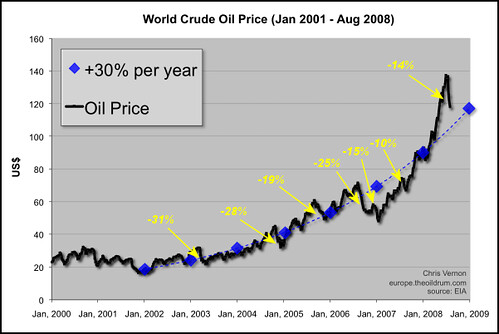 [/align]
A bunch of money had found its way into commodities as a hedge against inflation. The Fed has been letting the dollar devalue by keeping interest rates down. Recently, the dollar has bounced higher and the frenetic pace of the global economy has slackened in a response to high energy prices.
Since burgeoning demand for oil has been a salient characteristic of global markets, much of this money found its way into crude and natural gas. But this huge run-up is itself unsustainable unless the world economy keeps on keeping on.
Right now, we see fears that the world economy will slow dramatically. So some of money boosting crude and other commodities has fled those sectors as investors have taken profits or sought safer havens. Crude will probably fall to the 100 - $110 level but its anybody's guess.
[align=center]
[/align]- Carlhole
Re: The commodities dip of July/August 2008
by frankthetank » Fri 08 Aug 2008, 11:28:47
Calm before the storm...
lawns should be outlawed.
-

frankthetank - Light Sweet Crude

- Posts: 6202
- Joined: Thu 16 Sep 2004, 03:00:00
- Location: Southwest WI
Re: The commodities dip of July/August 2008
by evilgenius » Fri 08 Aug 2008, 12:25:31
$this->bbcode_second_pass_quote('firestarter', 'I')t's what happens in a deflationary credit collapse.
Yes, that is exactly what is happening. You can't lose so much of the money supply in a housing and credit crisis and not have a deflationary effect. Less money bidding means lower prices. If you want to win here you will need to figure out which players are going to be able to swallow up all of the rest of their competition during the troubled times ahead. Well, anyway, that's my tip. In these times I suppose you can lose your ass whatever you do.
When it comes down to it, the people will always shout, "Free Barabbas." They love Barabbas. He's one of them. He has the same dreams. He does what they wish they could do. That other guy is more removed, more inscrutable. He makes them think. "Crucify him."
-

evilgenius - Intermediate Crude
- Posts: 3730
- Joined: Tue 06 Dec 2005, 04:00:00
- Location: Stopped at the Border.
Re: The commodities dip of July/August 2008
by Twilight » Fri 08 Aug 2008, 13:46:58
The commodities dip is due to renewed dollar strength, less money entering circulation and more being destroyed servicing debt and defaults.
An example of the deflationary component from the front lines: a few months ago builders' merchants were warning their customers of price hikes in common materials such as cement, concrete, rebar and steel sections for the coming months and next year, even as their customers were slamming project pipelines shut, announcing massive layoffs, cutting back what few fixed assets they had, attempting to refinance debt and focusing on completing far-advanced projects before the buyers disappear.
Here is an example:
8 May: Plans have been approved for 250 new houses, shops and a church on the outskirts of Westhill. Aberdeenshire councillors have unanimously given builder Stewart Milne's multi million pound application the go-ahead.
21 July: The Stewart Milne Group said about 289 jobs could be lost, which is approximately 20% of its UK workforce.
Think those price increases will hold? Maybe for a time, but it is a question of inertia, because next year the residential and commercial buyers will not be there. Infrastructure and government will, and you could be forgiven for failing to notice what's happening outside that comfortable cocoon, but no matter what its growth is, it will not act as a complete replacement.
I think very quickly those price increases will turn into discounts.
Now you might say aha, but even after a severe fall, energy prices will remain historically high. True, materials with high embedded energy content cost what they cost and it makes no sense to sell for less. But as volumes collapse, you are going to end up with liquidated inventories getting dumped and suppliers in competition where once they could barely keep up with orders and sold at a premium. In time, this will feed all the way back to the mills and then the mining companies themselves. Not to mention anyone with any sense has already been pricing ahead of rising energy, because just one experience is enough to teach the lesson that it hurts like hell when you do not. I can assure you it hurts.
And why is all this happening?
Because banks are lending people and companies less money on more onerous terms. That source of spending on industrial commodities is drying up. The state is not going to keep building half million square foot warehouses on city boundaries while others stand empty, nor will it start completing tower blocks once their concrete skeletons have stood undefended from the weather for a year.
Whatever printing the central banks are doing so far to cover the implosion of financial assets is currently not significant enough to do much to compensate for the loss of the real source of inflation.
How bullish do you have to be to believe the ME Gulf, China and India will substantially replace the demand destruction that is about to take place in the West? Also, what is the prospect of banks lending yet more money for infrastructure there, when falling energy and commodity prices are reducing their income, hence safe debt load? Do you not think this might become a negative feedback loop as they wait and see what happens?
An example of the deflationary component from the front lines: a few months ago builders' merchants were warning their customers of price hikes in common materials such as cement, concrete, rebar and steel sections for the coming months and next year, even as their customers were slamming project pipelines shut, announcing massive layoffs, cutting back what few fixed assets they had, attempting to refinance debt and focusing on completing far-advanced projects before the buyers disappear.
Here is an example:
8 May: Plans have been approved for 250 new houses, shops and a church on the outskirts of Westhill. Aberdeenshire councillors have unanimously given builder Stewart Milne's multi million pound application the go-ahead.
21 July: The Stewart Milne Group said about 289 jobs could be lost, which is approximately 20% of its UK workforce.
Think those price increases will hold? Maybe for a time, but it is a question of inertia, because next year the residential and commercial buyers will not be there. Infrastructure and government will, and you could be forgiven for failing to notice what's happening outside that comfortable cocoon, but no matter what its growth is, it will not act as a complete replacement.
I think very quickly those price increases will turn into discounts.
Now you might say aha, but even after a severe fall, energy prices will remain historically high. True, materials with high embedded energy content cost what they cost and it makes no sense to sell for less. But as volumes collapse, you are going to end up with liquidated inventories getting dumped and suppliers in competition where once they could barely keep up with orders and sold at a premium. In time, this will feed all the way back to the mills and then the mining companies themselves. Not to mention anyone with any sense has already been pricing ahead of rising energy, because just one experience is enough to teach the lesson that it hurts like hell when you do not. I can assure you it hurts.
And why is all this happening?
Because banks are lending people and companies less money on more onerous terms. That source of spending on industrial commodities is drying up. The state is not going to keep building half million square foot warehouses on city boundaries while others stand empty, nor will it start completing tower blocks once their concrete skeletons have stood undefended from the weather for a year.
Whatever printing the central banks are doing so far to cover the implosion of financial assets is currently not significant enough to do much to compensate for the loss of the real source of inflation.
How bullish do you have to be to believe the ME Gulf, China and India will substantially replace the demand destruction that is about to take place in the West? Also, what is the prospect of banks lending yet more money for infrastructure there, when falling energy and commodity prices are reducing their income, hence safe debt load? Do you not think this might become a negative feedback loop as they wait and see what happens?
Last edited by Twilight on Fri 08 Aug 2008, 14:09:36, edited 2 times in total.
- Twilight
- Expert

- Posts: 3027
- Joined: Fri 02 Mar 2007, 04:00:00
Re: The commodities dip of July/August 2008
by erl » Fri 08 Aug 2008, 14:05:13
The dollar's climb in the last couple of days may also be due to the conflict in South Ossetia.
Conflicts in certain areas of the world often seem to spark a "flight to safety" in currencies.
That has usually meant strength for the U.S. Dollar.
The dollar's rise in turn is driving down commodities.
Conflicts in certain areas of the world often seem to spark a "flight to safety" in currencies.
That has usually meant strength for the U.S. Dollar.
The dollar's rise in turn is driving down commodities.
- erl
- Tar Sands

- Posts: 580
- Joined: Mon 21 Mar 2005, 04:00:00
Re: The commodities dip of July/August 2008
by aflurry » Fri 08 Aug 2008, 14:34:36
$this->bbcode_second_pass_quote('Jotapay', '
')Thoughts?
')Thoughts?
you are asking for some causal backstory to explain market fluctuation. there is none. there never is one. someone made a decision to trade. that's it.
-
aflurry - Tar Sands
- Posts: 824
- Joined: Mon 28 Mar 2005, 04:00:00
Re: The commodities dip of July/August 2008
by Twilight » Fri 08 Aug 2008, 14:48:47
Not always. Sometimes there is a change of paradigm. I think one is gathering enough strength to move the market, though it may do so next year. Right now is more likely a change of sentiment preceding the real fun.
- Twilight
- Expert
- Posts: 3027
- Joined: Fri 02 Mar 2007, 04:00:00
Re: The commodities dip of July/August 2008
by Jotapay » Fri 08 Aug 2008, 15:00:49
$this->bbcode_second_pass_quote('Twilight', 'R')ight now is more likely a change of sentiment preceding the real fun.
Whew! I was worried for a second there I would run out of train wrecks to watch!

- Jotapay
- Intermediate Crude
- Posts: 3394
- Joined: Sat 21 Jun 2008, 03:00:00
Re: The commodities dip of July/August 2008
by shady28 » Fri 08 Aug 2008, 16:05:52
Read Mises, an early 20th century economist, for what / why about deflationary forces (which is what the OP just described).
Credit is how monetary expansion occurs. When credit dries up, money becomes scarce. Scarce money is valuable money.
The more distant future (ie, 2+ years out) may still hold hyperinflation in store, most likely the result of federal policy makers caving to populist demand for relief from a deflationary spiral and simply printing money (they are not doing that yet, they are still pushing on the credit string).
That isn't where we are right now. We're in the initial phase of a deflationary spiral.
Credit is how monetary expansion occurs. When credit dries up, money becomes scarce. Scarce money is valuable money.
The more distant future (ie, 2+ years out) may still hold hyperinflation in store, most likely the result of federal policy makers caving to populist demand for relief from a deflationary spiral and simply printing money (they are not doing that yet, they are still pushing on the credit string).
That isn't where we are right now. We're in the initial phase of a deflationary spiral.
Welcome to the Kondratieff Winter
-
shady28 - Coal

- Posts: 412
- Joined: Wed 06 Jul 2005, 03:00:00
Re: The commodities dip of July/August 2008
by DantesPeak » Fri 08 Aug 2008, 21:06:04
I don't want to say I disagree with some of the well made points about deflation above, but I have some alternative explanations.
First, buying of US dollars by foreign central banks and funds has been very heavy these last few weeks. It's has not been unusual for this to occur when the US Treasury issues a large amount of bonds/bills. This is exactly what has happened lately. The amount of foreign buying is almost exactly the amount of new Treasury debt. This is no coincidence.
Second, the buying of dollars by foreign central banks is in the long run inflationary - not deflationary. Admittedly in the short run, people talk about an artifically made "rally". However foreign central banks create even more money to buy Treasuries - thereby adding to the world money supply.
Whether all this new money offsets the effects of economic deflation is open to debate, but so far, monetary inflation is way ahead of economic deflation.
Do any of you deflationists want make a figurative bet that commodity indexes will be lower at year end? I bet higher.
First, buying of US dollars by foreign central banks and funds has been very heavy these last few weeks. It's has not been unusual for this to occur when the US Treasury issues a large amount of bonds/bills. This is exactly what has happened lately. The amount of foreign buying is almost exactly the amount of new Treasury debt. This is no coincidence.
Second, the buying of dollars by foreign central banks is in the long run inflationary - not deflationary. Admittedly in the short run, people talk about an artifically made "rally". However foreign central banks create even more money to buy Treasuries - thereby adding to the world money supply.
Whether all this new money offsets the effects of economic deflation is open to debate, but so far, monetary inflation is way ahead of economic deflation.
Do any of you deflationists want make a figurative bet that commodity indexes will be lower at year end? I bet higher.
It's already over, now it's just a matter of adjusting.
-

DantesPeak - Expert
- Posts: 6277
- Joined: Sat 23 Oct 2004, 03:00:00
- Location: New Jersey
Re: The commodities dip of July/August 2008
by Twilight » Fri 08 Aug 2008, 21:51:01
$this->bbcode_second_pass_quote('DantesPeak', 'D')o any of you deflationists want make a figurative bet that commodity indexes will be lower at year end? I bet higher.
At year end, no bet. Too short a timescale for the stuff I am seeing appear as Q3 progresses, and some real eureka moments I am having these last couple of weeks. But a respectable time into next year, I expect construction-related commodities at least to have tanked. The US will be seeing its builders filing for bankruptcy protection one after another, and the layoffs in Europe will be well under way. In the UK there is a rush to complete advanced builds, but ground breaking is gone, the builders are laying off their design teams and managers, and the agencies supplying labour and consultants will have their phones cease ringing shortly. Completely. Well, except for government and infrastructure work, but given how far ahead that is budgeted (5 years not uncommon), there will be no new game in town. Judging by what some have said in the press, their backlogs are already down to whatever they are doing now, with the next job being whatever they get.
A fine example of demand that will not materialise. Appreciate the size.
And another. Notice the disparity in scale. 3,000 houses cancelled, a small local railway station will still be built for an existing community, with roadworks at a couple of junctions. £10m total expenditure set against perhaps £300m of business cancelled. Luckily I am not doing houses.
The striking thing is, the production and distribution capacity to supply the required materials still exists. These were next year's sales. So with all that production capacity about to be freed up as abruptly as the pulling of credit last month, competition for sales increasing and ahead-of-the-energy-curve price increases looking unnecessary, either someone absolutely huge steps in and starts buying, or rocks and metals dive.
EDIT: I suppose in these uncertain times there is no telling what might happen to the dollar or another key currency, what fresh market intervention we might see, whether energy prices might spike again, and so on. I accept that point. So I say this based on the cursed fundamentals that have let us down so often. I just do not see who will be buying the physical goods over here at any price next year, except the comparatively small sectors I have mentioned.
- Twilight
- Expert
- Posts: 3027
- Joined: Fri 02 Mar 2007, 04:00:00
