


PeakOil is You
can the world really afford $200+ a barrel
can the world really afford $200+ a barrel
 by energyhoggin » Mon 22 Jun 2009, 13:47:34
I know the financial markets dived for several reasons but how much of an impact did high energy cost have on the economy? A lot of people are certain that the price of crude will go up astronomically for a long time, i don't see this happening because the world will not be able to afford such high energy cost. In my opinion the economy and the price of oil will hover at a median price till there is virtually no oil left. When the price of crude reaches a high it will be brought down by a slide in the economy to a lower level but nominally higher than it once was. My question is, at what level will it become critical for survival?
Fact: There will be a limit to growth
- energyhoggin
- Wood

- Posts: 43
- Joined: Wed 03 Jun 2009, 16:51:55
Re: can the world really afford $200+ a barrel
by TreeFarmer » Mon 22 Jun 2009, 13:58:42
I have been thinking along these same lines myself. Assuming the US$ does not take a big hit, oil probably can't get to $200 or if it does stay there very long.
Like you are thinking, that price would choke off a tremendous amount of economic activity and thus reduce demand.
At the current time I see us going through a lot of big price swings.
TF
Like you are thinking, that price would choke off a tremendous amount of economic activity and thus reduce demand.
At the current time I see us going through a lot of big price swings.
TF
-

TreeFarmer - Tar Sands

- Posts: 609
- Joined: Tue 26 Jun 2007, 03:00:00
Re: can the world really afford $200+ a barrel
by NoWorries » Mon 22 Jun 2009, 14:05:02
Frankly I don't think the economy could sustain $100 /bbl right now, much less $150.
I think the breaking point is around $100-$110, in the absence of recession. Anything much above that for 6+ months and the economy returns to recession territory.
I think the breaking point is around $100-$110, in the absence of recession. Anything much above that for 6+ months and the economy returns to recession territory.
-
NoWorries - Peat
- Posts: 177
- Joined: Thu 05 Jun 2008, 03:00:00
Re: can the world really afford $200+ a barrel
by Caffeine » Mon 22 Jun 2009, 14:12:57
I would expect economic collapse if oil were to go to $200 and stay there.
Not necessarily civilization collapse, though.
Not necessarily civilization collapse, though.
- Caffeine
- Lignite
- Posts: 201
- Joined: Wed 16 Jul 2008, 03:00:00
Re: can the world really afford $200+ a barrel
by gnm » Mon 22 Jun 2009, 14:22:50
$this->bbcode_second_pass_quote('NoWorries', 'F')rankly I don't think the economy could sustain $100 /bbl right now, much less $150.
I think the breaking point is around $100-$110, in the absence of recession. Anything much above that for 6+ months and the economy returns to recession territory.
I think the breaking point is around $100-$110, in the absence of recession. Anything much above that for 6+ months and the economy returns to recession territory.
Returns? Otherwise I agree...
-G
- gnm
Re: can the world really afford $200+ a barrel
by rangerone314 » Mon 22 Jun 2009, 14:30:42
Can diabetics afford more expensive insulin? Can drug addicts afford drugs?
I'm not sure we want to live in a world that CAN afford $200+ a barrel.
I'm not sure we want to live in a world that CAN afford $200+ a barrel.
An ideology is by definition not a search for TRUTH-but a search for PROOF that its point of view is right
Equals barter and negotiate-people with power just take
You cant defend freedom by eliminating it-unknown
Our elected reps should wear sponsor patches on their suits so we know who they represent-like Nascar-Roy
Equals barter and negotiate-people with power just take
You cant defend freedom by eliminating it-unknown
Our elected reps should wear sponsor patches on their suits so we know who they represent-like Nascar-Roy
-

rangerone314 - Light Sweet Crude

- Posts: 4105
- Joined: Wed 03 Dec 2008, 04:00:00
- Location: Maryland
Re: can the world really afford $200+ a barrel
by TreeFarmer » Mon 22 Jun 2009, 15:30:39
We could just stay in a permanent recession which alternates between mild and severe. Occasionally we might be out of recession only to fall right back into recession. If this is the case, expect it to continue until we either have substitutes for most of our oil needs or we just give up.
It is not that life has to be horrible in a long-term oil based recession but, it would almost surely be a life with limited luxuries.
TF
It is not that life has to be horrible in a long-term oil based recession but, it would almost surely be a life with limited luxuries.
TF
-
TreeFarmer - Tar Sands
- Posts: 609
- Joined: Tue 26 Jun 2007, 03:00:00
Re: can the world really afford $200+ a barrel
by rangerone314 » Mon 22 Jun 2009, 16:05:59
$this->bbcode_second_pass_quote('TreeFarmer', 'W')e could just stay in a permanent recession which alternates between mild and severe. Occasionally we might be out of recession only to fall right back into recession. If this is the case, expect it to continue until we either have substitutes for most of our oil needs or we just give up.
It is not that life has to be horrible in a long-term oil based recession but, it would almost surely be a life with limited luxuries.
TF
It is not that life has to be horrible in a long-term oil based recession but, it would almost surely be a life with limited luxuries.
TF
LOL, instead of bi-polar between depressed and manic, we'll be bi-polar between depressed and recessed LOL
An ideology is by definition not a search for TRUTH-but a search for PROOF that its point of view is right
Equals barter and negotiate-people with power just take
You cant defend freedom by eliminating it-unknown
Our elected reps should wear sponsor patches on their suits so we know who they represent-like Nascar-Roy
Equals barter and negotiate-people with power just take
You cant defend freedom by eliminating it-unknown
Our elected reps should wear sponsor patches on their suits so we know who they represent-like Nascar-Roy
-
rangerone314 - Light Sweet Crude
- Posts: 4105
- Joined: Wed 03 Dec 2008, 04:00:00
- Location: Maryland
Re: can the world really afford $200+ a barrel
by nobodypanic » Mon 22 Jun 2009, 16:11:53
NO.
why? in my opinion, we have empirical evidence that it couldn't afford $140.00 oil, so no way it can deal w/$200, assuming we normalize to '08 dollars.
why? in my opinion, we have empirical evidence that it couldn't afford $140.00 oil, so no way it can deal w/$200, assuming we normalize to '08 dollars.
-

nobodypanic - Heavy Crude

- Posts: 1103
- Joined: Mon 02 Jun 2008, 03:00:00
Re: can the world really afford $200+ a barrel
by mos6507 » Mon 22 Jun 2009, 16:22:50
The world couldn't afford this:
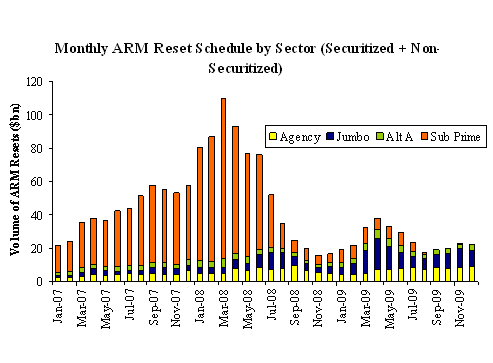
Whether it could afford $140 oil or not with no other polluting factors is hard to say. Obviously at certain inflection points life has to change. It doesn't necessarily mean skipping immediately to zompocalypse.
Whether it could afford $140 oil or not with no other polluting factors is hard to say. Obviously at certain inflection points life has to change. It doesn't necessarily mean skipping immediately to zompocalypse.
- mos6507
Re: can the world really afford $200+ a barrel
by nobodypanic » Mon 22 Jun 2009, 16:41:58
$this->bbcode_second_pass_quote('mos6507', 'T')he world couldn't afford this:
Whether it could afford $140 oil or not with no other polluting factors is hard to say. Obviously at certain inflection points life has to change. It doesn't necessarily mean skipping immediately to zompocalypse.
Whether it could afford $140 oil or not with no other polluting factors is hard to say. Obviously at certain inflection points life has to change. It doesn't necessarily mean skipping immediately to zompocalypse.
i am aware of your position and it does have merit. unlike others, i won't dismiss it arrogantly out of hand. however, in my opinion that was caused because we tried to extract more wealth from our economy than she could deliver due to, in some large part, energy constraints. in effect, we had paper instruments go into overshoot with respect to the underlying physical reality through mechanisms such as ARMs, CDSs, etc. therefore, in my view, peak oil both blew the bubble and then popped it.
it's perfectly fine if you disagree with my position. in my view, the more opinions, the merrier. maybe one of us sparks someone into a more perfect hypothesis through synthesis.
-
nobodypanic - Heavy Crude
- Posts: 1103
- Joined: Mon 02 Jun 2008, 03:00:00
Re: can the world really afford $200+ a barrel
by Schmuto » Mon 22 Jun 2009, 16:54:45
200 dollar oil - economy in depression, maybe TEOTWAWKI.
300 dollar oil - TEOTWAWKI
300 dollar oil - TEOTWAWKI
June 5, 09. Taking a powder for at least a while - big change of life coming up.
-
We're saved! YesPlease promises that we'll be running cars on battery cubes about the size of a toaster.
-
We're saved! YesPlease promises that we'll be running cars on battery cubes about the size of a toaster.
- Schmuto
- Tar Sands
- Posts: 659
- Joined: Wed 17 Dec 2008, 04:00:00
Re: can the world really afford $200+ a barrel
by Novus » Mon 22 Jun 2009, 17:29:54
Here is the conundrum of peak oil:
The cheap oil is gone so the oil producers need high priced oil in order to keep pumping. At the same time our economy can only support no more than a moderate price of oil. That price is about $70 to $80. Anything more than that and you get severe economic destruction which leads to oil prices readjusting downward. As posters like Oil Finder like to point out there are ten Saudi Arabias on the bottom of the ocean but it doesn't matter because we can't afford to drill for that oil. At some point the moderate priced oil will run out just as the cheap oil ran out. If we cannot figure out how to pay for the $200 oil of the future then it is TEOTWAKI.
The cheap oil is gone so the oil producers need high priced oil in order to keep pumping. At the same time our economy can only support no more than a moderate price of oil. That price is about $70 to $80. Anything more than that and you get severe economic destruction which leads to oil prices readjusting downward. As posters like Oil Finder like to point out there are ten Saudi Arabias on the bottom of the ocean but it doesn't matter because we can't afford to drill for that oil. At some point the moderate priced oil will run out just as the cheap oil ran out. If we cannot figure out how to pay for the $200 oil of the future then it is TEOTWAKI.
-

Novus - Intermediate Crude

- Posts: 2450
- Joined: Tue 21 Jun 2005, 03:00:00
Re: can the world really afford $200+ a barrel
by MonteQuest » Mon 22 Jun 2009, 17:47:14
$this->bbcode_second_pass_quote('TreeFarmer', 'W')e could just stay in a permanent recession which alternates between mild and severe.
That's called a depression. It's our future. Depression without end.
A Saudi saying, "My father rode a camel. I drive a car. My son flies a jet-plane. His son will ride a camel."
-

MonteQuest - Expert

- Posts: 16593
- Joined: Mon 06 Sep 2004, 03:00:00
- Location: Westboro, MO