$this->bbcode_second_pass_quote('OilFinder2', 'o')degaard I was trying to mimic your calculation.
I do not understand where you got the "95" from for spending for both the employed and unemployed. 95 what? Percent of something? Dollars?
Let's say you interviewed 100 people. 10% were unemployed, 90% were employed.
Income
The income of the 10 unemployed people would be 0 (assuming no income from anywhere).= $0 total
Let's say the average monthy income of the 90 employed people was $2000 = $180,000 total (90 * $2000)
-------------------------------------------------------------------------------------------------
Total income among the 100 interviewees would be $180,000
Consumption
Let's say the average monthly consumption expenditures of the 10 unemployed people was $1500/month = $15,000 total
Let's say the average monthly consumption expenditures of the 90 employed people was $1800/month = $162,000 total
--------------------------------------------------------------------------------------------------
Total consumption of the entire group would be $177,000
Since savings = income - consumption, we get:
Savings = $180,000 - $177,000 = $3,000
Since we're talking about the savings rate: $3,000 / $180,000 = 1.66% savings rate....
A 1.66% savings rate is much more realistic then your previous numbers.


PeakOil is You
Americans saving more, spending less
Re: Americans saving more, spending less
 by odegaard » Sat 02 May 2009, 00:57:56
I'll congratulate you for this.
However I disagree with your assumption that employed people have a 10% savings rate.
That is simply NOT true. (at least not for Americans)

add on:
If you assume a more realistic savings rate of 5% for employed people and plug the numbers in you'll get a -3.33% savings rate.
It's still negative.
"They're not too big to fail, they're too big to bail out!" Peter Schiff
- odegaard
- Lignite

- Posts: 382
- Joined: Tue 21 Apr 2009, 00:36:50
Re: Americans saving more, spending less
by Tyler_JC » Sat 02 May 2009, 02:33:05
I think we could be missing an important point.
The top 20% of households earn about half of the income.
Their behavior has a much larger impact on the national savings rate than the behavior of the bottom 80%.
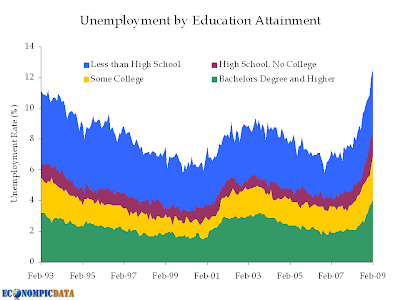
Moreover, unemployment benefits provide a much larger share of one's income for the bottom 80% than it does for the top 20%. And the top 20% is far less likely to lose their jobs in this recession compared to the bottom 80%.
The previous models were assuming perfect income equality which is obviously not the case.
If a person earning $200,000 a year goes from saving $40,000 to saving $80,000, that can swamp the impact of a few unemployed construction workers.
One of the biggest shifts, in my opinion, is the huge reduction in NEW consumer debt. Credit cards are being cut off. Middle/Working class people can't get access to new loans. Instead of spending 110% of their income, they are spending 100%. That also has a big impact on the savings rate.
If a $50K/year person goes from spending $55K to spending $50K, society has $5,000 less debt. Put another way, society has $5,000 more savings. Why shouldn't we count this as new savings? A decline in borrowing has the same net effect on society as an increase in savings. If I earn another $100 at work or my bills drop by $100, my standard of living improves by the same amount regardless of the reason.

Consumer debt, which had been growing rapidly, has stalled out.
We added roughly a trillion dollars a year in new consumer debt each year between 2002 and 2008. Now we aren't adding any new net consumer debt.
Households are rebuilding their balance sheets.
The top 20% of households earn about half of the income.
Their behavior has a much larger impact on the national savings rate than the behavior of the bottom 80%.
Moreover, unemployment benefits provide a much larger share of one's income for the bottom 80% than it does for the top 20%. And the top 20% is far less likely to lose their jobs in this recession compared to the bottom 80%.
The previous models were assuming perfect income equality which is obviously not the case.
If a person earning $200,000 a year goes from saving $40,000 to saving $80,000, that can swamp the impact of a few unemployed construction workers.
One of the biggest shifts, in my opinion, is the huge reduction in NEW consumer debt. Credit cards are being cut off. Middle/Working class people can't get access to new loans. Instead of spending 110% of their income, they are spending 100%. That also has a big impact on the savings rate.
If a $50K/year person goes from spending $55K to spending $50K, society has $5,000 less debt. Put another way, society has $5,000 more savings. Why shouldn't we count this as new savings? A decline in borrowing has the same net effect on society as an increase in savings. If I earn another $100 at work or my bills drop by $100, my standard of living improves by the same amount regardless of the reason.
Consumer debt, which had been growing rapidly, has stalled out.
We added roughly a trillion dollars a year in new consumer debt each year between 2002 and 2008. Now we aren't adding any new net consumer debt.
Households are rebuilding their balance sheets.
"www.peakoil.com is the Myspace of the Apocalypse."
- Tyler_JC
- Expert

- Posts: 5438
- Joined: Sat 25 Sep 2004, 03:00:00
- Location: Boston, MA
Re: Americans saving more, spending less
by vision-master » Sat 02 May 2009, 09:33:02
$this->bbcode_second_pass_quote('', 'M')oreover, unemployment benefits provide a much larger share of one's income for the bottom 80% than it does for the top 20%. And the top 20% is far less likely to lose their jobs in this recession compared to the bottom 80%.
Links?
- vision-master
Re: Americans saving more, spending less
by Quinny » Sat 02 May 2009, 09:52:04
$this->bbcode_second_pass_quote('vision-master', '')$this->bbcode_second_pass_quote('', 'M')oreover, unemployment benefits provide a much larger share of one's income for the bottom 80% than it does for the top 20%. And the top 20% is far less likely to lose their jobs in this recession compared to the bottom 80%.
Links?
Why do you need links?
Live, Love, Learn, Leave Legacy.....oh and have a Laugh while you're doing it!
-

Quinny - Intermediate Crude

- Posts: 3337
- Joined: Thu 03 Jul 2008, 03:00:00