by JohnDenver » Sat 07 Feb 2009, 22:52:32
$this->bbcode_second_pass_quote('ki11ercane', 'J')D, I have said this to you before DIRECTLY. That's all TRUE, but you freely elect to IGNORE the economical death spiral that will result. Same thing when you tell everyone we'll be saved if we electrify the world. Where does the money come from if the economy is broke and everyone is in neutral mode? While I agree it's WRONG, any reduction in any consumption, even as small at 4% (ie. billions of dollars) would decimate an economy, Japan included. Consumption will drop, not because it has to, but because people will be broke. Discretionary travel is an integral part of spending money to pay for your electrified cars, trucks, and trains. No money, no future.
I would agree that conservation will initially have some negative impact on the economy, but nothing like a "death spiral".
There are many reasons for this:
1) Conservation saves money and that money can be spent elsewhere. For example, the
average commute in the US is 16 miles long. Now suppose Joe with a 16 mile commute stops driving and rides a bike instead. It's slightly more inconvenient, but hardly impossible or the end of the world.
Joe used to drive an SUV with 12mpg fuel efficiency, so at $3 gas he was spending $80 a month. Thus he now has $80 more money, per month, than he used to have. And that money can and will be spent on other things.
2) Here's another example: Jane was driving a compact car that got the US average of 25mpg. Then she purchased a moped for $1300, which gets 100mpg. Assuming $3/gallon gas, car travel costs $.12/mile and moped travel costs $0.03/mile. So when she rides her moped, she's saving about $0.09/mile. At the moped's top speed of 45mph, she's saving $4/hour. She's making almost as much money driving a moped as she would working a second job. She'll pay off the moped in 6 months, and after that it's all gravy. Lots of extra money in her pocket is hardly a negative for the economy. That money will get spent somewhere, and the people in that industry will benefit. Furthermore, she spent money on the moped, which was stimulative to that industry.
3) High efficiency vehicles and car pooling don't reduce expenditure on anything except oil. People still buy and maintain vehicles. They get where they wanted to go and buy what they wanted to buy. I like to call it FAU (Functionality As Usual). Yes, this will lead to less money flowing into the Saudi economy, but who cares? That's their problem.
4) Same goes for telecommuting/telepresence. It boost sales of computer gear, reduces sales of oil, and puts extra money into the pocket of the conserver.
5) It's true that long distance tourist destinations may suffer, but when somebody doesn't take one of those vacations, they have saved money. It will get spent somewhere. Local travel destinations will likely benefit.
6) Conservation projects create jobs. For example, consider re-insulation of the entire building stock of the US. That would employ a lot of people, and give the insulation industry a big shot in the arm. And when it's done, people save money that they can spend elsewhere. Why would that be an economic negative?
7) Cutting out discretionary driving will have no effect on the economy in most cases. For example, cutting out driving to socialize doesn't hurt anybody except the filling station and OPEC. As a substitute you can talk on the video phone with Skype. Cutting out most shopping trips doesn't hurt if you go less frequently and buy in bulk.
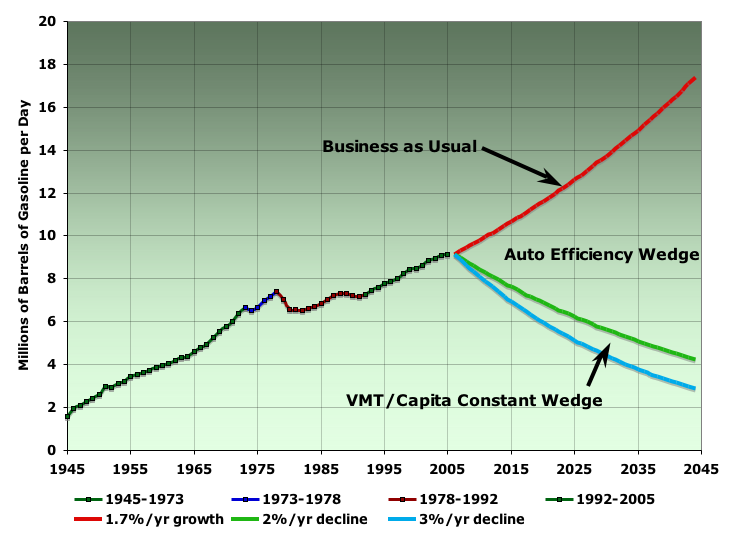
8] Furthermore, cutting out the discretionary travel is just a quick fix for an emergency. The reality is that the entire vehicle industry is totally focused now on efficiency. Every major manufacturer will be rolling out ultra-efficient and electric vehicles by 2010. And this process itself is driving explosive growth in a number of new industries such as batteries etc.
Your idea that a 4% drop will decimate an economy doesn't hold water. As of November Japanese oil consumption was down 17% year-on-year (3.71mbd, vs. an average of 5mbd last year). Yes, people are struggling here due to the economic crisis, but it's hardly a catastrophe. Unemployment is 4.4%, and to tell you the truth, if I wasn't reading the news, I wouldn't even be able to detect the difference between last year and this year.
As I said, I'm certain that conservation will have moderate negative effects in the short term, as people shift from dying industries like SUVs to growing industries like mopeds, EVs etc. But that's more like a transitional recession than the end of industrial society.