

PeakOil is You
You guys sound like a pack of damn ninnies
Re: You guys sound like a pack of damn ninnies
 by Specop_007 » Tue 16 Sep 2008, 14:09:03
$this->bbcode_second_pass_quote('ColossalContrarian', 'I') have no money invested so I can’t lose any. That was my point. You seem to be a know-it-all b!tch so good luck with that BOTTOM LINE: In a depression, a lot of people lose money, even their life savings.
It has nothing to do with being a know it all and everything to do with being confident enough in my understanding and assessment of the situation to ACT on it.
I see a whole bunch of people with opinions. I see damned few who are confident enough to act on what they believe. That alone tells me everything I need to know about how confident they are in what they type.
The first guy to test a parachute, now he was one confident son of a bitch wasnt he?
"Battle not with monsters, lest ye become a monster, and if you gaze into the
Abyss, the Abyss gazes also into you."
Ammo at a gunfight is like bubblegum in grade school: If you havent brought enough for everyone, you're in trouble
Abyss, the Abyss gazes also into you."
Ammo at a gunfight is like bubblegum in grade school: If you havent brought enough for everyone, you're in trouble
-
Specop_007 - Expert

- Posts: 5586
- Joined: Thu 12 Aug 2004, 03:00:00
Re: You guys sound like a pack of damn ninnies
by nobodypanic » Tue 16 Sep 2008, 14:52:50
next week it's all over! ![[smilie=BangHead.gif]](https://udev.peakoil.com/forums/images/smilies/BangHead.gif "BangHead")
-

nobodypanic - Heavy Crude

- Posts: 1103
- Joined: Mon 02 Jun 2008, 03:00:00
Re: You guys sound like a pack of damn ninnies
by kublikhan » Tue 16 Sep 2008, 15:00:43
I'm with you Specop, I think a lot of these people declaring that the end is here are living in fantasy land.
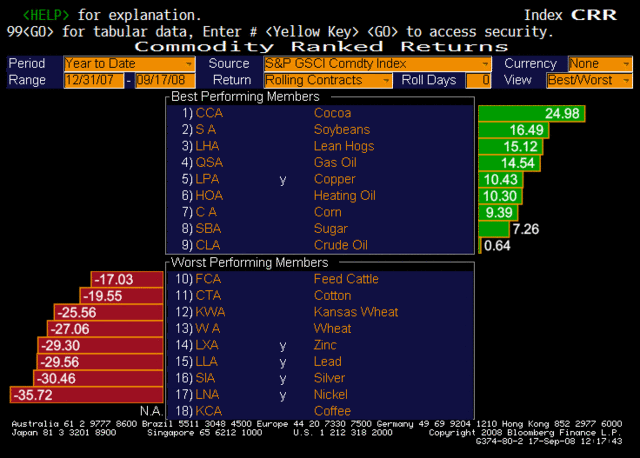
As for putting my money were my mouth is, I've been saying for months that commodities were overvalued and their rise was not driven by fundamentals. Now over a year's worth of gains have been wiped out:
Commodities
Saved quiet a penny by not buying into the hype.
As for putting my money were my mouth is, I've been saying for months that commodities were overvalued and their rise was not driven by fundamentals. Now over a year's worth of gains have been wiped out:
Commodities
Saved quiet a penny by not buying into the hype.
The oil barrel is half-full.
-

kublikhan - Master Prognosticator

- Posts: 5064
- Joined: Tue 06 Nov 2007, 04:00:00
- Location: Illinois
Re: You guys sound like a pack of damn ninnies
by hironegro » Tue 16 Sep 2008, 15:21:18
$this->bbcode_second_pass_quote('Specop_007', 'I') know very well people are losing jobs. You can either give up or pick yourself up and carry on. .
boot-straps!
- hironegro
- Coal

- Posts: 419
- Joined: Tue 08 Apr 2008, 03:00:00
Re: You guys sound like a pack of damn ninnies
by threadbear » Tue 16 Sep 2008, 15:56:23
$this->bbcode_second_pass_quote('kublikhan', 'I')'m with you Specop, I think a lot of these people declaring that the end is here are living in fantasy land.
As for putting my money were my mouth is, I've been saying for months that commodities were overvalued and their rise was not driven by fundamentals. Now over a year's worth of gains have been wiped out:
Commodities
Saved quiet a penny by not buying into the hype.
As for putting my money were my mouth is, I've been saying for months that commodities were overvalued and their rise was not driven by fundamentals. Now over a year's worth of gains have been wiped out:
Commodities
Saved quiet a penny by not buying into the hype.
You and I both. I also advised people who were buying precious metals, to hedge with cash. I haven't made any money in the last couple of months, but haven't lost anything either. Oil going from 60.00 to 147.00 in just over a year, was a big red flag.
I would be really wary, at this point, of succumbing to the capitulation effect. You have to be just as vigilant that commodities will go into over sold conditions. Peak resources, still raises the floor price, so you should make your moves accordingly. Watch Russia and Saudi Arabia, and also Russia's relationship with Opec.
-

threadbear - Expert
- Posts: 7577
- Joined: Sat 22 Jan 2005, 04:00:00
Re: You guys sound like a pack of damn ninnies
by threadbear » Tue 16 Sep 2008, 16:08:03
$this->bbcode_second_pass_quote('Oil_be_alroit', 'I') think Specop_007 certainly has a point.
OTOH it could be a bit like the guy who jumps out of 50 storey building saying as he goes past the 25th storey "Well, it's OK so far!"
OTOH it could be a bit like the guy who jumps out of 50 storey building saying as he goes past the 25th storey "Well, it's OK so far!"
Specop is a pretty good contrary indicator. If he thinks things muddle along, I will take the opposing view. It's going to be hellish. Thanks Specop.
-
threadbear - Expert
- Posts: 7577
- Joined: Sat 22 Jan 2005, 04:00:00





 Surely you jest - the "guards" would be the first ones to take out the masters. Southern slaveowners feared less outside aggression and more internal slave uprisings. Who better to kill you than the people closest to you? Been that way since Roman times, hell even before I'm sure.
 [/align]
 [/align]

