Donate Bitcoin

Donate Paypal


PeakOil is You

PeakOil is You

Drastic Reduction In Global Shipping

Discussions about the economic and financial ramifications of PEAK OIL

Re: Drastic Reduction In Global Shipping

Postby ReverseEngineer » Sun 03 Aug 2008, 03:20:51

$this->bbcode_second_pass_quote('cube', 'T')here's a lot of people here who think just because they are PO aware they must have the amazing ability to predict the future. There's a lot of stupid ideas and theories that have been proposed on this website. That's what debate is for.
To weed out bad ideas from the good.
Hopefully I have not proposed too many bad ideas myself. :wink:

BTW here's a post I made awhile back.
It's "only" 1/3 rd of a page long and it is related to shipping.
The last mile and PO


The "Last Mile" you describe is an important factor to consider in the overall cost of the moevement of goods. So whether the intercontinental transport is done via Sail or Bunker Fuel, you still do have the problem of taking the goods from the port of call to the final point of destination. Its the most energy intensive step in the process, and it of course drives up the cost of the goods at the end of the line to the consumer.

Thus the reason in da olden days, any goods which came from beyond the local area were very expensive, relative to the local economy. The scarcity of the item and its utility also contributed to the cost of the item. However, going right back to my favorite era of 1750, a fine watch made in Switzerland still could make its way to the Colonies in the pocket of a British soldier, it still could end up as a Trade item at a Fort in Albany. It would of course command a hefty price. Nowadays, a watch made in a Chinese factory which is better than that watch sits on every shelf in Walmart, and costs virtually nothing in comparison. All courtesy of Big Oil of course.

Some Bulk products were shipped in 1750, but not many. You did not really see shiploads of grain being moved about to feed populations far distant from the source of the grain. However, distilled products of agriculture were shipped, like Rum. It fetched a high enough price at the end of the line from a place it was cheap to produce to make it economic to ship, at least as a backhaul item.

In trying to peer into the Crystal Ball and see what life might be like in the aftermath of Peak Oil, the actual truth probably sits somewhere in the middle between some predictions that NOTHING from further than 1000 miles away will be available to that something MORE than what was available from 10,000 miles away was avaialble in 1750. How much more, and what type of stuff? This would depend mostly on how successfully individual areas develop surplus wealth beyond food production in their economies once the tractors go dry. The period of dislocation as the populations shrink down is not all that predictable in terms of its length, but during that period since there is about NO surplus beyond food production, about ALL trade has to stop. Eventually though, a balance is restored and as the surviving pockets rebuild, surplus will once again make trade a profitable thing to engage in. It of course starts small, just as it did in the 1400s as small sailboats matured into sailboats capable of navigating oceans. However, lots of advantaes over that time period. Theoretically in Libraries the KNOWLEDGE of how to build efficient hulls for a sailing vessel remain available. In dry dock, the rusting hulls of supertankers are available to use as raw material for new hulls rather than using wood, although that will be available also. Reworking it of course takes energy, but enough of that energy might be harvested throuh solar collection or geothermal power, besides of course using wood fired forges. Reardless of what is used or how its used to rebuild ships, clearly they can be rebuilt since they were once built before in the absence of oil. It doesn't happen in weeks or months or even years, it takes decades, because the actual surplus of labor to do it with is small in the absence of oil. However, since it happenned once before, it can happen again over time. In this incarnation however, we already know the best designs for the ships, we already know the geography of the earth and we already know how to fix longitude, though it depends on timepieces which will be hard to come by. Still, the DESIGNS are already there in the Library of Congress for good mechanical watches, they do not need to be reinvented. In someplace somewhere, Watchmakers will reappear. Maybe not Switzerland this time, maybe in the shop of some Peak Oil Survivalist in Wyoming, who knows?

Looked at in this way, Peak Oil does not mean The End, what it really means is the chance at a NEW BEGINNING. A chance to Start Over. No indivdual human life EVER has the chance to start over and not repeat the mistakes of the past. Society though if it survives even as just a kernel DOES have this chance. As long as we do not toast the planet completely and make it uninhabitable for human life, we can START OVER. 100 years from now, 200, 500, 1000 years; how long the process takes I cannot tell you. We will never have the kind of cheap energy Big Oil provided again, but that is a Good Thing. All Oil did was accelerate the tendency toward Greed in society, it devalued real Work and it turned the Planet into a vast sewer of pollution. We got a lesson in humility, Mother Nature RULES this planet, not Human Beings. Even with the Power of Big Oil, we could not really dominate the planet, in the end Mother Nature said NO MORE. A hard lesson, the punishment will be severe. Maybe it will be remembered the next time round.

Reverse Engineer
User avatar
ReverseEngineer
Intermediate Crude
Intermediate Crude
 
Posts: 3352
Joined: Wed 16 Jul 2008, 03:00:00

Re: Drastic Reduction In Global Shipping

Postby skeptik » Sun 03 Aug 2008, 04:59:43

$this->bbcode_second_pass_quote('BlueGhostNo2', ' ')This is vs Bill saying container based shipping will continue more or less as it is for a long time to come although they might switch to burning other fuels, no problem as they can burn pretty much anything.

Mr Bill does have this one nailed. Maritime shipping will be the last user of fossil hydorcarbon fuel in the post peak era - because moving stuff by sea is by far the most energy efficient way of getting stuff around the planet.

Ships can even burn (very messily at present, without built in exhaust stack scrubbers, as found on power stations) Orimulsion - which is an emulsion of Venezuelan extra-heavy crude and water. Plenty of that's going to be available for the foreseeable future.
User avatar
skeptik
Coal
Coal
 
Posts: 418
Joined: Wed 24 Aug 2005, 03:00:00
Location: Costa Geriatrica, Spain

Re: Drastic Reduction In Global Shipping

Postby yesplease » Sun 03 Aug 2008, 05:30:27

According to this and recent prices from Google's new search feature dealy, bunker fuel only accounted for ~5% of transportation costs as of 2006. After doubling as of recently, that's still only a ~5% increase in shipping costs, which is undoubtedly a much smaller part of the overall cost. If anything I'm guessing that the return of manufacturing in the US has more to do w/ the consistent 30% devaluation of the dollar compared to historic norms. I suppose LTL shipping could be impacted the most, possibly to the point where moving locally would be advantageous, provided their margins were tight enough, but for the most part globalization is here to stay short of something catastrophic IMO.
$this->bbcode_second_pass_quote('Professor Membrane', ' ')Not now son, I'm making ... TOAST!
User avatar
yesplease
Intermediate Crude
Intermediate Crude
 
Posts: 3765
Joined: Tue 03 Oct 2006, 03:00:00

Re: Drastic Reduction In Global Shipping

Postby ReverseEngineer » Sun 03 Aug 2008, 06:00:12

$this->bbcode_second_pass_quote('skeptik', '')$this->bbcode_second_pass_quote('BlueGhostNo2', ' ')This is vs Bill saying container based shipping will continue more or less as it is for a long time to come although they might switch to burning other fuels, no problem as they can burn pretty much anything.

Mr Bill does have this one nailed. Maritime shipping will be the last user of fossil hydorcarbon fuel in the post peak era - because moving stuff by sea is by far the most energy efficient way of getting stuff around the planet.

Ships can even burn (very messily at present, without built in exhaust stack scrubbers, as found on power stations) Orimulsion - which is an emulsion of Venezuelan extra-heavy crude and water. Plenty of that's going to be available for the foreseeable future.


The assumption here is that there will be many goods to MOVE in the post peak oil era. But will there really be? One part of the board here expects a huge die off, and quickly. Another faction looks at the economics and observes the overall destruction of wealth on the paper level. Still others look at the food supply question within individual areas, related as it is to the transport of oil from areas which don't have so much industrial ag production.

Where in all this is a TIMELINE we can grasp hold of? What is the leading indicator, and by how much will the demand destruction affect the production? How LONG does it take to spin down to a catastrophic system failure? Clearly there is enouh oil to keep idnustrial ag running for quite a number of years into the future, but if the economic system crashes, then even thouh the oil is in the round, this portion of the infrastructure failing screws the ability to use it. It seems to me that the paper wealth is burning up faster than the oil is. Point of fact, if there is no liquidity and nobody will float you money to build a large ship, even if it WAS economic to run that ship you cannot build it. Without the credit, you can;t move in this direction. We all know the credit markets are frozen about solid, so from where comes the money to build the bunker fuel ships and Hub Ports Mr Bill speaks of? Ben Bernanke and Henry Paulson fabricate still more currency to do this with? What?

If you accept the idea the economy is shrinking, all debt of this sort cannot work. Plan to build the ship today, by the time it is built the market it might have served has been destroyed. Lots of folks here seem to think the whole world is on the precipice RIGHT NOW, yet at the same time its argued we should invest in bunker fuel ships to carry huge loads of goods nobody will produce in 5 years? Where is the logic in that one? Have it one way or the other, you can't have it BOTH ways though.

Reverse Engineer
User avatar
ReverseEngineer
Intermediate Crude
Intermediate Crude
 
Posts: 3352
Joined: Wed 16 Jul 2008, 03:00:00
Top

Re: Drastic Reduction In Global Shipping

Postby cube » Sun 03 Aug 2008, 15:51:45

$this->bbcode_second_pass_quote('GASMON', 'T')he Southampton to Glasgow container train passes my house at around 10pm every day. Allways nearly full, mostly chinese / german boxes. God knows the cargo, but there heavy, this long train passes at about 80mph with 2 electric locos on front. Makes ornaments in my house shake a little.

Other freight trains seem longer & heavier too. No economic downturn here, yet, judging from passing freight trains.

Gasmon
ahh but how much of this demand for shipping is based on the "free market" vs. "government manipulation".

How much demand for global shipping would there be if China were to stop artificially lowering the value of it's currency to remain export competitive?
Furthermore, it's not just China but east Asia in general doing this. This is what I mean by government manipulation.
I think it's a safe bet the collapse of the US dollar would lead to "peak shipping". Whether this happens in 3 years or 30 who knows? How much longer will those freight trains continue to rumble past your house Gasmon is anybody's guess. :wink:
cube
Intermediate Crude
Intermediate Crude
 
Posts: 3909
Joined: Sat 12 Mar 2005, 04:00:00
Top

Re: Drastic Reduction In Global Shipping

Postby ReverseEngineer » Sun 03 Aug 2008, 18:03:12

$this->bbcode_second_pass_quote('cube', 'a')hh but how much of this demand for shipping is based on the "free market" vs. "government manipulation".

How much demand for global shipping would there be if China were to stop artificially lowering the value of it's currency to remain export competitive?
Furthermore, it's not just China but east Asia in general doing this. This is what I mean by government manipulation.
I think it's a safe bet the collapse of the US dollar would lead to "peak shipping". Whether this happens in 3 years or 30 who knows? How much longer will those freight trains continue to rumble past your house Gasmon is anybody's guess. :wink:


As we devalue our currency, in tandem with that the East Asian producers subsidize production. The products as a result remain cheap enough to buy. The price of oil to produce and transport the goods continues to rise though, so where in the world is the money cming from to keep this obviously out of balance equation IN balance? Answer, investors in the East Asian economies, perceived as great Future Growth possibilities because of their own internal demand and currently low level of consumption. Theory being here if the American Consumer Market dries up for Chinese goods, the Chinese can still sell it to the Chinese. LOL.

Lot of Paper Wealth still out there, and lots of it is flowing in the direction of East Asia, and this is the money being used to subsidize the production and transport. However, since there is about no chance the Chinese internal market could ever replace the old USA market based on cheap oil, eventually this flow of investor capital has to stop. How much is left out there of paper wealth to keep the economic machine running is anyone's guess. Merrill Lynch sold off $8B in collateralized debt for 22 cents on the dollar. Taking that one as a generalized figure, the true amount of Capital out there is less than 1/4 of what the paper says it is worth. Once the banks and hedge funds are forced by reality to write this down on their books, they just don't HAVE the money to keep investing more in China.

The whole process gets delayed and stalled through an inflationary spiral and through further mining of irredeemable debt. The governments take on the failures and issue still more Treasury Bonds which are supposed to pay a dividend down the line, but of course they never will. Still, the paper wealth has to fly SOMEWHERE if Equity stocks are tanking, and so it flies to perceived growth opportunities in China where it is being burned up through subsidies to current manufacturing. That paper is being flushed down the toilet along with all the other paper lost before it in the Equities market.

I personally thought the whole house of cards would go BUST pretty quickly after Bear Stearns, but boy the Central Banks sure do find creative ways to push the money around and issue still more credit and print more money! Since its Global and there is so MUCH of this capital floating around looking for a place to land, the economy keeps chugging along, although it slows a bit more each day with each factory closed, each home foreclosed on, each job lost. Its a HUGE engine though, with a LOT of inertia. It doesn't come to a crashing halt in an instant, at least so far anyhow this has not happenned. Its the RATE of failure you have to look at to determine how long it takes for the containers on the rail lines to start going single layer instead of stacked up two high. There is a Lag Time here between the fundamental problems and how long it takes for the brakes to slow down the train, so to speak. The braking process appears to be accelerating though, and so by next year at this time you will have many more failed banks, much higher unemployment and consequently fewer goods will be moving across the rail lines. 2 or 3 years maybe to peter down to a trickle? Just a guess. It could be disrupted in a smooth flow downward when you reach some as yet undefined Tipping Point. Then you could have a catastrophic failure that stops everything virtually within a month. Small Banks are going down left and right, but if/when Goldman Sachs goes down the financial panic would be about unstoppable. I do not think there is any way for the Fed to paper that one over. However, Ben Bernanke and his friends at Goldman are burning the midnight oil thinking of creative new ways to Socialize the Loss, while retaining the Privatized Gain. If successful, they can spin it down slowly and place most of the pain on the backs of the working class. There is a Tipping Point on that one also though, and once this is reached, the social fabric falls apart and you see a Revolution. CEOs will lose their heads, just as Marie Antoinette lost hers in the French Revolution. There will be no Cake left to eat.

Reverse Engineer
User avatar
ReverseEngineer
Intermediate Crude
Intermediate Crude
 
Posts: 3352
Joined: Wed 16 Jul 2008, 03:00:00
Top

Re: Drastic Reduction In Global Shipping

Postby MrBill » Mon 04 Aug 2008, 04:16:26

I hope no one interpreted my comments to mean that I believe there will be more container traffic in a post peak oil world? A decline in world trade would, of course, require fewer ships. The switch to larger ships, containers, intermodal transport and automated ports is in response to higher fuel costs and the search for efficiency gains to offset those higher costs.

But looking back at trade patterns during the merchantile period we see trade in low volume, high value products like coffee, tea, tobacco, etc. Bulky, low value goods were produced locally or sourced regionally and/or they were only available seasonally or in very limited quantities.

I do not happen to believe that we will run out of oil in the next 10 or 20-years. And I believe any die-off as the case may be will be more by attrition and declining birth rates. But these opinions of mine are a separate discussion. The difference between now and 1750 is not only do we have more than 10-times more people to support, but we are also facing over-fishing, collapsing wild fish stocks and marine habitat destruction, so it is not just peak oil that we are struggling with, but climate change and other survival issues at the same time. A return to the past is not currently an option.

My point was that IF you believe the whole world will run out of oil at roughly the same time; AND if you believe there is no alternative; AND if you believe that this will cause a fracture in, for example, agriculture and our ability to generate an agricultural surplus; HENCE the die-off; THEN there will be no demand for container ships, but also no demand for sailing ships either.

I do not believe that is the case. Some have suggested that we will have alternative sources of energy. We have no shortage of energy, but we do have a limited ability to convert sunshine into usable energy. Especially liquid transport fuels. However, stationary power is less of an issue. Ports can run on stationary power. Even if labor costs were very low a man simply cannot do the work of a machine as efficiently. As men need to be fed and housed in order that they can work you have to count the amount of food and the number of calories in order that they can perform that work, and compare it to the amount of calories that are needed to run a machine that can be turned off and on only as needed and does not have to be 'fed' when it is not producing any useful work. That is work that produces some positive economical value.

The switch from draught power to the internal combustion engine had the effect of freeing up approximately 25-percent of all agricultural production from animal feed for draught power to food production. An enormous jump in productivity that lead to lower food prices and subsequently higher living standards. As fuel prices rise, so do the costs of food and ferilizer. We start to give back some of those gains. As we have to spend more for food and fuel we have less disposable income for all other purchases. As we start to devote more arable land to the production of bio-fuels that have a lower EROEI than petroleum, for example, then we lose more of those productivity gains. Fuel, food and fertilizer become relatively more expensive. And living standards slip again.

We can only offset some of that loss in productivity if we have reliable sources of renewable alternative energy. If not, then living standards will irreversibly decline. A net loss of our ability to produce food combined with food, fuel and fertilizer being more expensive in absolute terms mean less disposable income and therefore less trade. Less trade, less demand for ocean going vessels. Fewer fish, fewer fishermen.

However, where any residual demand exists in a post peak oil world then a larger ship sailing less often is still economically more efficient than many smaller ships sailing more often. Even if it calls on a port less often. And containers are more efficient than bulky transport. Especially, if sources of alternative energy are found. Whatever changes in technology that we make on land will find their application at sea as well.

Therefore, as far into the future as I can see intermodal transport using ships, containers, barges and rail will be the predominate economic model. That means the bulk of our economic activity will take place in clusters around sources of renewable energy - hydro, wave, wind, geothermal, solar, nuclear, bio-fuels, etc. - and along coastal ports and inland waterways. Inland agriculture will be connected to ports by rail.

In poorer countries where they cannot maintain that infrastructure and/or they cannot produce anything of value to trade with there will be wide spread misery as food, fuel and fertilizer all become more expensive. Some of these countries may evolve, say becoming large producers and exporters of bio-mass, but that is far from a given seeing their current state of development even now with as yet abundant fossil fuels.

No one can accurately predict the future. There are too many variables and feedback loops. However, the value of scenario planning is in the analysis. Assiging probabilities to each outcome. But more importantly identifying the red flags. One of the biggest red flags we have identified is will there be economical sources of alternative energy in whatever shape or form in reasonable quantities? Change that assumption and the outcome changes.

But basically anyone that has not been able to successfully predict and act on economic developments, say in the last 5, 10 or 20-years, probably does not have any special or accurate insights into what will happen in the next twenty years or a century either. Just my opinion. I am just hear to learn from others that may have their own little piece of the overall puzzle. Like nobodypanic's concept ship. Will it ever get built? Who knows, but someone out there is thinking about it, so that is already a first step.
The organized state is a wonderful invention whereby everyone can live at someone else's expense.
User avatar
MrBill
Expert
Expert
 
Posts: 5630
Joined: Thu 15 Sep 2005, 03:00:00
Location: Eurasia

Re: Drastic Reduction In Global Shipping

Postby ReverseEngineer » Mon 04 Aug 2008, 05:50:16

<I do not happen to believe that we will run out of oil in the next 10 or 20-years. And I believe any die-off as the case may be will be more by attrition and declining birth rates. But these opinions of mine are a separate discussion.>

For the most part we agree Mr Bill. I also do not think that the majority of the die off will come in a catastrophic form, but comes more gradually through attrition. There probably will be some blips in this die off from War or Disease, comes faster for while but overall it matches the general lifespan at least to the 50 year age range. The number of really old folks we currently support through expensive medical care though cannot be supported long. An interesting question is how many people in America are say 70 or above? If we just removed them from the population, how far back into balance do we get? Knocks off the Social Security and Medicaire problems pretty quickly. LOL.

Basically, to get at least a short term balance, I would bet if all the people 70 or above comitted volutary suicide, we would go a long way to resolving our economic problems. They aren't producing, they are a drain on society. Old folks need to DIE sooner. Love my mom who is 80, but really the amount of money in Medicaire these days it takes to keep her going is ridiculous. I personally will walk into the Soylent Green recycle bin the minute I am no longer productive in society.

<My point was that IF you believe the whole world will run out of oil at roughly the same time; AND if you believe there is no alternative; AND if you believe that this will cause a fracture in, for example, agriculture and our ability to generate an agricultural surplus; HENCE the die-off; THEN there will be no demand for container ships, but also no demand for sailing ships either.>

Here we do not agree, at least in these propositions which I realize are not what you believe, just what you state in abstract. I don't think that you see an immediate dropoff, rather I think it takes some time to occur. Some global systems will fail, but intermediate systems will not. One thing for sure though, total volume of trade has to decrease here and as it does in terms of what works in the shipping biz you over time work away from the large container ship down to smaller vessels. Powered by sail or bunker fuel who knows, but the ships just HaVE to be smaller to be economic if the overall volume gets smaller.

You have two choices, you can WAIT to fill up a big ship until its full enough to justify a voyage, or you can send out a smaller ship immediately since it fills quickly. If the volume is large, the big ships are more economic. Samll volume, small ships are more economic, that is obvious. Samll ships also have the advantage or being able to hit small ports. they are more flexible in this way.

As long as you do not think the failure will be catastrophic but rather a gradual devolution, then it definitely is true that the same technologies which worked on the upslope work on the downslope also, yo move toward them gradually as the movement in the reverse direction was done gradually. You would have to accept catastrophic failure to make the argument that the same structures which worked in 1750 would not work in 2050. You argue against the likelihood of catastrophic failure though, so it seems to me you have to accept that small vessels can trade economically as the volume decreases. Or am I missing something? LOL.

Reverse Engineer
User avatar
ReverseEngineer
Intermediate Crude
Intermediate Crude
 
Posts: 3352
Joined: Wed 16 Jul 2008, 03:00:00

Re: Drastic Reduction In Global Shipping

Postby MrBill » Mon 04 Aug 2008, 08:11:12

I suppose if I had to argue, that I would argue that a hub and spoke inter-continental intermodal shipping model combines large vessels with smaller feeder vessels and trans-shipping.

When I used to work in the grain business we used all forms of transport. There was no either or. We used trucks, railcars, barges, lakers and large ships. Lakers (10k-40k tonnes) used to take smaller loads down the Great Lakes where they were then cross-loaded onto larger vessels bound for Europe (or ME). It was not cost efficient to send a smaller vessel in place of a large ship.

Again in ARA the larger ships were then cross-loaded onto barges, rail or truck for their onward journey to end user. But we also shipped specialty grains like feed peas in containers as the cargo sizes were much smaller. Many of these boats are self-loaders/unloaders so they require less port infrastructure.

We could run large trains with 100, 200 or more railcars filled with grain from Canada to the Gulf in direct competition from barge freight on the Mississippi. However, to be fair that was comparing on price alone. If there were any hidden subsidies I do not know? The rail companies may have offered such low rates on a loss leader basis to increase volume and reduce their fixed costs per tonne of freight? Or they wanted to use excess capacity? Regardless, as a grain trader for import and export you are watching all freight markets, and you move the cargo in the most efficient and/or economical manner to minimize your costs and maximize your profits.

My friend that studied shipping and works here for the largest shipping company on the island tells me that there is no way that rail can compete with water when all subsidies are taken into account. Just like trucking cannot compete fairly with railroads over distance either. But then bunker fuel is normally sold without any taxes on it, and ports are often subsidized as well, so to get the real, true picture we have to back those subsidies out so we are comparing likes to one another.

But in a post peak oil world energy will be more expensive in absolute terms as petroleum is replaced with less efficient alteratives that will increase the cost to generate and supply energy, but also we may have less net available energy, so both factors will affect the size of the economy, the economics of long-distance transport and the level of trade between nations.
The organized state is a wonderful invention whereby everyone can live at someone else's expense.
User avatar
MrBill
Expert
Expert
 
Posts: 5630
Joined: Thu 15 Sep 2005, 03:00:00
Location: Eurasia

Re: Drastic Reduction In Global Shipping

Postby ReverseEngineer » Tue 05 Aug 2008, 06:33:23

$this->bbcode_second_pass_quote('MrBill', 'I') suppose if I had to argue, that I would argue that a hub and spoke inter-continental intermodal shipping model combines large vessels with smaller feeder vessels and trans-shipping.


Since this in no way conflicts with the concept that smaller ships, possibly Sail-Powered, eventually replace larger ships powered by Bunker Fuel, I think we have reached a reasonable compromise for the moment :-)

As we spin down, no doubt intermodal shipping will morph into some form suitable to whatever economic activity is going on. It appears to me anyhow that at least for some period virtually no consumer based shipping will go on due to demand destruction as well as protectionism in the commodities trade. At a certain point when food becomes scarce enough/expensive enough on the shelves of the American Grocery store, it won't get shipped offshore. Clearly the traffic in transport of new Automobiles will decrease, since fewer will be produced. Once the volume decreases enough, the shipping companies themselves will of course have to downsize, dry docking many of the larger vessels, putting their balance sheets in the red. Still have to service the debt on most of those vessels, just they aren't producing income anymore.

The dislocation period is the most unpredictable element here. Its the "divide by zero" point on the curve, its not mathematically definable. IMHO, this period lasts 20-30 years, and is characterized by some international wars and some balkanization of modern states, and a breakdown of the global financial system temporarily replaced by local barter economies. Its only after this period with some overall population reduction of indeterminate measure that some form of international trade could restart itself. How big that would be and in what form it occurs and what type of ships will be doing the intercontinental transport are anyone's guess. If enough heavy crude burnable in Bunker Fuel ships is left available at that time and its economically competitive against sail rigged ships, that is the way it will go. If too much of even the junk fuel is burned up at that time, some form of sail rigged ships reappear.

We are just now riding the train INTO the Tunnel. The Light at the End of the Tunnel is not visible at all. Hopefully, when we see that light, it won't be the light of an Oncoming Train. LOL.

Reverse Engineer
User avatar
ReverseEngineer
Intermediate Crude
Intermediate Crude
 
Posts: 3352
Joined: Wed 16 Jul 2008, 03:00:00
Top

Re: Drastic Reduction In Global Shipping

Postby MrBill » Tue 05 Aug 2008, 07:43:44

Apparently you can run Lakers in fresh water for 70-100 plus years, so you can convert existing ships for other purposes. However, saltwater is much more corrosive, so after twenty or thirty years the ship is a write-off. It either needs to be melted down or abandoned depending on the cost of new steel versus the cost of recycling. If left to rot then rust will make the steel all but unusable.

Therefore, any prolongued disruption in intercontinental shipping would by necessity followed by the need to start from scratch as far as shipping fleets go. However, even in times of turbulence there will be an ad hoc need for ships and transport, so those still left in commission will be able to charge a hefty premium, whether that premium is paid in money or goods in kind.
The organized state is a wonderful invention whereby everyone can live at someone else's expense.
User avatar
MrBill
Expert
Expert
 
Posts: 5630
Joined: Thu 15 Sep 2005, 03:00:00
Location: Eurasia

Re: Drastic Reduction In Global Shipping

Postby Tanada » Tue 05 Aug 2008, 07:55:54

$this->bbcode_second_pass_quote('MrBill', 'A')pparently you can run Lakers in fresh water for 70-100 plus years, so you can convert existing ships for other purposes. However, saltwater is much more corrosive, so after twenty or thirty years the ship is a write-off. It either needs to be melted down or abandoned depending on the cost of new steel versus the cost of recycling. If left to rot then rust will make the steel all but unusable.

Therefore, any prolongued disruption in intercontinental shipping would by necessity followed by the need to start from scratch as far as shipping fleets go. However, even in times of turbulence there will be an ad hoc need for ships and transport, so those still left in commission will be able to charge a hefty premium, whether that premium is paid in money or goods in kind.


Hang on Mr. Bill, naval vessels given proper maintainence routinely stay in service for 40++ years, some of them for 50+. Merchant ships on the ocean kept growing because the size of the crew does not go up proportionately to the size of the ship, merchants on the high seas would have a higher profit margin for a ship that was as big as technology allowed because the savings in crew pay are substantial over the life of the ship. Older merchant ships might only have three less crew members but carry half the cargo, clearly there was an economic insentive to build them as big as you could for the specific route they are designed for.

It wasn't corrosion that killed the smaller ocean freighters, it was pure simple economics in a cheap energy world.

Also it does not matter how corroded a piece of steel gets, when you run it through a furnace with flux/slag the corrosion is carried away and you are left with pure iron and whatever alloy metals were in the mix minus whatever stuck to the slag, which usually isn't very much. If you have a 10,000 ton wreck for free I will gladly accept it and scrap it out, that would make me a tidy profit.
$this->bbcode_second_pass_quote('Alfred Tennyson', 'W')e are not now that strength which in old days
Moved earth and heaven, that which we are, we are;
One equal temper of heroic hearts,
Made weak by time and fate, but strong in will
To strive, to seek, to find, and not to yield.
Tanada
Site Admin
Site Admin
 
Posts: 17094
Joined: Thu 28 Apr 2005, 03:00:00
Location: South West shore Lake Erie, OH, USA
Top

Re: Drastic Reduction In Global Shipping

Postby MrBill » Tue 05 Aug 2008, 08:06:21

Hi Tanada! Yes I stand corrected. Of course, that assumes the vessel is well-maintained. Canada still uses some of its WWII-era naval vessels. Mind you they spend a lot of time being maintained and there is no commercial reason to maintain them. If there is no economic need for a vessel, however, then there is no income coming in to pay for that needed maintenance. We were talking about a cessation of economic activity for one reason or another.

Secondly, corroded steel can be reworked, but not steel that has rusted through due to the salt air. So if a ship is taken out of service its salvage needs to take place before it rusts away. The sooner the better. But that also means dealing with contaminants (hopefully), so again whether a ship gets recycled depends on the demand for steel, and the cost in terms of energy and manpower to recycle it compared with new steel. All factors to consider.
The organized state is a wonderful invention whereby everyone can live at someone else's expense.
User avatar
MrBill
Expert
Expert
 
Posts: 5630
Joined: Thu 15 Sep 2005, 03:00:00
Location: Eurasia

Re: Drastic Reduction In Global Shipping

Postby CarlosFerreira » Tue 05 Aug 2008, 18:30:37

If we consider all but the hardest of declines, like a massive die-off situation, bunker fuels made out of renewable sources (yes, I am talking plant derived fuels, like soy oil and stuff - please don't shoot me) will likely be available. That would be a source of trash recycling, wouldn't it?

My guess is that most reduction will come from demand destruction in western countries, because of increased costs of food, energy and basic needs. I'll even go as far as saying most shipping towards western countries will be of raw materials needed (food, water, stuff people need to live on) or the odd consumer product. In essence, due to rising prices, only cargoes with a high value will make sense.

This hits home with my concept of simpler, more local living. What do you guys think? The very first conclusion is that unnecessary consumer goods ("grown up toys") will be available, but rarer and MUCH MORE EXPENSIVE. That follows the past availability of consumer goods before globalization, here in Portugal: you wanted a nice VCR in 1980? Sure, there were shops that had them for sale - if only people could afford them. People couldn't, of course. The fight back then was to change the 1960 black and white TV. The second conclusion is that Asian countries, whose economies are highly dependent of a positive trade balance, might just get the sharp end of this.
Environmental News and Clippings:
http://www.google.co.uk/reader/shared/1 ... 4898696533
Environmental Economics and Systems
http://enviroecon.wordpress.com/
CarlosFerreira
Tar Sands
Tar Sands
 
Posts: 734
Joined: Wed 02 Jul 2008, 03:00:00
Location: Canterbury, UK

Re: Drastic Reduction In Global Shipping

Postby cube » Tue 05 Aug 2008, 19:06:30

$this->bbcode_second_pass_quote('CarlosFerreira', 'I')f we consider all but the hardest of declines, like a massive die-off situation, bunker fuels made out of renewable sources (yes, I am talking plant derived fuels, like soy oil and stuff - please don't shoot me) will likely be available. That would be a source of trash recycling, wouldn't it?
Speaking within the next 50 years this is what my crystal ball tells me.

1) Ships will get smaller and the reason is because of the trucking industry.
huh what?
When a ship docks in port it's containers get unloaded and sent onto say 5,000 trucks driving off into 5,000 different directions.
If half the truck drivers go out of business in the future (very plausible) then a 5,000 container ship won't make much sense. New ships will have to be built smaller.
BTW as of this writing the largest ship in the world can hold 7,600 containers.

2) Correct me if I'm wrong here:
Ships are amazingly fuel efficient so therefore the cost of fuel relative to (total capital+operations cost) is less for a ship then a truck. If there is some "alternative" fuel that gets developed it will most likely go into trucks first because they seem to need it more than anyone else.
//
From what I've been reading there are actually *serious* plans to build even bigger ships so technically the world has not reached "peak shipping" yet.
IMHO if / when a Malacca-max container ship actually gets built, it will become the shipping equivalent of the airbus A380. :roll:
cube
Intermediate Crude
Intermediate Crude
 
Posts: 3909
Joined: Sat 12 Mar 2005, 04:00:00
Top

Re: Drastic Reduction In Global Shipping

Postby CarlosFerreira » Tue 05 Aug 2008, 19:19:09

Yes, I agree. I read before that fuel costs were in the vicinity of 5% costs of shipping, so there's no rush in pouring soy milk into the fuel tanks of ships. I was pointing at a situation where there are potential shortages - shipping will not stop because of the "end", or unavailability, of oil. Although the all-renewable ship you (?) posted above was really interesting, maybe a substitute bunker fuel, from renewable sources, could be developed and available within interesting prices, which would help offset the cost increase of transported goods, even if that's just in a few percent.

My point is that reduced shipping will probably not come from the costs of shipping itself, which have been shown to be quite low, but from economic downturn.

Shipping may be a very efficient activity, and could maintain most of that efficiency, but the Last Mile, the increasing cost of extraction of raw materials - all those activities will be losing efficiency, causing a price increase and therefore reducing demand, in positive feedback.
Environmental News and Clippings:
http://www.google.co.uk/reader/shared/1 ... 4898696533
Environmental Economics and Systems
http://enviroecon.wordpress.com/
CarlosFerreira
Tar Sands
Tar Sands
 
Posts: 734
Joined: Wed 02 Jul 2008, 03:00:00
Location: Canterbury, UK

Re: Drastic Reduction In Global Shipping

Postby Canuk » Tue 05 Aug 2008, 23:31:51

$this->bbcode_second_pass_quote('ReverseEngineer', '
')As we spin down, no doubt intermodal shipping will morph into some form suitable to whatever economic activity is going on...


Here's a link that discuses the growth of the standard container for intermodal freight and the huge changes and cost reductions it brought to shipping due to automation.

http://press.princeton.edu/chapters/s8131.html

$this->bbcode_second_pass_quote('', '
')In 1961, before the container was in international use, ocean freight costs alone accounted for 12 percent of the value of U.S. exports and 10 percent of the value of U.S. imports. "These costs are more significant in many cases than governmental trade barriers,"...

...By far the biggest expense in this process was shifting the cargo from land transport to ship at the port of departure and moving it back to truck or train at the other end of the ocean voyage. As one expert explained, "a four thousand mile voyage for a shipment might consume 50 percent of its costs in covering just the two ten-mile movements through two ports." These were the costs that the container affected first, as the elimination of piece-by-piece freight handling brought lower expenses for longshore labor, insurance, pier rental, and the like...


It may be that intermodal freight will continue albeit at lower levels given that much of the port infrastructure is electrical. In the long term who knows...

This lower cost could explain the reason for grain shipping by rail since grain is loaded into rail cars not containers and requires special machinery and time. Perhaps MrBill it explains the cost difference you observed in grain shipping from Manitoba to Texas.

$this->bbcode_second_pass_quote('MrBill', '
')We could run large trains with 100, 200 or more railcars filled with grain from Canada to the Gulf in direct competition from barge freight on the Mississippi. However, to be fair that was comparing on price alone. If there were any hidden subsidies I do not know? The rail companies may have offered such low rates on a loss leader basis to increase volume and reduce their fixed costs per tonne of freight? Or they wanted to use excess capacity? Regardless, as a grain trader for import and export you are watching all freight markets, and you move the cargo in the most efficient and/or economical manner to minimize your costs and maximize your profits.


Also found a link that discusses some of the externalities of ocean freight on the Great Lakes.
http://www.invadingspecies.com/News.cfm?A=Get&ID=52
$this->bbcode_second_pass_quote('', '
')The research, disputed by the shipping industry, indicates that for every $1 that ocean vessels save in transportation expenses for their customers, the region experiences losses that could be nearly $100 in dealing with invaders and the problems they cause, such as fishery collapses.

A great example of a hidden cost of shipping borne by the local recipient versus charged to the shipment.
User avatar
Canuk
Peat
Peat
 
Posts: 109
Joined: Fri 04 Jul 2008, 03:00:00
Location: Hamilton, Ontario, Canada
Top

Re: Drastic Reduction In Global Shipping

Postby MrBill » Wed 06 Aug 2008, 02:56:53

Thanks for those links, Canuk. I remember reading about how the container revolutionised shipping, but it is nice to find a source for the information again. Cheers.

RE: grain from Manitoba to Texas. Not really a natural flow.

One, exports of wheat, oats and barley from Alberta, Saskatchewan and Manitoba are handled (at the moment) exclusively by the Canadian Wheat Board (CWB). So most Prairie grain gets shipped west-east for export out of Vancouver, Prince Rupert, Thunderbay or Churchill and not north-south of the 49th.

Secondly, yields on the Prairies for wheat, oats and barley as well as canola (rapeseed) do not approach yields of corn and soybeans in the Midwest. One we have a shorter growing season. Not enough heat units for feed corn. And secondly, we have less irrigation, so our yields per acre are generally lower. Comparing dryland farming in Manitoba for wheat to irrigated corn production in Iowa dramatically so.

Thirdly, as the Midwest is located near the Ohio and Mississippi Rivers the natural way to move corn or soybeans to Texas would be via barge, although I suppose that would compete with train as well? But I doubt rail from Canada can compete with rail from the Midwest.

Most corn and soybeans grown in Canada are in Ontario that is further south, gets more heat units per year and has a more favorable climate. There is two way border trading with corn and soybeans moving both north and south depending on the year, supply and demand, cost of local transport and price. Most of the corn and soybeans that moves from Ontario to Quebec is by truck, but rail is an alternative. To the Maritimes by rail mainly. Fishmeal from the east coast is one backhaul for the animal feed industry.

North-south exports to the Gulf of Mexico would be either hard red spring wheat for bread making or soft spring wheat for making pastas. But again from western Canada only by the CWB monopoly. Whereas from Ontario it might be the private grain companies. Some specialty grains like heavy feed oats get cleaned and polished in Ontario and then exported to places like Kentucky for the racehorse industry.

That is perhaps a little too much detail, but just to illustrate that the logistics are quite complicated, but that there is an almost seamless interconnection between truck, rail, barge, laker and ship when moving grain. It is not an either or decision, but one based on price. In the future it might be based on price and availability of fuel. The last numbers I saw - and they may be out of date by now - is that for 50-cents per bushel you can ship grain across the continent and for another 50-cents send it to another continent. If I have the chance I would be interested to know if those numbers are still close to reality?

Image

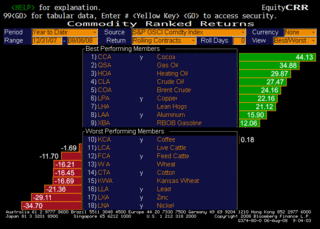
This graph just shows that wheat prices have sunk 16% year to date so far. Despite higher fuel and fertilizer prices, and the increased use of corn for bio-fuel. Wheat generally trades at a premium to corn as corn is primarily an animal feed whereas wheat is mostly used to make bread or pasta for human consumption. That relationship does not always hold, but overtime it has shown to be quite stable.

I think it just goes to prove that when we speak of the consequences of higher fuel prices on food and fertilizer that it is much more complicated then we might assume. Add in freight differentials and the picture gets much more complex. Projecting these relationships - import, export, domestic consumption, grain versus meat production, etc - into the future is not so black and white.
The organized state is a wonderful invention whereby everyone can live at someone else's expense.
User avatar
MrBill
Expert
Expert
 
Posts: 5630
Joined: Thu 15 Sep 2005, 03:00:00
Location: Eurasia

PreviousNext

Return to Economics & Finance

Who is online

Users browsing this forum: No registered users and 1 guest

cron