Donate Bitcoin

Donate Paypal


PeakOil is You

PeakOil is You

Drastic Reduction In Global Shipping

Discussions about the economic and financial ramifications of PEAK OIL

Re: Drastic Reduction In Global Shipping

Unread postby Homesteader » Mon 28 Jul 2008, 09:44:14

I've got to think marine engineers could come up with a self-feed system for steam ships powered by coal? Heck, its been done for pellet stoves.
"The era of procrastination, of half-measures, of soothing and baffling expedients, of delays, is coming to a close. In its place we are entering a period of consequences…"
Sir Winston Churchill

Beliefs are what people fall back on when the facts make them uncomfortable.
User avatar
Homesteader
Heavy Crude
Heavy Crude
 
Posts: 1856
Joined: Thu 12 Apr 2007, 03:00:00
Location: Economic Nomad

Re: Drastic Reduction In Global Shipping

Unread postby Madpaddy » Mon 28 Jul 2008, 09:45:12

$this->bbcode_second_pass_quote('Cube', ']')Owning a sailboat is like standing in a cold shower tearing up $100 bills.

That is so true. New sails for even a small boat can cost 1000's. We bought sails for our boat last year and they cost €3500 and that was a bargain. The sails should last for 10 years or more though.
User avatar
Madpaddy
Expert
Expert
 
Posts: 2043
Joined: Fri 25 Jun 2004, 03:00:00

Re: Drastic Reduction In Global Shipping

Unread postby dorlomin » Mon 28 Jul 2008, 10:00:44

$this->bbcode_second_pass_quote('Homesteader', 'I')'ve got to think marine engineers could come up with a self-feed system for steam ships powered by coal? Heck, its been done for pellet stoves.
Liquifying or powderising the coal by some means may be possible but the one thing is that the balance of the mass of the ship is very important so the coal bunkers may not be able to be placed near the boiler. That and ships have a habit of rolling in the heavier seas.
User avatar
dorlomin
Light Sweet Crude
Light Sweet Crude
 
Posts: 5193
Joined: Sun 05 Aug 2007, 03:00:00

Re: Drastic Reduction In Global Shipping

Unread postby shortonoil » Mon 28 Jul 2008, 10:12:29

$this->bbcode_second_pass_quote('dorlomin', 'W')e have a lot of coal to burn long before we need to turn to wind for ocean transport. Ofcourse though there is a labour issue with stoking boilers. Bunker oil gets fed in by flicking a switch. Coal needs a 'black gang' with shovels and back break labour.

Coal dust was a waste product and big problem for the coal mining industry until about 90 years ago. Coal dust is now MADE by crushing the coal and blowing it into a boiler with a stream of water (to increase production of CO). I doubt if anyone is going to return to shoveling coal for ships this century (unless civilization does fall completely apart, which is unlikely at best).

The end of the world is not coming, just the end of the world that you know.
User avatar
shortonoil
False ETP Prophet
False ETP Prophet
 
Posts: 7132
Joined: Thu 02 Dec 2004, 04:00:00
Location: VA USA

Re: Drastic Reduction In Global Shipping

Unread postby ReverseEngineer » Tue 29 Jul 2008, 02:23:08

OK, granted that you can't take a hull designed for prop driven power and just drop some sails on it. However at the same time you do indicate that Wind-Assisted ships are being built and that the potential fuel savings from this is in the 25-30% range. So it seems like some transition here toward sail is already happening, and one would figure it to further increase as the fuel oil decreases in supply and increases in price. This would then seem to keep shipping prices somewhat stable even in the face of rising oil prices, and at the same time is responsible for 25-30% of demand destruction on the shipping end, although clearly also to build the new ships takes a decent amount of energy in itself.

Also pretty clear is the demand destruction evident in the automotive market already. Reports today were outlining a 3.7% drop in miles driven in the month of May, the 7th such annualized decline, putting the Highway Trust Fund in jeopardy since less Gas Taxes are being collected. Less miles being driven means fewer trips to Walmart to buy Chinese Goods, which means fewer ships needed to haul those goods, further demand destruction there.

If indeed you want to try to slow down the demand destruction, you need to find some way to re-employ the people who are losing their jobs as the oil economy spins down. If you direct the movement away from oil and toward a more labor based economy, you save some oil, you maintain actual wealth production (though not as fast obviously), and you keep the money moving around through the population to some extent.

Now, the market will do this eventually by itself, but it will be quite haphazard and if you don't engineer the devolution toward human labor in some fashion, you end up with a bigger and quicker population crash then you otherwise might have had.

Most people here agree I think that it is far too late to engineer a transition off oil without pain. However, due to demand destruction, its not clear to me that the extant oil still left doesn't last about as long as as it took to use up the first half of the Earth Supply. However, figure its only half as long, maybe 50 years? Hard to say how fast and how much demand destruction continues onward here, but it seems the concept that demand for oil inexorably rises projecting out into the future is not correct. Because they can't afford the oil, people HAVE to start using less of it and they already are. More folks using bicycles, fewer cars produced, more folks using mass transit, more folks moving out of their suburban homes and Jingle Mailing the Keys to the Bank and doubling up with relatives in their houses, less folks buying stuff at Walmart shutting down more Chinese Factories putting more Chinese out of work there. How does the Chinese economy magically keep growing using internal demand? The oil is too expensive now for the Chinese to buy cars and drive them around willy nilly as we did when it came cheap. Besides, they are polluting up their environment so well they will have plenty of demand destruction from dead people. LOL.

I participate in another thread on the board here called "Planning for the Future". In that thread, people talk about their personal plans for survival when it really hits the fan. Some plans are more credible than others, but in principle I don't see why the Planning model can't work to stave off complete destruction on a larger social level. You have to make a transition back to human and animal labor with some assist from Wind Power and other sustainable energy resources at SOME point, the main question is how do you work your way back down the ladder? One way to get back down is just to let the ladder fail, everybody goes crashing downward and pretty quickly. However, demand destruction in the Market and Planning the descent could allow the population to experience a more gradual die off over a generation. Part of the process here would be finding ways to employ people to do what oil did, and building more ships which use Wind Assisted power or even are virtually entirely wind powered could do part of that job. Certainly the Container Ship is more efficient than the bulk transport ship, but again in principle its not impossible to build a large enough sailing vessel that handles containers either. I agree with the principle of having very large "hub" ports where intercontinental ships off load their goods, to be further shipped by smaller vessels plying the local trade. Water transport as noted is certainly the most efficient mover of large loads, and as much as possible you want to move the stuff around the country over the surrounding ocean first, then the navigable rivers second, the Mississippi being the main one here in North America. With the reduction in the Ice Pack, The Northwest Passage is opening up, you still have the St Lawrence seaway and the Great Lakes, the Hudson River and the Erie Canal.

Moving the goods around inside can still be accomplished with horses driven by Teamsters, by some steam locomotives powered by wood (or some coal in the downward transition). As big a load as one man can pull with a Big Rig? No way, the typical loads I pulled were in the neighborhood of 35 Tons, a horse drawn wagon system might pull 2 tons. However, having more Teamsters isn't a bad thing here, it provides more employment. Get rid of most of the oil used in the transport process and transition to human labor, you have a lot more left over to continue powering tractors an producing fertilizer for a while longer. You stretch out the end game this way.

Its hard to say how much the market forces will destroy demand, and how quickly. Its hard to say how fast the market responds to the ever decreasing supply and ever increasing price of oil. Personally, about 2 years ago when I came to the conclusion that I needed to get the heck OUT of society as best I could, I was pretty certain that by NOW the society would have ground to a complete halt. In March, when I watched Bear Stearns collapse, I was certain the Stock Market would crash completely within a month. When Fannie May and Freddie Mac went fundamentally Belly Up, it was inconceivable to me that the paper could be pushed around further to keep the House of Cards standing. Somehow though, the engine keeps churning onward, and its spinning down a lot slower than I thought it would. I go to the grocery every day, and there still is plenty of food I can afford to buy.

I'm still convinced there will be a major crash here, but I am no longer so sure of just how long it takes for it to happen. Nobody here really seems to be able to make a very good prediction either of how fast and in what manner it spins down, lot of OPINION on the subject of course though. LOL. Market forces of Demand Destruction and the Economic Shell Game Ben Bernanke is playing are slowing this whole thing down some, and I can see some ways that a catastrophic crash is delayed and a more gradual crash occurs. So in the rest of my lifetime which I project at no more than 20 years anyhow, I'm not sure these days whether I will have to go into my stock of food or hunt and fish for all my food in the future either. Doesn't hurt to be prepared though :-)

Reverse Engineer
User avatar
ReverseEngineer
Intermediate Crude
Intermediate Crude
 
Posts: 3352
Joined: Wed 16 Jul 2008, 03:00:00

Re: Drastic Reduction In Global Shipping

Unread postby ReverseEngineer » Tue 29 Jul 2008, 03:12:39

$this->bbcode_second_pass_quote('MrBill', 'W')ell, if you're so smart, and sure the economics are there already, then you should open up a shipyard. Good luck. Let us know how it turns out? Cheers. Yatch World - new and used sailing vessels

You are clearly being sarcastic here, but let me respond in a matter of fact fashion.
If I had the kind of capital to open up a shipyard, I probably would do it, much like T. Boone Pickens is using his oil based capital to build a Windfarm in TX. He's trying to operate ahead of the curve, although this exercise in alternative energy infrastructure building is too little too late to make that big a difference in the overall outcomes.

It also occured to me as a choice in getting out of society to use my capital to build a sailboat complete with wind turbines and solar cells and a reverse osmosis water maker and plop myself on an island somewhere in the South Pacific. However, I got no desire to end up like Fletcher Christian on Pitcairn Island with a bunch of Native Girls inbreeding ourselves to cretinism.
I don't have the kind of capital it takes to open a shipyard, maybe you do. If so, you might start operating ahead of the curve rather than trailing along behind it.

Dispense with the sarcasm. Its counter productive.

Reverse Engineer
User avatar
ReverseEngineer
Intermediate Crude
Intermediate Crude
 
Posts: 3352
Joined: Wed 16 Jul 2008, 03:00:00

Re: Drastic Reduction In Global Shipping

Unread postby MrBill » Tue 29 Jul 2008, 03:59:26

You're right the criticism is not necessary, but when you start accusing me of obfustication, not living in reality and not understanding economics and finance then you obiviously open the door slightly for me to show you how naive some of your own statements are. I will stop if you will stop.

There is no reason to open a shipyard. If you look around the globe more shipyards are closing than opening up. Basically any shipyard not benefiting from state aid, soft loans and cheap labor are gone. See Poland and Russia for examples. Those that are opening up in China are based on false economics and churning out shoddy products. See my comments in this thread that come from those actually in the shipping business.

Basically, due to the slowdown in the global economy there are more used sailboats for sale than buyers. Not surprisingly they are selling at large discounts to new boats. If it your desire to own such a boat then you do not need to be T. Boone Pickens to buy one.

I am really uninterested in theoretical arguments that are not based on hard facts. My interest is post peak oil resource depletion issues. Depletion economics. Where we are? How we got here? Where we are going? SWOT analysis. That is not an exercise in fantastical musing. That is a hard, systematic assessment of our environmental and economic limits to growth, and the social and political consequences of those limits.

That is based on the social-political institutions and economy we already have and not based on some fuzzy wish that we can magically transition to a new reality just because the alternative seems to be unpalatable. Many of my ideas are based on living, working and studying in emerging markets over the past 20-years, and my observations of living conditions in those developing countries. My understanding of this subject is not dependent on you sharing my views. Although your input is always appreciated. Thanks.
The organized state is a wonderful invention whereby everyone can live at someone else's expense.
User avatar
MrBill
Expert
Expert
 
Posts: 5630
Joined: Thu 15 Sep 2005, 03:00:00
Location: Eurasia

Re: Drastic Reduction In Global Shipping

Unread postby ReverseEngineer » Tue 29 Jul 2008, 05:53:37

I'm learning quite a bit from you Mr.Bill, though we don't have quite the same spin here. My writing is different from yours also, its more prone to metaphor and less technical, but to call me "naive" is an ad hominem argument in itself, given you don't really demonstrate the nature of the naivete. All you really do is paint your spin as the better researched one, which frankly I agree it is :-) Will I stop tweaking you in this discussion? Only when you stop tweaking me by calling me "naive". Which came first here, the Chicken or the Egg? Your posts on the subjects I have read so far show a vast depth of knowledge, but they also show a very particular kind of viewpoint which in itself is limited. As I perceive what you write, you don't think outside the box, rather you box everything into traditional economic principles you are comfortable with. When I tweak you, its to make you try to think outside that box, and once you get to know me better, you will find I do this sometimes with arguments counter to what I actually believe. I do it to try to get more than just the pat answers or the straightforward analysis. If you are a smart guy, and I think you are, you will come up with answers that are different in some way, and that is what I look for. Its quite simple just to read here the spin each of the long term members of the board have in the archives, its less simple to actually make you all think a little. Each person here has carved out a niche for themselves they are comfortable with, I am new here though and I am a Loose Cannon. You don't really know what I think yet, the discussion we are having is an exploration. I'm picking your brain here Mr. Bill, just you gotta be a bit patient with me in how I do this. I'm not naive, though sometimes I either play naive or in a given area I dont know all the facts, but I sure have spent plenty of time thinking about the problems facing us. I came to my conclusions in the absence of any discussion with anyone, I never even heard of "Peak Oil" before a few months ago when I ran across an article that mentioned it. Nevertheless, I came to mostly the same conclusions most of you came to a while back. So how is that "Naive"?

I am also more interested in possible outcomes and post peak oil depletion issues, but we differ in the approach here. You only wish to discuss what you call "hard facts", but really I have yet to see any hard facts at all, just a spin on the economics, which about everyone knows is a "soft" science. While I was trained as a physicist and mathematician, these days my analysis is more metaphorical and philosophical. So I am NOT so interested in trying to nail down numbers here as I am in trying to examine the absolute nature of society. I do get from you a clear picture of the economic analysis, but to my mind it is incomplete and its certainly not answering the questions in my mind regarding the speed at which the meltdown occurs nor the absolute fashion in which it occurs. Its a part of the puzzle, but by no means is it the complete puzzle, its very boxed in.

In any event, try to bear with me. I think differently then you do, but I am hardly naive, and I do not appreciate being called so. There are many variables involved here we don;t have a good grasp on yet, so your hard facts and my metaphors need to find a common ground if this discussion is to prove fruitful. You are a Nuts and Bolts guy, I am a Big Picture guy. Somewhere in between these viewpoints lies the TRUTH. Lets work together to find it. Calling me "naive" or getting sarcastic with me just won't facilitate that exploration, but of course neither will my playing games with you, so I will stop that if you grant me the freedom to make an independent analysis based on philosophy rather than the "facts", which aren't really facts at all, just opinion.

Reverse Engineer
User avatar
ReverseEngineer
Intermediate Crude
Intermediate Crude
 
Posts: 3352
Joined: Wed 16 Jul 2008, 03:00:00
Re: Drastic Reduction In Global Shipping

Unread postby Canuk » Wed 30 Jul 2008, 12:31:57

Here's an article about reucing shipping distances and shows the reduction in US imports (a little old its from early this month): link
$this->bbcode_second_pass_quote('', '')But on a global scale,” says Bingham, “we are seeing a lot more regional activity designed to shorten supply chains and save ocean carriers cost.”
Trade lanes in Southeast Asia and the Mediterranean are two prominent examples of this trend say analysts, pointing to the fact that carriers can use smaller vessels and spend less money on fuel. “And on the Trans-Pacific and Trans-Atlantic lanes, we are seeing more rationalization and new alliances,” says Bingham.

This morning my business was asked to quote on a robot and some tooling for a marine part that is coming back to Canada after oringinally being sourced in China. Higher than expected costs and long lead times were cited as reasons - might just be an isolated incident or possibly the first of a trend.

Reverse Engineer - there is a tall ships thread started that you might want to look at - others share your theory: link
User avatar
Canuk
Peat
Peat
 
Posts: 109
Joined: Fri 04 Jul 2008, 03:00:00
Location: Hamilton, Ontario, Canada
Top

Re: Drastic Reduction In Global Shipping

Unread postby MrBill » Thu 31 Jul 2008, 03:25:24

Thanks canuk. Going back to my post about Chinese workers living and working in Romania to produce goods for the EU. I was speaking to my friend from the German shipping company in Cyprus yesterday about it. I completely forgot about the Danube. Of course, from Romania the quickest way by water is up the Danube by barge. That is not to say that low volume, high value goods do not still go by truck due to the time value of money and the cost of capital, but bulk can still move by barge or in containers.

Inland waterways like the Erie Canal or the Rhine-Main-Neckar in Germany can only become more valuable over time as energy prices increase. Look on a map. Milan used to have an extensive canal system linking it to the Med. That was their source of competitiveness before rail and truck. Most of that network has fallen into to disrepair. If they are smart and forward looking they will realize the economic value of dredging and reactivating those canals again.

All great cities of the past sprung up in and around waterways. That is also the future.
The organized state is a wonderful invention whereby everyone can live at someone else's expense.
User avatar
MrBill
Expert
Expert
 
Posts: 5630
Joined: Thu 15 Sep 2005, 03:00:00
Location: Eurasia

Re: Drastic Reduction In Global Shipping

Unread postby the48thronin » Thu 31 Jul 2008, 04:12:49

$this->bbcode_second_pass_quote('cube', 'N')O !!!
Sailboats are completely different. Sails cannot just simply be slapped onto any regular ship. Because a sailboat has to be pushed by the wind it's hull is totally different, structurally speaking.
The wind forces would totally rip a regular ship's body to shreds if sails were simply slapped onto it.


Excuse me... picture a wind turbine and electric motor driving conventional propeller if you are desperate to convert.... same hull same dynamic pressures a couple small wind turbines mounted fore and aft in slightly reinforced muntings... It is possible if it had to be done.


PS, as I think on my 25 ft columbia........I think on all the hundred dollar bills I do not spend on fuel when I am sailing.

(sorry I could not resist)
Malthusian Riders Member!

Courtesy and Courage Sincerity and Self-control Honor and Loyalty a Code to Live By!
What do the miners do when the canary dies? EVACUATE THE MINE not argue about the color of it's feathers or buy a parrot instead.

Where is my pitchfork and torch? I need them for a visit to the castle!
User avatar
the48thronin
Tar Sands
Tar Sands
 
Posts: 871
Joined: Fri 30 May 2008, 03:00:00
Location: On the highway, or the water somewhere!
Top

Re: Drastic Reduction In Global Shipping

Unread postby MrBill » Thu 31 Jul 2008, 04:28:09

Huh? Wind turbines mounted fore and aft? How large would they have to be relative to the size of the vessel and the weight of the cargo? How could the wind be converted into forward momentum if you were sailing into the wind? You would need to convert more energy than you were using. What about the 800X drag of the water versus air plus the additional drag of waves and current? The wind turbines themselves are a source of drag. It might work on a carbon-fiber surfboard, but not in a container ship. Sorry it cannot be done.
The organized state is a wonderful invention whereby everyone can live at someone else's expense.
User avatar
MrBill
Expert
Expert
 
Posts: 5630
Joined: Thu 15 Sep 2005, 03:00:00
Location: Eurasia

Re: Drastic Reduction In Global Shipping

Unread postby the48thronin » Thu 31 Jul 2008, 04:54:31

$this->bbcode_second_pass_quote('MrBill', 'H')uh? Wind turbines mounted fore and aft? How large would they have to be relative to the size of the vessel and the weight of the cargo? How could the wind be converted into forward momentum if you were sailing into the wind? You would need to convert more energy than you were using. What about the 800X drag of the water versus air plus the additional drag of waves and current? The wind turbines themselves are a source of drag. It might work on a carbon-fiber surfboard, but not in a container ship. Sorry it cannot be done.


Possibly it can"t be done... I think I remember seeing a design that used the vertical roters with generators mounted properly below decks for stability. Motion on that design was from 4 prop shafts using conventional propellers. ( Would water jet pumps and directional exhaust ease navigation?) Was it ever built? I do not know. Could it sail directly upwind? No more than my Columbia can. ( this is one drawback of wind power in sails also), but the turbine idea might overcome the labor issue and was offered only as a possibility if conversion was necessary as PO effects might be approaching a critical point and development might have to utilize existing hulls. could the vertical turbines be stowed and double as on-board crane mounts Why not? Could you expect to stack the containers as high as present day? I do not think so, but we are talking a P O solution not a continuum of current practices.

I do understand hull drag a little, I also know about bubblers and drag reduction to increase speed for less power in torpedos...just as I use drag reduction on my truck to reduce fuel costs that was developed for fighter planes and cruise missiles. ( airtab )

It is an interesting idea, a better one than triremes and slaves at oars the next step back from wind power to propel ships.


( PS I do enjoy your posts thank you for sharing your knowledge.)
Malthusian Riders Member!

Courtesy and Courage Sincerity and Self-control Honor and Loyalty a Code to Live By!
What do the miners do when the canary dies? EVACUATE THE MINE not argue about the color of it's feathers or buy a parrot instead.

Where is my pitchfork and torch? I need them for a visit to the castle!
User avatar
the48thronin
Tar Sands
Tar Sands
 
Posts: 871
Joined: Fri 30 May 2008, 03:00:00
Location: On the highway, or the water somewhere!
Top

Re: Drastic Reduction In Global Shipping

Unread postby CarlosFerreira » Thu 31 Jul 2008, 07:05:17

This remind me of the study by Ayres and Warr, "Accounting for Growth: The Role of Physical Work". The pdf is available online. I can't really comment on the value of this research, but considering they are right, most growth depends on energy usage and energy efficiency. This is very important. Imagining the current globalized work could get by on wind power alone is pretty much like believing this is the train of the future.

Anyway, bringing those production facilities back from Asia isn't the cheapest, most efficient way, yet. We'll probably see some of that, but not everything will come back. First prices of products will increase due to shipping cost so much that demand is really destroyed. I wonder if, when we get to that point, the economy (due to escalating energy costs) won't be in such a bad shape that it simply doesn't matter.

Production went to Asia for a number of reasons, but 3 were very important: it was cheaper, due to lower labour costs; environmental laws were less restrictive than in the western world (effectively, we exported our impact on the planet to Asia); fuel prices allowed for cheap, efficient transportation.

Coming back only solves one of the problems: transportation costs. Those can be sustained, with some inflation in home soil. Private transportation will be the first to suffer, I guess. There will be oil for the boats to move for a long while yet. More efficient solution will be devised.

As for "canaries in the mine" of transportation and logistics, I'd keep an eye on these guys. Their business is supply chain management: imagine you want to build a radio: they'll locate the cheapest factories to produce each component, have all the components shipped around for partial assemblies and finally arrange for the transport back home. Interesting, really - your radio know a lot of asian countries and provinces by the time it arrives at your hand. I wish they'd publish reports of average kilometers contracted per year, we'd have an interesting idea of the state of shipping and land transport.
Environmental News and Clippings:
http://www.google.co.uk/reader/shared/1 ... 4898696533
Environmental Economics and Systems
http://enviroecon.wordpress.com/
CarlosFerreira
Tar Sands
Tar Sands
 
Posts: 734
Joined: Wed 02 Jul 2008, 03:00:00
Location: Canterbury, UK

Re: Drastic Reduction In Global Shipping

Unread postby MrBill » Thu 31 Jul 2008, 07:53:31

A Japanese inventor was able to convert the up and down action of waves to power to drive his boat. Quite interesting, but the technology is still in its infancy. I would equate it to if I am standing in shallow water I may be able to push your 25' sailboat through the water. But there is no way I could push a fully loaded container ship.

I do agree we can ship in smaller boats, but that defeats the purpose of economies of scale. By that point it makes more sense to produce and to source locally or regionally. In other words the end to globalization per se as it relates to production and consumption decisions.

But I guess my point is that although wind assisted technology and other alternative solutions may help shipping economics by reducing our reliance on fossil fuels is that due to their size that large (or very large) container ships can burn a variety of fossil and non-fossil fuels. Therefore before we return to sail technology we might first transition through coal to liquids technology and even wood pellets as the source of bunker fuel. Wind, wave and solar then would be used primarily as a source of onboard electrical power and not thrust.

On an unrelated point I heard some interesting things last night. One there is a container port in Hamburg that is almost entirely controlled remote. Crane operators are still used, but otherwise all the containers are loaded, unloaded and cross-loaded completely automatically or by remote operators.

Contrast that with Cape Town and the port is almost entirely run by men. This is a make work project. The problem is due to black empowerment initiatives that state that 'X' percent of the port workers must be colored. That alone is not the problem, but apparently some black crane operators have problems with depth perception? So they end up damaging a lot of containers, their loads and causing delays due to an inability to judge when to brake as they move containers into place. But automation is not an option as it is a government sponsored make work project.

I think we all naively assume that the invisible hand of the market is at work and we forget about government interference into every nook and cranny of the market place.

Also, I learned that shipping companies try not to mix crews to reduce potential onboard conflicts. For example, you cannot mix Coatians and Serbs on the same ship. Or Muslims and non-Muslims. As well as each country has their own tariffs for ship labor each ship is paid according to the wages and deductions unique to that particular country. So a ship full of Poles might be paid a different wage tariff than a ship with a Filipono crew.

The problem is cultural. A ship run predominately with crew of one culture may maintain the ship quite differently than a crew of another country. There are obviously nations that are famous for their seamenship, fishing or sailing. Others not. But its also a matter of trust. And who can work independently without being supervised the entire time. But a shipowner or a captain would also want to preserve harmony on board as well. The more I learn about the industry the more fascinating I find it all.

Little known facts. All of Cyprus has between 900-1000 ships under management. The city of Patrai (Patras) in Greece alone has over 3000 vessels under flag. I think from the outside looking in that we tend to also overlook the network effect and the body of knowledge that is built-up around one specific industry. The oil industry in Houston or Calgary. The offshore drilling knowledge in Aberdeen. The search for oil may change locations, but the know-how follows.

Surging Bunker Prices Pushing Up Freight Costs A very interesting podcast from Platts on Tanker Economics
$this->bbcode_second_pass_quote('', 'T')he surging bunker prices currently being experienced within the market are pushing up freight costs, which industry sources are predicting will lead to the earnings of tanker owners in 2008 being severely dented.

PODCAST

William Bathurst, an editor on Platt’s marine desk, discusses surging bunker prices and the subsequent effect of these on increasing freight costs. Click here to listen to the Podcast.
TANKER
The organized state is a wonderful invention whereby everyone can live at someone else's expense.
User avatar
MrBill
Expert
Expert
 
Posts: 5630
Joined: Thu 15 Sep 2005, 03:00:00
Location: Eurasia
Top

Re: Drastic Reduction In Global Shipping

Unread postby Canuk » Thu 31 Jul 2008, 12:31:27

$this->bbcode_second_pass_quote('MrBill', '
')Inland waterways like the Erie Canal or the Rhine-Main-Neckar in Germany can only become more valuable over time as energy prices increase. Look on a map. Milan used to have an extensive canal system linking it to the Med. That was their source of competitiveness before rail and truck. Most of that network has fallen into to disrepair. If they are smart and forward looking they will realize the economic value of dredging and reactivating those canals again.

All great cities of the past sprung up in and around waterways. That is also the future.


Agreed - unfortunately large portions of these canals have fallen into disuse and require extensive repairs. In fact in Syracuse NY they filled in the canal that ran through town and created "Erie Boulevard" a commercial strip for big box stores and strip malls. Of course it could alwasy be replaced but at considerably more expense.

Many of the original North American settlments were located on waterways since that was the only reasonable means of moving bulk goods. Only with the advent of the railroad did towns start to spring up in odd geographic locations giving us the grid layout of the midwest since they were used to refuel the trains. Another future problem is the growth in hydro power as many of the old water routes such as the Grand River in Southern Ontario have been dammed and no provision was left for docks since we had railroads.

$this->bbcode_second_pass_quote('MrBill', '
')On an unrelated point I heard some interesting things last night. One there is a container port in Hamburg that is almost entirely controlled remote. Crane operators are still used, but otherwise all the containers are loaded, unloaded and cross-loaded completely automatically or by remote operators.

Contrast that with Cape Town and the port is almost entirely run by men. This is a make work project. The problem is due to black empowerment initiatives that state that 'X' percent of the port workers must be colored. That alone is not the problem, but apparently some black crane operators have problems with depth perception? So they end up damaging a lot of containers, their loads and causing delays due to an inability to judge when to brake as they move containers into place. But automation is not an option as it is a government sponsored make work project.


This is also be due to the local labour rates and level of technology in the support infrastructure. Hamburg has high labour rates (and strong labour unions) and a diverse and advanced technological support infastructure (supply companies, mechanical and electrical subcontractors, etc.) all of which support the automation of tasks. I am unfamiliar with South Africa but would hazard a guess that the lower cost of labour and the lower level of technical support in their market would inhibit automation projects.

For the same reason that fully automated robotic workcells make economic sense in Southern Ontario the same product will be assembled in Mexico with mechanical assists and some minor automation. The technological infrastructure though present is not as robust and the labour rates low enough to easily offset the increase.

Any type of automation project would need to have a farily decent ROI to offset the risks by implementing more advanced technologies in the South African market.
User avatar
Canuk
Peat
Peat
 
Posts: 109
Joined: Fri 04 Jul 2008, 03:00:00
Location: Hamilton, Ontario, Canada
Top

Re: Drastic Reduction In Global Shipping

Unread postby MrBill » Fri 01 Aug 2008, 04:43:40

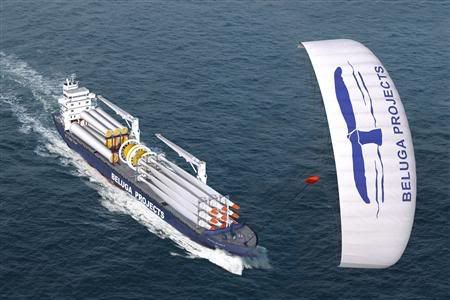
Here is a photo of that sail assisted container ship.

Image

From all the aid workers, project engineers, businessmen, etc. that I have spoken to with regards to projects in Africa is that they are generally set-up and running quite smoothly at first, but as time goes on there is no one their to maintain these plants, factories, projects, etc. Then they either fall into disrepair or parts are canibalized. Theft of critical parts that leave the whole unusable. It is not unusual to hear them say comments like, "we had it running, but when I went back three years later there was nothing left." So you not only need to automate the port at considerable cost, but you need a trained, reliable workforce to keep it running.

Image

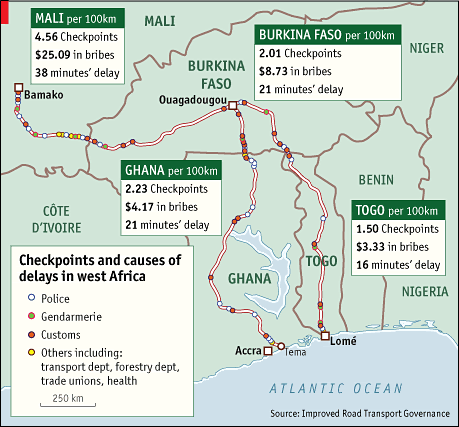
I co-authored a paper with a S. African on risk management in S. Africa. We identified risks over time. There is obviously a difference between say distributing softdrinks or beer from a centralized warehouse to neighboring countries as the risk is that you lose one load. You pay your bribes to the police or border guards, which is a hassle but it is a cost of doing business. And then you get paid up front when you deliver the load. That is one kind of risk. A quite low one.

Image

Another type of risk that is considerably higher is when you attempt to build a factory or a mine in one of these countries. Then you deal with corruption on a whole other level. And once you have sunk costs in your project it is not so easy to walk away. Therefore you're more vulnerable to corruption on an ongoing basis and officials have leverage over you because they know you cannot leave. So therefore, it might make more sense to manufacture outside the country and only sell into the country. That naturally does very little for the economic development and does not create jobs in that country.

Image

Special economic zones along the coast can sometimes overcome some of these problems. The deeper inland you go the more vulnerable you are to local conditions. Like roadblocks and being shaken down by the local police every 50 or 100 kms.

Image

One of my S. African friends just got back from there a few weeks ago. Had all his stuff stolen from where he was staying. As he says, you just leave your guard down for a second and it is long enough to create an opening for the thieves. You cannot believe how many ex-S. Africans live here in Cyprus. A lot of them in the shipping industry. But they all left out of safety concerns for them and their families. Especially the violence related to crime. So naturally port security is a huge issue as well.
The organized state is a wonderful invention whereby everyone can live at someone else's expense.
User avatar
MrBill
Expert
Expert
 
Posts: 5630
Joined: Thu 15 Sep 2005, 03:00:00
Location: Eurasia

Re: Drastic Reduction In Global Shipping

Unread postby skeptik » Fri 01 Aug 2008, 05:11:54

$this->bbcode_second_pass_quote('MrBill', ' ')How could the wind be converted into forward momentum if you were sailing into the wind?


Gearing. I agree it seems counterintuitive, and I too was skeptical when I first heard of it

http://www.treehugger.com/files/2007/02 ... sailbo.php

http://www.boatdesign.net/forums/showthread.php?t=1289
User avatar
skeptik
Coal
Coal
 
Posts: 418
Joined: Wed 24 Aug 2005, 03:00:00
Location: Costa Geriatrica, Spain
Top

Re: Drastic Reduction In Global Shipping

Unread postby BlueGhostNo2 » Fri 01 Aug 2008, 05:33:49

Just to chip in, Bill I've heard of sky sails before and it's not 'sail assisted' technology, thats a computer controlled power kite.
Will be epic when they get big enough that the container ships can do kite loops :D Kite Loop

More seriously, we already have nuclear powered subs and aircraft carriers, and commercially profitable nuclear power stations.

So, I imagine when we get to a high enough price of oil along with a large enough ship it will become profitable to have nuclear powered cargo ships...
User avatar
BlueGhostNo2
Peat
Peat
 
Posts: 124
Joined: Tue 24 Jun 2008, 03:00:00

Re: Drastic Reduction In Global Shipping

Unread postby MrBill » Fri 01 Aug 2008, 06:04:47

Yes, I made up the term 'sail assisted' just to differentiate it from sailing ships where wind is the primary thrust whereas the computer controlled kite is not the primary means of propulsion, but assists it to save on fuel costs.

No doubt we will also see micro nuclear reactors onboard very large container ships as companies like Toshiba improve that technology, but I think also realistically if we speak about scale that it will be hard to convert every ship to nuclear. I think there is a difference between a few nuclear icebreakers and whole commercial shipping fleets.

UPDATE:

Interesting links on the wind turbines and catamaran. Some interesting innovations. Of course, scale and scalability. One is a light-weight carbon-fiber surfboard, and the other is a rather large wind turbine mounted on a rather small catarmaran with very little wave resistance due to its twin hull design. Obviously, with the hull design and added weight of a container ship they would have to be proportionately larger.

Also thinking about the cost of crews, and having to for example feed them, we cannot forget that ships must keep fairly tight schedules. If we are talking about only a few noughts per hour it might dramatically increase sailing times and reduce the economics versus regional manufacturing and shorter supply chains. Under the motto just because something is possible does not mean it makes economic sense.
Last edited by MrBill on Fri 01 Aug 2008, 08:38:41, edited 1 time in total.
The organized state is a wonderful invention whereby everyone can live at someone else's expense.
User avatar
MrBill
Expert
Expert
 
Posts: 5630
Joined: Thu 15 Sep 2005, 03:00:00
Location: Eurasia

PreviousNext

Return to Economics & Finance

Who is online

Users browsing this forum: No registered users and 1 guest

cron