Ok. kublikhan says that the blue line rose because of cheap oil, thus cheap gasoline, even though it rose in direct relation to MPG gains
and the decline of gallons per vehicle.
This is pure coincidence?
Look at the three lines correlation before 1973. The lines are pretty parallel except for GPV consumption from about 1967 to 1973 when the oil crisis hit. The muscle cars of that era caused that GPV rise. The Hemi-Cuda, Roadrunner, Z28, etc.
Then, in 1973, MPG improved a little as people drove slower and bought Japanese vehicles. MPV and GPV dropped as gas was rationed.
1974 -75 all three lines are now rising parallel to each other until the Arab Embargo in 1979. Then MPV and GPV dropped while MPG rose due to slower speeds, the depression at that time, and people buying more efficient and smaller cars from Japan.
Then suddenly, GPV goes flat, and MPV an MPG rise parallel to each other.
We are to disregard this direct correlation and evidence of Jevons Paradox and believe it was cheap gas that made MPV rise?
Man...that had to be some cheap gas, indeed! Cheaper than before 1973 even, right? Otherwise why wasn't MPV going up like crazy then? MPV was only rising slightly while MPG was sligthly declining as the chart shows.
So, what was the price of gas during these periods?
1970 $.35/gal
1980 $1.22/gal
1981 $1.35/gal peak
1990 $1.09/gal
1991 $1.15/gal
2000 $$1.66/gal
Here is the data from a guy living in Texas using 1090 fill ups of Super unleaded, the most expensive.
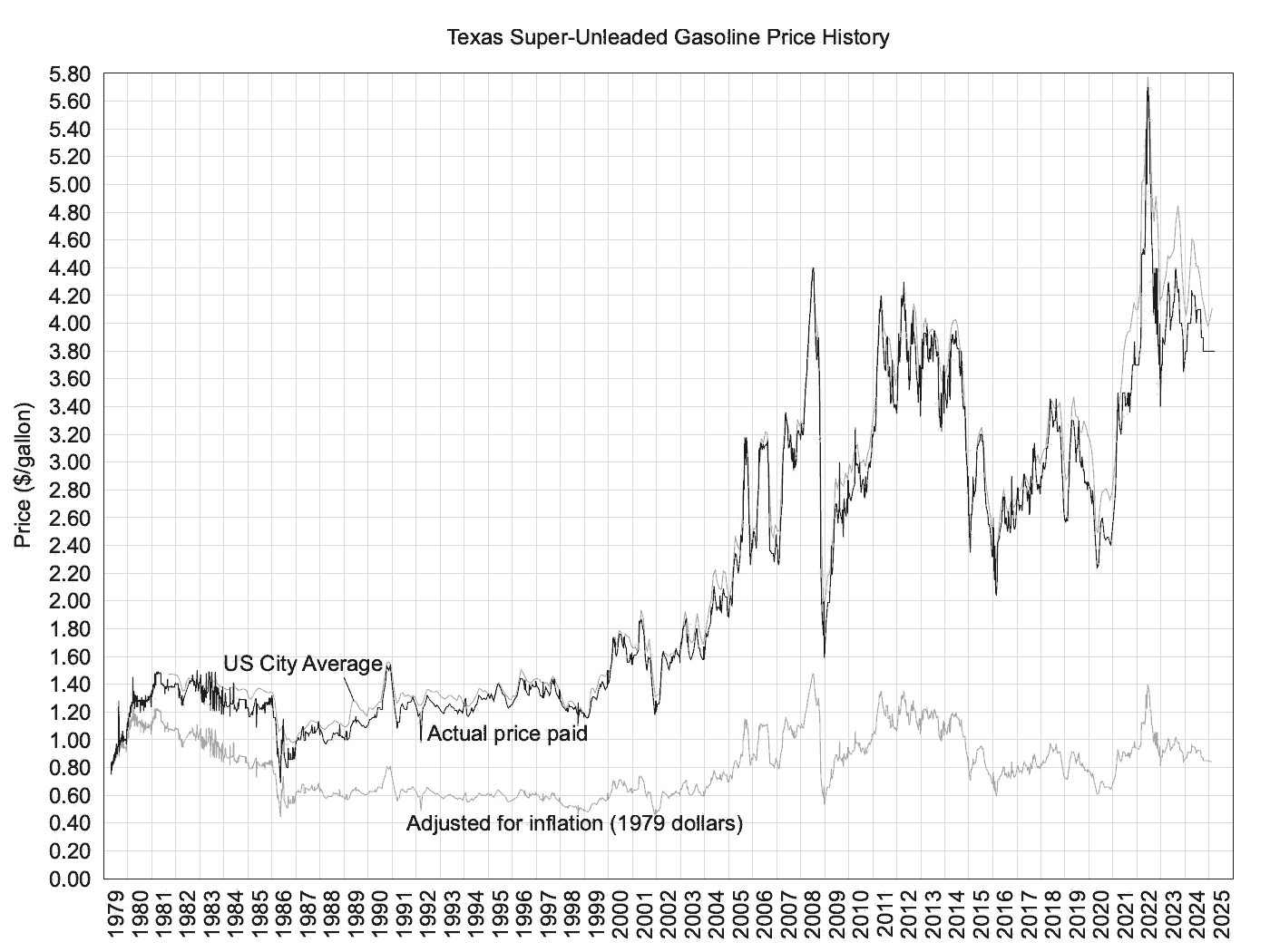
Looks like gas prices were rising when MPV started it's climb in 1981-82, not dropping and then only a few cents. The faint line next to the dark line, shows the average price for the entire U.S., from the Bureau of Labor Statistics.
Where is this $.10 cents a gallon or "cheap gas" that caused MPV to rise, kublikhan?
Hmmm?
Looks like more efficient engines and cars drove up MPV & GPV.
It's called Jevons Paradox.
A Saudi saying, "My father rode a camel. I drive a car. My son flies a jet-plane. His son will ride a camel."



 by kublikhan » Fri 11 Jul 2008, 18:23:24