$this->bbcode_second_pass_quote('AirlinePilot', '
')If paid, high level analysts are making these kinds of errors in factual analysis and then advising large multinational corporations and governments on future outlooks and plans, we are basically doomed.



PeakOil is You
Crude oil prices: Energy Bubble?
Re: Is the Oil and Energy Bubble About to Burst?
 by EnergyUnlimited » Tue 06 Nov 2007, 16:28:56
That is one of most perplexing aspects of PO and prospective doom.
But hey, you are dealing with economists here...
Perpetual exponential growth in finite world problem.
-

EnergyUnlimited - Light Sweet Crude

- Posts: 7537
- Joined: Mon 15 May 2006, 03:00:00
Re: Is the Oil and Energy Bubble About to Burst?
by Twilight » Tue 06 Nov 2007, 17:33:44
$this->bbcode_second_pass_quote('AirlinePilot', 'O')ne respected analyst actually believes OPEC has at it's immediate disposal 4mbpd of "excess supply" and there in lies your problem.
I fail to grasp how they can get it so wrong at this critical juncture.
If paid, high level analysts are making these kinds of errors in factual analysis and then advising large multinational corporations and governments on future outlooks and plans, we are basically doomed.
I fail to grasp how they can get it so wrong at this critical juncture.
If paid, high level analysts are making these kinds of errors in factual analysis and then advising large multinational corporations and governments on future outlooks and plans, we are basically doomed.
The problem is a failure to re-examine starting assumptions, perhaps even use of "data" having failed to recognise it as an assumption. If KSA has, say, 10.5mb/d capacity on paper and is pumping 8.5mb/d, then it has 2mb/d excess capacity. However, not all pieces of data are equal. In this case, one is very old. It is frequently cited, so he may not fully appreciate that. Even experts of international repute can take data for granted and forget to personally verify whether it remains current.
- Twilight
- Expert

- Posts: 3027
- Joined: Fri 02 Mar 2007, 04:00:00
Re: Is the Oil and Energy Bubble About to Burst?
by roccman » Tue 06 Nov 2007, 17:40:36
$this->bbcode_second_pass_quote('Twilight', '')$this->bbcode_second_pass_quote('AirlinePilot', 'O')ne respected analyst actually believes OPEC has at it's immediate disposal 4mbpd of "excess supply" and there in lies your problem.
I fail to grasp how they can get it so wrong at this critical juncture.
If paid, high level analysts are making these kinds of errors in factual analysis and then advising large multinational corporations and governments on future outlooks and plans, we are basically doomed.
I fail to grasp how they can get it so wrong at this critical juncture.
If paid, high level analysts are making these kinds of errors in factual analysis and then advising large multinational corporations and governments on future outlooks and plans, we are basically doomed.
The problem is a failure to re-examine starting assumptions, perhaps even use of "data" having failed to recognise it as an assumption. If KSA has, say, 10.5mb/d capacity on paper and is pumping 8.5mb/d, then it has 2mb/d excess capacity. However, not all pieces of data are equal. In this case, one is very old. It is frequently cited, so he may not fully appreciate that. Even experts of international repute can take data for granted and forget to personally verify whether it remains current.
A 295% increase overnight seems a strecth, but the "experts" use these numbers today...
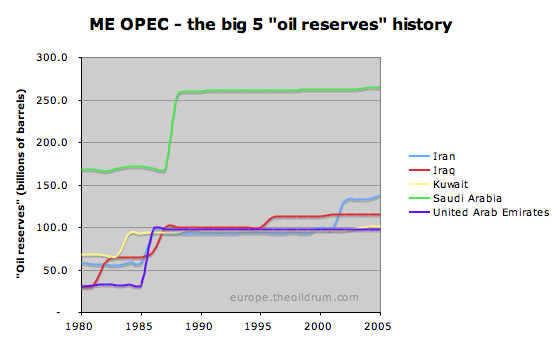
TOD on "reserves"
"There must be a bogeyman; there always is, and it cannot be something as esoteric as "resource depletion." You can't go to war with that." Emersonbiggins
-

roccman - Light Sweet Crude
- Posts: 4065
- Joined: Fri 27 Apr 2007, 03:00:00
- Location: The Great Sonoran Desert