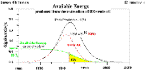
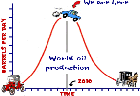
For me, the actual "peaking" of oil production is not as important as peak cheap oil, which I believe we've reached. Even if these finds could add a couple of million barrels per day to supply, it's only going to ramp up the ability of another few million or tens of millions of Chinese, Indians, Vietnames, etc to drive cars, crank up manufacturing, and generally burn it up as fast as it can be brought online.
On a side note, there's not a whole lot of positive to be gained by people believing that there's always going to be "another solution" or "millions more" out there - we'll just crank up the destruct-o-meter another few pegs as we assist in the acceleration of global warming, massive resource depletion & extinctions. I love a hot shower and taking a drive as much as the next person, but I think an orderly shutdown is preferable to all-out oil warfare. Because the bottom line is at some point, whether next week, next year, or next decade, or longer, we're going to hit a point of declining returns. If we've brought another 10 million barrels per day of users online when we hit that mark, it's just going to be that much more painful.


PeakOil is You
THE Ghawar Thread (merged)
Re: Ghawar field reserves decline overstated, survey says
 by jdmartin » Sat 15 Dec 2007, 02:50:44
After fueling up their cars, Twyman says they bowed their heads and asked God for cheaper gas.There was no immediate answer, but he says other motorists joined in and the service station owner didn't run them off.
-

jdmartin - Heavy Crude

- Posts: 1272
- Joined: Thu 19 May 2005, 03:00:00
- Location: Merry Ol' USA
Re: Ghawar field reserves decline overstated, survey says
by Valdemar » Sat 15 Dec 2007, 13:15:58
$this->bbcode_second_pass_quote('Oil-Finder', 'L')onger being . . . "several years." Oil production in the Bakken is *already* increasing, but the play is still in its infancy so there's still a lot of room for it to increase. It'll be a gradual process.
And final output rates? It doesn't matter if it's only making up for declines elsewhere.
$this->bbcode_second_pass_quote('', 'O')h. If you're going to use sarcasm you should use the

I don't see why I should do that for someone above the age of 10. It was obvious enough.
$this->bbcode_second_pass_quote('', 'A')nother peak oiler dismissal, minimization and excuse.
Oh hey, what a great rebuttal.
$this->bbcode_second_pass_quote('', 'F')unny you should mention China. It's not as if the Chinese are just sitting there, sipping away at the world's oil without doing exploration and development of their own. In fact, according to one Chinese academic they may be sitting on their own large reserves. India is doing the same, with some initial success.
Great. Let me know when they're pumping it. "Massive" potential oil discoveries are two a penny and it's not stopped demand outstripping supply so far.
"Nothing survives. Not your parents. Not your children. Not even stars."
-Pinbacker, Sunshine
-Pinbacker, Sunshine
-

Valdemar - Lignite

- Posts: 356
- Joined: Wed 28 Mar 2007, 03:00:00
- Location: Cambs., UK