Donate Bitcoin

Donate Paypal


PeakOil is You

PeakOil is You

Transport congestion

What's on your mind?
General interest discussions, not necessarily related to depletion.

Transport congestion

Unread postby JohnDenver » Thu 17 Feb 2005, 09:05:37

Some material on recent transport congestion here:
Article

"Arch Coal Inc. (ACI.N: Quote, Profile, Research) is the latest U.S. coal miner to warn about the pain of transportation delays. Earlier this week, it forecast a weaker first quarter in part due to railroad bottlenecks and barge delays that have hampered deliveries, offsetting the benefits of sky-high coal prices."

This puts a different slant on the discussion of bottlenecks. At the moment, energy prices are high, but that is not what is driving transport costs up. The real cause of transport cost inflation (at the moment) is strong growth combined with overloaded transport infrastructure.

A peak oil investor could get goofed up by this kind of phenomenon. Imagine somebody who knew about the "end of cheap coal", and invested in Arch Coal to capitalize on it. The price of coal rose, as expected, but the investment can't perform due to the "end of excess transport capacity". Focusing too much on energy as the limiting factor can lead you astray.

In fact, a good case could be made that congestion is the typical failure mode of extremely complex systems. Look at computer networks or power grids: they don't crash due to lack of energy. They crash due to congestion related phenomena which cause cascading failures.

Also from the article:

""It depends on whether you believe it's short-term or long- term disruption," Monahan said. "Some are restructuring the supply chain. If I'm using vendors that are more remote, there may be advantages to finding a closer supplier."
Most companies have not hit that "trigger point" yet, but there is evidence of companies that were outsourcing 100 percent offshore now hedging and moving 30 percent back closer to home, he added."

So a certain degree of relocalization is already happening, and it has nothing to do with scarcity of fossil fuels.
JohnDenver
Intermediate Crude
Intermediate Crude
 
Posts: 2145
Joined: Sun 29 Aug 2004, 03:00:00

Unread postby nero » Thu 17 Feb 2005, 12:49:23

Good point John,

I've always felt the relocalization idea was a bit tenuous. Where is the hard headed analysis on the subject in these forums? The one thread I did see pointed out that one of the cheepest shipped commodities on a weight or volume basis is oil iteslf. Serious relocalization would have to occur because of some sort of collapse in the world economy, not simply as a logical consequence of high oil prices.

If someone wants to make a stab at the analysis what percentage of the price of (wheat\tomato\beef\milk) is the transportation fuel cost? I don't know the answers (yet)but here are my guesses

wheat : 0.1%
tomato : 1.5%
beef : 1%
milk : 0.5%
User avatar
nero
Heavy Crude
Heavy Crude
 
Posts: 1433
Joined: Sat 22 May 2004, 03:00:00
Location: Ottawa, Ontario

Unread postby frankthetank » Thu 17 Feb 2005, 14:31:50

Googling found this site
http://www.clagettfarm.org/transportation.html

older article, but still some interesting things, like:

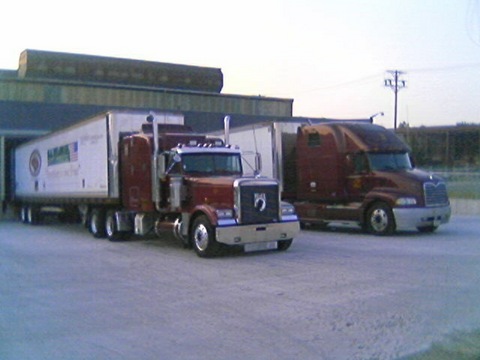
$this->bbcode_second_pass_quote('', 'I')n 1997, over 170 billion miles were traveled by tractor-trailers, using 42.5 billion gallons of diesel fuel. Tractor-trailers average 5.9 miles per gallon, which is low fuel efficiency, and diesel fuel is also responsible for a significant portion of air pollution, especially particulate matter. In any case, we enjoy an abundant and year-round supply of fresh produce at a price that is not necessarily reflected in food costs.


then there is this...
$this->bbcode_second_pass_quote('', ' ')The US Department of Transportation reports that in 1993, 257 million tons of fresh produce was shipped by truck in the U.S. Traveling over 23 billion-ton miles (BTM) shipped, they concluded that the average distance per shipment was 191 miles.


which seems at odds with this
$this->bbcode_second_pass_quote('', ' ')An analysis of the 1997 U.S. Department of Agriculture Fruit and Vegetable Market News report for the Jessup, MD Terminal Market found that the average pound of fresh produce that was distributed through the facility in 1997 traveled an average of 1,685.5 miles


And finally
$this->bbcode_second_pass_quote('', ' ')"If truckers stopped driving, then the whole US would shut down in days, and you wouldn't be able to eat," he told us as he described the many troubles and diversions of a truckdriver. Motorists who drive aggressively, the numerous charges and fees truckers must pay (including entrance to Jessup and to unload the apples) and especially the American public's lack of respect for the trucking industry were some of the issues, Tom noted, of his work on the road. Every day all over the U.S., truckdrivers are hauling our food from one place to another. It is a system that works, for now, and involves thousands of people who are the link between the farmers on the land and the retailers who sell the final product to you and me.
..i like his comment.."for now"...

A personal experience:
I bought navel oranges (big ones) for 4 for a buck...i am about 2000miles from where they are grown... How can they make money?
User avatar
frankthetank
Light Sweet Crude
Light Sweet Crude
 
Posts: 6202
Joined: Thu 16 Sep 2004, 03:00:00
Location: Southwest WI

Unread postby nero » Thu 17 Feb 2005, 23:07:29

Taking our figures of 1,685.5 miles on average with 5.9 miles per gallon means 286 gallon of diesel a trip. In the states isn't a gallon of diesel about 2 dollars, meaning that the fuel cost for the trip is only 572 dollars.
A fully loaded tractor trailor can carry about 46000 pounds and tomatoes go for about a dollar a pound retail so the street price of the load of tomatoes is $46000. In other words the cost of the long distance shipping was 1.2% of the total cost of the tomato to the consumer.
User avatar
nero
Heavy Crude
Heavy Crude
 
Posts: 1433
Joined: Sat 22 May 2004, 03:00:00
Location: Ottawa, Ontario

Unread postby gwmss15 » Fri 18 Feb 2005, 00:49:02

what would the costs be if you railed them instead as it takes less fuel to run the train and you can have 50 trailers worth in one train
User avatar
gwmss15
Peat
Peat
 
Posts: 199
Joined: Wed 13 Oct 2004, 03:00:00
Location: Mahachai City

Unread postby JohnDenver » Fri 18 Feb 2005, 01:16:49

Some calculations from a previous post:

$this->bbcode_second_pass_quote('Vexed', '
')For an easy-to-understand real-world example: My father just bought a 100 lb weight set made in China for my step brother at Wal-Mart. It cost $29.95. What does it cost to ship 100 lbs from China to the US?


The following article gives some price info on shipping oil:
http://www.iht.com/articles/2004/10/18/ ... anker.html

Price to move 2 million barrels of crude from Kuwait to Louisiana by Suez (approx. date Oct. 19, 2004): $6.95 million.

Doing the calculation, this turns out to be $.01/pound.

For container freight, we have some data here:
http://www.thestandard.com.hk/news_deta ... intcatid=1

North American, trans-Pacific service: average rate is US$1,547 per 20ft container.

Doing the calculations, and assuming a conservative rating of 17,500kg per container, I come up with $.04/pound.

So, the trans-Pacific shipment costs for the weight set should be in the neighborhood of $4, which is certainly doable.

But you have raised an important point. If peak oil is going to erode world trade, it will first begin to exert its effects on products which have a low price/weight ratio.

At $55, I calculate the p/w ratio for crude oil to be $0.18/pound.
Similarly, the p/w for the weight set is $0.30/pound.

So, paradoxically, the weight set you mention is actually more cost effective to transport than crude oil. After all crude is really heavy, bulky, cheap stuff.

Likewise, we can expect items with a high p/w ratio (gems, spices, silk, incense, viagra?) to continue to be traded long-distance no matter how far civilization declines.

(I don't live near Walmart now, but it's an interesting question: What Chinese-made item in Walmart has the lowest p/w? Your weight set seems like an excellent candidate.)
JohnDenver
Intermediate Crude
Intermediate Crude
 
Posts: 2145
Joined: Sun 29 Aug 2004, 03:00:00
Top

Unread postby JohnDenver » Fri 18 Feb 2005, 01:24:20

Hi nero. I couldn't help but snicker at the following:

$this->bbcode_second_pass_quote('nero', ' ')the street price of the load of tomatoes is $46000


I never knew tomatoes could be so exciting! :-D

I'll have to amend my list of items with high price/weight ratios: I forgot drugs, like heroin. High oil prices (or even the total elimination of fossil fuels) isn't going to dent that trade.
JohnDenver
Intermediate Crude
Intermediate Crude
 
Posts: 2145
Joined: Sun 29 Aug 2004, 03:00:00
Top

Unread postby JohnDenver » Fri 18 Feb 2005, 05:17:45

For comparison:

p/w ratio for crude oil: $0.18/lb.
p/w ratio for tomato: $1/lb.
p/w ratio for gold: $6500/lb.
p/w ratio for heroin: $250,000/lb.
JohnDenver
Intermediate Crude
Intermediate Crude
 
Posts: 2145
Joined: Sun 29 Aug 2004, 03:00:00

Unread postby BabyPeanut » Fri 18 Feb 2005, 08:13:00

$this->bbcode_second_pass_quote('frankthetank', '
')then there is this...
$this->bbcode_second_pass_quote('', ' ')The US Department of Transportation reports that in 1993, 257 million tons of fresh produce was shipped by truck in the U.S. Traveling over 23 billion-ton miles (BTM) shipped, they concluded that the average distance per shipment was 191 miles.


which seems at odds with this
$this->bbcode_second_pass_quote('', ' ')An analysis of the 1997 U.S. Department of Agriculture Fruit and Vegetable Market News report for the Jessup, MD Terminal Market found that the average pound of fresh produce that was distributed through the facility in 1997 traveled an average of 1,685.5 miles


Those, don't contradict. One's a shore and the other's for "In the US". Most likely the transportation for the MD one is for foreign goods.
BabyPeanut
Intermediate Crude
Intermediate Crude
 
Posts: 3275
Joined: Tue 17 Aug 2004, 03:00:00
Location: 39° 39' N 77° 77' W or thereabouts
Top

Unread postby RdSnt » Fri 18 Feb 2005, 10:08:07

Instead of comparing dollar costs, how about working out the energy costs.
How much energy is expended to manufacture and ship the weightset from China, compared to the same weightset made in the US. Assuming of course it is going to the same consumer.

In our PO world, energy costs is the sensible method for a proper C/B analysis.
Gravity is not a force, it is a boundary layer.
Everything is coincident.
Love: the state of suspended anticipation.
To get any appreciable distance from the Earth in
a sensible amount of time, you must lie.
User avatar
RdSnt
Heavy Crude
Heavy Crude
 
Posts: 1461
Joined: Wed 02 Feb 2005, 04:00:00
Location: Canada

Unread postby frankthetank » Fri 18 Feb 2005, 11:54:34

Baby~yeah ...after rereading it makes more sense....

Doing some rough calculations...i figured an Iranian oil tanker (big big ship!) uses about 70gallons of oil per knot....which isn't that bad considering a friend of mine has a 20ft cruiser type boat in hes @ about 1mpg(WOT).

http://www.ship-technology.com/projects/iran_delvar/

Theres a lot of money in drugs! wow...
User avatar
frankthetank
Light Sweet Crude
Light Sweet Crude
 
Posts: 6202
Joined: Thu 16 Sep 2004, 03:00:00
Location: Southwest WI

Unread postby nero » Fri 18 Feb 2005, 12:22:52

$this->bbcode_second_pass_quote('frankthetank', ' ')

$this->bbcode_second_pass_quote('', 't')hen there is this...
Quote:
The US Department of Transportation reports that in 1993, 257 million tons of fresh produce was shipped by truck in the U.S. Traveling over 23 billion-ton miles (BTM) shipped, they concluded that the average distance per shipment was 191 miles.


which seems at odds with this
Quote:
An analysis of the 1997 U.S. Department of Agriculture Fruit and Vegetable Market News report for the Jessup, MD Terminal Market found that the average pound of fresh produce that was distributed through the facility in 1997 traveled an average of 1,685.5 miles


Those, don't contradict. One's a shore and the other's for "In the US". Most likely the transportation for the MD one is for foreign goods.


The study indicates Jessup handles both domestic and international produce with the majority being domestic. . Also it gives numbers for indiividual vegetables some of which would be primarily sourced domestically (tomatoes for example) and the distance travelled is still large.

I think that the numbers don't disagree because they have different bases
One is 191miles per shipment
one is 1,685.5 miles per pound of fresh produce.
Simply assume that the same pound of fresh produce goes on several trucks in the process of distribution and you can see that the average distance per shipment may indeed be quite short. From the field to the processor/ packer, from the processor to the dstribution center, from the distribution centre to the wholesaler, from the wholesaler to the retail outlet.

Then also recognize that Jessup is in the north east in a seasonal climate. The average distance for produce shipped to Los Angeles may be much shorter since it is much closer to prime year-round growing areas.
User avatar
nero
Heavy Crude
Heavy Crude
 
Posts: 1433
Joined: Sat 22 May 2004, 03:00:00
Location: Ottawa, Ontario
Top

Unread postby johnmarkos » Sun 27 Feb 2005, 15:21:31

$this->bbcode_second_pass_quote('nero', 'T')aking our figures of 1,685.5 miles on average with 5.9 miles per gallon means 286 gallon of diesel a trip. In the states isn't a gallon of diesel about 2 dollars, meaning that the fuel cost for the trip is only 572 dollars.
A fully loaded tractor trailor can carry about 46000 pounds and tomatoes go for about a dollar a pound retail so the street price of the load of tomatoes is $46000. In other words the cost of the long distance shipping was 1.2% of the total cost of the tomato to the consumer.


This is a fascinating calculation. Considering that that the price of fuel would have to increase by at least an order of magnitude for transport by truck or rail to account for a noticeable portion of the cost of produce, it seems as though the "3000 mile Caesar salad" may have more of a future than James Kunstler thinks it does. Also, the numbers seem to back up my contention that mass starvation in the U.S. is unlikely in the next few decades.

Transport of individuals by personal, gasoline powered automobile seems far more inefficient than freight. How much of a loaded truck is the weight of the stuff being carried and how much of it is the weight of the truck itself (plus the driver)? In the case of a personal auto, of course, the weight of the vehicle far exceeds that of the driver. The ratio of vehicle weight to weight of entity being transported is approximately 20:1, for a 3000 pound mid-sized car moving a 150 pound driver and no passengers.
User avatar
johnmarkos
Tar Sands
Tar Sands
 
Posts: 866
Joined: Wed 19 May 2004, 03:00:00
Location: San Francisco, California
Top

Unread postby ararboin » Sun 27 Feb 2005, 16:04:11

Johndenver wrote:

$this->bbcode_second_pass_quote('', ' ')I forgot drugs, like heroin. High oil prices (or even the total elimination of fossil fuels) isn't going to dent that trade.


How will they get it from Afghanistan or Columbia to Chicago: camels, horses, carrier pigeons? I would think a home-grown industry would have to replace a global drug cartel.
User avatar
ararboin
Lignite
Lignite
 
Posts: 224
Joined: Tue 12 Oct 2004, 03:00:00
Top

Unread postby pilferage » Sun 27 Feb 2005, 19:07:05

$this->bbcode_second_pass_quote('frankthetank', 'I') bought navel oranges (big ones) for 4 for a buck...i am about 2000miles from where they are grown... How can they make money?

They don't, those are referred to as 'loss-leaders', incentives to get you in the store with the idea that you'll buy other things too, and they'll make a profit off of those.
"Humankind cannot gain anything without first giving something in return. To obtain, something of equal value must be lost. "
User avatar
pilferage
Tar Sands
Tar Sands
 
Posts: 553
Joined: Sun 21 Nov 2004, 04:00:00
Location: ~170ft/lbs@0rpm (on my bike)
Top


Return to Open Topic Discussion

Who is online

Users browsing this forum: No registered users and 0 guests

cron