Donate Bitcoin

Donate Paypal


PeakOil is You

PeakOil is You

CNN Discusses Inflationary Depression With Bank Failures

Discussions about the economic and financial ramifications of PEAK OIL

Re: CNN Discusses Inflationary Depression With Bank Failures

Postby dohboi » Wed 19 Mar 2008, 10:36:38

I noted this elsewhere, but did anyone else notice that British banks completely stopped loaning to each other for a while on Monday? Is such a spontaneous freeze common?

Bank-to-Bank
User avatar
dohboi
Harmless Drudge
Harmless Drudge
 
Posts: 19990
Joined: Mon 05 Dec 2005, 04:00:00

Re: CNN Discusses Inflationary Depression With Bank Failures

Postby MrBill » Wed 19 Mar 2008, 11:14:26

Not only not lending to one another, but putting out sell recommendations on their bonds, which is, of course, their alternative source of funding.

$this->bbcode_second_pass_quote('', 'I')nvestors should sell the bonds of Lehman Brothers Holdings Inc. and the three other largest U.S. brokerages because investors are likely to lose confidence in the industry, according to analysts at HSBC Securities.

Analysts Van Hesser and Daphne Feng in New York cut their fundamental recommendation on Lehman to ``underweight,'' indicating investors should hold fewer of the broker's bonds than indicated by benchmark indexes. They instituted a ``trading sell'' recommendation on the bonds of Goldman Sachs Group Inc., Morgan Stanley, Merrill Lynch & Co. and Lehman.


Source: March 17 (Bloomberg)
The organized state is a wonderful invention whereby everyone can live at someone else's expense.
User avatar
MrBill
Expert
Expert
 
Posts: 5630
Joined: Thu 15 Sep 2005, 03:00:00
Location: Eurasia

Re: CNN Discusses Inflationary Depression With Bank Failures

Postby efarmer » Wed 19 Mar 2008, 12:56:00

Mr. Bill, you always seem to spoil us with carefully reasoned
and plausible answers to impossible questions.

With the present scale and depth of the financial crisis
could you give us your best guess as to if a stable
regrouping point is:

Months Away

Years Away

Decades Away

Never

That's yet another dumb question efarmer, go piss off
User avatar
efarmer
Intermediate Crude
Intermediate Crude
 
Posts: 2003
Joined: Fri 17 Mar 2006, 04:00:00

Re: CNN Discusses Inflationary Depression With Bank Failures

Postby LoneSnark » Thu 20 Mar 2008, 00:19:52

$this->bbcode_second_pass_quote('', 'I') noted this elsewhere, but did anyone else notice that British banks completely stopped loaning to each other for a while on Monday? Is such a spontaneous freeze common?

Every decade or so. Why?
User avatar
LoneSnark
Tar Sands
Tar Sands
 
Posts: 514
Joined: Thu 15 Nov 2007, 04:00:00

Re: CNN Discusses Inflationary Depression With Bank Failures

Postby MrBill » Thu 20 Mar 2008, 05:05:33

$this->bbcode_second_pass_quote('efarmer', 'M')r. Bill, you always seem to spoil us with carefully reasoned
and plausible answers to impossible questions.

With the present scale and depth of the financial crisis
could you give us your best guess as to if a stable
regrouping point is:

Months Away

Years Away

Decades Away

Never

That's yet another dumb question efarmer, go piss off


I think this credit crisis will consume 2008 and extend into 2009. Whether that is the end of it will depend crucially on the public policy responses. It took more than two years for the market to find a bottom after the dotcon crash, and this crisis is by far worse. The Internet bubble was bad for investors, but it funded lots of useful new technology and innovation. This financial crash is just wiping out paper gains without creating any other value.

Basically what I am seeing, is that the Fed funds rate cuts are not filtering down to borrowers as banks hoard cash. In flat price terms my cost of borrowing has actually increased since the Fed's latest 75 bps cut.

I do not think this is a reflection of my own credit worthiness? Rather I see it as a limited pool of Interbank liquidity, and it is being rationed by price. I can still borrow, but I have to pay up for it. Otherwise the banks will ration what little funds they have to lend to the institution willing to pay more for it depending, of course, on whether they have good collateral, and are perceived as being creditworthy.

This hurts me in the short-term. But I would expect no less. No trader would like to lend at Libor + 1.00% when he can lend the same money at Libor + 2.50%. However, at this juncture capital security trumps yield, so borrowers are willing to pay up for scarce liquidity to make sure they can fund themselves come what may, and if there is even a hint of instability then the banks themselves are ruthless about cutting off the spigot. This is straining a lot of bank-client relationships as verbal assurances go out the window, and credit risk managers and lawyers scrutinize legal agreements for escape clauses.

$this->bbcode_second_pass_quote('', ' ') March 19 (Bloomberg) -- The cost of borrowing in pounds and euros rose as concern grew that some European banks are having increased difficulty accessing credit.

The London interbank offered rate, or Libor, for three-month loans in euros climbed 1 basis point to 4.67 percent today, the highest this year, the British Bankers' Association said. The comparable pound rate also added 1 basis point, to 5.98 percent, also the highest since 2007.

HBOS Plc, Britain's biggest mortgage lender, said today it has ``ready access'' to funding after the company plunged as much as 17 percent. Money-market rates are rising as banks hoard cash on speculation financial institutions will reveal more losses. Bear Stearns Cos. had to be rescued by JPMorgan Chase & Co. this week after a run on the bank.

``The market is concerned about another Bear Stearns-type event unfolding in Europe,'' said Richard Bryant, a bond trader at Citigroup Global Markets Inc. in New York. People are ``on edge yet again,'' he said.

The difference between what the U.K. government and banks pay to borrow for three months, a gauge of the availability of funds in the British money markets, rose to a record 179 basis points, from 152 basis points a week earlier. The spread averaged 11 basis points in the first half of last year.

Credit-default swaps on Edinburgh-based HBOS rose 19 basis points to 270, according to CMA Datavision. Contracts on Lloyds TSB rose 4 basis points to 114, CMA prices show. The securities, used to speculate on a company's ability to repay debt, rise as credit quality worsens. A basis point is 0.01 percentage point.


In hindsight, I could have almost predicted the start of this crisis to the day. When all of a sudden money center banks were calling me up and offering me hundreds of millions at very low spreads I should have seen that as the high tide mark. Actually I did, but I did not suspect spreads would deteriorate as far as they did.

Now we will be employing interest rate swaps (IRS) and future rate agreements (FRA) to protect ourselves against the higher rates to come. However, just to be clear, that protects me from higher Interbank rates, but does not guarantee liquidity. I still have a funding risk (the opposite of re-investment risk) if either my financial situation deteriorate or more likely the asset class that I am using as collateral deteriorates in price or quality. That is why you try to draw liquidity from deep and wide pools, and not have it concentrated in one or two places only.

$this->bbcode_second_pass_quote('', ' ')March 19 (Bloomberg) -- JWM Partners LLC, the investment firm run by ex-Long-Term Capital Management LP chief John Meriwether, lost 24 percent in its $1 billion fixed-income hedge fund this year through March 14, according to two people with knowledge of the matter.

Meriwether's Relative Value Opportunity fund was hurt as bond managers such as Peloton Partners LLP and Carlyle Capital Corp. were forced to sell securities to meet margin calls, said the investors, who asked not to be identified because JWM doesn't publicly disclose returns. The Greenwich, Connecticut-based firm, which is selling holdings to reduce borrowings and lower risk, didn't have any loans called, they said.


``There's been a lot of forced de-leveraging,'' said Benjamin Sarly, head of marketing at Sanno Point Capital Management in New York, a relative-value credit fund.

Meriwether declined to comment.

JWM Partners opened a year after Russia's 1998 default resulted in almost $4 billion of losses for Greenwich, Connecticut-based Long-Term Capital. The Federal Reserve orchestrated a bailout by its 14 lenders.

Relative-value funds try to profit from price changes between related bonds. They rarely make outright bets that a specific bond will rise or fall. Investors in these funds expect to make about 1 percent a month.


So in other words, what should have been neutral bets on a directional basis have wiped out two years worth of gains in one quarter. That is the rolling affect from one market to another and how contagion and liquidity contraction infects other 'more' stable markets. This has certainly been fascinating to watch! ; - ))
The organized state is a wonderful invention whereby everyone can live at someone else's expense.
User avatar
MrBill
Expert
Expert
 
Posts: 5630
Joined: Thu 15 Sep 2005, 03:00:00
Location: Eurasia
Top

Re: CNN Discusses Inflationary Depression With Bank Failures

Postby efarmer » Thu 20 Mar 2008, 12:16:52

We don't like our Mr. Bill, we love him. I had to think hard as I read
your response, in fact I thought so hard that I smelled rubber burning
and stopped to play with my yoyo and cool down twice.

So if I read you correctly Judge Dollar is sentencing us to money
jail for several years with our being eligible for parole after two
on good behavior.

If I end up sharing a cell with Greenspan I'm going to bitch slap
him every time he opens his yapper.
User avatar
efarmer
Intermediate Crude
Intermediate Crude
 
Posts: 2003
Joined: Fri 17 Mar 2006, 04:00:00

Re: CNN Discusses Inflationary Depression With Bank Failures

Postby MrBill » Thu 20 Mar 2008, 13:03:18

Inflationary response:
$this->bbcode_second_pass_quote('', 'I')f the United States bails out the financial system by buying mortgage debt directly, the price just might be surging inflation and a dollar crisis.

Calls are increasing for the government, either directly or via the Federal Reserve, to cut the knot of the credit crisis at a stroke by buying up mortgages that banks and investment banks are finding difficult to finance.


Source: If the bailout comes, watch for a dollar dive

Deflationary response:
$this->bbcode_second_pass_quote('', 'A')ctually, even the elevated prices of minerals, metals and food may be less a result of explosive world demand, led by China and India (which is nowadays the standard explanation proffered by many economists) and have more to do with cheap money, as Harvard University Professor Jeffrey Frankel has recently argued.

If Frankel's hypothesis is correct, monetary-policy options for the Asia-Pacific region are very limited. No matter what they do, the inflation genie won't go back into the bottle without a huge global deflationary shock, precisely the kind of U.S. recession that the Fed is so intent on preventing.

With crude oil at about $106 a barrel, and wheat futures almost 2 1/2 times as expensive as at the same time last year, fuel and food prices are a big worry for policy makers.


Source: Why Asia Can't Imitate Fed's Inflation Amnesia:


Dr. Frankel's original argument (which I have trouble with as per my comments)

Falling interest rates explain rising commodity prices

$this->bbcode_second_pass_quote('', 'H')igh interest rates reduce the demand for storable commodities, or increase the supply, through a variety of channels: by increasing the incentive for extraction today rather than tomorrow (think of the rates at which oil is pumped, gold mined, forests logged, or livestock herds culled); by decreasing firms' desire to carry inventories (think of oil inventories held in tanks); by encouraging speculators to shift out of spot commodity contracts, and into treasury bills.


Source: Real rates key to commodities prices

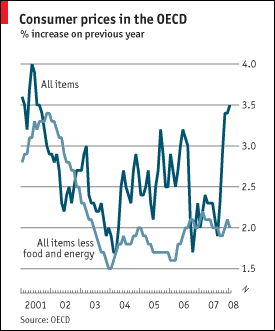
Global inflation a scurge in OECD not just the US dollar zone...
Image
... and as I argue this is due to global money supply growth. Therefore, it is more likely that low real interest rates result in faster economic expansion and demand for money supply growth, and this increased demand plus excess money supply growth feeds into higher asset prices including commodities. Or more accurately away from financial assets that are over-inflated and into physical assets that are seen as a real store of wealth and a hedge against inflation expectations.*

*Because truth be told you can replicate commodity gains through a structured note. You can actually outperform them. However, then you have to 'trust' the bank who guarantees the note. That trust today is absent in the market! The downside to physical commodities being the cost of carry that is influenced by real interest rates.

Happy Easter. Enjoy the long weekend! ; - ))
The organized state is a wonderful invention whereby everyone can live at someone else's expense.
User avatar
MrBill
Expert
Expert
 
Posts: 5630
Joined: Thu 15 Sep 2005, 03:00:00
Location: Eurasia
Top

Re: CNN Discusses Inflationary Depression With Bank Failures

Postby deMolay » Thu 20 Mar 2008, 21:58:58

As a fund manager I know once mentioned: "I'm diversifying from gold... into canned goods and guns"
User avatar
deMolay
Intermediate Crude
Intermediate Crude
 
Posts: 2671
Joined: Sun 04 Sep 2005, 03:00:00

Re: CNN Discusses Inflationary Depression With Bank Failures

Postby dohboi » Sat 22 Mar 2008, 17:48:10

LS wrote (in response to my asking how often banks stop lending to each other):

"Every decade or so. Why?"

Because I wanted to know--not being snarky, this time.

So basically every time there is a major recession?

I guess I just wanted to know what kind of a signal this might be. We are seeing some actions and events not seen since the great depression. Just wondered if this was another one, or something seen more frequently.

So thanks for the info, LS. Would you care to suggest any source where I might read up on this curious aspect of financial history?
User avatar
dohboi
Harmless Drudge
Harmless Drudge
 
Posts: 19990
Joined: Mon 05 Dec 2005, 04:00:00

Re: CNN Discusses Inflationary Depression With Bank Failures

Postby LoneSnark » Sun 23 Mar 2008, 21:15:44

Alan Greenspan's latest book has a very good insider perspective of the 1987 credit freeze. But it is an odd feature of economics literature that while stock markets have been studied to death, there has been very little academic study of the financial shocks you are addressing. I suspect the reason is banks and other financial institutions tend not to be eager to share their internal workings with outsiders, especially during times of stress.

That said, such events have been studied from a historian perspective. My favorite book in this vein was "Manias, Panics, and Crashes: A History of Financial Crises" which covers the occurance of such events going back to Roman times.
User avatar
LoneSnark
Tar Sands
Tar Sands
 
Posts: 514
Joined: Thu 15 Nov 2007, 04:00:00

Re: CNN Discusses Inflationary Depression With Bank Failures

Postby MrBill » Mon 24 Mar 2008, 04:42:46

I am enjoying Michael Pettis' The Volatility Machine that deals with liquidity traps and emerging market crashes. In terms of studying the mechanics of past financial crashes going back to 1820s up until 2001 when the book was written the lessons learned applied the United States is like reading tomorrow's newspaper. Great stuff. It is like knowing the end game in advance. I can recommend it as a good read as it looks at these crashes from a corporate finance perspective and not a flawed development model one. Very refreshing analysis written by a Wall Street bond trader turned Ivy League academic. Cheers.
The organized state is a wonderful invention whereby everyone can live at someone else's expense.
User avatar
MrBill
Expert
Expert
 
Posts: 5630
Joined: Thu 15 Sep 2005, 03:00:00
Location: Eurasia

Re: CNN Discusses Inflationary Depression With Bank Failures

Postby dohboi » Mon 24 Mar 2008, 06:43:26

Cool. Thanks, LS and Mr. B. More fodder for my reading list.

I wonder what the coming week has in store for us?
User avatar
dohboi
Harmless Drudge
Harmless Drudge
 
Posts: 19990
Joined: Mon 05 Dec 2005, 04:00:00

Re: CNN Discusses Inflationary Depression With Bank Failures

Postby MrBill » Mon 24 Mar 2008, 10:45:41

$this->bbcode_second_pass_quote('dohboi', 'C')ool. Thanks, LS and Mr. B. More fodder for my reading list.

I wonder what the coming week has in store for us?


Most likely a correction within the bear market. False optimism is slipping into the market. Players will be keen to get out of Q1'08 with a rally off the technical lows. But then reality will catch-up to us again once Q1'08 earnings start coming in April. Reuters estimates are down 5-10% for corporates and down 40% for financials.

Recession in U.S. Sows Slower Growth, Weaker Dollar

The $30 bailout of Bear Stearns was really to protect from the ultimate default of $10 trillion in derivatives where BS was a counterpart. If they failed then many of those transactions would not have a buyer/seller on the other side and would have needed to be unwound or re-hedged.

The risk was that Lehman and Merrill Lynch as well as others also hold those derivatives, and unwinding $20-30 trillion of derivatives could have quickly spiralled out of control forcing more writedowns at banks and non-bank financial institutions.

Dollar's Moves Force Whispers of `I' Word; G-7 Frets

Just as an aside I calcuated today that the Shanghai Index is off 42% from its peaks when measured in euros. That strips out any US dollar weakness or money supply growth in China. That is a lot of investor's wealth that has been destroyed in the growth story that in turn has been fuelling a lot of other growth and speculation. It will be hard for authorities there to engineer a soft-landing while maintaining job growth and social harmony.

So we are calmer now, but hardly on a solid footing for a strong rally. Too many imbalances remain to be worked out and/or written down.
The organized state is a wonderful invention whereby everyone can live at someone else's expense.
User avatar
MrBill
Expert
Expert
 
Posts: 5630
Joined: Thu 15 Sep 2005, 03:00:00
Location: Eurasia
Top

Re: CNN Discusses Inflationary Depression With Bank Failures

Postby patience » Mon 24 Mar 2008, 11:20:06

MrBill,
The dollar regained a point, and short term US treasuries went NEGATIVE yield. I read that this indicates a flight to safety for big investors, those too big to simply go to cash. Theory was that ABCP is "radioactive-no one will touch it". Thoughts?
Local fix-it guy..
User avatar
patience
Resting in Peace
 
Posts: 3180
Joined: Fri 04 Jan 2008, 04:00:00

Re: CNN Discusses Inflationary Depression With Bank Failures

Postby MrBill » Mon 24 Mar 2008, 12:59:50

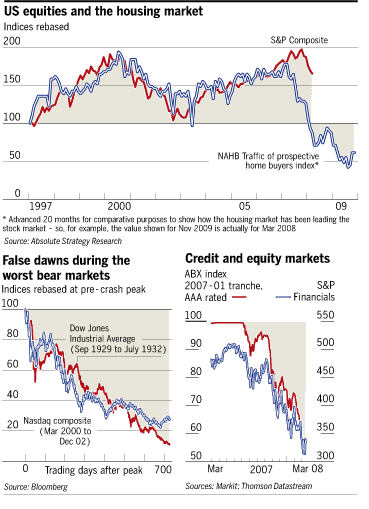
Mainly a technical correction to overbought/oversold conditions in the various asset classes. I would not read too much into this. Bonds were overbought. Stocks were oversold. The US dollar was oversold relative to many other currencies. And commodities were overbought.

This correction was a chance to address those conditions as the market succumbs to a false sense of security following on the heels of the relief rally surrounding the Fed's cut and bailout of Bear Stearns. But that still does not address the underlying problem is that firms like BS were sitting on trillions of derivatives.

$this->bbcode_second_pass_quote('', 'D')iane Garnick, an investment strategist at Invesco Ltd. in New York, comments on her outlook for U.S. financial markets. She spoke in an interview.

``The crisis is not over'' even though the Federal Reserve added liquidity to the markets, because ``what we are really focused on here is the fiscal crisis, and the credit crisis.''

``The individual consumer has borrowed against next year's earnings -- and two years, and five years -- and they have spent it all this year, last year and the previous year.''

``This is not an easy solution. The Fed cannot just step in and say `ah, excess liquidity will make all of this go away.' These problems are bigger than just simply a liquidity issue.''


Source: March 20 (Bloomberg)

But there are going to be a lot of headlines implying that now is a good time to buy, and that the worst is behind us. However, I think a lot of swallows will freeze before spring arrives.

Image
The organized state is a wonderful invention whereby everyone can live at someone else's expense.
User avatar
MrBill
Expert
Expert
 
Posts: 5630
Joined: Thu 15 Sep 2005, 03:00:00
Location: Eurasia
Top

Re: CNN Discusses Inflationary Depression With Bank Failures

Postby drew » Mon 24 Mar 2008, 16:02:41

Thanks, Mr. Bill, for the rosy optimism. You, as usual, made a good case for the times ahead.

As you'd say 'keeping the powder dry'

(I'll be having a look at those graphs in more detail when I get reading glasses!!)

Drew
User avatar
drew
Tar Sands
Tar Sands
 
Posts: 953
Joined: Thu 22 Jul 2004, 03:00:00
Location: canada

Re: CNN Discusses Inflationary Depression With Bank Failures

Postby pedalling_faster » Sun 30 Mar 2008, 19:16:19

$this->bbcode_second_pass_quote('MrBill', 'A')s someone noticed here, the US reporters seem to talk about three times as quickly


i almost got a Charlie Horse in my jaw muscle just listening to the woman on the right, talk fast that is.

i wonder if part of the pressure is the assistant producer whispering in their ear about the 8 commercials they have to cut to.

i thought shadowstats was looked at by the mainstream media the way they treat websites like Raw Story.
http://www.LASIK-Flap.com/ ~ Health Warning about LASIK Eye Surgery
User avatar
pedalling_faster
Permanently Banned
 
Posts: 1399
Joined: Sat 10 Dec 2005, 04:00:00
Top

Re: CNN Discusses Inflationary Depression With Bank Failures

Postby Cid_Yama » Sat 05 Apr 2008, 17:17:00

As we all know, the G7 financial authorities are fighting tooth and nail to rescue their financial systems. The bottom line of it is that they are INSOLVENT and require balance sheet repair of epic proportions. It will require a combination of MONEY printing, hocus pocus, smoke and mirrors and changing the rules -- whether it be the changing of balance sheet requirements at Fannie and Freddie, the expansion of the home loan banks, term lending facilities of one sort or another or opening the borrowing windows at the fed wider and wider in terms of eligible securities of participants (investment banks) which can access the lending.

In the last 6 weeks we have seen over 1 trillion dollars in combination of all of these things added to the pool of liquidity to underpin asset markets. Now comes the latest twist: “The return of marking to model” which was ended last November. Tedbits wrote about it at the time and it has bitten the banks and financial industry’s balance sheets HARD.

This is a picture of financial industry and banks’ balance sheets VAPORIZING before our very eyes. So what do the financial and banking authorities do? What else? Rewrite the regulatory guidance in respect to how to value them for REGULATORY reporting purposes. The SEC has issued an opinion letter informing financial and banking companies of how to deal with these thorny balance sheet and accounting compliance issues by telling them if they have a problem with the mark to market valuations then declare the prices as the result of forced liquidation and ignore them.

And how did they sidestep the horrendous losses due to be reported in the next three weeks from the 1st quarter? By backdating the interpretative notice back to January 1. Abracadabra: poof and money reappears on the balance sheets, hocus pocus of the highest order. That rule saw the light of day for a total of 45 days!!! Now it’s history.

link
"For my part, whatever anguish of spirit it may cost, I am willing to know the whole truth; to know the worst and provide for it." - Patrick Henry

The level of injustice and wrong you endure is directly determined by how much you quietly submit to. Even to the point of extinction.
User avatar
Cid_Yama
Light Sweet Crude
Light Sweet Crude
 
Posts: 7169
Joined: Sun 27 May 2007, 03:00:00
Location: The Post Peak Oil Historian

Previous

Return to Economics & Finance

Who is online

Users browsing this forum: No registered users and 1 guest

cron