$this->bbcode_second_pass_quote('kublikhan', ' ')$this->bbcode_second_pass_quote('MonteQuest', '')$this->bbcode_second_pass_quote('', 'L')arge-scale renewable energy generation is likely to have severe environmental impacts It has been commonly assumed that renewable energy generation is more environmentally friendly than the use of nonrenewable energy sources such as fossil fuels or nuclear power (Hayes 1977, Lovins 1977, Brower 1992, Boyle 1996). While this assumption may be correct, it must be realized that the capture and conversion of solar energy will have significant negative environmental impacts,
especially if they are employed on such a large scale as
to supply nearly 100% of the U.S. energy demand (Abbasiet al. 1995, Trainer 1995a).



PeakOil is You
JD Attacks the Issue of Scale II
Re: JD Attacks the Issue of Scale II
 by MonteQuest » Thu 28 Feb 2008, 02:46:43
Limits-to-Sustainability
No, it doesn't. It says: :It has been commonly assumed that renewable energy generation is more environmentally friendly than the use of nonrenewable energy sources such as fossil fuels. "
[quote]IMO, this paper does a poor job of supporting your view of widespread environmental damage from large scale renewable energy generation. I am guessing that you foresee worse effects than the paper describes? On equal scales, do you foresee renewable energy as causing more damage to the environment than fossil fuels?[/qute]
Your failure to grasp the concepts is not my problem.
Efforts to try an sustain a population in severe overshoot is a fools' errand.
Renewable energy capture will cause far more damage on the scale required.
What liveforms do you suggest give up their energy so we can feed it to our machines?
A Saudi saying, "My father rode a camel. I drive a car. My son flies a jet-plane. His son will ride a camel."
-

MonteQuest - Expert

- Posts: 16593
- Joined: Mon 06 Sep 2004, 03:00:00
- Location: Westboro, MO
Re: JD Attacks the Issue of Scale II
by TonyPrep » Thu 28 Feb 2008, 03:23:53
$this->bbcode_second_pass_quote('kublikhan', '')$this->bbcode_second_pass_quote('TonyPrep', 'I') have not done extensive study on the Solar Grand Plan but I hoped the authors of the plan would have. What are the consequences of diverting x% of sunlight for our own uses? I don't know but I'd sure like to know the answer. What are the consequences of diverting or acquiring resources to building up this grand plan so that eventually the present incumbents can be phased out? What are the consequences of growing this infrastructure exponentially, intending to displace existing plant, for the next 92 years, and beyond? Are the resources actually available? Is it reasonable to expect 10% of the then energy demand to come from biofuels, and how did they calculate that it is even possible? There are probably many other concerns that might be raised but the article addresses none of them and shows no hint that consequences were even examined (aside from the unsubstantiated claim that it wouldn't be as destructive as coal mining). If you want to believe that the authors must have considered more but chose not to include it in a 6 page Sci Am article, fair enough, but I'm not convinced.
You are doing it again Tony. Every time someone posts something you say something to the effect of: "I have reservations about: X. I think it could have some problems. But I will not backup my concerns with facts and research because I am too lazy to look it up. But I am convinced these problems are out there. Please look them up for me so I can debunk X easier." If you want to ridicule an idea, you should at least have the decency to backup your concerns and not ask other people to debunk themselves.I suppose I could just say "hmm, nice idea" and leave it at that. But this is my society too.
-

TonyPrep - Intermediate Crude

- Posts: 2842
- Joined: Sun 25 Sep 2005, 03:00:00
- Location: Waiuku, New Zealand


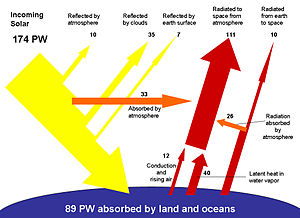 $this->bbcode_second_pass_quote('', 'A')bout half the incoming energy from the sun is absorbed by water and land masses, while the rest is reradiated back into space (values are in PW =1015 W).