Donate Bitcoin

Donate Paypal


PeakOil is You

PeakOil is You

JD Attacks the Issue of Scale II

General discussions of the systemic, societal and civilisational effects of depletion.

Re: JD Attacks the Issue of Scale II

Unread postby MonteQuest » Thu 28 Feb 2008, 02:46:43

$this->bbcode_second_pass_quote('kublikhan', ' ')$this->bbcode_second_pass_quote('MonteQuest', '')$this->bbcode_second_pass_quote('', 'L')arge-scale renewable energy generation is likely to have severe environmental impacts It has been commonly assumed that renewable energy generation is more environmentally friendly than the use of nonrenewable energy sources such as fossil fuels or nuclear power (Hayes 1977, Lovins 1977, Brower 1992, Boyle 1996). While this assumption may be correct, it must be realized that the capture and conversion of solar energy will have significant negative environmental impacts,
especially if they are employed on such a large scale as
to supply nearly 100% of the U.S. energy demand (Abbasiet al. 1995, Trainer 1995a).

Limits-to-Sustainability
Read the paper, I am still not seeing the environmental disaster you envision from large scale renewable energy generation. The quote above even states the environmental damage is likely to be less than fossil fuels.


No, it doesn't. It says: :It has been commonly assumed that renewable energy generation is more environmentally friendly than the use of nonrenewable energy sources such as fossil fuels. "

[quote]IMO, this paper does a poor job of supporting your view of widespread environmental damage from large scale renewable energy generation. I am guessing that you foresee worse effects than the paper describes? On equal scales, do you foresee renewable energy as causing more damage to the environment than fossil fuels?[/qute]

Your failure to grasp the concepts is not my problem.

Efforts to try an sustain a population in severe overshoot is a fools' errand.

Renewable energy capture will cause far more damage on the scale required.

What liveforms do you suggest give up their energy so we can feed it to our machines?
A Saudi saying, "My father rode a camel. I drive a car. My son flies a jet-plane. His son will ride a camel."
User avatar
MonteQuest
Expert
Expert
 
Posts: 16593
Joined: Mon 06 Sep 2004, 03:00:00
Location: Westboro, MO

Re: JD Attacks the Issue of Scale II

Unread postby TonyPrep » Thu 28 Feb 2008, 03:23:53

$this->bbcode_second_pass_quote('kublikhan', '')$this->bbcode_second_pass_quote('TonyPrep', 'I') have not done extensive study on the Solar Grand Plan but I hoped the authors of the plan would have. What are the consequences of diverting x% of sunlight for our own uses? I don't know but I'd sure like to know the answer. What are the consequences of diverting or acquiring resources to building up this grand plan so that eventually the present incumbents can be phased out? What are the consequences of growing this infrastructure exponentially, intending to displace existing plant, for the next 92 years, and beyond? Are the resources actually available? Is it reasonable to expect 10% of the then energy demand to come from biofuels, and how did they calculate that it is even possible? There are probably many other concerns that might be raised but the article addresses none of them and shows no hint that consequences were even examined (aside from the unsubstantiated claim that it wouldn't be as destructive as coal mining). If you want to believe that the authors must have considered more but chose not to include it in a 6 page Sci Am article, fair enough, but I'm not convinced.
You are doing it again Tony. Every time someone posts something you say something to the effect of: "I have reservations about: X. I think it could have some problems. But I will not backup my concerns with facts and research because I am too lazy to look it up. But I am convinced these problems are out there. Please look them up for me so I can debunk X easier." If you want to ridicule an idea, you should at least have the decency to backup your concerns and not ask other people to debunk themselves.
Hmm. You seem to be saying that if I have concerns but don't have the time or resources to explore them myself, then I should not raise the concerns. Pardon me, but that's nonsense. Besides, these are people who are proposing a grand plan that could take a huge amount of extra resources, in an attempt to eventually replace resources currently used. Are you saying that the author of these proposals don't have the same same responsibility that you are placing on me, to examine the consequences and requirements thoroughly? I find that logic badly flawed.

I suppose I could just say "hmm, nice idea" and leave it at that. But this is my society too.
User avatar
TonyPrep
Intermediate Crude
Intermediate Crude
 
Posts: 2842
Joined: Sun 25 Sep 2005, 03:00:00
Location: Waiuku, New Zealand
Top

Re: JD Attacks the Issue of Scale II

Unread postby kublikhan » Thu 28 Feb 2008, 04:57:51

$this->bbcode_second_pass_quote('MonteQuest', 'Y')our failure to grasp the concepts is not my problem.Efforts to try an sustain a population in severe overshoot is a fools' errand.Renewable energy capture will cause far more damage on the scale required.
I grasp the concepts thank you. But you failed to answer my questions. Namely:
1. Is it your belief that renewables cause more damage then fossil fuels, assuming equal scales?
2. What form of damage do you foresee renewables causing(on the scale required)? Dead insects? Glare from solar panels?
3. If the impact of renewables(on the scale required) is several orders of magnitude smaller than the impact of fossil fuels, why berate renewables so fiercely when even a small reduction in the percentage of carbon emissions will have a much larger effect?

$this->bbcode_second_pass_quote('TonyPrep', 'H')mm. You seem to be saying that if I have concerns but don't have the time or resources to explore them myself, then I should not raise the concerns. Pardon me, but that's nonsense. Besides, these are people who are proposing a grand plan that could take a huge amount of extra resources, in an attempt to eventually replace resources currently used. Are you saying that the author of these proposals don't have the same same responsibility that you are placing on me, to examine the consequences and requirements thoroughly? I find that logic badly flawed. I suppose I could just say "hmm, nice idea" and leave it at that. But this is my society too.
It is far easier to poke holes in something then it is to come up with a concrete plan of action. To me you come off as a naysayer. I wonder if this paper was 60 pages long describing precisely the effects it would have on the local ecology if you would still find something to poke holes in. For example, researchers find generally positive ecological impact of renewables(by displacing fossil fuels) in their study's. By these results seem to be unsatisfactory to you, you want to know what kind of hidden damage renewables are doing. if the research did not find it, what more needs to be done?
"A significant advantage of the use of renewable energy systems," say the researchers, "is that they are environmentally friendly because overall they result in lower dangerous pollutant emissions, this and one other major factor, they are essentially inexhaustible."
http://www.sciencedaily.com/releases/20 ... 153419.htm

As usual, you provide no sources Tony and I found Monty's source wanting, so I am yet again forced to try and find a source to support your concerns. I found this one, not quite as thorough as the limits to sustainability paper, but gives more chilling effects then dead insects and glare from solar panels.
$this->bbcode_second_pass_quote('', ' ') Among the renewable resources, only in solar power do we find the potential for an energy source capable of supplying more energy than is used.5

Suppose that of the 4.5x10¹⁷ kWh per annum that is used by the earth to evaporate water from the oceans we were to acquire just 0.1% or 4.5x10¹⁴ kWh per annum. Dividing by the hours in the year gives a continuous yield of 2.90x10¹⁰ kW. This would supply 2.4 kW to 12.1 billion people.6

This translates to roughly the amount of energy used today by the average American available to over twelve billion people. Since this is greater than the estimated carrying capacity of the Earth, this would be enough energy to supply the entire planet regardless of the population.

Unfortunately, at this scale, the production of solar energy would have some unpredictable negative environmental effects. If all the solar collectors were placed in one or just a few areas, they would probably have large effects on the local environment, and possibly have large effects on the world environment. Everything from changes in local rain conditions to another Ice Age has been predicted as a result of producing solar energy on this scale. The problem lies in the change of temperature and humidity near a solar panel; if the energy producing panels are kept non-centralized, they should not create the same local, mass temperature change that could have such bad effects on the environment.

Of all the energy sources available, solar has perhaps the most promise. Numerically, it is capable of producing the raw power required to satisfy the entire planet's energy needs. Environmentally, it is one of the least destructive of all the sources of energy. Practically, it can be adjusted to power nearly everything except transportation with very little adjustment, and even transportation with some modest modifications to the current general system of travel. Clearly, solar energy is a resource of the future.
http://www.ccs.neu.edu/home/feneric/solar.html
So the grave ecological damage is "some unpredictable negative environment effects". Somehow I doubt taking .1% of the energy used to evaporate the oceans would lead to an ice age. We are adding far more energy than that right now with global warming. But look at the conclusion reached. Solar has the most promise as the energy resource of the future. Yes Monty, that's on the scale required.
The oil barrel is half-full.
User avatar
kublikhan
Master Prognosticator
 
Posts: 5064
Joined: Tue 06 Nov 2007, 04:00:00
Location: Illinois
Top

Re: JD Attacks the Issue of Scale II

Unread postby yesplease » Thu 28 Feb 2008, 05:04:48

$this->bbcode_second_pass_quote('MonteQuest', 'H')e was refuting me with one link that was 21 years old. There are other sources I have linked to that say 40% total NPP today.
I don't think anyone was refuting anything. For that matter, there is no need to refute anything from someone who admittedly bases their statements on fallacious sources, doesn't seem to understand their own sources, cites figures from their own sources without pertinent background information, and asks others if they have heard of thermal dynamic equillibrium, which I guess means equilibrium, after posting statements like this.$this->bbcode_second_pass_quote('MonteQuest', 'W')hat solar energy strikes the earth and is not used?

Zero.
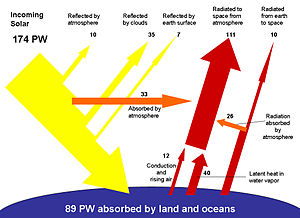
Image$this->bbcode_second_pass_quote('', 'A')bout half the incoming energy from the sun is absorbed by water and land masses, while the rest is reradiated back into space (values are in PW =1015 W).


That is to say, there's no need to refute statements if they are wrong and/or misleading, just pointing out that the author may want to correct them and/or provide more information is satisfactory IMO.
$this->bbcode_second_pass_quote('Professor Membrane', ' ')Not now son, I'm making ... TOAST!
User avatar
yesplease
Intermediate Crude
Intermediate Crude
 
Posts: 3765
Joined: Tue 03 Oct 2006, 03:00:00
Top

Re: JD Attacks the Issue of Scale II

Unread postby TonyPrep » Thu 28 Feb 2008, 06:29:51

$this->bbcode_second_pass_quote('kublikhan', 'I')t is far easier to poke holes in something then it is to come up with a concrete plan of action. To me you come off as a naysayer. I wonder if this paper was 60 pages long describing precisely the effects it would have on the local ecology if you would still find something to poke holes in.
Such wondering is a pointless exercise. The article was 6 pages and that is all I had to go on. You can wonder all you like but I'd have little room to criticize it for not exploring possible effects and resource shortages, if it included such exploration.

$this->bbcode_second_pass_quote('kublikhan', 'F')or example, researchers find generally positive ecological impact of renewables(by displacing fossil fuels) in their study's. By these results seem to be unsatisfactory to you, you want to know what kind of hidden damage renewables are doing. if the research did not find it, what more needs to be done?
You appear to be unaware of the scale of this plan and of its implicit assumption that the proposals have no end in sight, in terms of its growth (the plan goes up to 2050 in detail and to 2100 in summary, but there is no indication that we end up with a steady state economy thereafter). I realise that the consequences of human behaviour may not concern you, but it does concern others.

$this->bbcode_second_pass_quote('kublikhan', '"')A significant advantage of the use of renewable energy systems," say the researchers, "is that they are environmentally friendly because overall they result in lower dangerous pollutant emissions, this and one other major factor, they are essentially inexhaustible."
I don't dispute that, compared to their fossil fuel equivalents, some renewable energy systems are greener. However, in my opinion, this doesn't mean that any amount of renewable energy is good. What the solar grand plan was attempting to achieve was the complete substitution of solar power for current energy systems, apart from 10% in liquid biofuels. The report you cite doesn't seem to address such scale and the grand plan article doesn't address resource flows, or how the 10% biofuels would be achieved, as well of not considering what the environmental consequences might be.

Once fossil fuels are largely out of the picture, we won't get any further environmental damage from them (though there will be ongoing indirect damage) but merely envisaging lower damage systems doesn't really help, long term.

By the way, I do recoil when some study uses the phrase "essentially inexhaustable". It's largely meaningless, unless we reach some stable level of use, where the harnessing of that endless resource, which uses finite resources, is sustainable.

$this->bbcode_second_pass_quote('kublikhan', 'A')s usual, you provide no sources Tony and I found Monty's source wanting, so I am yet again forced to try and find a source to support your concerns. I found this one, not quite as thorough as the limits to sustainability paper, but gives more chilling effects then dead insects and glare from solar panels. http://www.ccs.neu.edu/home/feneric/solar.html
Thanks for that. Such consideration is more hopeful. I think we need to consider such solutions carefully, instead of jumping to assumptions, based on small percentages never being a problem.
User avatar
TonyPrep
Intermediate Crude
Intermediate Crude
 
Posts: 2842
Joined: Sun 25 Sep 2005, 03:00:00
Location: Waiuku, New Zealand
Top

Re: JD Attacks the Issue of Scale II

Unread postby kublikhan » Thu 28 Feb 2008, 22:10:44

$this->bbcode_second_pass_quote('TonyPrep', 'Y')ou appear to be unaware of the scale of this plan and of its implicit assumption that the proposals have no end in sight, in terms of its growth (the plan goes up to 2050 in detail and to 2100 in summary, but there is no indication that we end up with a steady state economy thereafter). I realise that the consequences of human behaviour may not concern you, but it does concern others.
This is why I have a problem with your comments. Everytime someone proposes a solution to the energy crisis or a solution to the water crisis, or a solution to crisis X, you jump all over them, "Your solution to crisis X may work, but you failed to solve crisis Y and Z as well." Can we not tackle one problem at a time? Must every solution proposed involve solving every problem on earth and changing core human behavior to boot? Is a solution to the energy crisis to be shunned, because it would just cause a bigger crisis later on in the form of a carrying capacity crisis?

$this->bbcode_second_pass_quote('TonyPrep', 'H')owever, in my opinion, this doesn't mean that any amount of renewable energy is good. What the solar grand plan was attempting to achieve was the complete substitution of solar power for current energy systems, apart from 10% in liquid biofuels. The report you cite doesn't seem to address such scale and the grand plan article doesn't address resource flows, or how the 10% biofuels would be achieved, as well of not considering what the environmental consequences might be.
Once fossil fuels are largely out of the picture, we won't get any further environmental damage from them (though there will be ongoing indirect damage) but merely envisaging lower damage systems doesn't really help, long term. I think we need to consider such solutions carefully, instead of jumping to assumptions, based on small percentages never being a problem.
As far as I know, the only concrete proof of environmental damage from solar power is with the recycling/disposal of toxic materials like lead acid batteries, cadmium, etc. Also the fossil fuel inputs used in their construction/transportation. Everything else is just speculation. I take it you want something like this: "every gigawatt of solar power added lowers local temperature by .1 degree and worldwide temperatures by .001 degrees. Also, rainfall is reduced .1% locally and .001% worldwide". As far as I know no such statistics exist and I would be highly skeptical of the truthfulness of such a claim if it did exist. In effect, you want a worldwide environmental impact analysis of what would amount to one of the largest human projects in history. We are still assessing the impact of CO2 emissions, ozone layer damage, etc, decades AFTER these things have happened, and we are still hazy on the specifics. How can you expect to get reliable and accurate results on a worldwide scale BEFORE such a system is even in place? I think you expectations are too high. Obviously some form of environmental impact analysis would take place before such a system was built, but I don't think it would ever satisfy your desires to know precisely what effects it would have on a global scale.
The oil barrel is half-full.
User avatar
kublikhan
Master Prognosticator
 
Posts: 5064
Joined: Tue 06 Nov 2007, 04:00:00
Location: Illinois
Top

Re: JD Attacks the Issue of Scale II

Unread postby dohboi » Fri 29 Feb 2008, 01:53:56

lonesnark wrote (a ways back) in response to an analogy between disregarding degraded land and disregarding "degraded" people:

"If I am speculating to you about possible uses of my home after it is damaged your response should in no way be similar to if I raped your wife."

It is not surprising that you view the land as just another commodity.

In fact the land is your mother, your wife and your daughter. It created you, it sustains you, and it may sustain your future.

But like all economists, you know the price of everything and the value of nothing.

Best of luck with your misperceptions of reality. Unfortunately, they are widely shared.
User avatar
dohboi
Harmless Drudge
Harmless Drudge
 
Posts: 19990
Joined: Mon 05 Dec 2005, 04:00:00

Re: JD Attacks the Issue of Scale II

Unread postby TonyPrep » Fri 29 Feb 2008, 04:18:53

$this->bbcode_second_pass_quote('kublikhan', 'T')his is why I have a problem with your comments. Everytime someone proposes a solution to the energy crisis or a solution to the water crisis, or a solution to crisis X, you jump all over them, "Your solution to crisis X may work, but you failed to solve crisis Y and Z as well." Can we not tackle one problem at a time? Must every solution proposed involve solving every problem on earth and changing core human behavior to boot? Is a solution to the energy crisis to be shunned, because it would just cause a bigger crisis later on in the form of a carrying capacity crisis?
I don't think tackling one problem at a time will cut it any more. Isn't that what we've been doing for decades or centuries? For example, what is the point of proposing an energy solution based on the assumption that economic growth will continue for the next 100 years, if it is most likely that we'll hit some vital resource limit before then? What is the point of proposing a grand plan that will undoubtedly use far more resources, at least in the short term (since existing infrastructure will continue to grow, for a time, and be maintained well into the plan), when we may have to figure out how to manage with less of everything, eventually? What is the point of not thinking about all the consequences when humans have a history of doing that and making things worse (such as the effect of some dams and of introducing certain species as a control mechanism, which backfires)? I'm saddened that so many people seem to prefer the blinkered approach. No doubt, it's easier, but I don't think it's what we need right now.

$this->bbcode_second_pass_quote('kublikhan', 'A')s far as I know, the only concrete proof of environmental damage from solar power is with the recycling/disposal of toxic materials like lead acid batteries, cadmium, etc. Also the fossil fuel inputs used in their construction/transportation. Everything else is just speculation. I take it you want something like this: "every gigawatt of solar power added lowers local temperature by .1 degree and worldwide temperatures by .001 degrees. Also, rainfall is reduced .1% locally and .001% worldwide". As far as I know no such statistics exist and I would be highly skeptical of the truthfulness of such a claim if it did exist. In effect, you want a worldwide environmental impact analysis of what would amount to one of the largest human projects in history. We are still assessing the impact of CO2 emissions, ozone layer damage, etc, decades AFTER these things have happened, and we are still hazy on the specifics. How can you expect to get reliable and accurate results on a worldwide scale BEFORE such a system is even in place? I think you expectations are too high. Obviously some form of environmental impact analysis would take place before such a system was built, but I don't think it would ever satisfy your desires to know precisely what effects it would have on a global scale.
No, I don't require such precision (though it would be nice). All I'd like to see is joined up thinking. Let's look at the whole picture, as much as we can, now. I'd like us to manage the transition as much as anyone but unless we consider the consequences of our actions, we may find ourselves in a much worse position. The way things are going, I don't hold out much hope but that doesn't mean I'll happily acquiesce to any grand scheme just because, from a thousand feet up, it looks like it may be of some help.
User avatar
TonyPrep
Intermediate Crude
Intermediate Crude
 
Posts: 2842
Joined: Sun 25 Sep 2005, 03:00:00
Location: Waiuku, New Zealand
Top

Re: JD Attacks the Issue of Scale II

Unread postby kublikhan » Fri 29 Feb 2008, 05:44:47

$this->bbcode_second_pass_quote('dohboi', 'l')onesnark wrote (a ways back) in response to an analogy between disregarding degraded land and disregarding "degraded" people:
"If I am speculating to you about possible uses of my home after it is damaged your response should in no way be similar to if I raped your wife."
It is not surprising that you view the land as just another commodity.
In fact the land is your mother, your wife and your daughter. It created you, it sustains you, and it may sustain your future.
But like all economists, you know the price of everything and the value of nothing.
Best of luck with your misperceptions of reality. Unfortunately, they are widely shared.
Nice little straw man. At no point did I say "fuck the land, us humans need it more than some filthy beasts." Do you realize how much damage coal power is doing as we speak? Strip mining, CO2 emissions, acid rain, etc. If we were to replace all that abusive coal with less abusive solar, we would be leaps and bounds better than where we are now. Notice I said less abusive, not environmentally friendly. As I have said several times before, no method of power generation is environmentally friendly. Do I think a power down should be done as well? Yes of course. But I am tired of hearing "It can't be done technologically. Go back to fantasy land cornucopian." But go ahead and keep posting about raping people's wives to make your point.

$this->bbcode_second_pass_quote('TonyPrep', 'I') don't think tackling one problem at a time will cut it any more. Isn't that what we've been doing for decades or centuries? For example, what is the point of proposing an energy solution based on the assumption that economic growth will continue for the next 100 years, if it is most likely that we'll hit some vital resource limit before then? What is the point of proposing a grand plan that will undoubtedly use far more resources, at least in the short term (since existing infrastructure will continue to grow, for a time, and be maintained well into the plan), when we may have to figure out how to manage with less of everything, eventually? What is the point of not thinking about all the consequences when humans have a history of doing that and making things worse (such as the effect of some dams and of introducing certain species as a control mechanism, which backfires)? I'm saddened that so many people seem to prefer the blinkered approach. No doubt, it's easier, but I don't think it's what we need right now.
I would love to see a power down, sustainable population level reached, eco friendly power generation, the whole shebang. But you have to temper that with political realities. It will take a brave politician indeed to go on the air and tell his fellow Americans they need to stop shopping for anything but necessities, take mass transit to work, and ditch their cars. But if he went a step further and imposed rationing and limited every family to 1 or 2 children? I don't think he would be in office long. It is possible such plans are being drawn up behind closed doors, but I think they could only be imposed under martial law conditions, or at least a much more repressive government than what we have now.

$this->bbcode_second_pass_quote('TonyPrep', 'N')o, I don't require such precision (though it would be nice). All I'd like to see is joined up thinking. Let's look at the whole picture, as much as we can, now. I'd like us to manage the transition as much as anyone but unless we consider the consequences of our actions, we may find ourselves in a much worse position. The way things are going, I don't hold out much hope but that doesn't mean I'll happily acquiesce to any grand scheme just because, from a thousand feet up, it looks like it may be of some help.
Well it looks like a nasty shitstorm is brewing where things are headed now. I would rather take my chances on implementing large scale renewables, accepting whatever consequences that may bring, then try and stay this present unsustainable course. Besides, I am not sure we could ever truly know what the worldwide effects would be even if we tried studying the proposed solutions for years. Do you?
The oil barrel is half-full.
User avatar
kublikhan
Master Prognosticator
 
Posts: 5064
Joined: Tue 06 Nov 2007, 04:00:00
Location: Illinois
Top

Re: JD Attacks the Issue of Scale II

Unread postby TonyPrep » Fri 29 Feb 2008, 06:01:02

$this->bbcode_second_pass_quote('kublikhan', 'W')ell it looks like a nasty shitstorm is brewing where things are headed now. I would rather take my chances on implementing large scale renewables, accepting whatever consequences that may bring, then try and stay this present unsustainable course. Besides, I am not sure we could ever truly know what the worldwide effects would be even if we tried studying the proposed solutions for years. Do you?
No. But if those proposing these schemes spent more time considering as many angles as they could, and coming up with strategies to mitigate problems, then we might have a plan that stands a reasonable chance of some success without just piling more problems on society. We will almost certainly have to scale back our perceptions of our future, anyway, so I'd prefer the precautionary principle, where it's determined there might be unacceptable consequences.

I agree with your previous comment that a politician who proposes austerity would not get into power, or be in power very long. No-one wants to hear bad news but that doesn't mean that the news is not bad. I think public education is key but I just can't see that happening any time soon.
User avatar
TonyPrep
Intermediate Crude
Intermediate Crude
 
Posts: 2842
Joined: Sun 25 Sep 2005, 03:00:00
Location: Waiuku, New Zealand
Top

Previous

Return to Peak Oil Discussion

Who is online

Users browsing this forum: No registered users and 1 guest

cron