Peak oil isn't the immediate cause. Greed is. However, the initial stages of the economic calamity now underway will be soon accelerated beyond belief by the coming high cost and scarcity of liquid energy.
Expect the fun to begin shortly after the election.



PeakOil is You
THE Energy Recession Thread (merged)
Re: So P.O Caused This Recession ... Right?
 by eastbay » Thu 31 Jan 2008, 21:27:55
Got Dharma?
Everything is Impermanent. Shakyamuni Buddha
Everything is Impermanent. Shakyamuni Buddha
-

eastbay - Expert

- Posts: 7186
- Joined: Sat 18 Dec 2004, 04:00:00
- Location: One Mile From the Columbia River
Re: So P.O Caused This Recession ... Right?
by Tyler_JC » Thu 31 Jan 2008, 22:43:33
$this->bbcode_second_pass_quote('alokin', 'R')ecession is not only the fault of Bush, under Clinton the interest rates were yet lowered to an unresponsible percentage, Bush only went on with the bad policy of depth.
I think PO is only one little cause of the recession, which is driven by depth.
What I would be interested is how will other countries suffer?
One thing is really interesting: oil prices remained relatively high. Until now they didn't get back to let's say $70/barrel. Even there must be some demand destruction.
I think PO is only one little cause of the recession, which is driven by depth.
What I would be interested is how will other countries suffer?
One thing is really interesting: oil prices remained relatively high. Until now they didn't get back to let's say $70/barrel. Even there must be some demand destruction.
To that last charge I respond...GREAT!
We need sustained high oil prices in order to motivate real change.
If prices crash back down to $20/barrel and all of these renewable energy projects go out of business, it rolls back the clock 20 years.
High energy prices will sustain the current renewable energy boom and prevent backsliding into inefficiency, like we did last time the world ran out of oil (1980s).
"www.peakoil.com is the Myspace of the Apocalypse."
- Tyler_JC
- Expert
- Posts: 5438
- Joined: Sat 25 Sep 2004, 03:00:00
- Location: Boston, MA
Re: So P.O Caused This Recession ... Right?
by cube » Fri 01 Feb 2008, 02:19:58
$this->bbcode_second_pass_quote('Tyler_JC', '.')..
To that last charge I respond...GREAT!
We need sustained high oil prices in order to motivate real change.
If prices crash back down to $20/barrel and all of these renewable energy projects go out of business, it rolls back the clock 20 years.
High energy prices will sustain the current renewable energy boom and prevent backsliding into inefficiency, like we did last time the world ran out of oil (1980s).
I do not think higher oil prices automatically lead to smarter decisions. Humans have shown the capacity to do stupid things regardless of the situation: high or low prices. For example take a look at ethanol. I'd hardly consider that a "smart" reply to high oil prices. There is nothing environmentally friendly about using precious and finite agricultural land to produce "food for cars".To that last charge I respond...GREAT!
We need sustained high oil prices in order to motivate real change.
If prices crash back down to $20/barrel and all of these renewable energy projects go out of business, it rolls back the clock 20 years.
High energy prices will sustain the current renewable energy boom and prevent backsliding into inefficiency, like we did last time the world ran out of oil (1980s).
- cube
- Intermediate Crude

- Posts: 3909
- Joined: Sat 12 Mar 2005, 04:00:00
Re: So P.O Caused This Recession ... Right?
by LoneSnark » Fri 01 Feb 2008, 02:37:43
But Cube, 'people' did not opt for Ethanol, politicians did. I think people will respond appropriately to high prices because they are spending their own money.
I think politicians will respond inappropriately because they are spending other people's money.
So, Ethanol is just another example of stupid politicians to add to the pile we already have.
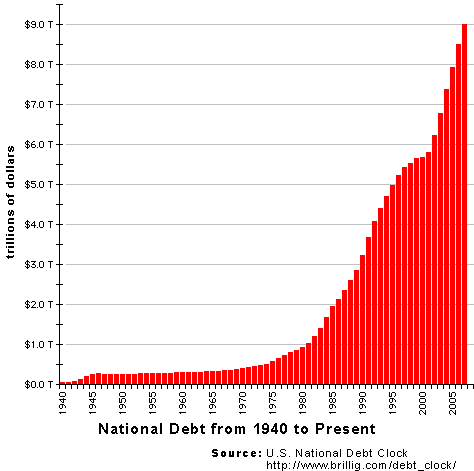
seldom_seen, your graph is more a measure of inflation, not the debt itself. When talking post 1913 dollars you need to stick to inflation-adjusted dollars if you want it to mean anything.
Finally, Gerben called it: recessions happen, just like death and taxes. If we don't have one in 2008 we will have one in 2009, or 2010, whenever. It is inevitable; we are human and therefore prone to bouts of exuberance and pessimism. High oil prices may have caused it to happen sooner, but low oil prices would not have prevented it.
But as I have explained before, the great depression was a unique event in human history. Our history books are filled with the lessons and therefore they are unlikely to be repeated. So another 'great depression' is not going to happen. But, a repeat of the early 1980s recession is possible, as JPL suggested, just not likely. In my opinion this recession will be more similar to the early 1990s recession, which was driven by high oil prices (Iraq war), unwinding housing bust from the S&L collapse, and spiraling government deficits.
I think politicians will respond inappropriately because they are spending other people's money.
So, Ethanol is just another example of stupid politicians to add to the pile we already have.
seldom_seen, your graph is more a measure of inflation, not the debt itself. When talking post 1913 dollars you need to stick to inflation-adjusted dollars if you want it to mean anything.
Finally, Gerben called it: recessions happen, just like death and taxes. If we don't have one in 2008 we will have one in 2009, or 2010, whenever. It is inevitable; we are human and therefore prone to bouts of exuberance and pessimism. High oil prices may have caused it to happen sooner, but low oil prices would not have prevented it.
But as I have explained before, the great depression was a unique event in human history. Our history books are filled with the lessons and therefore they are unlikely to be repeated. So another 'great depression' is not going to happen. But, a repeat of the early 1980s recession is possible, as JPL suggested, just not likely. In my opinion this recession will be more similar to the early 1990s recession, which was driven by high oil prices (Iraq war), unwinding housing bust from the S&L collapse, and spiraling government deficits.
-

LoneSnark - Tar Sands

- Posts: 514
- Joined: Thu 15 Nov 2007, 04:00:00
Re: So P.O Caused This Recession ... Right?
by cube » Fri 01 Feb 2008, 03:44:50
$this->bbcode_second_pass_quote('LoneSnark', 'B')ut Cube, 'people' did not opt for Ethanol, politicians did. I think people will respond appropriately to high prices because they are spending their own money.
and who placed those politicians in office to begin with? --> the people. Granted not every action a politician makes is based on the will of the people. Sometimes a politician will try to be clever and slip a law through that looks innocent on the surface until further inspection reveals how dangerous it may be. MOST people on this forum are against bio-fuels. However not to sound insulting, the average American on the street, is not as "educated" about energy issues as compared to PO.com regulars/fetishists. I think the reason why we have ethanol subsidies is because most Americans haven't done their homework and seriously do not know how bad it is.$this->bbcode_second_pass_quote('LoneSnark', 'F')inally, Gerben called it: recessions happen, just like death and taxes. If we don't have one in 2008 we will have one in 2009, or 2010, whenever. It is inevitable; we are human and therefore prone to bouts of exuberance and pessimism. High oil prices may have caused it to happen sooner, but low oil prices would not have prevented it.
$this->bbcode_second_pass_quote('LoneSnark', 'B')ut as I have explained before, the great depression was a unique event in human history. Our history books are filled with the lessons and therefore they are unlikely to be repeated. So another 'great depression' is not going to happen.

Always trying to think out of the box, instead of giving my reason as to why I think it's perfectly possible for us to have a depression...instead I'm going to explain why the recovery was so successful back in the days.
In the 1930's:
1) few people owned stocks - thus few people actually lost money
2) people were not upside down on home mortgages
3) world energy exporter
4) world's greatest creditor
5) people actually saved money the old fashion way (I'm not talking about the equity in your home or 401K)
Basically, as bad as things got during the 1930's America was actually on a very solid foundation....so a strong recovery was inevitable.
If president Hillary Clinton tried to do an FDR style (increase government spending to create a massive public jobs program) the US dollar would get beaten down to hell in the Forex markets and commodities would shoot up to the moon.
my 2 cents....
- cube
- Intermediate Crude
- Posts: 3909
- Joined: Sat 12 Mar 2005, 04:00:00