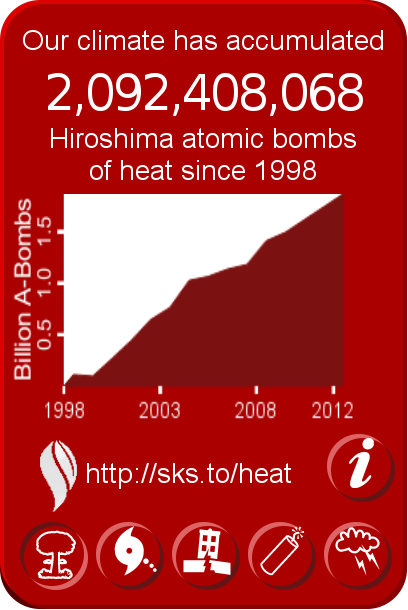
Beautiful information design, excellent Flash work.
Were I you, I'd contact the various SourceBook folks, art departments of the MSM, etc. I think they'd find this information very useful, especially the way you've designed it.
Good job!



PeakOil is You
THE Peak Oil & Climate Change Thread (merged)
Re: Peak oil/global warming animations
 by canis_lupus » Mon 18 Jun 2007, 12:55:44
- canis_lupus
- Lignite

- Posts: 231
- Joined: Thu 07 Apr 2005, 03:00:00
- Location: West of Chicago
Re: Peak oil/global warming animations
by jivah » Mon 18 Jun 2007, 18:02:18
Hi canis,
Thanks for the comments, I will look them up.
Cheers
Thanks for the comments, I will look them up.
Cheers
- jivah
- Wood
- Posts: 12
- Joined: Sat 03 Jul 2004, 03:00:00
- Location: London
Re: Peak oil/global warming animations
by pitbull » Mon 18 Jun 2007, 21:34:05
I like the animation, good job. How about one on peak oil now?
-

pitbull - Wood
- Posts: 17
- Joined: Wed 16 May 2007, 03:00:00
Re: Peak oil/global warming animations
by MonteQuest » Mon 18 Jun 2007, 22:01:22
Lots of peakoil videos at youtube.
Something like this animation on peak oil would be good as a visual aid.
Something like this animation on peak oil would be good as a visual aid.
A Saudi saying, "My father rode a camel. I drive a car. My son flies a jet-plane. His son will ride a camel."
-

MonteQuest - Expert

- Posts: 16593
- Joined: Mon 06 Sep 2004, 03:00:00
- Location: Westboro, MO
Groups Urge New Drive to Fight Oil-Climate Crisis
by Graeme » Wed 19 Sep 2007, 22:51:37
Groups Urge New Drive to Fight Oil-Climate Crisis
$this->bbcode_second_pass_quote('', 'A')ctivists and foreign policy experts held a public forum this weekend to launch what they hope will be "a combined international movement" to respond to the threats of climate change and the depletion of oil and other cheap energy sources.
They said no less than "planetary survival" is at stake.
"Confronting the Triple Crisis" brought 60 speakers from 16 countries to Washington, DC, the capital of a nation "whose way of life is one of the key drivers behind the global crises we face," according to a statement from conference organizer International Forum on Globalization (IFG).
The 3-day summit was the first of its kind to examine climate change, peak oil, and the extinction of species as one interconnected problem with common solutions, according to the IFG and co-sponsor Institute for Policy Studies (IPS).
Speakers urged attendees to lobby their governments for more proactive climate change and energy policies and to make specific adjustments in their own lives to help mitigate the challenges the world faces. Among other personal initiatives, they suggested using more public transportation and consuming fewer -- not just "greener" -- products.
The Teach-In also coincided with the publication of the "Manifesto on Global Economic Transitions," an international call to action that upholds the idea of "less and local" -- buying fewer things and those that are produced nearby -- as a way to ensure a global transition towards a safer, more equitable, and sustainable world.
$this->bbcode_second_pass_quote('', 'A')ctivists and foreign policy experts held a public forum this weekend to launch what they hope will be "a combined international movement" to respond to the threats of climate change and the depletion of oil and other cheap energy sources.
They said no less than "planetary survival" is at stake.
"Confronting the Triple Crisis" brought 60 speakers from 16 countries to Washington, DC, the capital of a nation "whose way of life is one of the key drivers behind the global crises we face," according to a statement from conference organizer International Forum on Globalization (IFG).
The 3-day summit was the first of its kind to examine climate change, peak oil, and the extinction of species as one interconnected problem with common solutions, according to the IFG and co-sponsor Institute for Policy Studies (IPS).
Speakers urged attendees to lobby their governments for more proactive climate change and energy policies and to make specific adjustments in their own lives to help mitigate the challenges the world faces. Among other personal initiatives, they suggested using more public transportation and consuming fewer -- not just "greener" -- products.
The Teach-In also coincided with the publication of the "Manifesto on Global Economic Transitions," an international call to action that upholds the idea of "less and local" -- buying fewer things and those that are produced nearby -- as a way to ensure a global transition towards a safer, more equitable, and sustainable world.
yahoo
Human history becomes more and more a race between education and catastrophe. H. G. Wells.
Fatih Birol's motto: leave oil before it leaves us.
Fatih Birol's motto: leave oil before it leaves us.
-

Graeme - Fusion

- Posts: 13258
- Joined: Fri 04 Mar 2005, 04:00:00
- Location: New Zealand
Re: Groups Urge New Drive to Fight Oil-Climate Crisis
by americandream » Thu 20 Sep 2007, 00:11:16
If countries are prepared to shed life in war in order to preserve the current way of life, what hope have these deluded fools of changing them by exhortation.
- americandream
- Permanently Banned
- Posts: 8650
- Joined: Mon 18 Oct 2004, 03:00:00
Re: Groups Urge New Drive to Fight Oil-Climate Crisis
by Doly » Thu 20 Sep 2007, 10:27:31
$this->bbcode_second_pass_quote('americandream', 'I')f countries are prepared to shed life in war in order to preserve the current way of life, what hope have these deluded fools of changing them by exhortation.
Oh, about the same as the people that organized the protests in the Sixties, the French Revolution, the American war of Independence, the...
"Never doubt that a small group of thoughtful, committed citizens can change the world. Indeed, it is the only thing that ever has." - Margaret Mead.
-

Doly - Expert
- Posts: 4370
- Joined: Fri 03 Dec 2004, 04:00:00
Re: Groups Urge New Drive to Fight Oil-Climate Crisis
by americandream » Thu 20 Sep 2007, 18:48:35
$this->bbcode_second_pass_quote('Doly', '')$this->bbcode_second_pass_quote('americandream', 'I')f countries are prepared to shed life in war in order to preserve the current way of life, what hope have these deluded fools of changing them by exhortation.
Oh, about the same as the people that organized the protests in the Sixties, the French Revolution, the American war of Independence, the...
"Never doubt that a small group of thoughtful, committed citizens can change the world. Indeed, it is the only thing that ever has." - Margaret Mead.
All the above involved armed insurrection or the threat of armed insurrection (with the sixties, there was the risk of affiliation with the Soviets and all the underlying threat of armed struggle that carried.) In 10 years, we will be standing on the brink of mass extinction, despair and a complete loss of any faith in the ideals that once inspired us to great heights.
I have no doubt that the current liberal culture of "pacifism" and excessive "optimism" has completely neutered our ability to act to the degree where we are now gaily marching towards the end, in the meantime, merrily partaking of fantasies which inculcate a sense of feel good but nothing more
- americandream
- Permanently Banned
- Posts: 8650
- Joined: Mon 18 Oct 2004, 03:00:00